
How Space-Grade Storage Products Are Defining Mission Lifespans?
When we think about the hurdles of space exploration, the mind typically drifts to propulsion systems or the structural integrity of a launch vehicle. However, for the engineers at NASA’s Jet Propulsion Laboratory and private entities like SpaceX and Planet Labs, the single greatest source of anxiety often lies in a component no bigger than a postage stamp: the storage device. In the vacuum of space, where a single charged particle can flip a bit and render a satellite’s operating system useless, Space-Grade Storage Products Market is no longer just about capacity; it is about survival.
The demand for these specialized components is currently outpacing the supply of qualified hardware. Over the last 18 months alone, lead times for radiation-hardened (rad-hard) solid-state drives (SSDs) have stretched from 20 weeks to over 52 weeks. This bottleneck isn’t due to a lack of silicon, but a lack of hardened silicon.
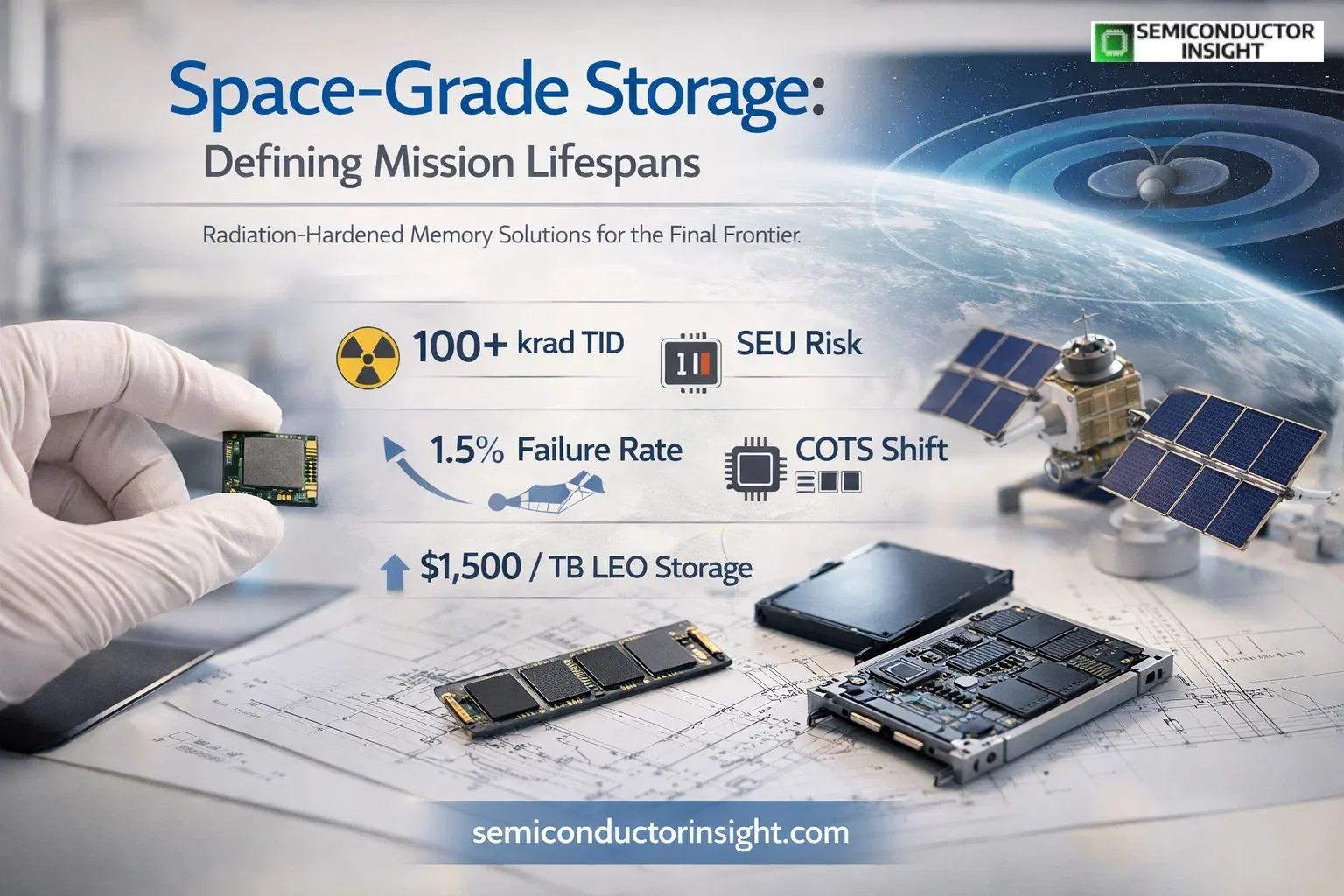
Space-grade storage must endure a total ionising dose (TID) of more than 100 krad (kilorads) with no data damage, in contrast to the typical laptop SSD, which would be destroyed by the Van Allen radiation belts within hours. In comparison, a typical commercial SSD fails at about 10 to 20 krad.
The Glitch That Ground a Constellation
To understand the stakes, we only need to look at the 2021 anomaly involving a major Low Earth Orbit (LEO) broadband constellation. Operators reported that 1.5% of their initial satellite batch suffered from single-event upsets (SEUs) at a rate three times higher than predicted. The culprit was insufficient shielding around the storage controllers. As the satellites passed through the South Atlantic Anomaly, cosmic rays were physically altering the bits in the flash memory, causing the satellites to lose their orientation data and, in three cases, leading to total decommissioning.
This incident served as a harsh reality check for the NewSpace industry. It highlighted a stark statistic: while the cost of launching a kilogram to LEO has dropped by 95% in the last decade, the cost of a single bit flip in a critical storage sector can result in a $10 million asset becoming space junk overnight.
Material Science vs. Machine Learning
The current evolution in space-grade storage is fascinating because it merges old-school material science with cutting-edge artificial intelligence. Historically, rad-hard storage relied on massive, bulky shielding and older, larger-node process technologies (typically 180nm to 90nm) because these older nodes were naturally less susceptible to radiation-induced latch-up.
Today, the market is shifting toward a hybrid approach. We are seeing the introduction of 3D NAND technology in space for the first time, but with a twist. Because 3D NAND is inherently more susceptible to radiation than planar NAND, manufacturers are now embedding on-drive machine learning algorithms. These algorithms don’t just correct errors; they predict them. By analyzing the rate of electron leakage in specific cells relative to the satellite’s orbital position, the drive can preemptively refresh data sectors before corruption occurs. This has allowed new entrants in the market to increase storage density from the previous standard of 256GB per unit to 2TB and beyond, without expanding the physical footprint of the satellite bus.
Radiation Environment & the Storage Challenge
The fundamental driver of every design decision in space-grade storage is radiation. ESA’s decade-long study of its three Swarm spacecraft which mapped Earth’s magnetic field from 2013 through 2023 provided one of the most detailed empirical datasets on how in-orbit radiation affects on board memory over time.
Over 3,327 days of continuous operation, researchers tracked Single Event Upsets (SEUs) across the satellites’ memory components. Critically, the actual observed error rate was lower than pre-flight worst-case estimates, though researchers noted meaningful part-to-part variability even within the same production batch a finding directly relevant to quality control for storage vendors serving the space market.
For instance, NASA’s RadPC Test, 2025: NASA’s Radiation Tolerant Computer payload scheduled aboard a Commercial Lunar Payload Services (CLPS) delivery in 2025 is undergoing its most demanding trial yet, passing through Earth’s Van Allen radiation belts en route to the lunar surface. This mission tests whether radiation-tolerant computing (which relies on software-based recovery rather than hardware hardening) can protect storage and compute functions through deep-space transit a key benchmark for future architecture choices.
Lastly before we wrap up, don’t forget to look at our most recent exclusive report for in-depth insights: https://semiconductorinsight.com/report/space-grade-storage-products-market/
The Shift from Military-Grade to Commercial-Grade
- Historically, Space-Grade Storage Products Market was dominated by monolithic defense contracts where a single unit cost upwards of $200,000. That economic model is fracturing. With the rise of commercial constellations requiring 10,000 to 40,000 satellites, the industry is experiencing a qualification gap.
- There is currently a massive push for COTS (Commercial Off-The-Shelf) with Screening. We are seeing a bifurcation in the market.
- For high-orbit (GEO) and deep-space missions, the market still relies on Class V (space-grade) components costing $50,000 per terabyte. But for LEO constellations, the market has exploded for radiation-tolerant rather than radiation-hardened storage. These components, which cost roughly $1,500 per terabyte, are being launched by the hundreds.
- A notable instance of this shift occurred in 2023 when a major satellite integrator announced they had successfully flown a standard NVMe SSD in a LEO satellite for 18 months with no uncorrectable errors, simply by utilizing a proprietary software layer that constantly cycled the power to the NAND chips during periods of high particle flux. This software-defined storage approach is effectively adding a new dimension to the market, decoupling the physical hardware from the mission-critical reliability requirements.
The Supply Chain Reality
Finally, it is impossible to discuss this sector without acknowledging the raw material reality. The construction of space-grade storage relies heavily on tantalum and ceramic packages. Space-grade units must use hermetically sealed ceramic column grid arrays (CCGAs), in contrast to commercial chips that are packaged in plastic.
Currently, the global supply of qualified tantalum capacitors essential for preventing power surges in space is facing a deficit of roughly 12% relative to the projected satellite manufacturing demand for 2025. This physical constraint means that even if the silicon is available, the packaging to make it space-worthy is becoming the new limiting factor in how fast we can expand our presence in orbit.

Comments (0)