
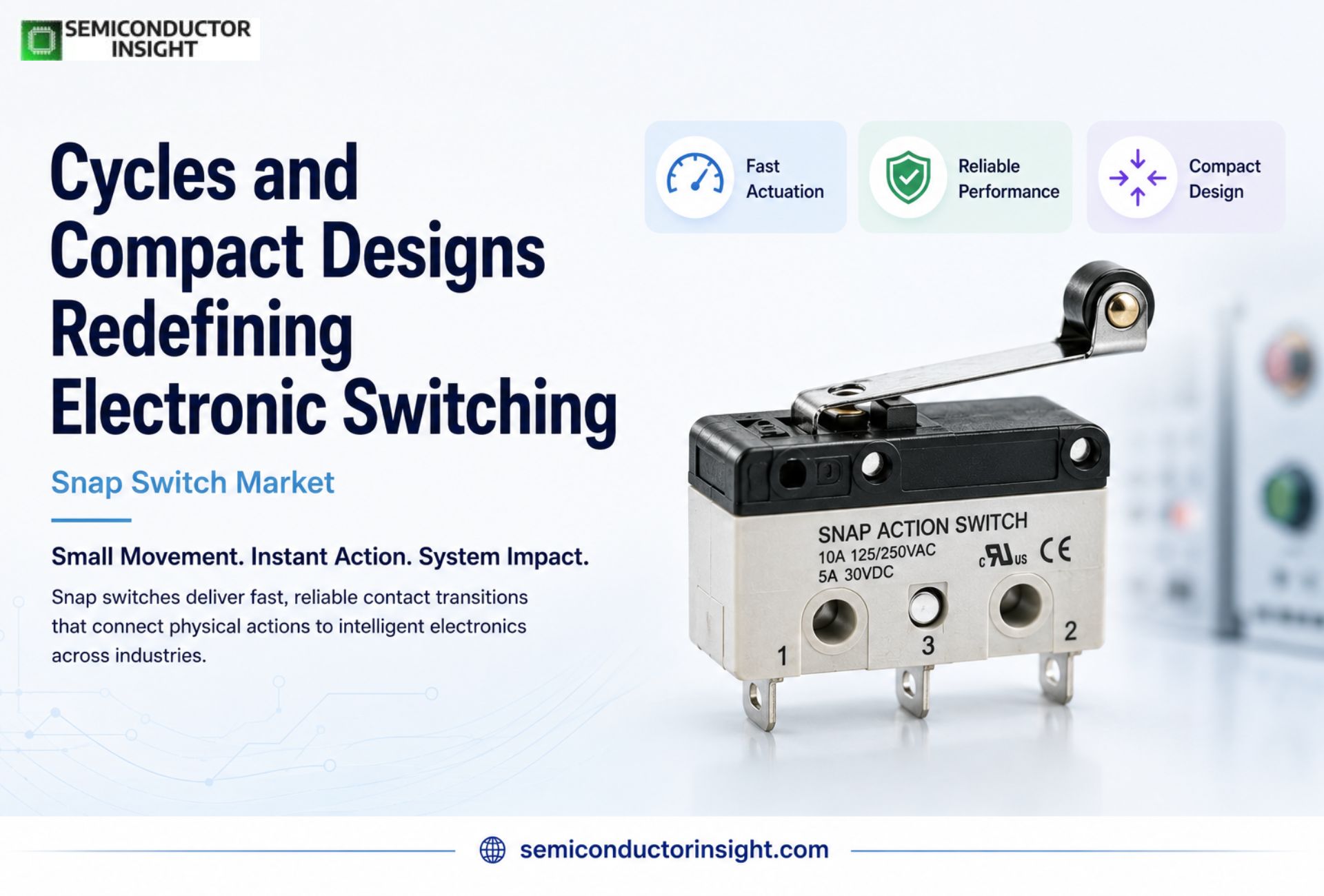
Snap Switch Market 2026: 3,000,000 Cycles and Compact Designs Redefining Electronic Switching
A snap switch, commonly called a snap-action switch or microswitch, is a mechanical electrical switch designed to change its contact state rapidly when an actuator reaches a defined position. The mechanism is simple, but its usefulness comes from repeatable actuation, tactile feedback and the ability to produce a distinct electrical transition from relatively small mechanical movement.
This places snap switches in an interesting position within semiconductor and electronic hardware. They do not replace sensors, microcontrollers or semiconductor switches. Instead, they frequently work alongside them, providing a physical input that can be detected, processed and acted upon electronically.
The switching sequence is becoming part of the system design
Modern applications increasingly treat the switch as one stage in a larger electronic chain:
Physical movement → Actuator displacement → Snap mechanism → Contact transition → Signal conditioning → MCU / control IC → System response
That architecture appears in equipment ranging from control panels and appliances to industrial machinery and automotive systems. The value is therefore not simply the switch itself, but its ability to provide a predictable physical trigger to increasingly sophisticated electronics.
100,000 operations is no longer an unusual engineering target
- Switch lifetime varies substantially by construction, electrical load and application. Manufacturer specifications demonstrate why cycle rating has become an important selection parameter.
- Compact snap-action components can be designed for 100,000 or more mechanical operations, while specialized designs can reach into the millions of cycles under suitable conditions.
- The engineering challenge becomes more demanding when switching takes place under vibration, dust, humidity, temperature variation or electrical loads that accelerate contact wear.
- Manufacturers such as OMRON and Honeywell continue to offer miniature switching products designed for industrial and transportation environments where space and reliability are tightly constrained.
Miniaturization is changing the physical footprint
Electronic products are becoming denser, and the switch has to fit into that equation. Engineers increasingly look for smaller bodies, shorter actuator travel, multiple mounting configurations and terminals compatible with automated PCB assembly.
This is particularly relevant to handheld electronics, appliances, control equipment and compact industrial devices. A few millimeters saved in a control assembly can create room for additional electronics, shielding or thermal management.
Design priorities in 2026 increasingly revolve around:
- Compact package dimensions
- Defined operating force
- Repeatable contact movement
- High mechanical endurance
- PCB and panel mounting flexibility
- Resistance to dust and moisture
- Stable performance across temperature ranges
Automotive electronics are creating new switching points
Vehicle electronics offer another important application pathway. Electrification has increased the number of electronically controlled functions inside vehicles, while advanced driver assistance systems and increasingly software-defined vehicle architectures are adding further electronic content.
Snap-action switches can serve where a physical position, cover, pedal, latch, lever or control mechanism needs a discrete electrical indication. Their role is complementary to semiconductor sensors and digital control systems rather than competitive with them.
TE Connectivity, for example, describes its broader connectivity and sensing portfolio as serving transportation, automated factories, renewable energy, data centers and medical technology across 130+ countries and 20 industries, illustrating the breadth of environments in which compact switching and sensing hardware operates.
Industrial automation puts reliability under the microscope
Factory automation is another area where mechanical switching remains relevant. Robots, machinery, safety mechanisms, doors, access systems and position-control equipment often require dependable detection of a physical state.
The growth of collaborative robotics reinforces this requirement. OMRON’s TM collaborative robot portfolio includes models ranging from 4 kg to 20 kg payload capacity, demonstrating how compact sensing, switching and control components operate within increasingly sophisticated automated machinery.
You can freely browse our most recent updated report to learn more about it before scrolling further: https://semiconductorinsight.com/report/snap-switch-market/
The interesting shift is not mechanical versus electronic
Snap Switch Market is evolving around hybrid control architectures. A mechanical switch can establish the physical event, while semiconductors determine what happens next. Microcontrollers interpret the signal, communication chips transmit the status, and software decides the response.
That relationship explains why snap switches continue to find space in modern electronics despite the rapid expansion of touch interfaces, Hall sensors, optical sensing and solid-state switching. For applications where a clear physical trigger, predictable actuation and repeatable contact transition are important, a small mechanical component can still perform a job that a more sophisticated technology does not necessarily make simpler.

Comments (0)