MARKET INSIGHTS
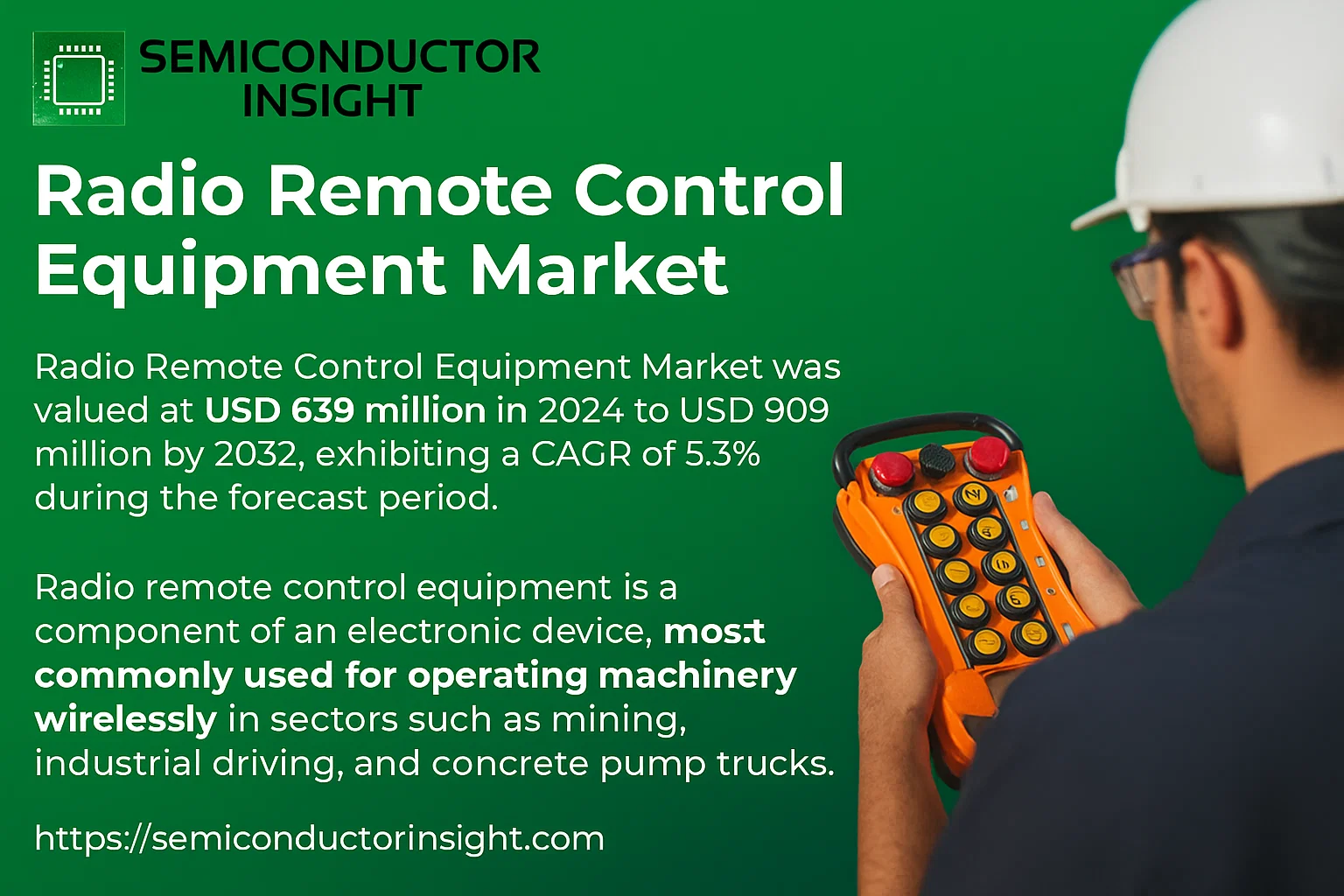
Global Radio Remote Control Equipment Market was valued at USD 639 million in 2024 to USD 909 million by 2032, exhibiting a CAGR of 5.3% during the forecast period.
Radio remote control equipment is a component of an electronic device, most commonly used for operating machinery wirelessly in sectors such as mining, industrial driving, and concrete pump trucks. These systems have continually evolved to include advanced features like Bluetooth connectivity, motion sensor-enabled capabilities, and voice control.
The market is experiencing steady growth driven by increasing automation across industrial sectors and the demand for enhanced operational safety and efficiency. However, challenges such as signal interference in harsh environments and high initial setup costs can restrain expansion. Key players are focusing on technological innovations and strategic collaborations to strengthen their market position. For instance, major manufacturers like HBC, Cattron Group, and Allgon collectively hold a significant share of the global market.
MARKET DRIVERS
Rising Industrial Automation and Safety Standards
Global push for industrial automation, particularly in manufacturing, construction, and material handling, is a primary driver for the radio remote control (RRC) equipment market. These systems enhance operational efficiency by allowing operators to control machinery from a safe distance, directly contributing to improved workplace safety and productivity. The adoption of stringent safety regulations mandating the use of remote control for hazardous operations is further accelerating market growth.
Technological Advancements in Wireless Communication
Ongoing innovation in wireless technologies, including the development of robust, secure, and interference-resistant protocols, is expanding the capabilities and reliability of RRC systems. The integration of features like encrypted data transmission, frequency hopping spread spectrum (FHSS), and real-time diagnostics is making RRC equipment more attractive for critical applications, driving adoption across various sectors.
Furthermore, the growth of the logistics and e-commerce sectors is increasing the demand for advanced crane and forklift remote controls in warehouses and ports, creating a sustained demand for RRC solutions.
MARKET CHALLENGES
High Initial Investment and Integration Complexities
The substantial upfront cost associated with deploying advanced radio remote control systems can be a barrier, especially for small and medium-sized enterprises. Retrofitting older machinery with new RRC technology often involves significant engineering effort and cost, which can deter adoption.
Other Challenges
Signal Interference and Reliability Concerns
In industrial environments crowded with multiple wireless devices, ensuring reliable communication without interference remains a technical challenge. System reliability is paramount for safety-critical applications, and any failure can lead to costly downtime or safety incidents.
Cybersecurity Vulnerabilities
As RRC systems become more connected and software-defined, they are increasingly vulnerable to cyber-attacks. Ensuring robust security protocols to prevent unauthorized access and command hijacking is a persistent challenge for manufacturers and operators alike.
MARKET RESTRAINTS
Economic Volatility and Capital Expenditure Constraints
Global economic uncertainties and fluctuations in key end-user industries, such as construction and mining, can lead to reduced capital expenditure on new equipment, including radio remote controls. During economic downturns, companies often delay or cancel modernization projects, directly restraining market growth.
Stringent and Evolving Regulatory Approvals
RRC equipment must comply with diverse and often stringent regional and international radio frequency regulations and safety standards (e.g., CE, FCC, SIL). The time and cost associated with obtaining and maintaining these certifications can slow down product launches and act as a significant restraint for market players.
MARKET OPPORTUNITIES
Expansion in Emerging Economies
Rapid industrialization and infrastructure development in emerging economies across Asia-Pacific, Latin America, and the Middle East present substantial growth opportunities. The increasing investment in construction, mining, and port facilities in these regions is driving the demand for advanced material handling equipment, which extensively utilizes RRC systems.
Integration with IoT and Industry 4.0
The convergence of RRC systems with the Internet of Things (IoT) and Industry 4.0 principles opens new frontiers. Smart RRCs can provide predictive maintenance data, equipment utilization analytics, and seamless integration with central control systems, creating value-added solutions and new revenue streams for manufacturers.
Development of Application-Specific Solutions
There is a growing opportunity to develop specialized RRC equipment for niche applications, such as underwater remotely operated vehicles (ROVs), agriculture, and renewable energy maintenance. Customized solutions that address the unique challenges of these sectors represent a significant market opportunity.
Radio Remote Control Equipment Market Trends
Steady Market Expansion Driven by Industrial Automation
Global market for radio remote control equipment is on a consistent growth trajectory, projected to increase from a valuation of USD 639 million in 2024 to USD 909 million by 2032, representing a compound annual growth rate (CAGR) of 5.3%. This sustained expansion is fundamentally linked to the accelerating pace of industrial automation across key sectors. The demand for enhanced operational efficiency, improved workplace safety, and the ability to control heavy machinery from a safe distance are primary drivers. Radio remote controls have evolved from basic push-button systems to incorporate advanced functionalities like Bluetooth, motion sensors, and robust digital communication protocols, making them indispensable in modern industrial settings.
Other Trends
Geographic Market Dynamics
Market leadership is concentrated in the Asia-Pacific region, which commands approximately 41% of the global market share. This dominance is fueled by rapid industrialization, significant infrastructure development, and a large manufacturing base in countries like China. Europe follows as the second-largest market with a 30% share, supported by established industrial sectors and stringent safety regulations. North America holds a 20% share, driven by technological adoption in logistics and construction. The majority of production is centered in Europe, the United States, and China, which collectively account for over 84% of the global manufacturing output.
Application-Specific Growth Drivers
The application landscape reveals concentrated demand in specific industries. The construction crane segment represents a major market, where radio remote controls are critical for precise and safe lifting operations. The mining industry is another key driver, utilizing this equipment to operate machinery in hazardous environments, thereby enhancing worker safety. Mobile hydraulics, industry and logistics, and forestry applications also contribute significantly to market volume, each with unique requirements for reliability and range.
Consolidated Competitive Landscape and Innovation
The market features a moderately consolidated competitive environment, with the top three manufacturers HBC, Cattron Group, and Allgon holding a combined market share of approximately 30%. This concentration fosters intense competition focused on product innovation, reliability, and compliance with international safety standards. The primary product types are push-buttons and joysticks, with ongoing development aimed at integrating IoT capabilities for predictive maintenance and data analytics. The key challenge for manufacturers remains navigating complex regional regulatory frameworks while continuing to develop cost-effective, interoperable solutions for a diverse industrial clientele.
COMPETITIVE LANDSCAPE
Key Industry Players
A Market Characterized by Technological Specialization and Global Reach
Global Radio Remote Control Equipment Market is moderately concentrated, with the top three playersHBC, Cattron Group, and Allgoncollectively holding a significant share of approximately 30%. This structure is driven by high technical requirements, stringent safety certifications, and the need for robust, reliable products in demanding industrial environments such as mining, construction, and logistics. Market leadership is often defined by deep industry expertise, with players like HBC and Hetronic Group establishing strong reputations for safety and durability in crane and mobile hydraulic applications. The competitive dynamics are shaped by continuous innovation in areas like Bluetooth connectivity, enhanced safety protocols, and extended operational range, with major players headquartered predominantly in Europe and North America.
Beyond the top-tier leaders, a dynamic ecosystem of specialized and regional players caters to niche segments and applications. Companies such as Scanreco and Autec are prominent for their advanced solutions in industrial and forestry machinery, while technology giants like Schneider Electric and Danfoss leverage their broader automation portfolios to integrate radio remote controls into comprehensive industrial systems. The Asia-Pacific region, being the largest market, has fostered the growth of significant players like Green Electric and Shanghai Techwell Auto-control Technology, which compete effectively on cost and regional support. Manufacturers like Conductix-Wampfler and OMNEX (Eaton) hold strong positions in material handling and mobile equipment sectors, demonstrating the market’s diversity.
List of Key Radio Remote Control Equipment Companies Profiled
- HBC
- Cattron Group
- Allgon
- Scanreco
- Hetronic Group
- Schneider Electric
- Autec
- OMNEX (Eaton)
- Danfoss
- Conductix-Wampfler (JAY Electronique)
- TELECRANE
- NBB
- Green Electric
- Lodar
- Shanghai Techwell Auto-control Technology
Segment Analysis:
| Segment Category | Sub-Segments | Key Insights |
| By Type |
|
Push-buttons represent the leading segment by type, primarily due to their simplicity, reliability, and lower cost, making them the preferred choice for basic control functions across numerous industrial applications. Their straightforward interface is ideal for repetitive, single-command operations. In contrast, Joy-sticks are favored for applications requiring precise, multi-directional control, such as operating cranes and complex mobile machinery, offering superior maneuverability but often at a higher price point. |
| By Application |
|
Industry and Logistics is the dominant application segment, driven by the extensive use of radio remote controls for operating overhead cranes, automated guided vehicles (AGVs), and material handling equipment in warehouses and manufacturing plants, where safety and operational efficiency are paramount. The Construction Crane segment also shows significant demand for enabling precise load maneuvering from a safe distance. Meanwhile, the Mining sector relies heavily on these systems for remote operation of heavy machinery in hazardous environments, a critical driver for market growth. |
| By End User |
|
Construction and Mining Corporations constitute the leading end-user segment. These industries demand robust and reliable radio remote control solutions to ensure operator safety in inherently dangerous worksites and to enhance the precision of complex machinery operations. Logistics and Warehousing Companies represent another major segment, utilizing this equipment to improve the efficiency and safety of material handling processes. Heavy Machinery Manufacturers are key as they increasingly integrate advanced remote control systems as original equipment to add value and functionality to their products. |
| By Technology |
|
Proprietary Radio Frequency (RF) technology leads this segment due to its proven reliability, long-range capability, and resilience to interference in harsh industrial environments, making it the backbone of critical control systems. While Bluetooth and Wi-Fi technologies are gaining traction for their connectivity features and integration with smart devices, they are often limited by range and potential latency issues. Industrial Wireless Protocols are specifically designed for mission-critical applications, offering enhanced security and deterministic performance, which is essential for heavy industrial uses. |
| By Safety and Certification |
|
Safety-Certified equipment, complying with standards like Safety Integrity Level (SIL) or Performance Level (PL), is the leading segment. This dominance is driven by stringent regulatory requirements and the critical need to prevent accidents in high-risk sectors such as mining, chemicals, and heavy lifting. Explosion-Proof Certified equipment is essential for operations in hazardous atmospheres, creating a specialized but vital niche. While Standard Industrial Grade equipment serves many applications, the market trend strongly favors certified systems that guarantee operational safety and liability protection. |
Regional Analysis: Radio Remote Control Equipment Market
Asia-Pacific
The dense concentration of manufacturing facilities and ongoing mega-construction projects across the region creates immense demand for radio remote controls for cranes, hoists, and machinery. The push for worker safety and operational efficiency in these high-intensity environments is a primary adoption driver, with manufacturers increasingly offering customized solutions for local applications.
The presence of numerous domestic manufacturers ensures a steady supply of equipment that is competitively priced and tailored to regional requirements. This local ecosystem fosters innovation and rapid adoption of new technologies, such as enhanced frequency agility and improved battery life, making advanced features more accessible to a broader user base.
As a global trade nexus, the expansion and modernization of port facilities in countries like Singapore, China, and Malaysia are critical. This drives the need for highly reliable and robust radio remote control systems for ship-to-shore cranes and container handling equipment to maximize throughput and ensure smooth, safe logistics operations.
Governments are increasingly implementing stringent workplace safety regulations, mandating the use of equipment that minimizes human interaction with heavy machinery. This regulatory push, combined with growing awareness of operational hazards, is accelerating the replacement of traditional pendant controls with safer, more flexible radio remote systems across the industrial landscape.
Europe
Europe represents a mature yet steadily growing market for radio remote control equipment, characterized by a strong emphasis on safety, stringent regulatory frameworks, and the modernization of existing industrial infrastructure. The region’s advanced manufacturing sector, particularly in Germany, Italy, and France, is a major consumer, with a focus on integrating radio controls for precision tasks in automotive and aerospace assembly lines. There is a significant trend towards retrofitting older machinery with modern, safety-certified radio remote controls to comply with EU directives on machinery safety. The mining and logistics sectors in Northern and Eastern Europe also contribute to demand, driven by a need for efficiency and worker safety in harsh environments. Innovation is focused on cybersecurity for wireless systems and interoperability with existing industrial automation networks.
North America
The North American market is driven by robust industrial activity, a strong focus on operational efficiency, and high safety standards, particularly in the United States and Canada. Key end-user industries include construction, where radio remote controls are essential for operating cranes and concrete pumps on large-scale projects, and manufacturing, where they enhance flexibility in material handling. The region’s large mining and energy sectors also utilize these systems for heavy machinery operation in remote and hazardous locations. A notable trend is the adoption of advanced digital systems offering enhanced signal security and integration with broader site management software. The market is characterized by demand for high-reliability, durable equipment capable of performing in diverse and demanding climatic conditions.
South America
The South American market for radio remote control equipment is emerging, with growth primarily fueled by the mining, agriculture, and construction sectors in countries like Brazil and Chile. The vast mining operations for minerals and metals are a significant driver, requiring reliable remote control solutions for large equipment in open-pit environments to improve safety and productivity. In agriculture, there is growing adoption for controlling irrigation systems and large machinery. The market is less saturated than in other regions, presenting opportunities for growth, though it can be influenced by economic volatility and infrastructure development pace. Demand is often for cost-effective and rugged systems suited to the challenging operational conditions prevalent in the region.
Middle East & Africa
This region shows diverse and nascent growth potential, heavily tied to large-scale infrastructure and construction projects, particularly in the Gulf Cooperation Council (GCC) countries. The development of smart cities, ports, and industrial zones drives demand for radio remote controls in crane operations and construction machinery. The mining sector in Africa, especially in South Africa and West Africa, also presents opportunities. A key characteristic is the demand for equipment that can withstand extreme environmental conditions, such as high temperatures and dust. Market growth is gradual, often dependent on foreign investment and large government-led projects, with a focus on basic, reliable functionality over advanced features in many areas.
Report Scope
This market research report provides a comprehensive analysis of the Radio Remote Control Equipment Market, covering the forecast period 2025–2032. It offers detailed insights into market dynamics, technological advancements, competitive landscape, and key trends shaping the industry.
Key focus areas of the report include:
- Market Overview: The report begins with an overview outlining its current market scenario, key growth indicators, and industry transformation drivers. It discusses macroeconomic factors, demand–supply balance, regulatory landscape, and the strategic role of semiconductors in powering advancements across industries such as automotive, telecommunications, consumer electronics, and industrial automation.
- Market Size & Forecast: Historical data and future projections for revenue, unit shipments, and market value across major regions and segments.
- Segmentation Analysis: Detailed breakdown by product type, technology, application, and end-user industry to identify high-growth segments and investment opportunities.
- Regional Insights: Insights into market performance across North America, Europe, Asia-Pacific, Latin America, and the Middle East & Africa, including country-level analysis where relevant.
- Competitive Landscape: Profiles of leading market participants, including their product offerings, R&D focus, manufacturing capacity, pricing strategies, and recent developments such as mergers, acquisitions, and partnerships.
- Technology Trends & Innovation: Assessment of emerging technologies, integration of AI/IoT, semiconductor design trends, fabrication techniques, and evolving industry standards.
- Market Drivers & Restraints: Evaluation of factors driving market growth along with challenges, supply chain constraints, regulatory issues, and market-entry barriers.
- Stakeholder Insights: Insights for component suppliers, OEMs, system integrators, investors, and policymakers regarding the evolving ecosystem and strategic opportunities.
Primary and secondary research methods are employed, including interviews with industry experts, data from verified sources, and real-time market intelligence to ensure the accuracy and reliability of the insights presented.
FREQUENTLY ASKED QUESTIONS:
What is the current market size of Radio Remote Control Equipment Market?
-> Radio Remote Control Equipment Market was valued at USD 639 million in 2024 to USD 909 million by 2032, exhibiting a CAGR of 5.3% during the forecast period.
Which key companies operate in Radio Remote Control Equipment Market?
-> Key players include HBC, Cattron Group, Allgon, Scanreco, Hetronic Group, Schneider Electric, Autec, OMNEX (Eaton), Danfoss, and Conductix-Wampfler (JAY Electronique), among others. The top three players hold a share of about 30%.
What are the key growth drivers?
-> Key growth drivers include industrial automation, safety regulations for machinery operation, and the increasing adoption of wireless control in sectors like mining, construction, and logistics.
Which region dominates the market?
-> Asia-Pacific is the largest market, holding a share of about 41%, followed by Europe and North America with shares of approximately 30% and 20%, respectively.
What are the emerging trends?
-> Emerging trends include the integration of bluetooth connectivity, motion sensor-enabled capabilities, voice control, and the advancement of remote control technology for enhanced operational efficiency.

Get Sample Report PDF for Exclusive Insights
Report Sample Includes
- Table of Contents
- List of Tables & Figures
- Charts, Research Methodology, and more...
 Download Sample Report PDF