
Why SMT Touch Switches Are Gaining Ground in High-Density Semiconductor Designs?
In everything from smartphones to industrial controllers, surface-mount tactile switches have subtly become indispensable for providing clear, dependable user feedback. SMT versions install directly into PCBs, reducing board space and assembly stages while enabling automated high-volume lines, in contrast to previous through-hole designs.
Manufacturers now routinely achieve placement rates exceeding 136,000 components per hour, making these compact switches a natural fit for dense semiconductor layouts where every millimetre counts.
The Compact Power of SMD Tactile Interfaces
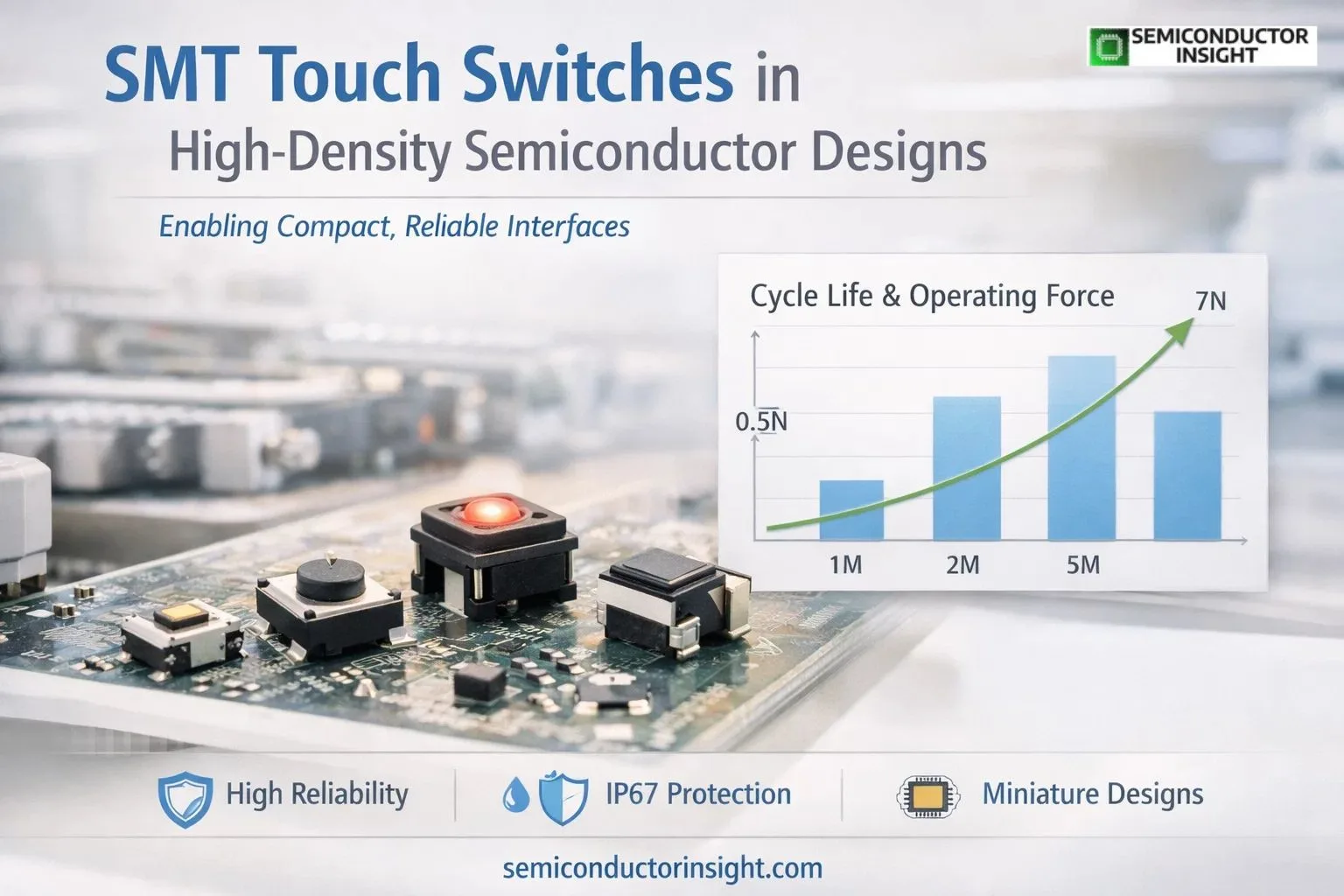
- Modern SMT touch switches pack serious performance into tiny footprints. Panasonic’s latest 6 mm square SMD series offers cycle lives up to 1,000,000 operations at 3.5 N force, while select long-travel models hit 5,000,000 cycles.
- Operating forces range from a feather-light 0.5 N for consumer gadgets to a firm 7 N in automotive-qualified versions that resist accidental activation. IP67-rated options with integrated actuators handle dust, moisture, and vibration critical for edge-mounted side-operational switches in tight enclosures.
- Gold-plated domes and low-bounce contacts deliver that satisfying click without signal noise, perfect for high-speed data-centre boards or medical handhelds.
- Littelfuse’s new K5V4 Series takes this further with the first reflow-compatible SPDT illuminated tactile switch. Built from high-temperature polyarylate plastic rated to 250 °C, it supports Gull Wing and Pin-in-Paste configurations.
- Designers no longer need protective sleeves or secondary hand soldering standard SMT reflow lines handle everything, cutting costs and complexity in dense networking and professional AV systems.
You Can Freely Surf Our Latest Updated Report Here: https://semiconductorinsight.com/report/smt-touch-switch-market/
SMT Touch Switch Innovations Driving Measurable Business Value
Automotive electronics lean heavily on these switches. Automotive-qualified 6 mm and 4.9 mm models provide steady contact resistance and excellent solder ability even after thermal cycling. In smart factories and IoT nodes, low-profile 3 mm × 2 mm SMD switches enable clean, button-free interfaces on sensor hubs.
Data centers and rack-mount servers use illuminated SPDT versions for status panels that must survive constant handling. Consumer wearable benefit from ultra-miniature 2.6 mm × 1.6 mm packages that keep devices slim yet responsive. Across these sectors, the shift to SMT has trimmed assembly costs by 30-50 % compared with traditional methods while boosting reliability in vibration-heavy environments.
Outcomes That Accelerate Market Success
| Switch Series | Max Cycle Life | Operating Force | Key Features | Primary Use Cases |
| Panasonic 6 mm Square Long Travel | 1,000,000+ | 2.5-3.6 N | Automotive qualified, IP67 | Vehicle controls, EV interfaces |
| Panasonic Side-Operational Edge | 500,000 | 1.0-2.4 N | Low profile, actuator option | Wearables, compact IoT modules |
| Littelfuse K5V4 SPDT | High reliability (gold dome) | 4 N | Reflow SMT, LED backlighting | Data centers, industrial panels |
| General SMD Tactile | 50,000-5,000,000 | 0.5-7 N | Dust-resistant, low bounce | Consumer electronics, medical |
Advanced Compact Designs and Smart Systems Powering Demand Surge
- The broader printed circuit board assembly (PCBA) market where most SMT touch switches land is on track to reach $147.5 billion by 2035, growing at a steady 4.7 % CAGR through 2025-2035.
- Consumer electronics, automotive electrification, IoT devices, 5G infrastructure, and medical equipment are the main engines.
- Tactile switches rank among the fastest-growing component categories over the past decade, fueled by the explosion of touch-enabled smart products.
- Electronic components overall expanded from roughly $300 billion in 2012 to $430 billion in 2019, with surface-mount solutions capturing the lion’s share thanks to automation and size reduction.
- Demand for SMT touch switches tracks this trajectory. As devices shrink and user interfaces move from mechanical buttons to seamless, illuminated controls, these switches deliver the tactile confirmation users expect without sacrificing board real estate or production speed.
- Automotive and industrial sectors lead adoption because reflow-compatible designs eliminate manual steps and support the high-mix, high-volume lines now standard in EV and smart-factory builds.
Advanced Layout Techniques Supporting Seamless Soldering Processes
Reflow soldering compatibility marks the biggest leap. Traditional tactile switches often required wave soldering or hand work; today’s SMT versions go straight through standard ovens. This shift simplifies supply chains, reduces defect rates, and let’s contract manufacturers scale output without retooling entire lines.
For semiconductor packaging houses and EMS providers, the payoff is faster time-to-market and lower per-unit costs exactly what high-density AI accelerators, 5G modules, and edge-computing boards demand.
Reinventing Digital Interaction for High-Performance Semiconductor Systems
Looking ahead, expect tighter integration with capacitive hybrids and LED feedback in even smaller packages. Automotive-qualified long-travel switches will handle harsher environments, while ultra-low-force models will appear in next-generation wearables and foldables. The push toward sustainable manufacturing will favor lead-free, high-temperature plastics that maintain performance through multiple reflow passes.
SMT touch switches have moved from niche component to strategic enabler. They give semiconductor designers the freedom to pack more functionality into smaller footprints while delivering the intuitive, reliable interaction that end users now take for granted. As PCBA volumes climb and smart-device ecosystems expand, these unassuming surface-mount parts will keep powering the interfaces that make advanced electronics feel effortless.

Comments (0)