SMT Touch Switch Market Insights
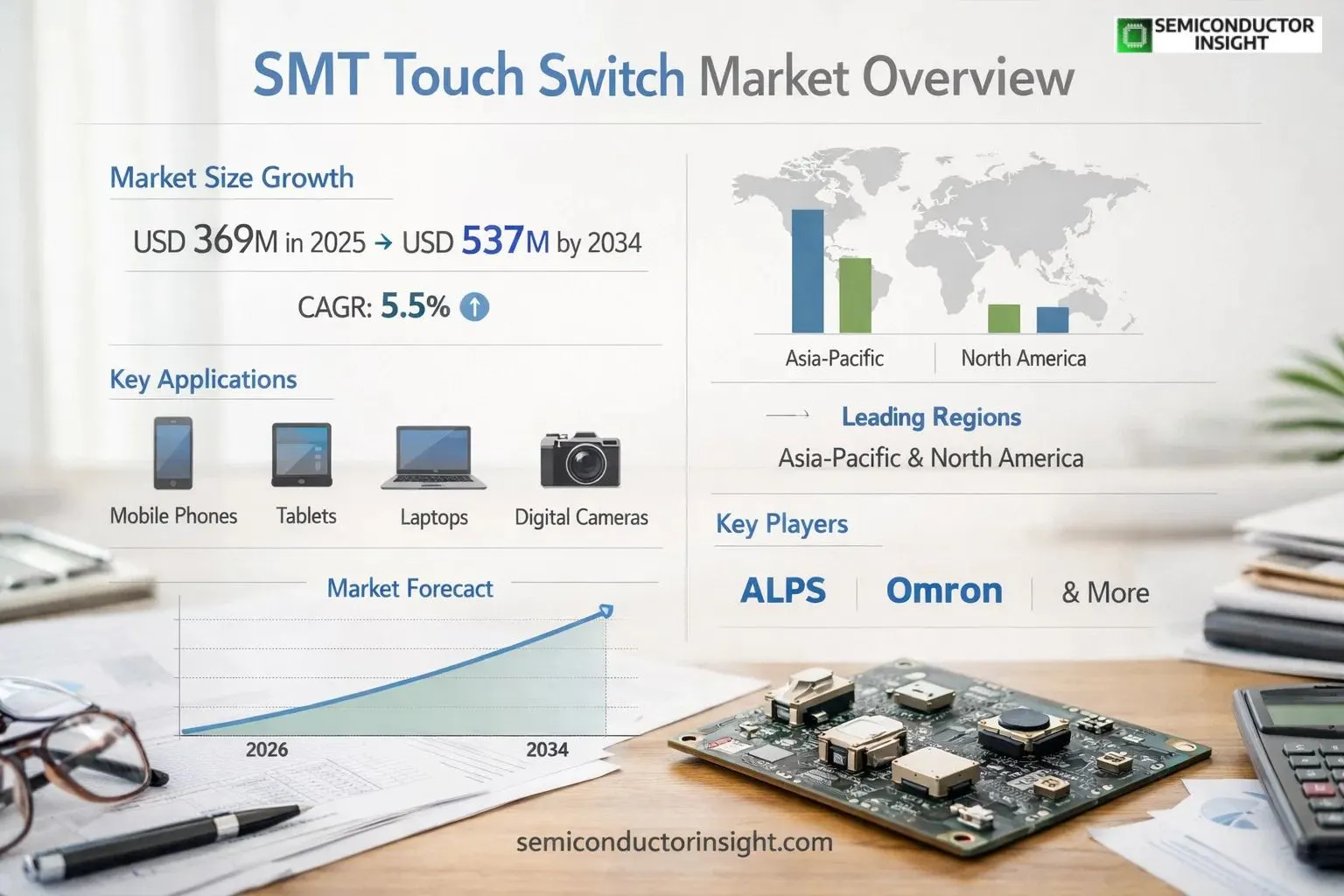
Global SMT Touch Switch market size was valued at USD 369 million in 2025. The market is projected to grow from USD 387 million in 2026 to USD 537 million by 2034, exhibiting a CAGR of 5.5% during the forecast period.
SMT (Surface Mount Technology) touch switches are compact, low-profile components widely used in electronic devices for tactile feedback and user interface control. Unlike traditional through-hole switches, SMT variants are mounted directly onto printed circuit boards, offering space-saving advantages and simplified assembly processes. These switches typically feature two-pin, three-pin, or four-pin configurations with varying actuation forces and travel distances to suit different applications.
The market growth is driven by increasing demand for miniaturized electronics across consumer devices like smartphones, tablets, and wearables. Furthermore, automotive infotainment systems and industrial control panels are adopting SMT touch switches for their reliability in harsh environments. Key manufacturers continue to innovate with waterproof designs and enhanced durability features to address evolving industry requirements.
MARKET DRIVERS
Growing Demand for Miniaturized Electronics
SMT touch switch market is experiencing significant growth due to the increasing demand for compact electronic devices. Smartphones, wearables, and IoT devices require space-saving components like SMT touch switches that offer reliable performance in tight spaces. The global miniaturization trend is expected to drive a 7.2% CAGR for SMT components through 2028.
Advancements in Consumer Electronics Interfaces
Major electronics manufacturers are adopting SMT touch switches to create sleek, modern user interfaces. These switches eliminate mechanical parts, reducing failure points while improving aesthetic appeal. The consumer electronics segment accounts for approximately 62% of total SMT touch switch demand worldwide.
➤ Industry reports indicate the automotive sector will adopt 28% more SMT touch switches annually as vehicles incorporate more touch-controlled dashboard interfaces
Regulatory pressure for energy-efficient components is another key driver, with SMT touch switches consuming up to 40% less power than traditional mechanical switches in comparable applications.
MARKET CHALLENGES
Technical Limitations in Harsh Environments
SMT touch switches face performance challenges in industrial settings where gloves, moisture, or electromagnetic interference can affect functionality. While capacitive touch technology has improved, these limitations restrict adoption in approximately 15% of potential industrial applications.
Other Challenges
Precision Manufacturing Requirements
The production of reliable SMT touch switches requires cleanroom conditions and micron-level precision during assembly. This creates higher barriers to entry for new manufacturers compared to conventional switch technologies.
MARKET RESTRAINTS
High Initial Tooling Costs
The transition from mechanical switches to SMT touch switches requires substantial capital investment in new manufacturing equipment and employee training. Many small to mid-sized electronics manufacturers report switching costs between $250,000-$500,000 for complete production line upgrades.
MARKET OPPORTUNITIES
Emerging Applications in Medical Devices
The healthcare sector presents significant growth potential for SMT touch switch manufacturers. Medical equipment designers increasingly specify these components for their ease of cleaning, antimicrobial surface compatibility, and reliability in critical applications. The medical device segment is projected to account for 18% of market growth between 2024-2027.
Emerging Market Dynamics in SMT Touch Switch Market Trends
Miniaturization Drives Adoption Across Consumer Electronics
SMT touch switch market is experiencing significant growth due to increasing demand for compact electronic components. As smartphones, tablets and wearable devices continue to shrink in size while adding functionality, manufacturers are shifting from through-hole to surface mount technology (SMT) variants. The thinner profile of SMT touch switches allows for more streamlined device designs without compromising tactile feedback performance.
Other Trends
Modular Designs for Flexible Manufacturing
Leading manufacturers are developing modular SMT touch switch configurations that enable easier integration with automated pick-and-place assembly lines. This trend is particularly notable among Japanese and South Korean electronics manufacturers who prioritize production efficiency and component standardization.
Material Innovations Enhance Durability
Recent advancements in contact materials and membrane technologies have extended the operational lifespan of SMT touch switches beyond traditional models. Gold alloy contacts and silicone-based actuators are becoming industry standards for premium applications, reducing contact resistance while maintaining reliability across temperature variations.
Regulatory Compliance Impacts Market
Stringent RoHS and REACH regulations continue to influence material selection in SMT touch switch market. Manufacturers are investing in halogen-free materials and lead-free soldering processes, with European and North American markets showing particularly strong demand for compliant components.
Regional Production Shifts
SMT touch switch market is witnessing geographic redistribution of manufacturing capabilities, with Southeast Asian nations emerging as alternative production hubs. This trend responds to both tariff considerations and supply chain diversification strategies among major electronics brands.
COMPETITIVE LANDSCAPE
Key Industry Players
SMT Touch Switch Market Dominated by Global Electronics Components Leaders
SMT touch switch market is consolidated with top players like ALPS, Panasonic, and Omron collectively holding significant market share. ALPS leads through its diversified product portfolio and strong R&D capabilities in miniature switch technology. Japanese manufacturers dominate due to their precision engineering expertise, while TE Connectivity and Wurth Elektronik represent strong Western competitors with extensive distribution networks.
Niche players such as BEWIN and Brio Electronic Technology specialize in customized SMT switches for specific applications like medical devices and automotive electronics. The market sees increasing competition from Chinese manufacturers like Dongguan Hengqi Electronic Technology, offering cost-competitive alternatives while expanding their technical capabilities.
List of Key SMT Touch Switch Companies Profiled
- ALPS
- Panasonic
- Omron
- C&K Components
- TE Connectivity
- Wurth Elektronik
- CTS
- Mitsumi Electric
- BEWIN
- NKK Switches
- Bourns
- APEM
- E-Switch
- Brio Electronic Technology
- Hro Electronics
- Dongguan Hengqi Electronic Technology
Segment Analysis:
| Segment Category | Sub-Segments | Key Insights |
| By Type |
|
Two-pin switches dominate SMT touch switch market due to their simplicity and cost-effectiveness while maintaining reliable performance.
|
| By Application |
|
Mobile Phone segment leads in application areas due to high volume production and the need for compact, reliable switching solutions in smartphones.
|
| By End User |
|
Consumer Electronics represents the largest end-user segment for SMT touch switches, driven by the proliferation of portable smart devices.
|
| By Technology |
|
Tactile Feedback switches maintain strong demand as they provide physical confirmation of activation.
|
| By Manufacturer Type |
|
Global Brands dominate the high-volume segments through established supply chains and brand recognition.
|
Regional Analysis: SMT Touch Switch Market
Asia-Pacific
Asia-Pacific’s dense network of EMS providers and PCB manufacturers creates ideal conditions for SMT touch switch production. China’s Pearl River Delta and Yangtze River Delta regions alone account for over 60% of global electronics manufacturing capacity.
The region leads in adopting advanced SMT technologies including ultra-thin tactile switches with MEMS designs. Japanese suppliers dominate high-reliability applications while Taiwanese firms specialize in cost-optimized consumer solutions.
Expanding automotive electronics and smart appliance markets in India and Southeast Asia drive demand for durable SMT touch switches. Local manufacturers increasingly integrate haptic feedback capabilities to meet premium segment requirements.
Major Asian electronics firms are investing heavily in next-generation capacitive SMT switches with enhanced ESD protection. South Korean companies lead in developing transparent touch solutions for display integration.
North America
The North American SMT touch switch market benefits from strong demand in aerospace, medical, and industrial automation sectors. U.S.-based manufacturers focus on ruggedized designs with IP ratings for harsh environments, while Canadian firms specialize in low-power IoT applications. The region sees growing adoption of SMT tactile switches in automotive human-machine interfaces, particularly for electric vehicles. Strict quality standards and certification requirements create barriers for commodity products but support premium pricing for specialized solutions. Technology transfers from defense applications are driving innovation in EMI-resistant switch designs.
Europe
European manufacturers emphasize sustainability in SMT touch switch production, with German companies leading in recyclable materials and energy-efficient switch architectures. The automotive sector represents the largest application area, particularly for dashboard and infotainment controls. Medical device manufacturers demand high-reliability SMT switches with antimicrobial coatings. Eastern European EMS providers are gaining market share by offering cost-effective solutions with EU compliance. The region shows strong growth in industrial HMI applications, driving demand for sealed SMT switches with long lifecycle ratings.
South America
Brazil emerges as the regional leader for SMT touch switches in South America, supported by growing electronics manufacturing capabilities. Consumer appliances and automotive aftermarket represent primary application areas. The market shows preference for hybrid mechanical-tactile switches that balance cost and durability. Challenges include import dependency for advanced components and fluctuating local currency impacts on production costs. Industrial automation investments in Argentina and Colombia are creating new opportunities for SMT switch suppliers.
Middle East & Africa
The MEA region shows gradual SMT touch switch market growth, led by smart infrastructure projects in the Gulf Cooperation Council countries. UAE and Saudi Arabia drive demand for switches in building automation and hospitality sector applications. South Africa serves as the manufacturing hub for the African continent, with localization benefits for regional supply chains. The market favors dust- and moisture-resistant switch designs suitable for harsh climate conditions. Limited local production capacity creates opportunities for international suppliers, particularly in the oil & gas sector.
Report Scope
This market research report provides a comprehensive analysis of SMT Touch Switch Market, covering the forecast period 2026–2034. It offers detailed insights into market dynamics, technological advancements, competitive landscape, and key trends shaping the industry.
Key focus areas of the report include:
- Market Overview: The report begins with an overview outlining its current market scenario, key growth indicators, and industry transformation drivers. It discusses macroeconomic factors, demand–supply balance, regulatory landscape, and the strategic role of SMT touch switches in powering advancements across industries such as consumer electronics, telecommunications, and industrial automation.
- Market Size & Forecast: Historical data and future projections for revenue, unit shipments, and market value across major regions and segments.
- Segmentation Analysis: Detailed breakdown by product type, application, and end-user industry to identify high-growth segments and investment opportunities.
- Regional Insights: Insights into market performance across North America, Europe, Asia-Pacific, Latin America, and the Middle East & Africa, including country-level analysis where relevant.
- Competitive Landscape: Profiles of leading market participants, including their product offerings, R&D focus, manufacturing capacity, pricing strategies, and recent developments such as mergers, acquisitions, and partnerships.
- Technology Trends & Innovation: Assessment of emerging technologies and evolving industry standards.
- Market Drivers & Restraints: Evaluation of factors driving market growth along with challenges, supply chain constraints, regulatory issues, and market-entry barriers.
- Stakeholder Insights: Insights for component suppliers, OEMs, system integrators, investors, and policymakers regarding the evolving ecosystem and strategic opportunities.
Primary and secondary research methods are employed, including interviews with industry experts, data from verified sources, and real-time market intelligence to ensure the accuracy and reliability of the insights presented.
FREQUENTLY ASKED QUESTIONS:
What is the current market size of SMT Touch Switch Market?
-> SMT Touch Switch Market was valued at USD 369 million in 2025 and is expected to reach USD 537 million by 2034.
What is the growth rate of SMT Touch Switch Market?
-> The market is projected to grow at a CAGR of 5.5% during the forecast period (2026-2034).
Which key companies operate in SMT Touch Switch Market?
-> Key players include ALPS, Panasonic, Omron, C&K Components, TE Connectivity, Wurth Elektronik, CTS, Mitsumi Electric, BEWIN, and NKK Switches, among others.
What are the main applications of SMT Touch Switches?
-> Main applications include mobile phones, tablets, laptops, digital cameras, and recreational machines.
Which region dominates SMT Touch Switch market?
-> The U.S. market is estimated at USD million in 2025, while China is expected to reach USD million during the forecast period.
Get Sample Report PDF for Exclusive Insights
Report Sample Includes
- Table of Contents
- List of Tables & Figures
- Charts, Research Methodology, and more...
 Download Sample Report PDF