Market Insights
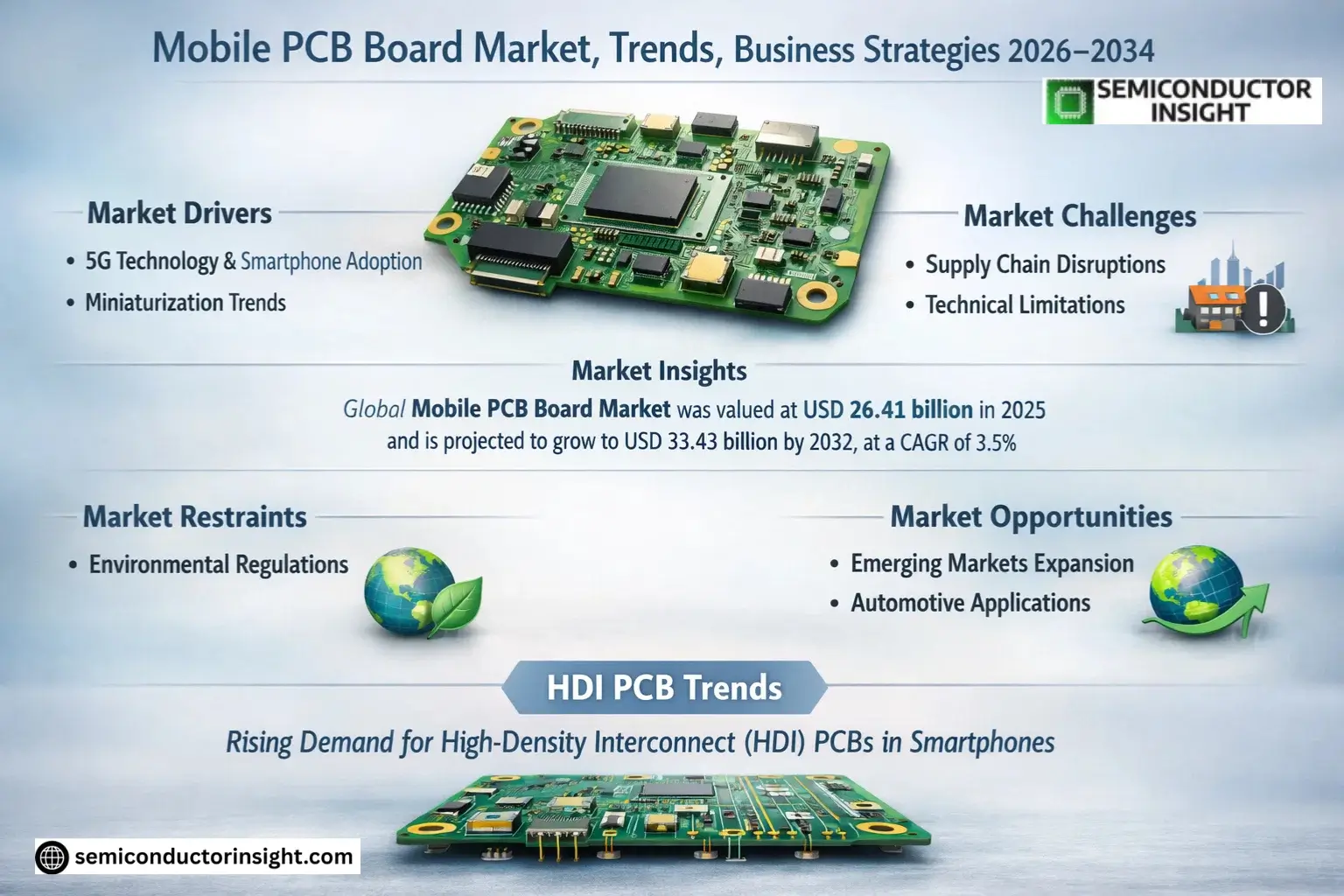
Global Mobile PCB Board Market size was valued at USD 26.41 billion in 2025. The market is projected to grow from USD 27.32 billion in 2026 to USD 33.43 billion by 2032, exhibiting a CAGR of 3.4% during the forecast period.
Mobile PCB boards are critical components in smartphones, enabling electrical connectivity and signal transmission between key modules such as processors, memory, RF systems, cameras, and power management units. These boards come in various forms, including rigid PCBs, high-density interconnect (HDI) PCBs, flexible PCBs (FPCs), and rigid-flex PCBs each designed to meet stringent requirements for compactness, signal integrity, and reliability.
The market growth is driven by increasing smartphone adoption, advancements in PCB manufacturing technologies, and rising demand for high-performance mobile devices with enhanced functionalities. While conventional rigid PCBs dominate cost-sensitive segments, HDI and flexible PCBs are gaining traction due to their superior performance in space-constrained applications.
MARKET DRIVERS
5G Technology and Smartphone Adoption
Global Mobile PCB Board Market is experiencing rapid growth due to increasing demand for 5G-enabled smartphones. As carriers expand 5G networks worldwide, smartphone manufacturers require advanced PCB boards capable of handling higher frequencies and faster data transfer. The market is projected to grow at a 8.2% CAGR through 2025.
Miniaturization Trends
Manufacturers are developing increasingly compact PCB designs to accommodate slimmer smartphone form factors. High-density interconnect (HDI) PCBs now represent over 40% of total mobile PCB board production, with this share expected to increase further.
Additional growth comes from IoT integration in mobile devices, requiring specialized PCB configurations that support multiple connectivity protocols.
MARKET CHALLENGES
Supply Chain Disruptions
Mobile PCB Board Market faces significant challenges from global semiconductor shortages and raw material price volatility. Copper prices have fluctuated by up to 30% in recent quarters, directly impacting PCB production costs.
Other Challenges
Technical Limitations
As smartphones incorporate more advanced features, PCB designs must balance thermal management with space constraints. Heat dissipation remains a critical challenge for high-performance mobile PCB boards.
MARKET RESTRAINTS
Environmental Regulations
Strict environmental regulations in major markets affect Mobile PCB Board production. The EU’s RoHS directive and similar policies worldwide restrict hazardous substances, requiring manufacturers to invest in alternative materials and processes that can increase costs by 15-20%.
MARKET OPPORTUNITIES
Emerging Markets Expansion
Developing regions present significant growth potential for the Mobile PCB Board Market. With smartphone penetration in Africa and Southeast Asia expected to double by 2027, demand for entry-level and mid-range smartphone PCBs will drive substantial market expansion.
Automotive Applications
The integration of mobile PCB technologies in vehicle infotainment and ADAS systems creates new revenue streams. Automotive-grade mobile PCBs represent a USD 2.3 billion opportunity by 2025 as vehicles become more connected.
Mobile PCB Board Market Trends
Increasing Demand for High-Density Interconnect (HDI) PCBs
Mobile PCB Board Market is experiencing significant growth in HDI PCB adoption, driven by smartphone manufacturers’ need for compact, high-performance circuit boards. HDI PCBs enable thinner device designs while accommodating more components in limited space, making them essential for flagship smartphones featuring advanced processors and multiple camera modules. Leading OEMs are prioritizing HDI PCBs with finer line widths and micro-vias to support 5G and AI functionalities.
Other Trends
Shift Toward Foldable Smartphone-Compatible PCBs
With foldable smartphones gaining market share, PCB manufacturers are developing specialized flexible and rigid-flex solutions that withstand repeated bending cycles while maintaining signal integrity. This requires advanced polyimide materials and innovative layer stackup configurations, presenting both technical challenges and margin opportunities for suppliers.
Regional Manufacturing and Supply Chain Adjustments
Mobile PCB Board Market is undergoing geographic realignment as manufacturers establish production facilities closer to smartphone assembly hubs in Southeast Asia. This trend responds to tariff considerations and the need for just-in-time delivery of PCBs to EMS providers. China remains the dominant production base, but Vietnam and India are emerging as alternative locations for mid-range PCB manufacturing.
Material Innovation for Thermal Management
As smartphone chipsets generate more heat, PCB material systems are evolving to incorporate better thermal dissipation properties. Manufacturers are developing modified FR4 formulations and hybrid material stacks that maintain high-frequency performance while reducing thermal resistance, particularly for processor-intensive applications.
Consolidation Among PCB Suppliers
The market is witnessing strategic mergers and acquisitions as leading Mobile PCB Board manufacturers seek to expand technological capabilities and geographic reach. Established players are acquiring specialized FPC and rigid-flex producers to offer complete solutions to smartphone brands, while smaller suppliers face margin pressure from tier-1 OEM procurement strategies.
COMPETITIVE LANDSCAPE
Key Industry Players
Global Mobile PCB Market Dominated by Asian Manufacturers with Technological Edge
Global Mobile PCB Board Market remains concentrated with Asian manufacturers leading technological innovation and production capacity. Zhen Ding Technology, Unimicron Technology, and Compeq collectively hold significant market share, specializing in advanced HDI and flexible PCB solutions for premium smartphones. These tier-1 suppliers maintain strategic partnerships with Apple, Samsung, and Chinese OEMs, leveraging vertically integrated manufacturing and R&D investment in high-layer-count boards. The market exhibits moderate consolidation, with the top 5 players accounting for approximately 40% revenue share, while mid-tier competitors focus on cost-optimized solutions for emerging markets.
Specialty PCB manufacturers like Nippon Mektron and Ibiden dominate the high-end rigid-flex segment for foldable devices, while Samsung Electro-Mechanics maintains captive supply for Samsung Galaxy series. Regional Chinese players such as DSBJ and Shennan Circuits are gaining traction through government-supported capacity expansions and competitive pricing strategies. The competitive landscape faces pricing pressures from smartphone OEMs, driving ongoing investments in automation, substrate innovations, and miniaturization technologies to preserve margins.
List of Key Mobile PCB Companies Profiled
- Zhen Ding Technology
- Unimicron Technology
- Compeq
- Nippon Mektron
- Ibiden
- AT&S
- Samsung Electro-Mechanics
- TTM Technologies
- Tripod Technology
- DSBJ
- Shennan Circuits Company
- Kinwong
- Zhuhai Founder
- Interflex
- Victory Giant Technology
Segment Analysis:
| Segment Category | Sub-Segments | Key Insights |
| By Type |
|
HDI PCB dominates the Mobile PCB Board Market due to:
|
| By Application |
|
Flagship Smartphones drive premium PCB demand with:
|
| By End User |
|
Smartphone OEMs maintain the strongest influence because:
|
| By Material System |
|
Polyimide Materials show significant potential due to:
|
| By Layer Count |
|
Multilayer PCBs are increasingly preferred because:
|
Regional Analysis: Mobile PCB Board Market
China accounts for over half of global mobile PCB production, with clusters in Shenzhen and Suzhou offering complete supply chain solutions. Chinese manufacturers lead in both volume production and adoption of automated PCB assembly lines.
South Korean firms specialize in high-performance PCBs for flagship smartphones, with advanced capabilities in flexible and rigid-flex PCB technologies. Their R&D focuses on thermal management and signal integrity solutions.
Taiwanese manufacturers excel in high-mix, low-volume PCB production for specialized mobile applications. Their strength lies in quick prototyping and adapting to new smartphone form factors and connectivity standards.
Emerging production hubs in Vietnam, Thailand, and Malaysia are capturing growing shares of mobile PCB manufacturing as companies diversify supply chains beyond China while maintaining regional proximity.
North America
The North American Mobile PCB Board Market focuses on high-value design and specialized applications. While manufacturing volume is limited compared to Asia, the region leads in PCB design software and testing methodologies. U.S. firms dominate intellectual property related to advanced mobile PCB architectures, particularly for 5G antennas and RF components. The proximity to major smartphone brands and silicon designers enables tight integration between chipset development and PCB layout optimization.
Europe
European mobile PCB activity centers around automotive-grade applications and industrial mobile devices. German and French PCB suppliers maintain technological leadership in reliability-focused designs for rugged smartphones. The region shows growing interest in sustainable PCB materials and processes to comply with environmental regulations, influencing global mobile PCB material standards.
Middle East & Africa
MEA represents a growing consumption market with localized assembly operations emerging in North Africa. While PCB manufacturing presence is limited, the region shows increasing demand for cost-optimized mobile PCB solutions. Middle Eastern markets prioritize PCB designs that accommodate high-temperature operation and dust protection for mobile devices.
South America
Brazil serves as the primary Mobile PCB Board Market in South America, with local assembly driving demand. The region’s focus remains on entry-level and mid-range smartphone PCBs, with manufacturers emphasizing cost-effective solutions that balance performance and affordability for price-sensitive consumers.
Report Scope
This market research report provides a comprehensive analysis of the Mobile PCB Board Market, covering the forecast period 2025–2032. It offers detailed insights into market dynamics, technological advancements, competitive landscape, and key trends shaping the industry.
Key focus areas of the report include:
- Market Overview: The report begins with an overview outlining its current market scenario, key growth indicators, and industry transformation drivers. It discusses macroeconomic factors, demand-supply balance, regulatory landscape, and the strategic role of mobile PCB boards in powering advancements across smartphone manufacturing.
- Market Size & Forecast: Historical data and future projections for revenue, unit shipments, and market value across major regions and segments.
- Segmentation Analysis: Detailed breakdown by product type (HDI PCB, Flexible PCB, Rigid-Flex PCB), material system, layer count, and application (Entry/Mid-range, Upper Mid-range, Flagship, Foldable Smartphone) to identify high-growth segments.
- Regional Insights: Insights into market performance across North America, Europe, Asia, South America, and Middle East & Africa, including country-level analysis.
- Competitive Landscape: Profiles of leading market participants, including their product offerings, R&D focus, manufacturing capacity, pricing strategies, and recent developments.
- Technology Trends & Innovation: Assessment of emerging PCB technologies, design trends, and fabrication techniques in mobile applications.
- Market Drivers & Restraints: Evaluation of factors driving market growth along with challenges, supply chain constraints, and technical barriers.
- Stakeholder Insights: Strategic insights for component suppliers, smartphone OEMs, EMS/ODM partners, and investors.
Primary and secondary research methods are employed, including interviews with industry experts and data from verified sources to ensure accuracy.
FREQUENTLY ASKED QUESTIONS:
What is the current market size of Mobile PCB Board Market?
-> Mobile PCB Board Market size was valued at USD 26.41 billion in 2025. The market is projected to grow from USD 27.32 billion in 2026 to USD 33.43 billion by 2032, exhibiting a CAGR of 3.4% during the forecast period.
What is the expected growth rate (CAGR) of the Mobile PCB Board market?
-> The market is expected to grow at a CAGR of 3.4% during the forecast period 2025-2032.
Which key companies operate in Mobile PCB Board Market?
-> Key players include Zhen Ding Technology, Unimicron Technology, Compeq, Nippon Mektron, Ibiden, AT&S, Samsung Electro-Mechanics, TTM Technologies, Tripod Technology, and DSBJ.
What are the major product types in this market?
-> Major types include HDI PCB, Flexible PCB (FPC), Rigid-Flex PCB, with HDI PCBs showing the highest growth potential.
What is the typical gross margin range for mobile PCB manufacturers?
-> The industry maintains moderate gross margins of 15-20%, with advanced products like HDI and rigid-flex PCBs achieving higher margins.
Get Sample Report PDF for Exclusive Insights
Report Sample Includes
- Table of Contents
- List of Tables & Figures
- Charts, Research Methodology, and more...
 Download Sample Report PDF