
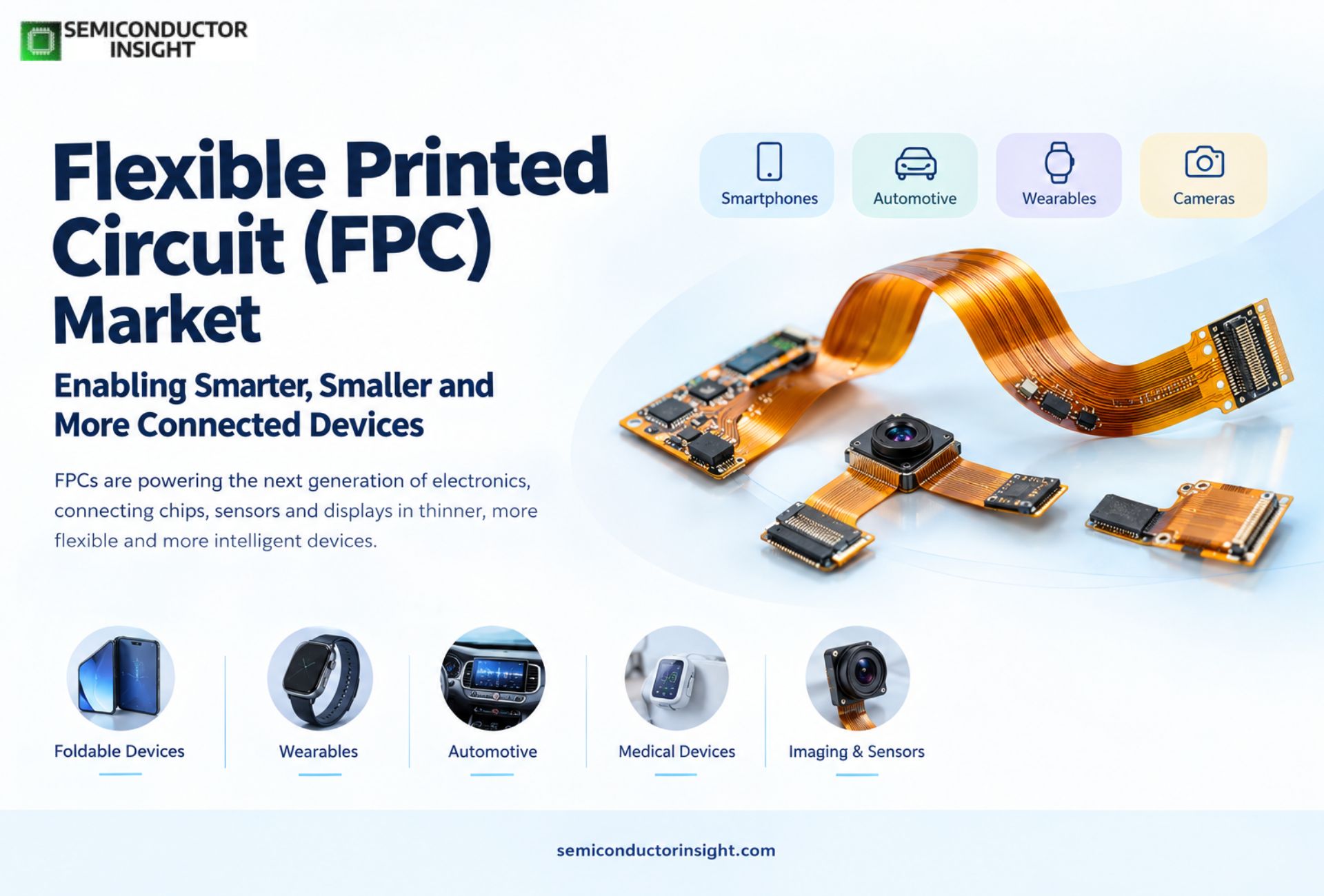
Single-Sided vs. Double-Sided FPC Designs across the 2026 FPC Market
The flexible printed circuit, or FPC, has become one of the less visible but increasingly important building blocks of modern electronics. It allows electrical connections to bend, fold and occupy irregular spaces where a conventional rigid printed circuit board would be difficult to install. That characteristic is becoming more valuable as consumer devices become thinner, automotive electronics become more distributed and wearable products pack more sensors into smaller spaces.
The technology is particularly relevant to semiconductor-enabled products because chips are only useful when they can be electrically connected to displays, sensors, cameras, batteries, antennas and other modules. FPCs provide that physical and electrical bridge.
FPC in one minute
An FPC is a flexible circuit manufactured on a bendable substrate, commonly using polyimide or similar flexible materials with conductive copper layers. Depending on the design, it can incorporate conductors, insulation, vias, surface finishes, connectors and stiffeners.
The basic architecture can be viewed as:
Flexible substrate → Copper conductor → Circuit pattern → Surface protection → Connector or component interface
The completed circuit can be bent or folded during product assembly, in contrast to a rigid PCB. This makes it especially helpful in situations where two components must move in relation to one another or where space is limited.
Why flexibility is becoming an engineering advantage?
- The value of FPCs is not simply that they bend. Their real advantage is that they can replace multiple wires, connectors and rigid boards while following the physical geometry of a product.
- A single flexible circuit can route signals through a narrow hinge, connect a camera module to a main board or link sensors positioned around a wearable device.
- Fewer individual interconnections can also help simplify assembly and improve reliability when the circuit is properly engineered for the application’s mechanical requirements.
- This is increasingly relevant as electronics designers pursue smaller footprints without sacrificing functionality.
The semiconductor connection runs deeper than it appears
FPC demand is closely tied to the growing number of electronic modules inside modern products. Smartphones, tablets, smartwatches, hearables, cameras, vehicles and medical equipment can contain numerous semiconductor-based components that require compact interconnection.
Apple’s current product ecosystem illustrates the trend. The company says Apple Intelligence is now integrated across iPhone, iPad, Mac, Apple Watch, AirPods and Apple Vision Pro, demonstrating how computing, sensing and connectivity are spreading across increasingly compact device categories.
This creates an important design chain:
More semiconductor functions
↓
More sensors and modules
↓
Greater interconnection density
↓
Less available internal space
↓
Greater requirement for flexible circuit architectures
Foldable and wearable designs are testing FPC engineering
Foldable electronics create a particularly demanding environment because electrical connections must tolerate repeated movement around hinges and folding mechanisms. Wearables present a different challenge, with circuits required to follow curved surfaces while remaining lightweight and compact.
The same design philosophy is spreading into smart glasses, hearables, medical wearables and sensor-rich accessories. In these products, the circuit is no longer simply an electrical pathway. Its thickness, bending radius, weight and mechanical durability can influence the physical design of the entire device.
Automotive electronics are opening another FPC pathway
Vehicle architectures are also changing the role of flexible circuits. Modern vehicles contain cameras, displays, lighting systems, battery-management electronics, radar-related components, sensors and increasingly sophisticated electronic control systems.
As electronics are distributed throughout the vehicle rather than concentrated in one location, flexible interconnects can help designers route signals through constrained spaces.
The semiconductor supply chain is simultaneously becoming more geographically distributed. In 2025, Apple announced partnerships involving TSMC, GlobalFoundries, Texas Instruments, Broadcom and Amkor as part of its American Manufacturing Program, covering semiconductor manufacturing, wireless components and advanced packaging.
For FPC manufacturers, this broader expansion of electronics manufacturing matters because every additional module creates potential demand for interconnection technologies.
Materials are becoming part of the FPC conversation
- The FPC industry is also facing changes in material economics. Flexible circuit construction depends heavily on copper, polymer films, adhesives and specialized processing materials.
- Panasonic Industry announced in January 2025 that it would revise prices for several flexible circuit board materials from April 2025, citing higher raw-material and logistics costs.
- The announced increases ranged from 20% to 30% for several flexible circuit materials, while one resin-coated copper foil product was listed for a 50% increase.
- This illustrates why substrate engineering, material utilization and supply continuity are becoming increasingly important alongside circuit performance.
Sustainability is moving into the circuit layer
FPC sustainability is also becoming more concrete. Apple reported in 2026 that all Apple-designed printed circuit boards had reached 100% recycled gold plating and 100% recycled tin soldering. The company’s definition explicitly includes flexible printed circuit boards.
That development is significant because it shifts sustainability discussions beyond packaging and batteries into the electronics interconnection layer itself.
For FPC suppliers, this can translate into greater attention to material traceability, recycled content, responsible sourcing and process efficiency.
What engineers are optimizing now
Modern FPC development increasingly revolves around a combination of electrical, mechanical and manufacturing requirements. Designers are balancing:
- Higher circuit density within smaller footprints
- Controlled impedance for high-speed signal transmission
- Repeated bending and flexing requirements
- Thermal behavior around semiconductor and power components
- Connector reliability and assembly tolerances
- Material thickness and weight reduction
- Compatibility with automated manufacturing
The engineering challenge is therefore multidimensional. Making a circuit thinner is not enough if signal integrity, heat management or mechanical durability deteriorates.
You can freely browse our most recent updated report to learn more about it before scrolling further: https://semiconductorinsight.com/report/fpc-market/
The next FPC design question is not simply how thin
The FPC market is moving alongside a broader transformation in electronics design. Devices are becoming more connected, sensor-rich and spatially constrained, while automotive and industrial systems are distributing electronics across increasingly complex physical architectures.
At the same time, semiconductor packaging is becoming more sophisticated. Apple is currently recruiting engineers for advanced package architecture covering SoC, memory, RF and cellular technologies, with its role description emphasizing physical design, signal and power integrity, scalability and AI-assisted design.
That convergence points toward the next stage of FPC development: circuits designed not merely to connect components, but to become an integrated part of the product’s mechanical, electrical and manufacturing architecture.
Therefore, flexibility is not the best FPC tale in 2026. It is the capacity to reduce the size, weight, connectivity, and integration complexity of increasingly complex electronics.

Comments (0)