
The Silent Dashboard War How Automotive DRAM Became the New Horsepower for Autonomous Driving
Nobody talks about it at the car launch events. You hear about the sleek UI, the 0-100 timing, and the number of LIDARs. But beneath that shiny center console, a brutal resource war is happening one that has nothing to do with silicon wafers for CPUs and everything to do with a tiny, unsung component called Automotive DRAM.
We are officially entering the era of the Terabyte on Wheels, and the supply chain is screaming.
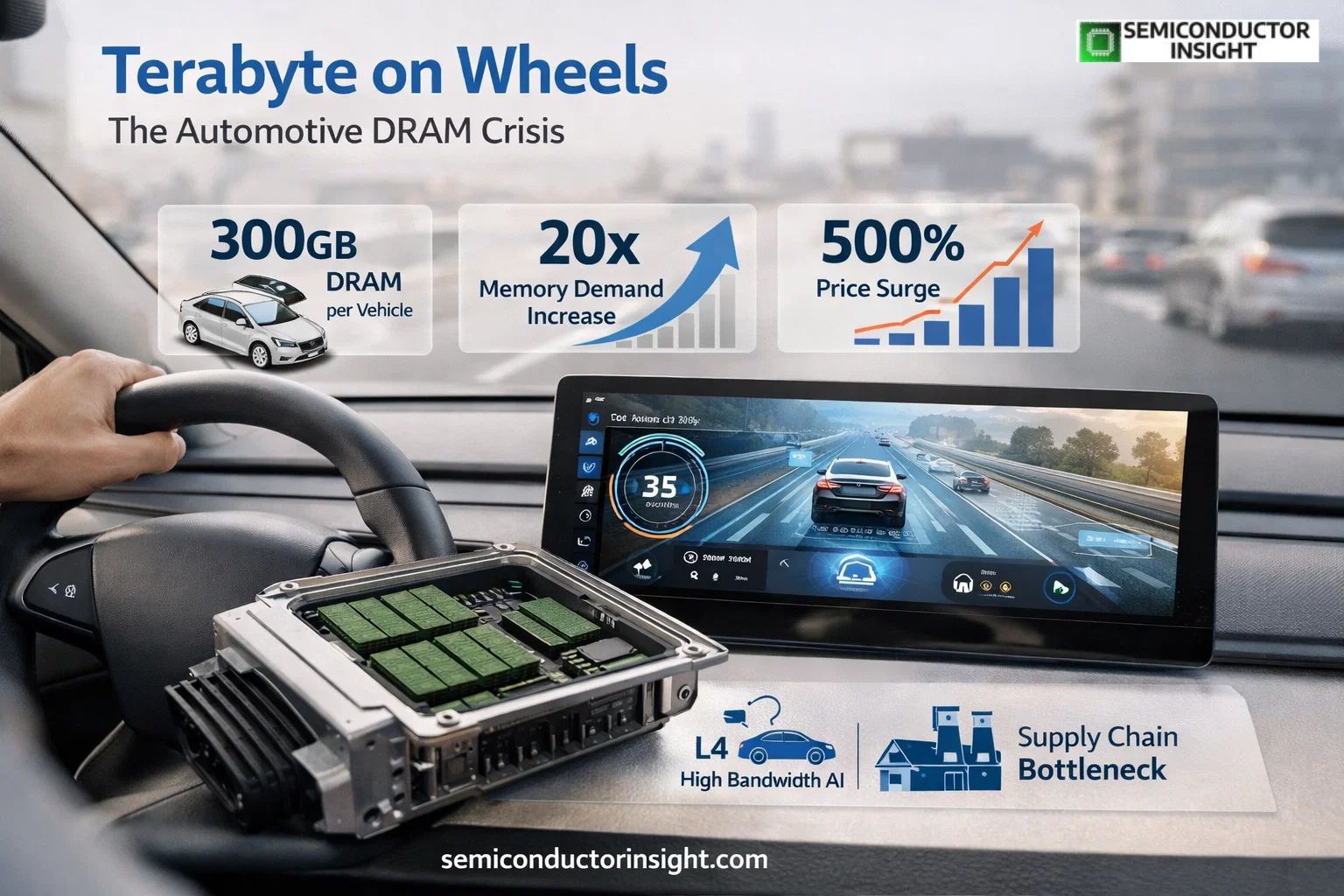
The 300GB Elephant in the Room
Forget horsepower. The new currency in the EV race is Bandwidth. I recently came across a statement from a Micron executive that stopped me mid-scroll. They mentioned that as we creep toward geofenced Level 4 autonomy, the memory Bill of Materials (BOM) per vehicle is projected to explode from a measly 16GB to over 300GB of DRAM
Let that sink in. That is a 20x increase. We aren’t just asking cars to park themselves anymore; we are asking them to run local Generative AI, process 8K screens for every passenger, and make life-or-death braking decisions in milliseconds The shift from L2 to L4 isn’t a software update; it is a hardware heist where DRAM is the primary target.
The Price Tag Nobody Prepared For
If you are in procurement or supply chain management right now, you likely aren’t sleeping well. The stats coming out of Q1 2026 are brutal. We aren’t just seeing inflation; we are seeing a vertical price spike.
Reports indicate that some LPDDR and DDR5 automotive-grade products have seen price surges of 300% to 500%, with some specific cases hitting 1,000% compared to early 2025.
Battle for Smart Innovation Leadership
- Here is the structural flaw that most analysts missed until recently. The DRAM world is dominated by three giants, and right now, they are looking at a 60%+ profit margin on High Bandwidth Memory (HBM) sold to Nvidia and hyperscalers versus the razor-thin, high-liability margins on automotive DRAM
What would you do?
- The fabs are pivoting. Wafers that used to make DDR4 for your car’s infotainment system are being reconfigured to make DDR5 and HBM for AI data centres.
- A Wells Fargo analysis recently highlighted that autos account for less than 10% of global DRAM demand, making them a take-it-or-leave-it customer for chipmakers.
- The result is a massive supply choke point. We are seeing a repeat of the 2021 shortage, but this time, it isn’t about foundry capacity; it is about raw chemical engineering and allocation priority.
The Structural Gap Explained
There is a term gaining traction in engineering circles: the technology mismatch. Your average smartphone changes every 12 months. Your car has a 10-year life cycle.
Manufacturers are phasing out older nodes (like DDR4) to focus on DDR5/LPDDR5X for AI. But an automotive LPDDR4 chip needs to be qualified for years to pass AEC-Q100 Grade 1 standards (that -40°C to +125°C torture test) We are hitting a structural gap where the old chips are going extinct, and the new chips are too expensive or too bleeding edge to slap into a mass-production vehicle.
Our most recent updated related study is available for free at this link: https://semiconductorinsight.com/report/automotive-dram-for-autonomous-driving-market/
The Heat is the Real Killer
Let’s geek out on the physics for a second. Standard NAND flash dies in a car. It just does. Automotive engineers reading this know the nightmare of thermal throttling.
We are stuffing 300GB of DRAM into a metal box sitting on an engine block or under a windshield in Arizona in August. The industry is pushing hard into LPDDR5X with Enhanced ECC (Error Correction Code), specifically optimized to handle the system-in-line penalties that used to kill bandwidth. We are seeing solutions that reduce power consumption per picojoule while clawing back 15-25% of lost bandwidth just by changing how the memory talks to the processor. That isn’t a spec sheet bump; that is a physics breakthrough required to keep the screen from freezing when the cabin hits 60°C.
Where the Rubber Meets the Road?
So, what does this mean for the actual vehicle? Right now, the intelligence of a car is throttled by its memory bus width. The high-end autonomous systems are demanding 256-to-512-bit bus widths to function. If the DRAM isn’t there, the software stack doesn’t matter. You can have the best AI model in the world, but if the data pipeline is clogged, the car hesitates. And hesitation in autonomous driving equals danger.
The takeaway here is harsh: Memory is no longer a commodity; it is the bottleneck.
As we look under the hood, the winners of the next EV wave won’t just be the best battery chemists; they will be the automakers who locked down their DRAM supply chains and engineered their thermal envelopes around the LPDDR5X curve. The era of cheap, dumb cars is over. Welcome to the age of the memory-starved automobile.

Comments (0)