Market Insights
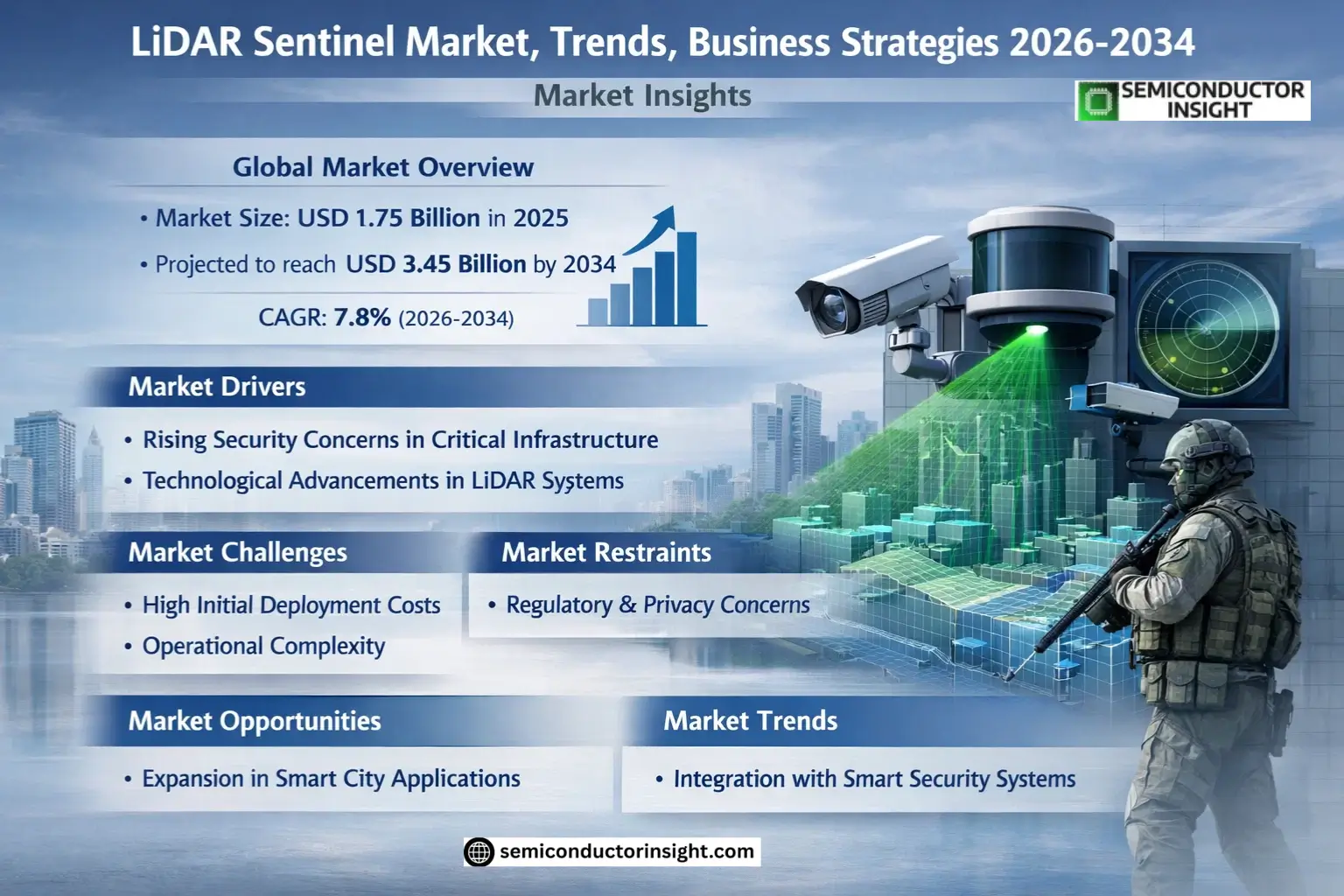
Global LiDAR Sentinel Market size was valued at USD 1.75 billion in 2025. The market is projected to grow from USD 1.92 billion in 2026 to USD 3.45 billion by 2034, exhibiting a CAGR of 7.8% during the forecast period.
LiDAR Sentinel is an advanced security and surveillance system that integrates LiDAR (Light Detection and Ranging) technology with complementary solutions such as video analytics, AI-driven data fusion, and real-time monitoring capabilities. It offers high-precision detection, long-range coverage, and robust performance in challenging environments, making it indispensable for applications like military security, critical infrastructure protection, and transportation hubs.
The market growth is driven by increasing demand for automated surveillance systems, rising investments in smart city projects, and advancements in sensor technologies. Furthermore, geopolitical tensions and heightened security concerns are accelerating adoption across defense sectors globally. Key players such as Hangzhou Hikvision Digital Technology, Zhejiang Dahua Technology, and Maxvision Technology are expanding their portfolios with AI-enhanced LiDAR solutions to capture emerging opportunities.
MARKET DRIVERS
Increasing Demand for Advanced Surveillance Solutions
LiDAR Sentinel Market is experiencing significant growth due to rising security concerns across critical infrastructure sites. Governments and private enterprises are increasingly deploying LiDAR-based sentinel systems to enhance perimeter security and threat detection capabilities. The technology’s ability to provide high-resolution 3D mapping in real-time makes it indispensable for modern security applications.
Technological Advancements in LiDAR Systems
Continuous improvements in LiDAR sensor technology, including higher accuracy and longer detection ranges, are driving market adoption. The integration of AI with LiDAR Sentinel systems has enabled automatic threat classification, reducing false alarms and improving response times.
Military applications remain a key growth area, with defense agencies worldwide modernizing their surveillance infrastructure with LiDAR Sentinel technology for border protection and critical asset monitoring.
MARKET CHALLENGES
High Initial Deployment Costs
The significant capital expenditure required for LiDAR Sentinel systems remains a barrier to widespread adoption, particularly for smaller organizations. System costs include not just the LiDAR sensors but also the supporting infrastructure, processing units, and integration with existing security systems.
Other Challenges
Operational Complexity
Deploying and maintaining LiDAR Sentinel systems requires specialized technical expertise, creating challenges for organizations with limited in-house capabilities. Regular calibration and software updates are essential for maintaining system accuracy.
MARKET RESTRAINTS
Regulatory and Privacy Concerns
Increasing scrutiny of surveillance technologies and data collection practices is creating regulatory challenges for LiDAR Sentinel deployments. Some jurisdictions have implemented restrictions on the use of advanced monitoring systems, potentially limiting market growth in certain regions.
MARKET OPPORTUNITIES
Expansion in Smart City Applications
The growing smart city initiatives worldwide present significant opportunities for LiDAR Sentinel systems. Municipalities are adopting these solutions for traffic monitoring, crowd control, and urban security management. The ability to integrate with other smart city infrastructure makes LiDAR Sentinel technology particularly valuable for comprehensive urban surveillance networks.
LiDAR Sentinel Market Trends
Integration with Smart Security Systems Drives Growth
LiDAR Sentinel Market is witnessing increased adoption due to its integration with advanced security ecosystems. These systems combine LiDAR’s precision detection with video analytics and AI-powered threat assessment, creating comprehensive perimeter protection solutions. Major applications include critical infrastructure protection and high-security facilities where false alarms must be minimized.
Other Trends
Military Applications Lead Deployment
Military sectors account for over 40% of LiDAR Sentinel deployments globally, utilizing the technology for border surveillance and base protection. The systems’ ability to operate in diverse weather conditions and detect intrusions at long ranges makes them preferable to traditional surveillance methods.
Asia-Pacific Emerges as High-Growth Region
China’s investment in smart city infrastructure and India’s border security modernization programs are accelerating LiDAR Sentinel adoption. Regional manufacturers like Hikvision and Dahua Technology are developing cost-effective solutions tailored for developing markets, increasing accessibility beyond traditional military buyers.
Integration Challenges Present Opportunities
While LiDAR Sentinel systems offer superior detection capabilities, integrating them with legacy security infrastructure remains a technical hurdle. This has created a niche for specialized service providers offering system customization and interoperability solutions across different security platforms.
Technological Advancements Enhance Capabilities
Recent developments include multi-sensor fusion capabilities that combine LiDAR data with thermal imaging and radar inputs. Market leaders are also introducing compact, power-efficient designs suitable for mobile deployments and temporary security installations at public events.
COMPETITIVE LANDSCAPE
Key Industry Players
Global LiDAR Sentinel Market Dominated by Technology and Security Specialists
LiDAR Sentinel Market is characterized by a competitive landscape where technology integration and security expertise converge. Maxvision Technology and Pelco emerge as frontrunners, collectively holding a significant market share due to their advanced LiDAR-based security solutions and global distribution networks. The market structure shows increasing vertical integration as companies like Hikvision and Dahua combine LiDAR capabilities with their existing video surveillance ecosystems.
Mid-tier players such as LighTekton and Baoding Galaxy Electronic Technology focus on niche military applications, while regional specialists like Shenzhen Huazhenglian Industrial dominate specific Asian markets. Emerging players are differentiating through AI-powered analytics integration, with Sense Time leading this innovation wave. The competitive intensity is increasing as traditional defense contractors explore partnerships with LiDAR specialists.
List of Key LiDAR Sentinel Companies Profiled
- Maxvision Technology
- Pelco
- SENTINEL
- Hangzhou Hikvision Digital Technology
- Sense Time
- Zhejiang Dahua Technology
- Baoding Galaxy Electronic Technology
- LighTekton
- Shenzhen Huazhenglian Industrial
- Hope Wish Photoelectronic Technology
- Quanergy Systems
- Hexagon AB
- Teledyne Technologies
- Velodyne Lidar
- Leica Geosystems
Segment Analysis:
| Segment Category | Sub-Segments | Key Insights |
| By Type |
|
Integrated Systems dominate due to their seamless operation and reduced installation complexity. These systems combine LiDAR with complementary technologies in a single package for optimized performance. Market preference for integrated solutions is driven by:
|
| By Application |
|
Military Security remains the primary application area for LiDAR Sentinel systems with growing adoption across other sectors. Key drivers include:
|
| By End User |
|
Government Agencies represent the core customer base with expanding commercial adoption. Market dynamics show:
|
| By Technology Integration |
|
Hybrid Surveillance Solutions are gaining prominence as the preferred configuration. The integration benefits include:
|
| By Detection Range |
|
Medium-Range systems currently represent the most balanced solution for security applications. Key considerations:
|
Regional Analysis: Global LiDAR Sentinel Market
North America
North America leads in developing AI-integrated LiDAR systems, with Silicon Valley and Boston emerging as key innovation centers. Research institutions collaborate with tech giants to enhance sensor accuracy and data processing capabilities.
Federal and state agencies widely deploy LiDAR Sentinel for infrastructure projects and environmental monitoring. The U.S. Geological Survey utilizes these systems for topographic mapping and disaster management applications.
Energy companies leverage LiDAR Sentinel for pipeline monitoring while telecom operators use it for network planning. The technology sees growing adoption in precision agriculture across the Midwest farming belt.
Cross-industry collaborations between LiDAR manufacturers and cloud service providers accelerate market growth. These partnerships enhance data storage and analytics capabilities for enterprise customers.
Europe
Europe represents the second-largest LiDAR Sentinel Market, driven by strict environmental regulations and smart city initiatives. Germany and UK lead in adoption for autonomous vehicle testing and urban planning. The region sees increasing demand for airborne LiDAR systems in archaeological surveys and coastal monitoring. European Union funding supports research projects integrating LiDAR with IoT platforms for environmental protection applications.
Asia-Pacific
The Asia-Pacific LiDAR Sentinel Market exhibits the fastest growth, fueled by rapid infrastructure development. China dominates regional demand with massive smart city projects and transportation network expansions. Emerging economies like India deploy LiDAR systems for railway corridor mapping and flood risk assessment. Japan and South Korea focus on industrial automation applications, creating new opportunities for LiDAR technology providers.
South America
South America shows growing interest in LiDAR Sentinel technology for mining operations and forest conservation. Brazil leads regional adoption with applications in Amazon rainforest monitoring and urban expansion planning. Challenges include limited technical expertise and infrastructure constraints in remote areas, though international partnerships help bridge these gaps.
Middle East & Africa
The Middle East utilizes LiDAR Sentinel for large-scale construction projects and oil pipeline monitoring. Africa sees selective adoption in agriculture and wildlife conservation, with South Africa and Kenya emerging as key markets. Regional growth remains constrained by budget limitations but shows potential with increasing foreign investments.
Report Scope
This market research report provides a comprehensive analysis of the LiDAR Sentinel Market , covering the forecast period 2025-2034. It offers detailed insights into market dynamics, technological advancements, competitive landscape, and key trends shaping the industry.
Key focus areas of the report include:
- Market Overview: The report begins with an overview outlining its current market scenario, key growth indicators, and industry transformation drivers. It discusses macroeconomic factors, demand-supply balance, regulatory landscape, and the strategic role of LiDAR technology in powering advancements across industries such as military security, transportation hubs, and public safety.
- Market Size & Forecast: Historical data and future projections for revenue, unit shipments, and market value across major regions and segments.
- Segmentation Analysis: Detailed breakdown by product type, technology, application, and end-user industry to identify high-growth segments and investment opportunities.
- Regional Insights: Insights into market performance across North America, Europe, Asia-Pacific, Latin America, and the Middle East & Africa, including country-level analysis where relevant.
- Competitive Landscape: Profiles of leading market participants, including their product offerings, R&D focus, manufacturing capacity, pricing strategies, and recent developments such as mergers, acquisitions, and partnerships.
- Technology Trends & Innovation: Assessment of emerging technologies, integration of AI/IoT, LiDAR design trends, fabrication techniques, and evolving industry standards.
- Market Drivers & Restraints: Evaluation of factors driving market growth along with challenges, supply chain constraints, regulatory issues, and market-entry barriers.
- Stakeholder Insights: Insights for component suppliers, OEMs, system integrators, investors, and policymakers regarding the evolving ecosystem and strategic opportunities.
Primary and secondary research methods are employed, including interviews with industry experts, data from verified sources, and real-time market intelligence to ensure the accuracy and reliability of the insights presented.
FREQUENTLY ASKED QUESTIONS:
What is the current market size of LiDAR Sentinel Market?
-> LiDAR Sentinel Market size was valued at USD 1.75 billion in 2025. The market is projected to grow from USD 1.92 billion in 2026 to USD 3.45 billion by 2034, exhibiting a CAGR of 7.8% during the forecast period.
Which key companies operate in LiDAR Sentinel Market?
-> Key players include Maxvision Technology, Pelco, SENTINEL, Hangzhou Hikvision Digital Technology, Sense Time, Zhejiang Dahua Technology, Baoding Galaxy Electronic Technology, LighTekton, Shenzhen Huazhenglian Industrial, and Hope Wish Photoelectronic Technology, among others.
What are the key growth drivers?
-> Key growth drivers include increasing demand for high-precision security systems, technological advancements in LiDAR, and growing adoption in military and transportation applications.
Which region dominates the market?
-> Asia is the fastest-growing region, with significant market presence in China, while North America remains a dominant market, particularly the U.S.
What are the emerging trends?
-> Emerging trends include integration of LiDAR with video tracking and data fusion technologies, development of long-distance detection systems, and real-time security solutions.

Get Sample Report PDF for Exclusive Insights
Report Sample Includes
- Table of Contents
- List of Tables & Figures
- Charts, Research Methodology, and more...
 Download Sample Report PDF