Automotive DRAM for Autonomous Driving Market Insights
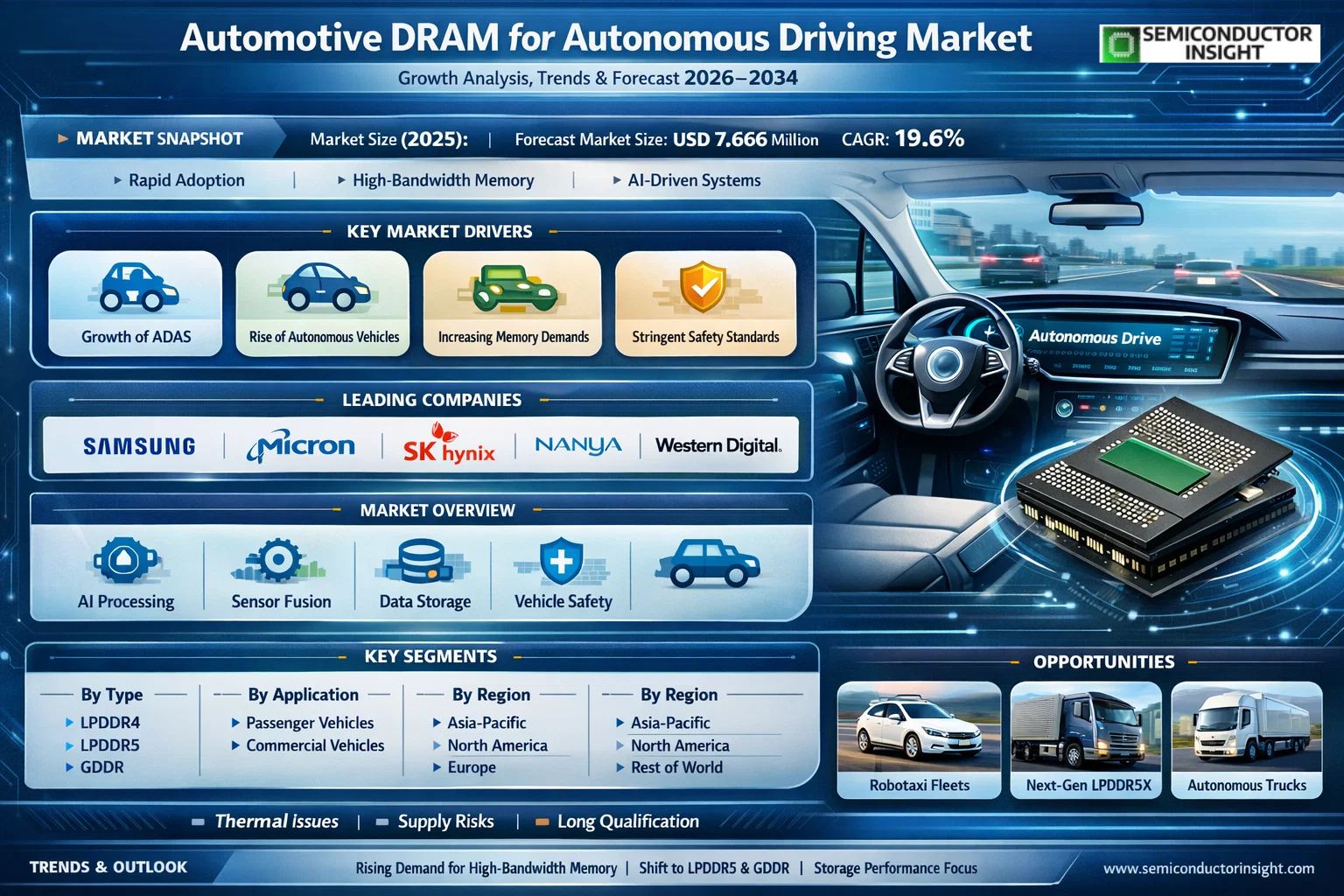
Global Automotive DRAM for Autonomous Driving market size was valued at USD 2,252 million in 2025. The market is projected to grow from USD 2,694 million in 2026 to USD 7,666 million by 2034, exhibiting a CAGR of 19.6% during the forecast period.
Automotive DRAM (Dynamic Random-Access Memory) for autonomous driving refers to high-performance, automotive-grade memory solutions specifically engineered to meet the stringent reliability, safety, and bandwidth requirements of advanced driver-assistance systems (ADAS) and fully autonomous vehicle platforms. These memory components include LPDDR4, LPDDR5, and GDDR variants, each designed to support the massive data throughput demands of real-time sensor fusion, AI inference, and decision-making processes in modern autonomous vehicles. Unlike conventional consumer DRAM, automotive-grade DRAM must comply with AEC-Q100 qualification standards and operate reliably across extreme temperature ranges and vibration-intensive environments.
The market is witnessing robust momentum driven by the accelerating deployment of autonomous and semi-autonomous vehicles globally. A critical insight shaping this market is that 90% of the power consumption and latency in AI-driven automotive operations originates from storage and data transfer, rather than the AI processor itself. In the vast majority of working conditions, the AI processor remains idle, waiting for the storage system to supply data , meaning storage bandwidth is effectively synonymous with real computing power in autonomous driving architectures. This dynamic has made high-bandwidth automotive DRAM an indispensable component in next-generation vehicle platforms. Leading manufacturers such as Samsung, Micron Technology, and SK hynix dominate the competitive landscape, collectively accounting for a substantial share of global revenues, as automotive OEMs and Tier-1 suppliers intensify their focus on memory-centric AI performance optimization.
MARKET DRIVERS
Rising Complexity of Autonomous Driving Systems Fueling Demand for High-Performance Automotive DRAM
The rapid advancement of autonomous driving technologies has emerged as one of the most significant forces propelling the automotive DRAM for autonomous driving market. Modern autonomous vehicles rely on a vast ecosystem of sensors, cameras, LiDAR systems, and radar units that continuously generate enormous volumes of data requiring real-time processing. Advanced driver assistance systems (ADAS) and fully autonomous platforms demand memory solutions capable of operating at high bandwidth with minimal latency, making automotive-grade DRAM an indispensable component. As vehicles progress from Level 2 to Level 4 and Level 5 autonomy, the computational load placed on in-vehicle processing units grows exponentially, necessitating more robust and higher-capacity DRAM solutions tailored for automotive environments.
Proliferation of In-Vehicle AI Processors and SoCs Accelerating Automotive DRAM Adoption
The widespread integration of artificial intelligence accelerators and system-on-chip (SoC) architectures within autonomous vehicle platforms is creating sustained demand for automotive DRAM modules. Leading semiconductor companies have developed dedicated automotive AI processors that require high-bandwidth memory interfaces to support neural network inference tasks such as object detection, path planning, and semantic segmentation. These processors typically interface with LPDDR5 and GDDR6-based automotive DRAM, which offer the throughput needed to manage concurrent AI workloads without compromising functional safety requirements. The growing deployment of centralized compute architectures in next-generation vehicles is further amplifying this trend, consolidating multiple domain controllers into single high-performance computing units that require significantly more memory bandwidth.
➤ The transition toward zonal and centralized vehicle architectures is fundamentally reshaping memory requirements, with automotive DRAM for autonomous driving applications expected to account for a growing share of total automotive semiconductor content per vehicle as OEMs scale electrification and autonomy features simultaneously.
Stringent AEC-Q100 qualification standards and the requirement for ISO 26262 functional safety compliance have prompted memory manufacturers to invest heavily in automotive-specific DRAM product lines. Unlike consumer-grade DRAM, automotive DRAM for autonomous driving must withstand extended temperature ranges, demonstrate higher reliability over vehicle lifetimes, and support error-correcting code (ECC) functionality to detect and correct data faults in safety-critical applications. This specialized product development activity reflects the strong commercial pull from automotive OEMs and Tier-1 suppliers who require memory solutions that meet both performance and safety benchmarks simultaneously.
MARKET CHALLENGES
Thermal Management and Power Consumption Constraints Presenting Significant Challenges for Automotive DRAM Deployment
One of the foremost challenges confronting the automotive DRAM for autonomous driving market relates to the management of heat dissipation and power consumption within space-constrained vehicle computing platforms. High-bandwidth automotive DRAM modules operating continuously to support real-time sensor fusion and AI inference generate substantial thermal output, which must be managed without compromising adjacent electronic components or exceeding vehicle thermal envelopes. Packaging innovations such as 3D-stacked DRAM and high-bandwidth memory (HBM) architectures introduce additional thermal complexity, and automotive-grade thermal solutions remain technically demanding and cost-intensive to implement reliably across diverse vehicle form factors and global climate conditions.
Other Challenges
Supply Chain Concentration and Geopolitical Risks
The automotive DRAM for autonomous driving supply chain remains concentrated among a limited number of leading memory manufacturers, creating vulnerability to supply disruptions stemming from geopolitical tensions, natural disasters, or capacity constraints. Automotive OEMs and Tier-1 suppliers have experienced the consequences of such concentration during previous semiconductor shortages, which exposed the fragility of just-in-time procurement models. Diversifying the supplier base for automotive-grade DRAM is challenging given the high qualification barriers and the limited number of fabs capable of producing memory to automotive specifications, leaving supply chain resilience as an ongoing operational challenge for the industry.
Long Automotive Qualification Cycles Slowing Technology Adoption
The extended qualification and validation timelines inherent to the automotive industry create a structural lag between the availability of advanced DRAM technologies and their adoption in autonomous driving platforms. Qualifying a new automotive DRAM product to AEC-Q100 standards and integrating it into a certified functional safety architecture can require multiple years of testing and validation, during which consumer-grade memory technology may have advanced by one or more generations. This qualification gap means that autonomous vehicles may be constrained to use memory technologies that lag behind the state of the art, potentially limiting the performance ceiling of deployed autonomous driving systems until next-generation automotive DRAM completes the necessary certification processes.
MARKET RESTRAINTS
High Cost of Automotive-Grade DRAM Limiting Widespread Deployment Across Vehicle Segments
The premium pricing associated with automotive DRAM for autonomous driving relative to standard consumer memory products represents a meaningful restraint on market expansion, particularly in cost-sensitive mid-range and entry-level vehicle segments. Automotive-grade DRAM commands a significant price premium due to the additional testing, qualification, and reliability engineering required to meet AEC-Q100 and ISO 26262 standards. For mass-market vehicles where autonomous features are being introduced at lower price points, the incremental bill-of-materials cost associated with automotive-grade memory solutions can create margin pressure for OEMs and Tier-1 suppliers, potentially slowing the pace at which advanced ADAS and autonomous driving capabilities are democratized across broader vehicle portfolios.
Regulatory Uncertainty and Inconsistent Global Standards Constraining Market Scalability
Divergent regulatory frameworks governing autonomous vehicle deployment across key markets including North America, Europe, and Asia-Pacific introduce uncertainty that can constrain investment decisions across the automotive DRAM for autonomous driving market value chain. Memory suppliers and system integrators must design and qualify products capable of meeting varying safety and functional certification requirements across jurisdictions, increasing development costs and complexity. The absence of a harmonized global standard for autonomous driving system validation means that automotive DRAM solutions may require market-specific adaptations or certifications, fragmenting development resources and limiting the economies of scale that would otherwise reduce per-unit costs and accelerate broader market adoption across all vehicle classes and regions.
MARKET OPPORTUNITIES
Expansion of Software-Defined Vehicle Architectures Creating New Demand Vectors for Automotive DRAM
The industry-wide transition toward software-defined vehicle (SDV) architectures represents a compelling growth opportunity for the automotive DRAM for autonomous driving market. SDV platforms require over-the-air update capabilities, dynamic resource allocation, and persistent high-performance computing infrastructure that place greater demands on onboard memory systems. As automakers shift toward centralized high-performance compute nodes capable of supporting iterative software updates and expanding autonomous feature sets over the vehicle lifetime, the installed base of automotive DRAM per vehicle is expected to increase substantially. This architectural evolution creates a structural demand uplift that is independent of incremental sensor or actuator additions, representing a durable long-term growth driver for automotive memory suppliers.
Emerging Robotaxi and Commercial Autonomous Vehicle Segments Offering High-Value Market Expansion
The development and commercial scaling of robotaxi fleets and autonomous commercial vehicles including trucks, delivery vans, and logistics platforms present high-value opportunities for automotive DRAM for autonomous driving suppliers. These vehicle categories operate at higher levels of autonomy and require substantially greater onboard compute and memory resources compared to passenger vehicles with partial ADAS features. Fleet operators prioritize system reliability and continuous operational performance, characteristics that align directly with the value proposition of high-reliability automotive-grade DRAM solutions. As pilot robotaxi deployments in select urban markets progress toward commercial scale and regulatory frameworks for autonomous commercial vehicles mature, memory suppliers with established automotive-grade product portfolios are well-positioned to capture disproportionate revenue growth from these emerging high-memory-content platforms.
Next-Generation LPDDR5X and HBM Adoption in Automotive Platforms Unlocking Performance-Driven Upgrades
The anticipated qualification and adoption of next-generation memory standards, including LPDDR5X and automotive-optimized high-bandwidth memory variants, within autonomous driving compute platforms represents a significant near-term market opportunity. These advanced DRAM technologies deliver materially higher bandwidth and improved power efficiency compared to current-generation automotive memory, enabling more sophisticated AI model inference and multi-sensor data fusion at reduced energy budgets. As autonomous vehicle developers seek to maximize the performance of onboard computing platforms without exceeding power and thermal constraints, the transition to higher-specification automotive DRAM for autonomous driving applications is expected to generate meaningful incremental revenue for memory manufacturers who successfully complete automotive qualification of their next-generation product lines ahead of competitive alternatives.
MAIN TITLE HERE () Trends
Rising Demand for High-Bandwidth Memory in Autonomous Vehicle Systems
The Automotive DRAM for Autonomous Driving Market is experiencing a significant transformation driven by the rapid integration of AI-based perception and decision-making systems in modern vehicles. As autonomous driving platforms become increasingly sophisticated, the demand for high-performance, automotive-grade DRAM has intensified considerably. A critical insight shaping this market is that storage infrastructure , not processing power alone , serves as the true bottleneck in AI computing performance. Industry analysis consistently highlights that approximately 90% of power consumption and operational delay in AI systems stem from storage access and data transfer operations, making automotive DRAM a pivotal component in realizing the full potential of autonomous driving technology.
Other Trends
LPDDR5 Adoption Accelerating Across Autonomous Platforms
Within the Automotive DRAM for Autonomous Driving Market, LPDDR5 memory is gaining notable traction as automakers and Tier-1 suppliers demand greater bandwidth and lower latency for real-time sensor fusion and neural network inference. While LPDDR4 continues to maintain a substantial installed base across mid-level driver assistance systems, next-generation autonomous platforms are increasingly specifying LPDDR5 for its superior data throughput and energy efficiency. This transition is particularly pronounced in Level 3 and Level 4 autonomous vehicle programs, where continuous data streams from LiDAR, radar, and camera arrays must be processed with minimal delay.
Competitive Landscape Consolidating Around Key Memory Suppliers
Global Automotive DRAM for Autonomous Driving Market remains highly concentrated, with Samsung, Micron Technology, and SK Hynix collectively accounting for a dominant share of worldwide revenues. These manufacturers are actively investing in automotive-qualified memory solutions that comply with AEC-Q100 standards, ensuring reliability across extreme temperature ranges and demanding operational environments. Strategic partnerships between memory suppliers and autonomous vehicle platform developers are becoming more common, reflecting the industry’s recognition that purpose-built automotive DRAM , rather than repurposed consumer-grade memory , is essential for functional safety compliance.
Regional Dynamics Shaping Market Investments
Asia-Pacific, led by China, Japan, and South Korea, represents a major hub of activity within the Automotive DRAM for Autonomous Driving Market, underpinned by robust domestic electric vehicle production and strong government support for intelligent transportation systems. North America remains a key innovation center, with the United States hosting numerous autonomous vehicle development programs that are creating sustained demand for advanced memory solutions. Europe is also emerging as a significant market, driven by stringent vehicle safety regulations and automaker commitments to deploying advanced driver assistance systems across passenger and commercial vehicle segments.
Storage Bandwidth as the Defining Performance Metric
A defining trend within the Automotive DRAM for Autonomous Driving Market is the industry’s growing recognition that storage bandwidth effectively determines real-world AI computing performance in autonomous systems. Since AI processors spend the majority of operational cycles waiting for data transfers from memory, optimizing DRAM bandwidth has become a strategic priority for autonomous vehicle architects. This understanding is accelerating investment in GDDR and next-generation LPDDR technologies, as manufacturers seek memory solutions capable of sustaining the continuous, high-volume data flows that safe and reliable autonomous driving demands.
COMPETITIVE LANDSCAPE
Key Industry Players
Automotive DRAM for Autonomous Driving Market , Competitive Dynamics and Leading Manufacturer Profiles
Global Automotive DRAM for Autonomous Driving market is characterized by a high degree of concentration, with a small number of vertically integrated semiconductor giants commanding the majority of revenue share. Samsung Electronics leads the competitive field, leveraging its unmatched manufacturing scale, advanced process node capabilities, and deep integration with automotive-grade qualification standards such as AEC-Q100. The South Korean conglomerate has made significant investments in LPDDR5 and GDDR6 memory solutions tailored for ADAS and fully autonomous driving platforms, positioning itself as the preferred memory supplier for Tier-1 automotive ECU and domain controller manufacturers globally. Micron Technology and SK hynix closely follow, each investing heavily in automotive-qualified DRAM portfolios that meet the stringent reliability, temperature, and longevity requirements demanded by OEMs. As the market was valued at approximately USD 2,252 million in 2025 and is projected to reach USD 7,666 million by 2034 at a CAGR of 19.6%, competition among these incumbents is intensifying around bandwidth performance, power efficiency, and functional safety compliance , particularly as AI inference workloads in autonomous driving systems increasingly expose storage bandwidth as the primary performance bottleneck rather than the compute processor itself.
Beyond the dominant triad, a broader ecosystem of specialized and emerging players is actively shaping the competitive landscape. Companies such as Winbond Electronics and CXMT (ChangXin Memory Technologies) are expanding their automotive DRAM capabilities, with CXMT representing China’s strategic push toward domestic memory self-sufficiency amid ongoing geopolitical supply chain pressures. Nanya Technology, a Taiwanese manufacturer, continues to serve cost-sensitive automotive segments, while Integrated Silicon Solution Inc. (ISSI) targets niche automotive memory applications requiring long product lifecycles and wide operating temperature ranges. On the system and module side, companies like Advantech, Swissbit, and ATP Electronics provide automotive-qualified DRAM modules and embedded memory solutions that integrate into autonomous driving computing platforms. As LPDDR5 adoption accelerates and GDDR-based solutions gain traction in high-performance autonomous driving SoCs from players like NVIDIA, Qualcomm, and Mobileye, memory suppliers are under increasing pressure to co-develop application-specific memory architectures that align with the evolving requirements of L3 through L5 autonomy systems.
List of Key Automotive DRAM for Autonomous Driving Companies Profiled
- Samsung Electronics
- Micron Technology
- SK hynix
- Nanya Technology
- Winbond Electronics
- ChangXin Memory Technologies (CXMT)
- Integrated Silicon Solution Inc. (ISSI)
- ATP Electronics
- Swissbit
- Advantech
- Kingston Technology
- Alliance Memory
- Elite Semiconductor Memory Technology Inc. (ESMT)
- Powerchip Semiconductor Manufacturing Corp. (PSMC)
- GigaDevice Semiconductor
Segment Analysis:
| Segment Category | Sub-Segments | Key Insights |
| By Type |
|
LPDDR5 is rapidly emerging as the leading segment in the Automotive DRAM for Autonomous Driving market, driven by its superior bandwidth and power efficiency characteristics that are indispensable for next-generation autonomous systems.
|
| By Application |
|
Passenger Vehicle represents the dominant application segment for Automotive DRAM in the autonomous driving space, propelled by the accelerating integration of advanced driver-assistance systems (ADAS) and fully autonomous features in consumer-grade automobiles.
|
| By End User |
|
Original Equipment Manufacturers (OEMs) constitute the leading end-user segment, as automotive OEMs are at the forefront of integrating high-performance DRAM solutions directly into vehicle architectures to support the increasing computational demands of autonomous driving systems.
|
| By Autonomy Level |
|
Level 4 & Level 5 (High/Full Automation) represents the most strategically significant and highest-value segment in terms of DRAM performance requirements, as these autonomy levels necessitate continuous, latency-free processing of massive multi-sensor data inputs without any human intervention.
|
| By Function |
|
AI Inference & Processing is the dominant functional segment driving the highest performance demands on automotive DRAM, as real-time AI model execution for object detection, path planning, and decision-making requires sustained high-bandwidth memory access with minimal latency.
|
Regional Analysis: Automotive DRAM for Autonomous Driving Market
Asia-Pacific
China represents the largest single national market within Asia-Pacific for automotive DRAM for autonomous driving applications. The country’s aggressive rollout of smart city infrastructure, coupled with strong policy support for new energy and autonomous vehicles, creates sustained demand. Domestic automakers and technology giants are collaborating to develop indigenously designed autonomous platforms that rely heavily on high-performance automotive-grade DRAM modules.
South Korea’s semiconductor giants hold commanding positions in global DRAM production, supplying automotive-grade memory components to vehicle manufacturers worldwide. The country’s deep expertise in memory chip design and fabrication directly benefits the automotive DRAM for autonomous driving market, ensuring consistent supply of high-reliability, temperature-resilient memory products tailored specifically for demanding in-vehicle computing environments.
Japan’s legacy of precision automotive engineering aligns naturally with the rigorous requirements of automotive DRAM for autonomous driving systems. Leading Japanese OEMs are accelerating adoption of sophisticated memory architectures within autonomous vehicle platforms. The country’s collaborative approach between automakers, tier-one suppliers, and semiconductor developers fosters innovation in memory-intensive sensing, perception, and decision-making systems critical to autonomous mobility.
Beyond the established leaders, markets such as India, Taiwan, and Southeast Asian nations are emerging as important contributors to the regional automotive DRAM for autonomous driving landscape. Taiwan’s semiconductor design capabilities complement regional supply chains, while India’s growing automotive sector and expanding smart mobility initiatives are beginning to generate meaningful demand for advanced memory solutions embedded in autonomous vehicle architectures.
North America
North America occupies a pivotal position in the automotive DRAM for autonomous driving market, anchored by the United States’ leadership in autonomous vehicle research, development, and commercialization. Silicon Valley’s technology ecosystem has cultivated a dense network of autonomous driving startups, established automotive OEMs, and semiconductor innovators who collectively drive demand for high-performance automotive DRAM solutions. Major automotive technology companies are actively testing and deploying autonomous platforms across several U.S. states, translating into significant and growing consumption of automotive-grade memory components. Canada contributes through its growing artificial intelligence research community and government-supported smart transportation initiatives. The region benefits from robust intellectual property frameworks, strong venture capital investment in autonomous mobility, and a regulatory environment that, while evolving, continues to encourage autonomous vehicle pilot programs. North America’s focus on developing fully autonomous long-haul trucking and urban mobility solutions creates specialized demand for ruggedized, high-bandwidth DRAM architectures capable of sustaining performance under demanding operational conditions.
Europe
Europe represents a sophisticated and strategically significant market for automotive DRAM for autonomous driving, characterized by stringent safety standards, a mature automotive manufacturing base, and progressive regulatory frameworks governing connected and automated vehicles. Germany, as the heartland of European automotive excellence, drives substantial demand through its premium OEMs that are actively embedding autonomous capabilities into next-generation vehicle platforms. France, Sweden, and the Netherlands are contributing through advanced research programs and public-private partnerships aimed at accelerating autonomous mobility deployment. The European Union’s regulatory initiatives around vehicle safety, data processing, and intelligent transportation systems are shaping the specifications and performance benchmarks required of automotive DRAM solutions within the region. European automotive suppliers are increasingly focused on sourcing memory components that comply with automotive functional safety standards, creating a highly quality-driven procurement environment that rewards suppliers capable of meeting exacting reliability and endurance criteria across diverse operational conditions.
South America
South America currently occupies an emerging position in Global automotive DRAM for autonomous driving market, with growth trajectory closely tied to broader automotive sector modernization and economic development across the region. Brazil serves as the primary automotive manufacturing hub, hosting assembly operations for several global OEMs and gradually incorporating advanced driver-assistance technologies into locally produced vehicles. While full-scale autonomous vehicle deployment remains in early stages across the region, the adoption of semi-autonomous features and connected vehicle platforms is progressively increasing demand for automotive-grade memory solutions. Government infrastructure development programs in select South American economies are beginning to lay the groundwork for smarter transportation networks. The region’s market expansion will depend significantly on macroeconomic stability, regulatory progress, and continued foreign investment in automotive technology modernization initiatives that progressively elevate the complexity and memory requirements of vehicles manufactured and sold across South American markets.
Middle East & Africa
The Middle East and Africa region represents an nascent but increasingly relevant participant in the automotive DRAM for autonomous driving market, with growth driven primarily by smart city ambitions and high-income market segments in Gulf Cooperation Council nations. The United Arab Emirates and Saudi Arabia are making substantial investments in intelligent transportation infrastructure, autonomous mobility trials, and technology-driven urban development projects that require sophisticated vehicular computing platforms embedded with high-performance automotive DRAM. South Africa serves as the primary automotive manufacturing presence on the African continent, though autonomous vehicle technology adoption remains at an exploratory stage. The broader African market presents long-term potential as digital infrastructure expands and connected vehicle technologies become more accessible. Strategic partnerships between regional governments and global automotive technology firms are expected to gradually elevate the penetration of autonomous driving systems and, consequently, the demand for specialized automotive DRAM solutions across the Middle East and Africa throughout the forecast period.
Report Scope
This market research report provides a comprehensive analysis of the Automotive DRAM for Autonomous Driving Market, covering the forecast period 2026–2034. It offers detailed insights into market dynamics, technological advancements, competitive landscape, and key trends shaping the industry.
Key focus areas of the report include:
- Market Overview: The report begins with an overview outlining its current market scenario, key growth indicators, and industry transformation drivers. It discusses macroeconomic factors, demand–supply balance, regulatory landscape, and the strategic role of semiconductors in powering advancements across industries such as automotive, telecommunications, consumer electronics, and industrial automation.
- Market Size & Forecast: Historical data and future projections for revenue, unit shipments, and market value across major regions and segments.
- Segmentation Analysis: Detailed breakdown by product type, technology, application, and end-user industry to identify high-growth segments and investment opportunities.
- Regional Insights: Insights into market performance across North America, Europe, Asia-Pacific, Latin America, and the Middle East & Africa, including country-level analysis where relevant.
- Competitive Landscape: Profiles of leading market participants, including their product offerings, R&D focus, manufacturing capacity, pricing strategies, and recent developments such as mergers, acquisitions, and partnerships.
- Technology Trends & Innovation: Assessment of emerging technologies, integration of AI/IoT, semiconductor design trends, fabrication techniques, and evolving industry standards.
- Market Drivers & Restraints: Evaluation of factors driving market growth along with challenges, supply chain constraints, regulatory issues, and market-entry barriers.
- Stakeholder Insights: Insights for component suppliers, OEMs, system integrators, investors, and policymakers regarding the evolving ecosystem and strategic opportunities.
Primary and secondary research methods are employed, including interviews with industry experts, data from verified sources, and real-time market intelligence to ensure the accuracy and reliability of the insights presented.
FREQUENTLY ASKED QUESTIONS:
What is the current market size of Automotive DRAM for Autonomous Driving Market?
-> Global Automotive DRAM for Autonomous Driving Market was valued at USD 2,252 million in 2025 and is expected to reach USD 7,666 million by 2034, growing at a CAGR of 19.6% during the forecast period.
Which key companies operate in Automotive DRAM for Autonomous Driving Market?
-> Key players include Samsung, Micron Technology, SK hynix, among others. In 2025, Global top five players held a significant share of the market in terms of revenue.
What are the key growth drivers?
-> Key growth drivers include rapid adoption of autonomous and advanced driver-assistance systems (ADAS), increasing demand for high-bandwidth memory solutions, and the critical role of storage performance in AI computing. Notably, 90% of the power consumption and delay of AI operation come from storage or data transfer, making high-performance DRAM essential for autonomous driving applications.
Which region dominates the market?
-> Asia is a dominant region in the Automotive DRAM for Autonomous Driving Market, with key countries including China, Japan, and South Korea playing significant roles. North America, particularly the U.S., also represents a major market, alongside strong growth across Europe and emerging markets in South America and the Middle East & Africa.
What are the emerging trends?
-> Emerging trends include the shift toward LPDDR5 and GDDR memory technologies, rising integration of AI-driven storage systems in autonomous vehicles, increasing storage bandwidth requirements for real-time data processing, and the growing adoption of automotive-grade DRAM solutions to meet stringent reliability and safety standards in passenger and commercial vehicles.

Get Sample Report PDF for Exclusive Insights
Report Sample Includes
- Table of Contents
- List of Tables & Figures
- Charts, Research Methodology, and more...