

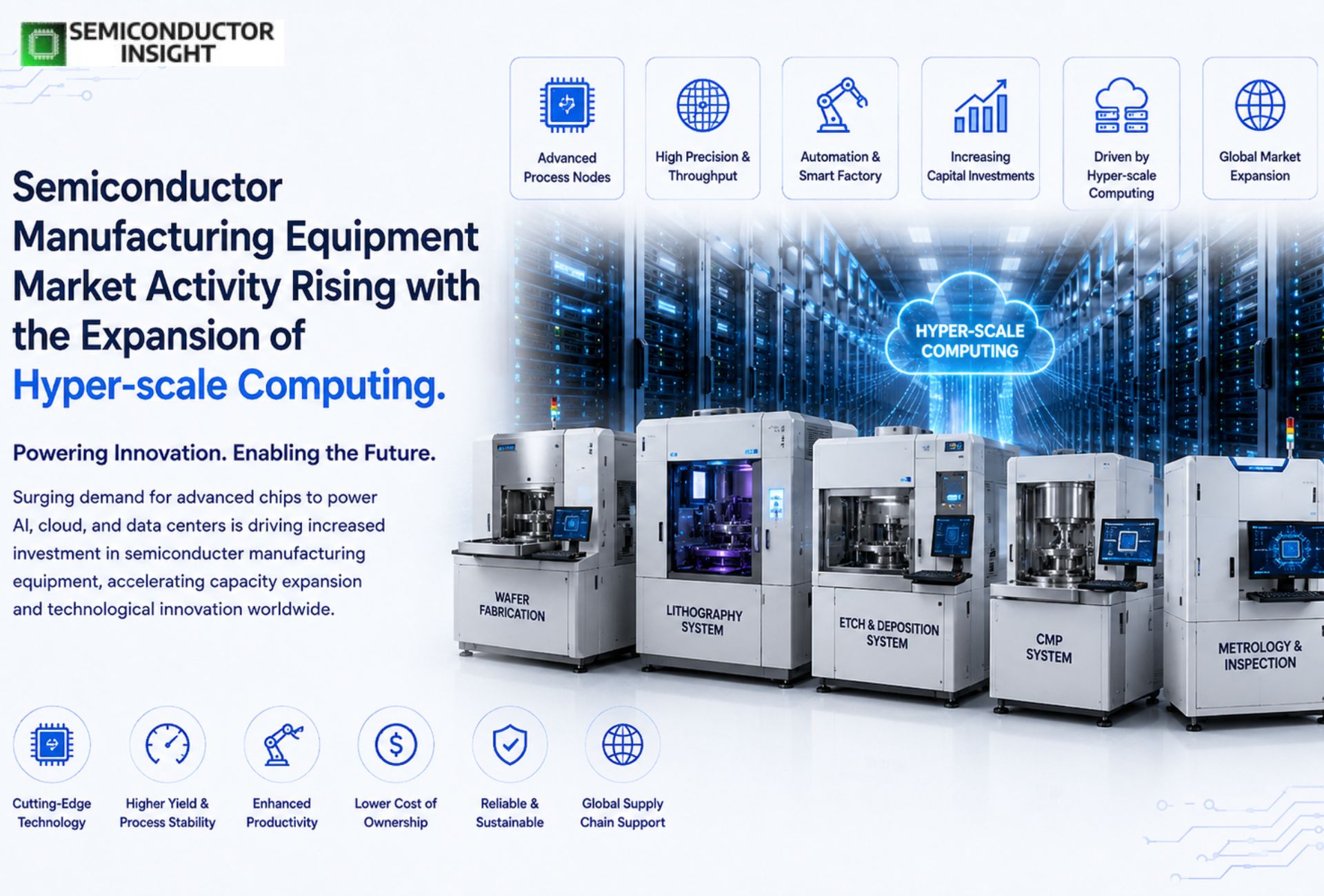
Semiconductor Manufacturing Equipment Market Activity Rising with the Expansion of Hyper-scale Computing
The semiconductor industry has entered one of its most aggressive investment cycles in decades, and manufacturing equipment suppliers are positioned at the Centre of this transformation. From AI accelerators and advanced GPUs to electric vehicle chips and high-performance memory devices, the need for more sophisticated semiconductor fabrication tools is accelerating worldwide.
Fabrication plants are no longer expanding solely to meet smartphone demand. Today’s equipment purchases are increasingly tied to hyperscale AI infrastructure, sovereign semiconductor strategies, and advanced computing requirements. Governments and technology companies are investing billions into new fabrication facilities capable of producing smaller, faster, and more power-efficient chips.
- According to the Semiconductor Industry Association, global semiconductor sales crossed USD 600 billion in recent industry reporting periods, reflecting the scale of investment flowing into the broader semiconductor ecosystem.
- Equipment manufacturers supplying lithography, etching, deposition, and wafer inspection systems are experiencing unprecedented order volumes as fabs prepare for future node transitions.
Stay connected for additional in-depth information right here: https://semiconductorinsight.com/report/semiconductor-manufacturing-equipment-market-2/
Why Advanced Packaging Is Becoming a Strategic Priority?
One of the biggest changes reshaping chip manufacturing is the shift toward advanced packaging technologies. Traditional chip scaling alone is no longer sufficient for handling AI workloads and data-intensive applications.
Manufacturers are increasingly adopting:
- 2.5D and 3D packaging architectures
- Chiplet integration platforms
- High bandwidth memory stacking
- Hybrid bonding technologies
These packaging innovations require entirely new categories of semiconductor manufacturing equipment capable of handling complex interconnect structures and ultra-precise assembly processes.
Companies producing AI processors are now relying heavily on advanced packaging to improve computing performance without dramatically increasing power consumption. This trend has intensified demand for wafer bonding systems, advanced metrology tools, and precision inspection equipment.
Taiwan, South Korea, Japan, and the United States continue expanding packaging-related infrastructure as advanced computing demand rises globally.
The Race toward Smaller Process Nodes Is Intensifying Equipment Demand
The move toward 3nm and emerging sub-2nm semiconductor technologies is making chip manufacturing far more complex than before. At these advanced nodes, production depends on highly specialized fabrication systems that can operate with extreme precision and consistency.
Extreme ultraviolet lithography has become one of the most important technologies in advanced chip production. EUV systems can cost more than USD 150 million each and contain thousands of components that must function within nanometer-level tolerances.
Chipmakers are also upgrading several other critical systems, including plasma etching equipment, atomic layer deposition tools, defect inspection platforms, process control software, and high-purity wafer handling systems. As transistor density continues to rise, even the smallest manufacturing variation can affect chip performance, pushing fabs to invest more heavily in next-generation inspection and process control technologies.
National Semiconductor Policies Are Creating Equipment Expansion Cycles
Governments worldwide are treating semiconductor manufacturing as a strategic national priority. Recent geopolitical disruptions and supply chain vulnerabilities exposed the risks associated with concentrated chip production.
- The European Commission, the United States Department of Commerce, and multiple Asian governments have introduced semiconductor support programs aimed at strengthening domestic manufacturing capabilities.
- The United States CHIPS and Science Act alone introduced more than USD 50 billion in semiconductor-related incentives. Meanwhile, Europe and parts of Asia are expanding local fabrication ecosystems to reduce dependency on overseas supply chains.
These initiatives are directly benefiting semiconductor manufacturing equipment providers as new fabs require complete production infrastructure ranging from cleanroom systems to wafer fabrication tools.
Smart Factories Are Redefining Semiconductor Production Lines
Modern semiconductor fabs increasingly resemble fully automated digital ecosystems rather than traditional manufacturing facilities. AI-driven automation, robotics, and predictive maintenance systems are becoming central to semiconductor production efficiency.
Today’s advanced fabs use:
- Autonomous wafer transport systems
- AI-based defect detection
- Digital twins for equipment simulation
- Predictive maintenance analytics
- Real-time process monitoring platforms
A single advanced fabrication facility can process tens of thousands of wafers every month while generating enormous volumes of operational data. Manufacturers are investing in software-integrated equipment platforms that improve yield optimization and reduce downtime.
This digital transformation is particularly important because advanced semiconductor production requires near-perfect manufacturing precision across every process stage.
AI Servers and Data Centres Are Reshaping Equipment Investments
The explosive growth of AI applications is creating a new semiconductor demand cycle unlike previous consumer electronics booms. Large language models, cloud AI systems, and enterprise data analytics require powerful GPUs, high-capacity memory chips, and advanced networking semiconductors.
Major cloud providers are now investing heavily in AI-focused data Centres containing thousands of accelerator chips. This surge is increasing demand for:
- High bandwidth memory manufacturing tools
- Silicon interposer fabrication systems
- Advanced substrate production equipment
- Thermal management process technologies
In some leading-edge facilities, electricity consumption and cooling infrastructure have become as strategically important as the chips themselves. Semiconductor equipment suppliers are therefore adapting their systems for higher efficiency and sustainable fab operations.
Talent Shortages Are Influencing Fab Expansion Timelines
Despite rapid infrastructure investments, the semiconductor industry continues facing workforce shortages across engineering, materials science, and advanced manufacturing operations.
To fill the growing labour shortages, universities and technical colleges are growing their semiconductor-focused training programs. To improve workforce pipelines, nations like Germany, South Korea, India, and the US are expanding collaborations between academic institutions and semiconductor firms.
The growing sophistication of semiconductor manufacturing equipment also requires highly specialized technicians capable of managing nanoscale fabrication environments.
As fabs become more automated, future workforce requirements are shifting toward AI integration, robotics maintenance, and process analytics expertise.
The Semiconductor Manufacturing Equipment Market Is Becoming a Technology Security Asset
Semiconductor manufacturing equipment has evolved beyond industrial machinery into a strategic technology asset influencing economic competitiveness, AI leadership, and national security.
From advanced lithography systems to AI-powered inspection platforms, the industry now sits at the foundation of nearly every modern technology ecosystem. The growing demand for AI computing, electric mobility, cloud infrastructure, and intelligent devices continues pushing semiconductor manufacturers toward larger and more advanced production capabilities.
As governments and enterprises race to secure chip supply resilience, semiconductor manufacturing equipment providers are expected to remain central to the next phase of global digital infrastructure expansion.

Comments (0)