
The Rise of Innovation in the Industrial Grade Blue Laser Diodes Market for Microfabrication
At the core of industrial-grade blue laser diodes lies gallium nitride (GaN), a material that has transformed optoelectronics. GaN enables strong energy output in the blue spectrum, which allows for superior resolution and tighter focus during processing, in contrast to conventional semiconductor materials.
According to technical publications from the IEEE and compound semiconductor journals, GaN-based devices now account for a dominant share of short-wavelength laser applications due to their thermal stability and efficiency under high-power conditions. This material advantage is what allows blue laser diodes to operate reliably in demanding industrial setups.
The transition toward GaN is not just a material upgrade it represents a shift toward high-performance photonics integration within semiconductor manufacturing.
Wafer Processing and Micro Patterning Applications
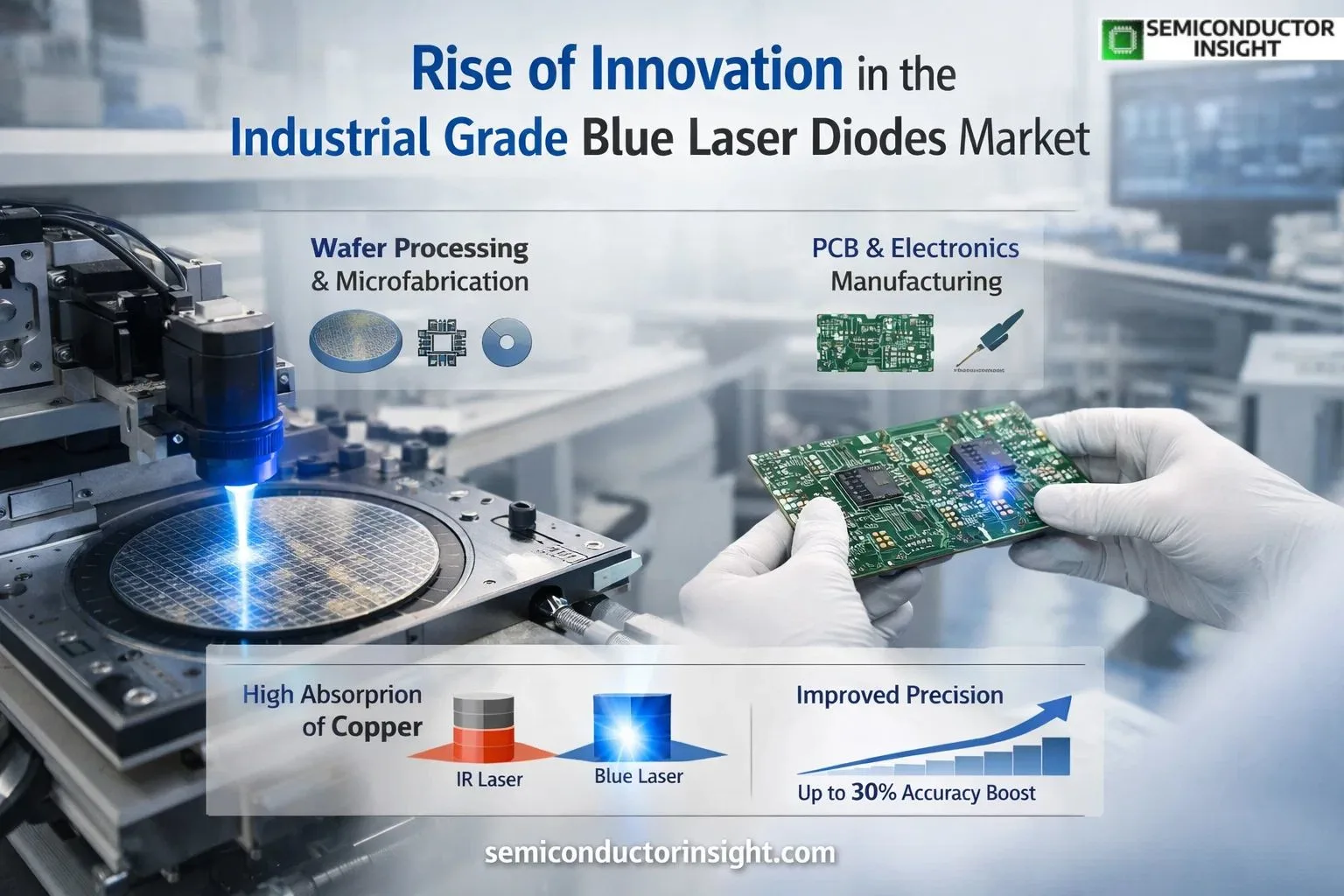
- One of the most impactful uses of blue laser diodes is in wafer processing, where precision is non-negotiable. These lasers are widely used for micro-patterning, drilling, and surface modification, especially in advanced packaging and MEMS fabrication.
- In semiconductor fabrication environments, shorter wavelengths around 450 nm allow for finer feature definition compared to infrared lasers. Industry case studies have shown that blue laser-based systems can improve processing accuracy by up to 30% in microstructuring tasks, particularly in brittle materials like ceramics and glass substrates.
- This capability is becoming increasingly important as chip architectures grow more complex, requiring ultra-fine pattern control at every stage of production.
Powering Growth in Precision Electronics and Board-Level Manufacturing
Beyond wafer fabs, industrial-grade blue laser diodes are gaining traction in printed circuit board manufacturing and electronics assembly. They are used for precision soldering, copper processing, and high-speed marking.
Their absorption efficiency in copper significantly higher than longer wavelength lasers makes them particularly effective for next-generation PCB designs. This is critical as electronics manufacturers shift toward compact, high-density layouts where traditional methods fall short.
Manufacturing reports and engineering case examples highlight that blue laser systems can reduce processing time while improving joint quality, reinforcing their position as a high-accuracy manufacturing tool.
Integration with Automated Production Systems
Modern semiconductor and electronics production lines are increasingly automated, and blue laser diodes are designed to fit seamlessly into these environments. They are now integrated with robotic systems, machine vision, and real-time monitoring platforms.
This integration allows manufacturers to achieve consistent output with minimal manual intervention. For example, automated laser processing units equipped with blue diodes can operate continuously with high repeatability, supporting lights-out manufacturing models.
The shift toward automation is not just about efficiency it is about ensuring process consistency at scale, something critical in semiconductor production.
For an in-depth breakdown aligned with your market goals, request the full report: https://semiconductorinsight.com/report/industrial-grade-blue-laser-diodes-market/
Thermal Management and Reliability in Industrial Use
- Operating in high-power industrial environments requires robust thermal management.
- Blue laser diodes are engineered with advanced cooling mechanisms and packaging techniques to maintain performance stability over long durations.
- Engineering studies indicate that improved heat dissipation designs have extended diode lifespans significantly, reducing maintenance frequency and downtime. This reliability is crucial for industries where even minor disruptions can lead to substantial production losses.
- As a result, manufacturers are prioritizing long-term operational stability alongside performance, making reliability a key competitive factor in this market.
Expanding Footprint in Emerging Semiconductor Technologies
The growing complexity of semiconductor devices ranging from AI chips to advanced sensors is creating new opportunities for blue laser diode applications. These lasers are increasingly being used in areas such as microLED fabrication, optical data storage components, and precision sensor manufacturing.
In microLED production, for instance, blue lasers play a role in mass transfer and repair processes, where accuracy at the micron level is essential. Similarly, their use in sensor fabrication supports the development of compact, high-performance devices used in automotive and industrial systems.
This expanding application base highlights how blue laser diodes are evolving from a niche tool to a multi-functional enabler within the semiconductor ecosystem.
Competitive Engineering and Product Innovation Trends
The competitive landscape is shaped by continuous engineering improvements rather than volume alone. Companies are focusing on increasing output power, improving beam quality, and enhancing energy efficiency.
Recent product releases from photonics manufacturers demonstrate a clear trend toward compact, high strength modules capable of delivering stable performance in industrial conditions. This includes innovations in beam shaping and wavelength stability, which directly impact processing precision.
What defines success in this space is not scale, but the ability to deliver application-specific performance enhancements that align with evolving semiconductor manufacturing needs.
The Industrial Grade Blue Laser Diodes Market is steadily becoming a cornerstone of precision photonics in semiconductor manufacturing. As fabrication technologies push the limits of miniaturization and complexity, these laser systems are proving essential not just as tools, but as foundational elements enabling the next wave of electronics innovation.

Comments (0)