Industrial Grade Blue Laser Diodes Market Insights
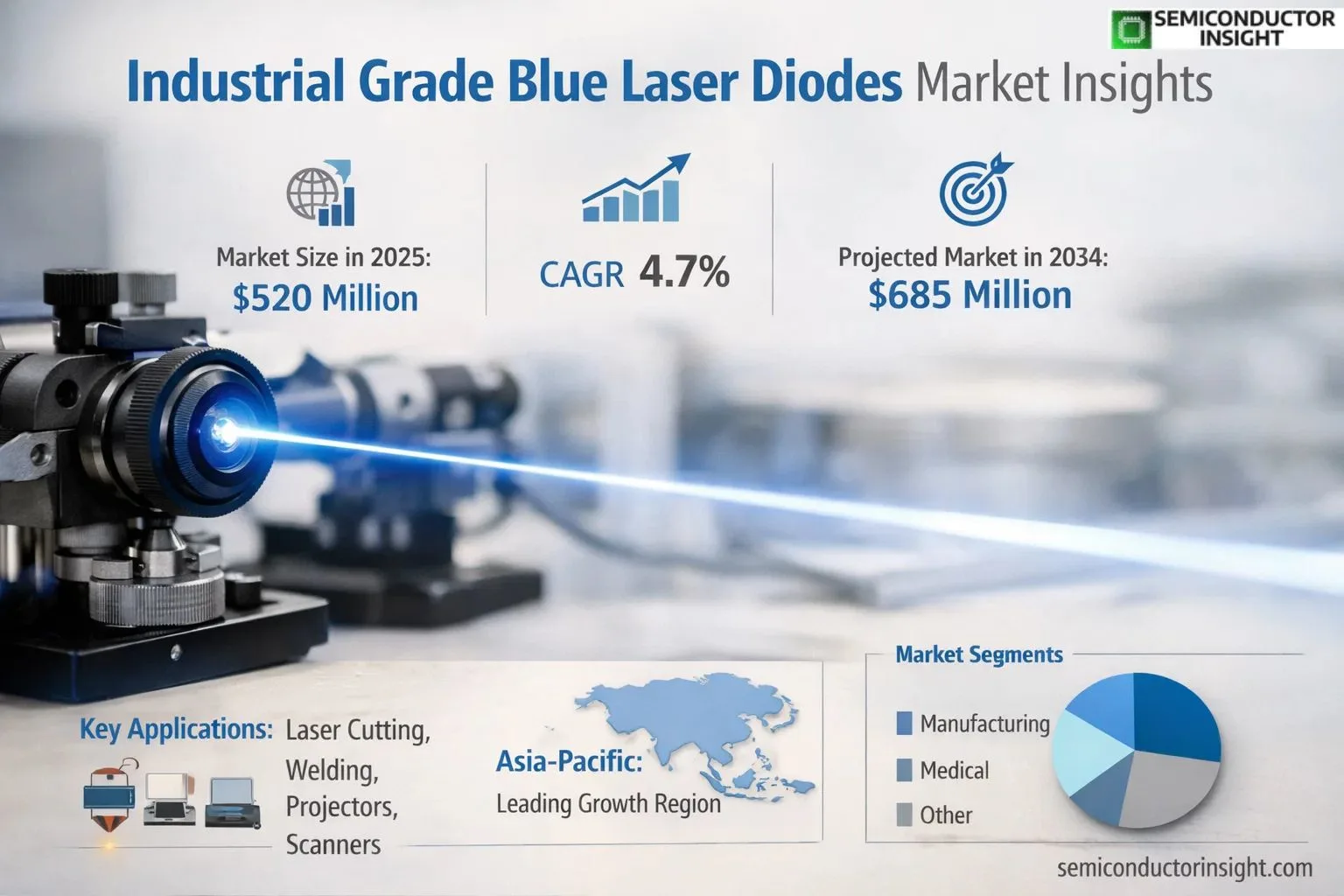
Global industrial grade blue laser diodes market size was valued at USD 520 million in 2025. Market is projected to grow from USD 543 million in 2026 to USD 685 million by 2034, exhibiting a CAGR of 4.7% during the forecast period.
Industrial-grade blue laser diodes are semiconductor-based devices capable of emitting high-intensity blue light, primarily utilizing materials such as gallium nitride (GaN) and indium gallium nitride (InGaN). These components function through electron-hole recombination at the PN junction, converting electrical energy into coherent blue laser light with wavelengths typically between 400-500 nm. Their robust design enables precise beam control, making them indispensable for applications requiring high-energy density and accuracy.
Market growth is driven by increasing adoption in laser cutting, welding, and additive manufacturing due to superior precision over traditional infrared lasers. Furthermore, advancements in projector technologies and demand for compact scanning systems contribute to expansion. Key players like Nichia and Osram Opto Semiconductors dominate the sector through continuous R&D investments. For instance, recent innovations include higher-power multi-mode diodes for industrial tools and single-mode variants for medical devices.
MARKET DRIVERS
Growing Demand in High-Precision Manufacturing
The industrial grade blue laser diodes market is witnessing significant growth due to increasing adoption in high-precision manufacturing processes. These diodes offer superior beam quality with wavelengths between 400-450nm, making them ideal for applications requiring micron-level accuracy. The automotive and aerospace sectors are driving nearly 32% of the current demand for industrial blue laser systems.
Advancements in Material Processing
Recent technological improvements have enhanced the power output and efficiency of industrial grade blue laser diodes, with some models now achieving over 5W continuous wave output. This enables new applications in copper and gold material processing where infrared lasers were previously ineffective. Market for blue laser diodes in electronics manufacturing is projected to grow at 8.4% CAGR through 2028.
➤ Key sectors adopting blue laser technology include medical device manufacturing (23% growth YOY), semiconductor lithography, and advanced welding applications
MARKET CHALLENGES
High Initial Investment Costs
Industrial grade blue laser diode systems require substantial capital expenditure, with complete solutions often exceeding $50,000. This creates barriers for small and medium enterprises looking to adopt the technology. Additionally, the specialized cooling systems needed for high-power operation add to the total cost of ownership.
Other Challenges
Technical Limitations
Current blue laser diodes face limitations in beam stability at higher power outputs above 7W, requiring frequent calibration in industrial environments. The components also show higher sensitivity to thermal fluctuations compared to infrared alternatives.
MARKET RESTRAINTS
Supply Chain Constraints for Gallium Nitride Materials
The industrial grade blue laser diodes market faces production bottlenecks due to limited availability of high-quality gallium nitride (GaN) substrates. Over 78% of global GaN production is concentrated in just three countries, creating potential supply risks. Price volatility for these critical materials has increased by 17% in the past two years.
MARKET OPPORTUNITIES
Emerging Applications in Additive Manufacturing
The industrial grade blue laser diodes market stands to benefit from the rapid growth of metal 3D printing, where blue wavelengths offer advantages in processing reflective materials. Leading manufacturers are developing blue laser powder bed fusion systems that could capture 15-20% of the additive manufacturing equipment market within five years.
Emerging Trends in Industrial Grade Blue Laser Diodes Market
Expanding Applications in Precision Manufacturing
The Industrial Grade Blue Laser Diodes market is witnessing significant growth due to rising adoption in laser cutting and welding applications. These diodes offer superior precision compared to traditional infrared lasers, particularly when processing copper and gold materials. Major manufacturers are developing higher-power blue laser systems to meet industrial demands for improved beam quality and energy efficiency.
Other Trends
GaN-based Semiconductor Advancements
Innovations in gallium nitride (GaN) and indium gallium nitride (InGaN) semiconductor technologies are enhancing the performance and reliability of blue laser diodes. Industry leaders are investing in research to improve thermal management and increase output power while maintaining compact form factors essential for industrial integration.
Regional Market Developments
Asia Pacific leads in Industrial Grade Blue Laser Diodes production, with Japan and China housing key manufacturers like Nichia and Huagong Tech. Meanwhile, North America shows strong demand growth driven by automotive and aerospace applications. European markets are focusing on photonics integration for industrial automation solutions.
Strategic Industry Collaborations
Major players including Sony and Osram Opto Semiconductors are forming technology partnerships to develop next-generation laser solutions. These collaborations aim to bridge the gap between semiconductor innovation and industrial application requirements, particularly for high-power welding and material processing systems.
Miniaturization and System Integration
Market is shifting toward compact laser module designs that integrate cooling systems and power management. This trend supports the growing demand for portable industrial laser solutions in field maintenance and on-site manufacturing applications. System manufacturers are prioritizing energy-efficient designs with reduced thermal output.
COMPETITIVE LANDSCAPE
Key Industry Players
Sony and Nichia Dominate with 40% Combined Market Share
Sony Corporation and Nichia Corporation lead the industrial blue laser diode market with approximately 40% combined revenue share in 2025. Japanese manufacturers maintain technological superiority in GaN-based semiconductor development, with Sony specializing in high-power applications for laser cutting/welding, while Nichia focuses on precision components for medical and measurement systems. Market structure shows tier-1 suppliers securing long-term contracts with industrial OEMs, creating high barriers to entry.
European players like Osram Opto Semiconductors and TOPTICA Photonics Inc. specialize in customized solutions for automotive and aerospace applications. Emerging Chinese manufacturers including Huagong Tech Company Limited are gaining traction through competitive pricing and government-supported R&D initiatives, particularly in the consumer electronics and display sectors. Product differentiation occurs primarily through wavelength stability (445-465nm range) and thermal management capabilities.
List of Key Industrial Grade Blue Laser Diodes Companies Profiled
- Sony Semiconductor Solutions Corporation
- Nichia Corporation
- Sharp Corporation
- Osram Opto Semiconductors
- USHIO Inc.
- TOPTICA Photonics Inc.
- Egismos Technology Corporation
- Ondax Inc.
- Huagong Tech Company Limited
- Hamamatsu Photonics K.K.
- Coherent Corp.
- II-VI Incorporated
- Panasonic Corporation
- Rohm Semiconductor
- Sumitomo Electric Industries Ltd.
Segment Analysis:
| Segment Category | Sub-Segments | Key Insights |
| By Type |
|
Single-mode Blue Laser Diodes dominate due to their superior beam quality and precision:
|
| By Application |
|
Laser Cutting and Welding applications show strongest adoption potential:
|
| By End User |
|
Manufacturing & Industrial segment leads in adoption rates:
|
| By Technology |
|
GaN-based Diodes are the most widely adopted technology:
|
| By Power Output |
|
Medium Power (1-5W) diodes show strongest market demand:
|
Regional Analysis: Industrial Grade Blue Laser Diodes Market
Asia-Pacific
China’s industrial grade blue laser diode market benefits from the “Made in China 2025” initiative, driving adoption in automotive electronics and consumer device manufacturing. Provincial governments offer subsidies for laser equipment upgrades, particularly in Guangdong’s electronics hub and Jiangsu’s industrial zones.
Japanese firms maintain technological superiority in blue laser diode production, with vertically integrated manufacturers controlling key patents. The country’s focus on quality and precision makes its industrial lasers preferred for high-end manufacturing applications worldwide.
South Korea’s industrial grade blue laser demand stems from its advanced semiconductor and display industries. Major conglomerates invest in laser-based automation to maintain competitive edge in memory chip and OLED panel production.
The Asia-Pacific benefits from complete supply chains for industrial grade blue laser systems, with localized component suppliers and skilled labor pools reducing production costs. This ecosystem supports faster adoption cycles compared to other regions.
North America
North America maintains strong industrial grade blue laser diodes demand, particularly in defense, aerospace, and medical device manufacturing sectors. The region hosts several specialized laser system integrators that customize blue diode solutions for high-precision applications. Research institutions collaborate with manufacturers to develop next-generation diode technologies. Automotive manufacturers in the Midwest are adopting blue lasers for battery welding in electric vehicle production. The presence of major technology companies in Silicon Valley drives demand for specialized laser components in electronics manufacturing.
Europe
European industrial grade blue laser diode adoption concentrates in Germany’s automotive sector and Scandinavia’s renewable energy industries. Strict manufacturing quality standards favor high-performance laser systems from established German and Swiss manufacturers. The region shows growing interest in blue laser applications for photovoltaic manufacturing and precision engineering. EU-funded research projects support development of energy-efficient diode technologies. Medical device manufacturers in Ireland and Belgium increasingly incorporate blue lasers in production processes.
South America
South America’s industrial grade blue laser diode market is emerging, primarily serving Brazil’s automotive and Argentina’s agricultural equipment sectors. Limited local manufacturing capability leads to dependence on imported laser systems. Mining operations in Chile show increasing interest in laser-based material processing. Government initiatives to boost industrial automation may accelerate adoption, though economic volatility constrains market growth potential compared to other regions.
Middle East & Africa
The Middle East demonstrates niche demand for industrial grade blue laser diodes in oilfield equipment manufacturing and precision machining. UAE’s growing aerospace sector represents a key market segment. African adoption remains minimal outside South Africa’s automotive component manufacturing. Limited industrial infrastructure and technical expertise constrain broader market development, though some countries show interest in laser applications for mining equipment maintenance.
Report Scope
This market research report provides a comprehensive analysis of the Industrial Grade Blue Laser Diodes Market, covering the forecast period 2026–2034. It offers detailed insights into market dynamics, technological advancements, competitive landscape, and key trends shaping the industry.
Key focus areas of the report include:
- Market Overview: The report begins with an overview outlining its current market scenario, key growth indicators, and industry transformation drivers. It discusses macroeconomic factors, demand-supply balance, regulatory landscape, and the strategic role of semiconductors in powering advancements across industries such as automotive, telecommunications, consumer electronics, and industrial automation.
- Market Size & Forecast: Historical data and future projections for revenue, unit shipments, and market value across major regions and segments.
- Segmentation Analysis: Detailed breakdown by product type, technology, application, and end-user industry to identify high-growth segments and investment opportunities.
- Regional Insights: Insights into market performance across North America, Europe, Asia-Pacific, Latin America, and the Middle East & Africa, including country-level analysis where relevant.
- Competitive Landscape: Profiles of leading market participants, including their product offerings, R&D focus, manufacturing capacity, pricing strategies, and recent developments such as mergers, acquisitions, and partnerships.
- Technology Trends & Innovation: Assessment of emerging technologies, integration of AI/IoT, semiconductor design trends, fabrication techniques, and evolving industry standards.
- Market Drivers & Restraints: Evaluation of factors driving market growth along with challenges, supply chain constraints, regulatory issues, and market-entry barriers.
- Stakeholder Insights: Insights for component suppliers, OEMs, system integrators, investors, and policymakers regarding the evolving ecosystem and strategic opportunities.
Primary and secondary research methods are employed, including interviews with industry experts, data from verified sources, and real-time market intelligence to ensure the accuracy and reliability of the insights presented.
FREQUENTLY ASKED QUESTIONS:
What is the current market size of Industrial Grade Blue Laser Diodes Market?
-> The Industrial Grade Blue Laser Diodes Market was valued at USD 520 million in 2025 and is expected to reach USD 685 million by 2034.
What is the projected growth rate (CAGR) of the Industrial Grade Blue Laser Diodes Market?
-> Market is projected to grow at a CAGR of 4.7% during the forecast period 2026-2034.
Which key companies operate in Industrial Grade Blue Laser Diodes Market?
-> Key players include Sony, Nichia, Sharp, Osram Opto Semiconductors, USHIO, TOPTICA Photonics Inc., Egismos Technology Corporation, Ondax, Huagong Tech Company Limited, among others.
What are the major application segments for Industrial Grade Blue Laser Diodes?
-> Major applications include Laser Cutting and Welding, Laser Projector, Scanner, and Other industrial uses.
Which region dominates the Industrial Grade Blue Laser Diodes market?
-> In 2025, the U.S. market size was estimated at $ million, while China is projected to reach $ million in the forecast period.
Asia-Pacific remains a key growth region with increasing industrial applications.

Get Sample Report PDF for Exclusive Insights
Report Sample Includes
- Table of Contents
- List of Tables & Figures
- Charts, Research Methodology, and more...