
RISC – V CPU IP Market Powered by License – Free Innovation Ecosystems
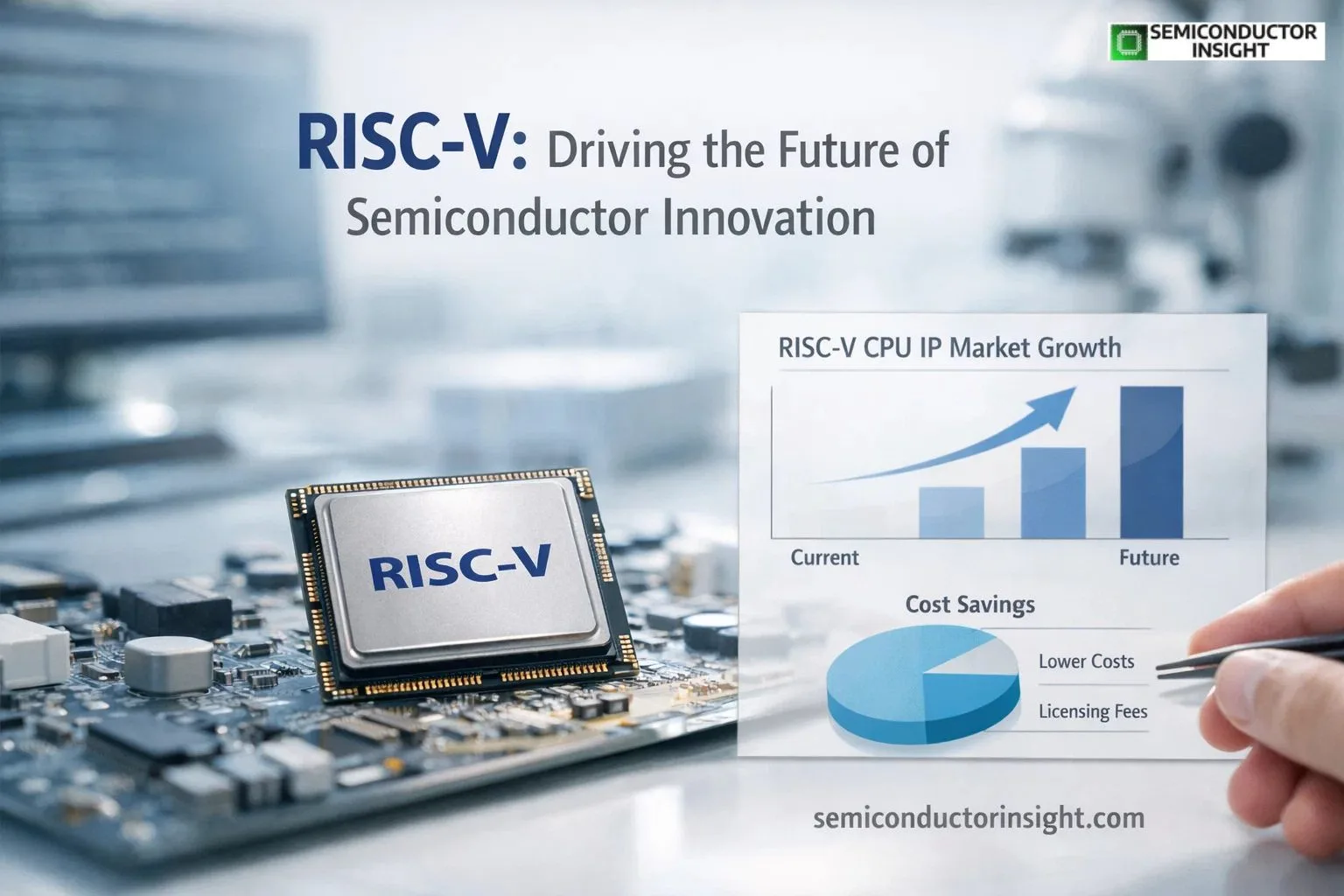
Due to its open – standard instruction set architecture (ISA), RISC – V CPU IP market is becoming a revolutionary force in semiconductor design. In contrast to proprietary architectures, RISC – V removes vendor lock – in and license fees, allowing businesses to create customised processors at far reduced costs. This single factor has become the strongest catalyst for market expansion, particularly in an era where chip sovereignty and cost efficiency are critical.
What makes this growth structurally different is that RISC – V is not just another CPU architecture it represents a shift toward democratized silicon development. Companies no longer need to depend on traditional IP vendors, allowing faster innovation cycles and product differentiation.
Milestone timeline
- In 2010, Krste Asanović, Waterman, and Lee made RISC – V at UC Berkeley.
- 2015: The RISC-V Foundation was set up, and the first workshop had 40 companies.
- In 2016, NVIDIA says it will switch Falcon GPU controllers to RISC-V.
- 2019: SiFive releases the first high-performance RISC-V core that can be used out of order (U8). The foundation transfers to Switzerland. Number of members: 236
- 10 billion chips with RISC-V cores delivered in 2022; the global IP market reached $7.9 billion, an 8.4% increase.
- 2023: More than 13 billion RISC-V cores will be available on the market (RISC-V Summit). RISC – V IP revenue is $156 million. The EU has promised €270 million to the RISC – V HPC program.
- In 2024, NVIDIA sends out 1 billion RISC-V cores in one year. RVA23 profile approved. RISC – V IP revenue CAGR is 39.5%
- 25% market penetration confirmed by 2025. There are more than 4,600 members. Infineon becomes a Premier member. The status of ISO/IEC PAS Submitter has been given. Alibaba DAMO releases the Xuantie C930 server core
- In January 2026, the SiFive P870-V vector-cryptography core on TSMC N3E was released. Ventana gets $300 million in a Series C round in December 2025. The global semi market is getting close to $1 trillion.
For a more thorough report, please contact us using our most recent report: https://semiconductorinsight.com/report/risc-v-cpu-ip-market/
Architecture Flexibility as a Design – Level Advantage
At the core of RISC – V’s adoption is its modular architecture. Designers can choose only the required instruction sets and extend them for specific workloads such as AI acceleration, automotive safety systems, or IoT edge devices.
This flexibility is particularly valuable in modern semiconductor applications where workload specialization is critical. For instance, edge AI processors increasingly require domain – specific instruction sets, and RISC – V enables this customization without redesigning entire chip architectures.
Semiconductor companies account for nearly 50% of total RISC – V IP demand, highlighting how deeply integrated the architecture has become in commercial chip design pipelines.
The result is a shift from general – purpose CPUs toward application – specific silicon, where performance – per – watt and workload optimization are more important than raw computing power.
Real – World Acceleration through Industry Adoption
- Recent developments highlight how quickly RISC – V is moving into mainstream semiconductor ecosystems. One of the most notable industry shifts is the integration of RISC – V into AI and high – performance computing platforms.
- NVIDIA’s move to enable RISC – V support within its CUDA ecosystem represents a major validation of the architecture’s capability in advanced computing environments. This allows RISC – V CPUs to act as control processors in AI systems, traditionally dominated by x86 and ARM
- Similarly, GlobalFoundries acquisition of MIPS and its integration of RISC – V IP into manufacturing workflows demonstrates vertical integration between chip design and fabrication. This approach reduces time – to – market while aligning IP development with production capabilities.
- Startups are also accelerating innovation. Rivos, for example, has raised significant funding to develop RISC – V – based AI server chips, targeting hyperscale data centers and competing with established GPU – driven architectures.
- These instances indicate that RISC – V is no longer limited to microcontrollers it is entering data centers, AI infrastructure, and high – performance computing domains.
Silicon Penetration and Ecosystem Expansion
RISC – V’s adoption is scaling at a pace that exceeds earlier expectations. The architecture is projected to achieve around 25% market penetration in certain semiconductor segments, particularly in microcontrollers and embedded systems.
Additionally, global shipments are expected to surpass 21 billion RISC – V – based chips by 2031, reflecting widespread integration across consumer electronics, automotive systems, and industrial devices.
This rapid expansion is supported by a growing ecosystem of open – source tools, development platforms, and academic contributions. Universities and research institutions are actively contributing to RISC – V core development, enabling faster prototyping and innovation at lower costs.
The ecosystem – driven model is fundamentally different from traditional semiconductor development, where innovation is typically controlled by a few dominant players.
Shift toward Domain – Specific and Edge Computing Architectures
One of the most defining trends in the RISC – V CPU IP market is its alignment with edge computing and domain – specific architectures. Traditional CPU models are increasingly being replaced by specialized processors designed for specific tasks such as machine learning inference, real – time analytics, and sensor data processing.
RISC – V’s extensibility allows companies to embed custom accelerators directly into CPU designs, reducing latency and improving efficiency. This is particularly relevant in automotive systems, where real – time processing and safety compliance are critical.
The architecture is also gaining traction in industrial IoT, where low power consumption and scalability are essential. Its ability to operate efficiently in resource – constrained environments makes it a preferred choice for next – generation embedded systems.

Comments (0)