
Market Insights
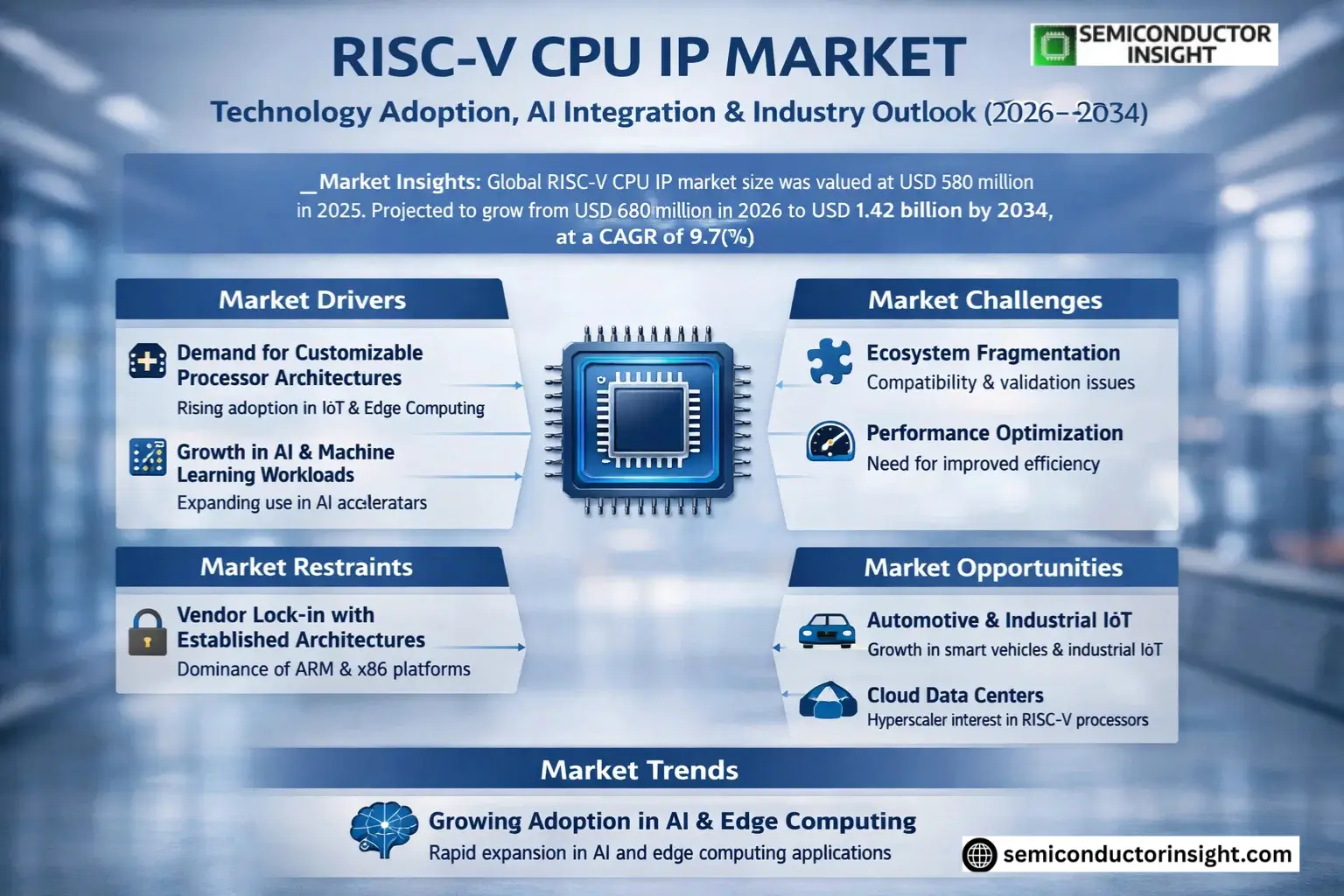
Global RISC-V CPU IP Market size was valued at USD 580 million in 2025. The market is projected to grow from USD 680 million in 2026 to USD 1.42 billion by 2034, exhibiting a CAGR of 9.7% during the forecast period.
RISC-V CPU IP refers to processor designs based on the open-source RISC-V instruction set architecture (ISA), enabling customization for applications ranging from embedded systems to high-performance computing. Unlike proprietary architectures, RISC-V offers flexibility and scalability, driving adoption across industries such as consumer electronics, automotive, and AI accelerators.
The market growth is fueled by increasing demand for energy-efficient processors, rising investments in edge computing, and the shift toward open-standard architectures. Key players like SiFive, Andes Technology, and Codasip are expanding their portfolios with optimized cores for AI/ML workloads and IoT devices. For instance, in Q1 2024, SiFive launched its X280 processor IP for data center acceleration, targeting hyperscalers seeking alternatives to traditional x86 solutions.
MARKET DRIVERS
Growing Demand for Customizable Processor Architectures
RISC-V CPU IP Market is experiencing rapid growth due to increasing demand for customizable and open-source processor architectures. Companies are adopting RISC-V to avoid licensing fees and gain design flexibility, particularly in IoT and edge computing applications. The architecture’s modularity allows for tailored solutions, driving adoption across diverse industries.
Expansion in AI and Machine Learning Workloads
RISC-V CPU IP is gaining traction in AI accelerators and ML processors due to its efficient instruction set and extensibility. Custom extensions for vector processing and neural network operations are making RISC-V a competitive alternative in these high-growth segments. The market is projected to grow at over 30% CAGR through 2027 as AI adoption increases.
Government initiatives worldwide supporting open-source hardware development are further accelerating RISC-V adoption, particularly in China and Europe where technological sovereignty is a strategic priority.
MARKET CHALLENGES
Ecosystem Fragmentation Concerns
While the open nature of RISC-V CPU IP enables innovation, it also leads to ecosystem fragmentation with multiple competing implementations. This creates compatibility challenges for developers and increases validation costs for commercial adoption. The lack of a single dominant ecosystem comparable to ARM’s poses hurdles for mainstream acceptance.
Other Challenges
Performance Optimization Needs
Commercial RISC-V CPU IP cores still face challenges in matching the performance-per-watt efficiency of established architectures in high-performance applications, requiring continued R&D investment.
Security Standards Development
The emerging nature of RISC-V means security certification processes and trusted execution environments are still evolving, impacting adoption in safety-critical applications.
MARKET RESTRAINTS
Vendor Lock-in with Established Architectures
RISC-V CPU IP Market faces competition from entrenched architectures with mature ecosystems. Many system-on-chip designers remain hesitant to switch from ARM and x86 due to existing software investments and proven performance characteristics. Hardware validation costs and retraining requirements create significant switching barriers.
MARKET OPPORTUNITIES
Emerging Applications in Automotive and Industrial IoT
The automotive sector presents significant growth potential for RISC-V CPU IP as vehicle architectures shift toward domain controllers and zonal architectures. RISC-V’s configurability makes it ideal for specialized automotive processing needs, with several major Tier 1 suppliers already evaluating implementations. The industrial IoT market similarly offers opportunities through needs for low-power, customizable edge processors.
Cloud Service Provider Adoption
Major cloud providers are increasingly exploring RISC-V CPU IP for custom server processors and accelerators, seeking alternatives to proprietary architectures. This could drive significant volume adoption if hyperscalers commit to large-scale deployments.
RISC-V CPU IP Market Trends
Growing Adoption in AI and Edge Computing
RISC-V CPU IP Market is experiencing significant growth due to increasing demand for customizable processors in AI and edge computing applications. The open-source nature of RISC-V architecture allows for specialized optimizations that traditional proprietary architectures cannot match. Major tech companies are leveraging this flexibility to develop innovative solutions for machine learning workloads.
Other Trends
Expansion in Automotive Sector
Automotive manufacturers are adopting RISC-V CPU IP cores for advanced driver-assistance systems (ADAS) and in-vehicle infotainment. The architecture’s scalability makes it suitable for both low-power sensor processing and high-performance compute tasks in next-generation vehicles.
Diversification of Product Offerings
Leading RISC-V CPU IP providers are expanding their portfolios to include optimized solutions for specific verticals. Andes Technology and SiFive have introduced specialized variants targeting IoT, data centers, and industrial automation. This trend is creating new opportunities in previously untapped application segments.
Region-Specific Developments
China has emerged as a key growth market for RISC-V CPU IP, with domestic companies developing alternatives to restricted foreign technologies. Meanwhile, North America continues to lead in innovation, particularly in AI accelerator designs combining RISC-V cores with proprietary extensions.
Collaboration Between Ecosystem Players
RISC-V CPU IP Market ecosystem is seeing increased collaboration between IP vendors, foundries, and software providers. Standardization efforts around vector extensions and security features are accelerating adoption across industries. Major EDA tool providers have incorporated native RISC-V support in their design flows.
COMPETITIVE LANDSCAPE
Key Industry Players
RISC-V CPU IP Market Dominated by Open-Source Ecosystem Champions
RISC-V CPU IP Market is witnessing intense competition with SiFive and Andes Technology Corporation emerging as clear leaders due to their comprehensive IP portfolios and early adoption strategies. These companies collectively hold a significant revenue share in the 32-bit and 64-bit IP segments. The market structure remains fragmented with numerous specialized players offering customized solutions for machine learning, automotive, and IoT applications.
Niche players like Codasip and Nuclei System Technology are gaining traction through application-specific RISC-V cores, particularly in China’s rapidly growing semiconductor ecosystem. Ventana Micro Systems has differentiated itself with high-performance server-grade designs, while Lattice Semiconductor focuses on low-power FPGA implementations. The open-source nature of RISC-V continues to attract new entrants, intensifying price competition.
List of Key RISC-V CPU IP Companies Profiled
- Andes Technology Corporation
- SiFive
- Codasip
- Lattice Semiconductor
- Ventana Micro Systems
- Renesas Electronics
- Imagination Technologies
- Nuclei System Technology
- Beijing ESWIN Computing Technology
- StarFive Technology
- Shenzhen Pengxin Technology
- Microchip Technology
- Esperanto Technologies
- Western Digital
- GreenWaves Technologies
Segment Analysis:
| Segment Category | Sub-Segments | Key Insights |
| By Type |
|
64-bit IP dominates due to:
|
| By Application |
|
Data Center & Network Communications shows strongest growth potential:
|
| By End User |
|
Semiconductor Companies lead adoption:
|
| By Customization Level |
|
Configurable Cores show highest demand:
|
| By Development Stage |
|
Mass Production segment expanding rapidly:
|
Regional Analysis: RISC-V CPU IP Market
Chinese semiconductor firms are aggressively adopting RISC-V CPU IP to reduce reliance on Western architectures. Government-backed research institutes are developing complete RISC-V ecosystems, from cores to development tools.
India’s fabless semiconductor companies are leveraging RISC-V for customized AI chips, supported by academic programs at IITs. Bangalore’s startup ecosystem is producing innovative RISC-V implementations for edge computing.
Japanese automakers are integrating RISC-V IP in ADAS and in-vehicle systems. The architecture’s modularity allows customization for safety-critical automotive applications while avoiding licensing constraints.
Taiwan’s foundries offer optimized RISC-V manufacturing processes, attracting global designers. The island’s IP vendors provide complementary chiplet designs for heterogeneous RISC-V-based systems.
North America
North America’s RISC-V CPU IP Market benefits from strong academic research and startup ecosystems. Silicon Valley remains the global center for RISC-V innovation, with multiple foundation members headquartered in the region. The U.S. defense sector is funding secure RISC-V implementations for aerospace applications. Canada’s AI research community is adopting RISC-V for neuromorphic computing architectures. While adoption in enterprise computing remains limited, hyperscalers are evaluating RISC-V for next-gen data center accelerators.
Europe
Europe shows measured adoption of RISC-V CPU IP, with strongest traction in industrial automation and automotive sectors. The EU’s processor initiative supports RISC-V development for sovereign chip designs. Germany’s automotive suppliers are testing RISC-V in ECU designs, while French research centers explore its use in HPC. The region’s strict IP protection environment creates both opportunities and challenges for open-source architectures.
South America
South America’s RISC-V market is in early stages, with Brazil leading research efforts through academic initiatives. The region’s focus on IoT and agricultural tech presents opportunities for energy-efficient RISC-V implementations. Limited semiconductor infrastructure slows commercial adoption, but government-funded tech hubs are establishing RISC-V design capabilities.
Middle East & Africa
The MEA region shows nascent interest in RISC-V, primarily driven by smart city projects in Gulf states. Israel’s security tech sector explores RISC-V for surveillance processors. South Africa’s universities participate in global RISC-V research collaborations, while North African countries consider it for telecom infrastructure modernization.
Report Scope
This market research report provides a comprehensive analysis of the RISC-V CPU IP Market , covering the forecast period 2025–2034. It offers detailed insights into market dynamics, technological advancements, competitive landscape, and key trends shaping the industry.
Key focus areas of the report include:
- Market Overview: The report begins with an overview outlining its current market scenario, key growth indicators, and industry transformation drivers. It discusses macroeconomic factors, demand–supply balance, regulatory landscape, and the strategic role of semiconductors in powering advancements across industries such as automotive, telecommunications, consumer electronics, and industrial automation.
- Market Size & Forecast: Historical data and future projections for revenue, unit shipments, and market value across major regions and segments.
- Segmentation Analysis: Detailed breakdown by product type, technology, application, and end-user industry to identify high-growth segments and investment opportunities.
- Regional Insights: Insights into market performance across North America, Europe, Asia-Pacific, Latin America, and the Middle East & Africa, including country-level analysis where relevant.
- Competitive Landscape: Profiles of leading market participants, including their product offerings, R&D focus, manufacturing capacity, pricing strategies, and recent developments such as mergers, acquisitions, and partnerships.
- Technology Trends & Innovation: Assessment of emerging technologies, integration of AI/IoT, semiconductor design trends, fabrication techniques, and evolving industry standards.
- Market Drivers & Restraints: Evaluation of factors driving market growth along with challenges, supply chain constraints, regulatory issues, and market-entry barriers.
- Stakeholder Insights: Insights for component suppliers, OEMs, system integrators, investors, and policymakers regarding the evolving ecosystem and strategic opportunities.
Primary and secondary research methods are employed, including interviews with industry experts, data from verified sources, and real-time market intelligence to ensure the accuracy and reliability of the insights presented.
FREQUENTLY ASKED QUESTIONS:
What is the current market size of RISC-V CPU IP Market?
-> RISC-V CPU IP Market size was valued at USD 580 million in 2025. The market is projected to grow from USD 680 million in 2026 to USD 1.42 billion by 2034, exhibiting a CAGR of 9.7% during the forecast period.
Which key companies operate in RISC-V CPU IP Market?
-> Key players include Lattice, Ventana, Renesas, Andes Technology Corporation, Codasip, SiFive, Imagination Tech, Nuclei System Technology, Beijing ESWIN Computing Technology, and StarFive, among others.
What are the key growth drivers?
-> Key growth drivers include increasing demand for customizable processor designs, adoption in consumer electronics and data centers, and open-source architecture advantages.
Which region dominates the market?
-> Asia is a key market with China reaching USD million by 2034, while North America (U.S. estimated at USD million in 2025) remains a significant player.
What are the emerging trends?
-> Emerging trends include 32-bit IP segment growth (projected at USD million by 2034) and adoption in machine learning & AI applications.
Get Sample Report PDF for Exclusive Insights
Report Sample Includes
- Table of Contents
- List of Tables & Figures
- Charts, Research Methodology, and more...
 Download Sample Report PDF