CPU for Server Market, Trends, Business Strategies 2025-2032

CPU for Server Market was valued at 21450 million in 2024 and is projected to reach US$ 33260 million by 2032, at a CAGR of 6.2% during the forecast period

PDF Icon Download Sample Report PDF
  • Quick Dispatch

    All Orders

  • Secure Payment

    100% Secure Payment

Price range: $1,500.00 through $4,250.00

Clear

MARKET INSIGHTS

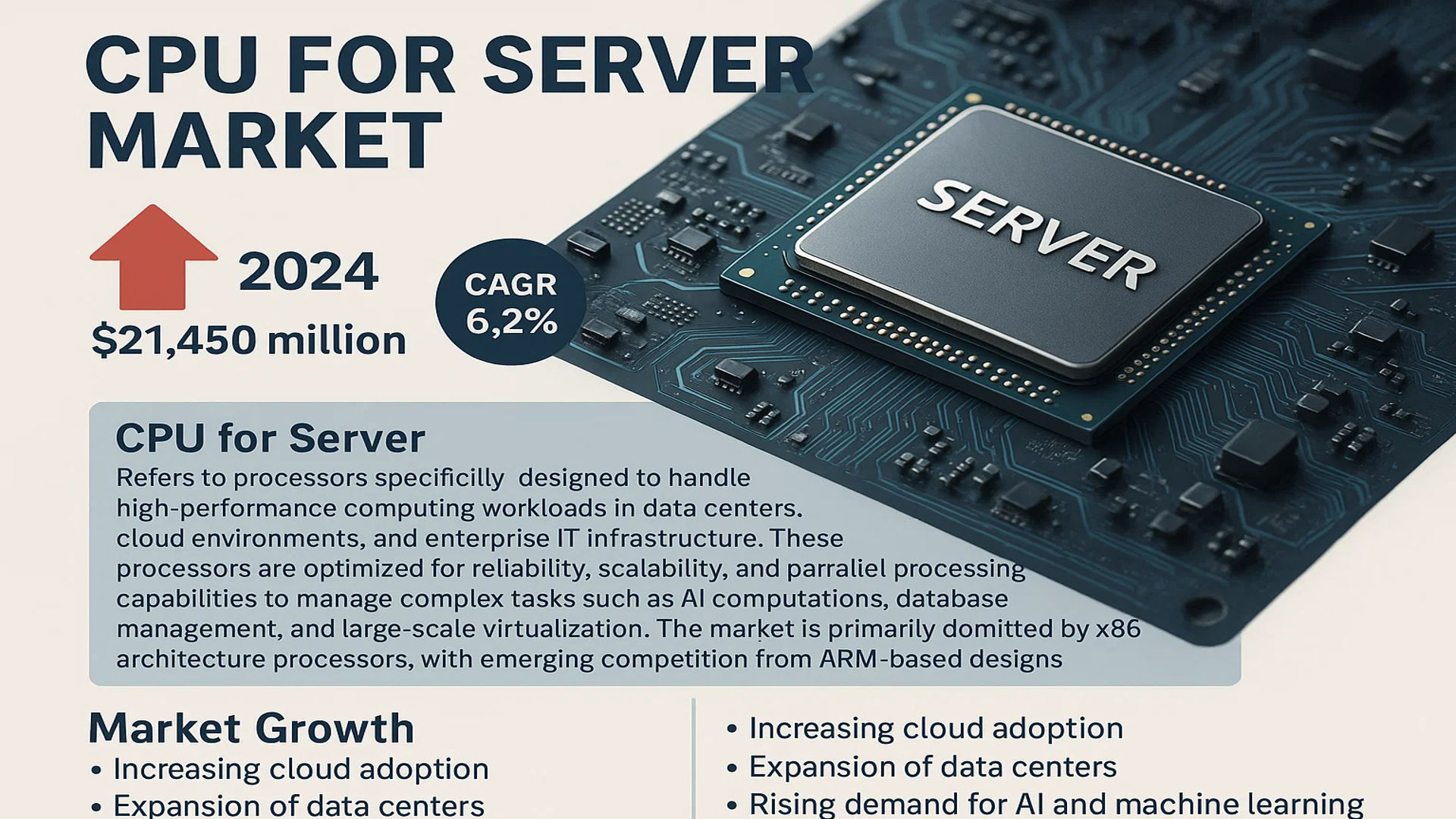
The global CPU for Server Market was valued at 21450 million in 2024 and is projected to reach US$ 33260 million by 2032, at a CAGR of 6.2% during the forecast period.

CPU for Server refers to processors specifically designed to handle high-performance computing workloads in data centers, cloud environments, and enterprise IT infrastructure. These processors are optimized for reliability, scalability, and parallel processing capabilities to manage complex tasks such as AI computations, database management, and large-scale virtualization. The market is primarily dominated by x86 architecture processors, with emerging competition from ARM-based designs.

The market growth is driven by increasing cloud adoption, expansion of data centers, and rising demand for AI and machine learning applications. While Intel maintains market leadership with over 70% share through its Xeon processors, AMD’s EPYC series has gained significant traction with its competitive pricing and performance. Furthermore, the growing adoption of edge computing and 5G networks is creating new opportunities for specialized server processors, particularly in the Asia-Pacific region where digital transformation initiatives are accelerating.
CPU for Server Market

MARKET DYNAMICS

MARKET DRIVERS

Booming Cloud Computing and Data Center Expansion Fuel Server CPU Demand

The global server CPU market is experiencing robust growth driven by unprecedented expansion in cloud computing and data center infrastructure. Cloud service providers are investing billions annually to scale their operations worldwide, with hyperscale data center capacity projected to grow at nearly 20% CAGR through 2030. These facilities require high-performance server processors capable of handling massive parallel workloads efficiently. The shift to hybrid cloud environments and multi-cloud strategies across enterprises further accelerates adoption of advanced server CPUs, particularly those optimized for virtualization and containerized workloads.

AI and Machine Learning Workloads Drive Specialized Processor Adoption

Artificial intelligence adoption across industries is transforming server CPU requirements, with the AI server market expected to triple in value by 2026. Modern AI workloads demand processors with enhanced matrix operation capabilities, larger cache sizes, and superior memory bandwidth. This has led to innovative architectural developments, such as AMD’s incorporation of AI accelerators in their EPYC processors and Intel’s Advanced Matrix Extensions in Xeon Scalable CPUs. The machine learning inference market alone accounts for over 35% of new server processor deployments, illustrating how AI specialization is reshaping the competitive landscape.

5G and Edge Computing Create New Infrastructure Requirements

The global rollout of 5G networks and edge computing infrastructure is generating demand for power-efficient server processors optimized for distributed environments. Edge data centers require CPUs that balance performance with thermal design power (TDP) constraints, favoring ARM-based designs and specialized SoCs. With mobile edge computing investment projected to exceed $15 billion annually by 2025, processor manufacturers are developing new product lines specifically for these low-latency, high-efficiency applications. This represents a significant growth vector beyond traditional data center deployments.

MARKET RESTRAINTS

Supply Chain Disruptions and Semiconductor Shortages Constrain Market Growth

The server CPU market continues to face challenges from global semiconductor supply chain constraints, with lead times for advanced nodes remaining above 30 weeks. Foundry capacity for cutting-edge process technologies is particularly strained, affecting the production of high-end server processors. These bottlenecks have led to allocation systems and prioritization of strategic customers, making it difficult for smaller data center operators to secure inventory. Component shortages affecting complementary technologies like power management ICs further compound production challenges across the server ecosystem.

Rising Power Consumption and Thermal Challenges Limit Performance Scaling

As server CPUs push performance boundaries, power consumption has emerged as a critical constraint, with flagship server processors now exceeding 400W TDP. Data center operators face increasing pressure to balance performance gains with energy efficiency and sustainability goals. The cost of power and cooling now represents over 40% of total data center operating expenses in many regions, forcing careful evaluation of processor choices. This thermal wall is driving architectural innovations but simultaneously slowing raw performance improvements compared to historical Moore’s Law trends.

MARKET CHALLENGES

Heterogeneous Computing Architectures Increase Software Complexity

The rise of specialized server processors for AI, HPC, and edge computing has created significant software compatibility and optimization challenges. Developers now face the burden of optimizing applications for diverse instruction sets and accelerator architectures, from x86 to ARM and custom accelerators. This software fragmentation can reduce the effective performance of cutting-edge processors and increase total cost of ownership through additional development overhead. Industry standardization efforts remain fragmented, with competing ecosystems vying for developer mindshare.

Geopolitical Tensions Impact Global Supply and Technology Access

Trade restrictions and export controls in the semiconductor sector are creating uncertainty for server CPU manufacturers and buyers alike. Restrictions on advanced chip technologies to certain markets have forced regionalization of supply chains, potentially leading to bifurcated product roadmaps. These geopolitical factors introduce additional complexity in long-term infrastructure planning for global enterprises and cloud providers who require consistent worldwide deployment capabilities.

MARKET OPPORTUNITIES

Emerging RISC-V Architecture Presents Disruptive Potential

The open-standard RISC-V instruction set architecture is gaining traction in specialized server applications, offering customization opportunities that proprietary architectures cannot match. Early adopters are leveraging RISC-V for specific workloads like AI inference and security processing, with performance-per-watt advantages in targeted scenarios. The ecosystem is rapidly maturing, with RISC-V server processors expected to capture meaningful market share in edge and hyperscale environments within the next 3-5 years.

Chiplet-Based Designs Enable Flexible Performance Scaling

Advanced packaging technologies and chiplet architectures are revolutionizing server CPU design, allowing manufacturers to mix and match compute, I/O, and accelerator modules. This modular approach enables more responsive product development cycles and targeted performance enhancements. Industry adoption of universal chiplet interconnect standards will further accelerate this trend, potentially reducing development costs by 30-40% while enabling rapid customization for specific workload requirements.

CPU FOR SERVER MARKET TRENDS

Shift Toward Heterogeneous Computing Architectures

The server CPU market is witnessing a transformative shift toward heterogeneous computing architectures, driven by the growing demand for specialized workloads like AI training, cloud computing, and high-performance analytics. Intel and AMD are leading this transition with their hybrid core designs, integrating performance and efficiency cores to optimize power consumption while maintaining computational throughput. The rise of AI-accelerated workloads has further propelled the adoption of server processors with enhanced matrix multiplication capabilities, a trend that accounted for nearly 30% of data center processor upgrades in 2024. Additionally, innovations in advanced node technologies, such as Intel’s Intel 4 process and AMD’s 5nm Zen 4 architecture, are enabling higher transistor density and superior energy efficiency.

Other Trends

Edge Computing Driving Demand for Low-Power CPUs

Edge computing has emerged as a critical growth driver for server CPUs, particularly those designed for low-power yet high-performance applications. Enterprises are increasingly deploying ARM-based server processors from vendors like Ampere Computing and Qualcomm, which offer superior thermal efficiency for decentralized computing environments. Providers delivering cloud-to-edge infrastructure report a 45% increase in demand for power-efficient server processors since 2023, primarily for IoT, industrial automation, and real-time analytics. Furthermore, the global 5G rollout is accelerating edge computing adoption, necessitating server CPUs capable of handling ultra-low-latency workloads at distributed locations.

Accelerated Cloud Adoption Bolsters Server CPU Innovation

The rapid expansion of hyperscale data centers, particularly by cloud service providers like AWS, Microsoft Azure, and Google Cloud, is a major contributor to server CPU market growth. These providers accounted for over 60% of new server processor deployments in 2024, prioritizing scalable and multi-tenant architectures. Leading vendors such as AMD and Intel have responded with EPYC and Xeon processors optimized for virtualization-heavy workloads, with some models supporting up to 128 cores per socket. Meanwhile, cloud-native applications are pushing demand for scalable, multi-threaded processors, with a notable 20% year-over-year increase in high-core-count CPU adoption.

COMPETITIVE LANDSCAPE

Key Industry Players

Innovation and Market Expansion Drive Fierce Competition in Server CPU Sector

The global server CPU market remains highly competitive, dominated by established players while facing disruption from emerging innovators. Intel Corporation continues to lead the market with over 70% share in 2024, leveraging its powerful Xeon processor family that has become the backbone of enterprise data centers worldwide. The company’s deep integration with cloud providers and long-standing ecosystem partnerships reinforce its market dominance.

Advanced Micro Devices (AMD) has emerged as the primary challenger, growing its market share significantly through its EPYC processor lineup. AMD’s focus on high core counts and energy efficiency has resonated particularly well with hyperscale data center operators. The company’s recent innovations in 3D V-Cache technology and chiplet design architecture demonstrate its commitment to pushing performance boundaries in the server CPU space.

Meanwhile, ARM-based competitors are gaining traction, with companies like Ampere Computing and Huawei’s HiSilicon carving out niche positions in cloud-native and edge computing applications. While ARM server CPUs currently represent a smaller portion of the market, their energy efficiency advantages and growing software compatibility are driving increased adoption among certain enterprise segments.

Chinese manufacturers including Phytium Technology and Hygon Information Technology are expanding their domestic market presence through government-supported initiatives, though they remain minor players in the global arena. These companies are focusing on developing localized alternatives to reduce dependence on Western technology, particularly in sensitive sectors.

List of Key Server CPU Companies Profiled

Segment Analysis:

By Type

x86 CPU Segment Dominates the Market Due to Widespread Adoption in Data Centers and Cloud Computing

The market is segmented based on type into:

  • x86 CPU
    • Subtypes: Intel Xeon, AMD EPYC, and others
  • Arm-based CPU
    • Subtypes: Huawei Kunpeng, Ampere Computing, AWS Graviton, and others

By Application

AI Server Segment Grows Rapidly Due to Increasing Demand for Machine Learning and Deep Learning Workloads

The market is segmented based on application into:

  • AI Server
  • General Purpose Server

By Architecture

Multi-Core Processors Gain Traction for High-Performance Computing Applications

The market is segmented based on architecture into:

  • Single-Core
  • Multi-Core
    • Subtypes: Dual-Core, Quad-Core, Hexa-Core, Octa-Core, and others

By End User

Cloud Service Providers Lead Adoption Due to Expansion of Hyperscale Data Centers

The market is segmented based on end user into:

  • Cloud Service Providers
  • Enterprises
  • Government Organizations
  • Academic & Research Institutions

Regional Analysis: CPU for Server Market

North America
The North American server CPU market remains the most technologically advanced and mature, with the U.S. accounting for over 85% of regional demand due to strong data center expansion and enterprise digitization initiatives. Major cloud service providers like AWS, Microsoft Azure, and Google Cloud are driving significant adoption of next-generation processors, particularly for AI and high-performance computing workloads. Intel continues to dominate with its Xeon Scalable processors, though AMD has gained notable traction with EPYC chips offering superior price-to-performance ratios. The region is also witnessing early ARM-based server adoption through Amazon’s Graviton processors and Ampere Computing’s offerings.

Europe
European enterprises display growing preference for energy-efficient server processors to comply with strict sustainability regulations, creating opportunities for both x86 and ARM architectures. Germany leads regional demand, followed by the UK and France, with hyperscalers investing heavily in green data centers. While Intel maintains majority share, AMD’s EPYC processors have gained popularity for cloud-native applications. The region shows cautious but growing interest in alternative architectures from Ampere and other ARM-based vendors, particularly for specialized workloads like telecommunications and edge computing.

Asia-Pacific
APAC represents the fastest-growing server CPU market globally, driven by massive digital infrastructure projects and expanding cloud ecosystems in China, Japan, and India. China’s domestic semiconductor policies have boosted adoption of locally-developed ARM processors like Huawei’s Kunpeng and Phytium’s solutions, though x86 remains dominant for enterprise applications. Japan and South Korea show strong preference for leading-edge server processors to support advanced manufacturing and 5G infrastructure. The region’s diverse requirements span from cost-sensitive general-purpose servers to cutting-edge AI accelerators, creating opportunities across all processor segments.

South America
Server CPU adoption in South America shows steady but slower growth, constrained by economic volatility and infrastructure limitations. Brazil accounts for nearly half of regional demand, with financial services and telecom sectors driving most purchases. While Intel processors dominate, there’s growing interest in AMD’s value-oriented EPYC lineup among cost-conscious enterprises. Cloud adoption remains in early stages compared to other regions, delaying widespread deployment of next-generation architectures. However, the region shows long-term potential as digital transformation initiatives gain momentum across key industries.

Middle East & Africa
The MEA server CPU market displays uneven development, with Gulf Cooperation Council countries leading adoption while other regions lag due to infrastructure constraints. UAE and Saudi Arabia are investing heavily in smart city and cloud infrastructure projects, driving demand for high-performance server processors. ARM-based solutions show promise for energy-efficient deployments in harsh climates, though x86 remains standard for most applications. The region presents long-term growth potential as digital transformation accelerates, though adoption patterns will likely follow oil-driven economic cycles in key markets.

Report Scope

This market research report provides a comprehensive analysis of the Global CPU for Server Market, covering the forecast period 2025–2032. It offers detailed insights into market dynamics, technological advancements, competitive landscape, and key trends shaping the industry.

Key focus areas of the report include:

  • Market Size & Forecast: Historical data and future projections for revenue, unit shipments, and market value across major regions and segments. The Global CPU for Server market was valued at USD 21,450 million in 2024 and is projected to reach USD 33,260 million by 2032, growing at a CAGR of 6.2% during the forecast period.
  • Segmentation Analysis: Detailed breakdown by product type (x86 CPU, Arm-based CPU), application (AI Server, General Purpose Server), and end-user industry to identify high-growth segments and investment opportunities. x86 CPU currently dominates with over 70% market share in 2024.
  • Regional Outlook: Insights into market performance across North America, Europe, Asia-Pacific, Latin America, and the Middle East & Africa, including country-level analysis where relevant. Asia-Pacific is the fastest-growing region due to increasing data center investments.
  • Competitive Landscape: Profiles of leading market participants including Intel, AMD, HiSilicon, Ampere Computing, and IBM, including their product offerings, R&D focus, manufacturing capacity, pricing strategies, and recent developments. Intel currently holds over 70% market share with its Xeon processors.
  • Technology Trends & Innovation: Assessment of emerging technologies including ARM-based processors, AI-optimized chips, advanced fabrication techniques (5nm and below), and evolving industry standards for data center efficiency.
  • Market Drivers & Restraints: Evaluation of factors driving market growth (cloud computing expansion, AI adoption, 5G deployment) along with challenges (supply chain constraints, geopolitical factors, high R&D costs).
  • Stakeholder Analysis: Insights for component suppliers, OEMs, system integrators, investors, and policymakers regarding the evolving ecosystem and strategic opportunities in the server CPU market.

Primary and secondary research methods are employed, including interviews with industry experts, data from verified sources, and real-time market intelligence to ensure the accuracy and reliability of the insights presented.

FREQUENTLY ASKED QUESTIONS:

What is the current market size of Global CPU for Server Market?

-> CPU for Server Market was valued at 21450 million in 2024 and is projected to reach US$ 33260 million by 2032, at a CAGR of 6.2% during the forecast period.

Which key companies operate in Global CPU for Server Market?

-> Key players include Intel, AMD, HiSilicon, Ampere Computing, IBM, Google Axion, Phytium Technology, Chengdu Sunway Technologies, Montage Technology, and Hygon Information Technology.

What are the key growth drivers?

-> Key growth drivers include cloud computing expansion, increasing AI workloads, data center investments, and 5G network deployment.

Which region dominates the market?

-> North America currently holds the largest market share, while Asia-Pacific is the fastest-growing region.

What are the emerging trends?

-> Emerging trends include ARM-based server processors, AI-optimized chips, chiplet architectures, and advanced process nodes (5nm and below).

CPU for Server Market, Trends, Business Strategies 2025-2032

Get Sample Report PDF for Exclusive Insights

Report Sample Includes

  • Table of Contents
  • List of Tables & Figures
  • Charts, Research Methodology, and more...

PDF Icon Download Sample Report PDF

Download Sample Report

Table of Content

1 Introduction to Research & Analysis Reports
1.1 CPU for Server Market Definition
1.2 Market Segments
1.2.1 Segment by Type
1.2.2 Segment by Application
1.3 Global CPU for Server Market Overview
1.4 Features & Benefits of This Report
1.5 Methodology & Sources of Information
1.5.1 Research Methodology
1.5.2 Research Process
1.5.3 Base Year
1.5.4 Report Assumptions & Caveats
2 Global CPU for Server Overall Market Size
2.1 Global CPU for Server Market Size: 2024 VS 2032
2.2 Global CPU for Server Market Size, Prospects & Forecasts: 2020-2032
2.3 Global CPU for Server Sales: 2020-2032
3 Company Landscape
3.1 Top CPU for Server Players in Global Market
3.2 Top Global CPU for Server Companies Ranked by Revenue
3.3 Global CPU for Server Revenue by Companies
3.4 Global CPU for Server Sales by Companies
3.5 Global CPU for Server Price by Manufacturer (2020-2025)
3.6 Top 3 and Top 5 CPU for Server Companies in Global Market, by Revenue in 2024
3.7 Global Manufacturers CPU for Server Product Type
3.8 Tier 1, Tier 2, and Tier 3 CPU for Server Players in Global Market
3.8.1 List of Global Tier 1 CPU for Server Companies
3.8.2 List of Global Tier 2 and Tier 3 CPU for Server Companies
4 Sights by Product
4.1 Overview
4.1.1 Segment by Type – Global CPU for Server Market Size Markets, 2024 & 2032
4.1.2 x86 CPU
4.1.3 Arm-based CPU
4.2 Segment by Type – Global CPU for Server Revenue & Forecasts
4.2.1 Segment by Type – Global CPU for Server Revenue, 2020-2025
4.2.2 Segment by Type – Global CPU for Server Revenue, 2026-2032
4.2.3 Segment by Type – Global CPU for Server Revenue Market Share, 2020-2032
4.3 Segment by Type – Global CPU for Server Sales & Forecasts
4.3.1 Segment by Type – Global CPU for Server Sales, 2020-2025
4.3.2 Segment by Type – Global CPU for Server Sales, 2026-2032
4.3.3 Segment by Type – Global CPU for Server Sales Market Share, 2020-2032
4.4 Segment by Type – Global CPU for Server Price (Manufacturers Selling Prices), 2020-2032
5 Sights by Application
5.1 Overview
5.1.1 Segment by Application – Global CPU for Server Market Size, 2024 & 2032
5.1.2 AI Server
5.1.3 General Purpose Server
5.2 Segment by Application – Global CPU for Server Revenue & Forecasts
5.2.1 Segment by Application – Global CPU for Server Revenue, 2020-2025
5.2.2 Segment by Application – Global CPU for Server Revenue, 2026-2032
5.2.3 Segment by Application – Global CPU for Server Revenue Market Share, 2020-2032
5.3 Segment by Application – Global CPU for Server Sales & Forecasts
5.3.1 Segment by Application – Global CPU for Server Sales, 2020-2025
5.3.2 Segment by Application – Global CPU for Server Sales, 2026-2032
5.3.3 Segment by Application – Global CPU for Server Sales Market Share, 2020-2032
5.4 Segment by Application – Global CPU for Server Price (Manufacturers Selling Prices), 2020-2032
6 Sights by Region
6.1 By Region – Global CPU for Server Market Size, 2024 & 2032
6.2 By Region – Global CPU for Server Revenue & Forecasts
6.2.1 By Region – Global CPU for Server Revenue, 2020-2025
6.2.2 By Region – Global CPU for Server Revenue, 2026-2032
6.2.3 By Region – Global CPU for Server Revenue Market Share, 2020-2032
6.3 By Region – Global CPU for Server Sales & Forecasts
6.3.1 By Region – Global CPU for Server Sales, 2020-2025
6.3.2 By Region – Global CPU for Server Sales, 2026-2032
6.3.3 By Region – Global CPU for Server Sales Market Share, 2020-2032
6.4 North America
6.4.1 By Country – North America CPU for Server Revenue, 2020-2032
6.4.2 By Country – North America CPU for Server Sales, 2020-2032
6.4.3 United States CPU for Server Market Size, 2020-2032
6.4.4 Canada CPU for Server Market Size, 2020-2032
6.4.5 Mexico CPU for Server Market Size, 2020-2032
6.5 Europe
6.5.1 By Country – Europe CPU for Server Revenue, 2020-2032
6.5.2 By Country – Europe CPU for Server Sales, 2020-2032
6.5.3 Germany CPU for Server Market Size, 2020-2032
6.5.4 France CPU for Server Market Size, 2020-2032
6.5.5 U.K. CPU for Server Market Size, 2020-2032
6.5.6 Italy CPU for Server Market Size, 2020-2032
6.5.7 Russia CPU for Server Market Size, 2020-2032
6.5.8 Nordic Countries CPU for Server Market Size, 2020-2032
6.5.9 Benelux CPU for Server Market Size, 2020-2032
6.6 Asia
6.6.1 By Region – Asia CPU for Server Revenue, 2020-2032
6.6.2 By Region – Asia CPU for Server Sales, 2020-2032
6.6.3 China CPU for Server Market Size, 2020-2032
6.6.4 Japan CPU for Server Market Size, 2020-2032
6.6.5 South Korea CPU for Server Market Size, 2020-2032
6.6.6 Southeast Asia CPU for Server Market Size, 2020-2032
6.6.7 India CPU for Server Market Size, 2020-2032
6.7 South America
6.7.1 By Country – South America CPU for Server Revenue, 2020-2032
6.7.2 By Country – South America CPU for Server Sales, 2020-2032
6.7.3 Brazil CPU for Server Market Size, 2020-2032
6.7.4 Argentina CPU for Server Market Size, 2020-2032
6.8 Middle East & Africa
6.8.1 By Country – Middle East & Africa CPU for Server Revenue, 2020-2032
6.8.2 By Country – Middle East & Africa CPU for Server Sales, 2020-2032
6.8.3 Turkey CPU for Server Market Size, 2020-2032
6.8.4 Israel CPU for Server Market Size, 2020-2032
6.8.5 Saudi Arabia CPU for Server Market Size, 2020-2032
6.8.6 UAE CPU for Server Market Size, 2020-2032
7 Manufacturers & Brands Profiles
7.1 Intel
7.1.1 Intel Company Summary
7.1.2 Intel Business Overview
7.1.3 Intel CPU for Server Major Product Offerings
7.1.4 Intel CPU for Server Sales and Revenue in Global (2020-2025)
7.1.5 Intel Key News & Latest Developments
7.2 AMD
7.2.1 AMD Company Summary
7.2.2 AMD Business Overview
7.2.3 AMD CPU for Server Major Product Offerings
7.2.4 AMD CPU for Server Sales and Revenue in Global (2020-2025)
7.2.5 AMD Key News & Latest Developments
7.3 HiSilicon
7.3.1 HiSilicon Company Summary
7.3.2 HiSilicon Business Overview
7.3.3 HiSilicon CPU for Server Major Product Offerings
7.3.4 HiSilicon CPU for Server Sales and Revenue in Global (2020-2025)
7.3.5 HiSilicon Key News & Latest Developments
7.4 Ampere Computing
7.4.1 Ampere Computing Company Summary
7.4.2 Ampere Computing Business Overview
7.4.3 Ampere Computing CPU for Server Major Product Offerings
7.4.4 Ampere Computing CPU for Server Sales and Revenue in Global (2020-2025)
7.4.5 Ampere Computing Key News & Latest Developments
7.5 IBM
7.5.1 IBM Company Summary
7.5.2 IBM Business Overview
7.5.3 IBM CPU for Server Major Product Offerings
7.5.4 IBM CPU for Server Sales and Revenue in Global (2020-2025)
7.5.5 IBM Key News & Latest Developments
7.6 Google Axion
7.6.1 Google Axion Company Summary
7.6.2 Google Axion Business Overview
7.6.3 Google Axion CPU for Server Major Product Offerings
7.6.4 Google Axion CPU for Server Sales and Revenue in Global (2020-2025)
7.6.5 Google Axion Key News & Latest Developments
7.7 Phytium Technology
7.7.1 Phytium Technology Company Summary
7.7.2 Phytium Technology Business Overview
7.7.3 Phytium Technology CPU for Server Major Product Offerings
7.7.4 Phytium Technology CPU for Server Sales and Revenue in Global (2020-2025)
7.7.5 Phytium Technology Key News & Latest Developments
7.8 Chengdu Sunway Technologies
7.8.1 Chengdu Sunway Technologies Company Summary
7.8.2 Chengdu Sunway Technologies Business Overview
7.8.3 Chengdu Sunway Technologies CPU for Server Major Product Offerings
7.8.4 Chengdu Sunway Technologies CPU for Server Sales and Revenue in Global (2020-2025)
7.8.5 Chengdu Sunway Technologies Key News & Latest Developments
7.9 Montage Technology
7.9.1 Montage Technology Company Summary
7.9.2 Montage Technology Business Overview
7.9.3 Montage Technology CPU for Server Major Product Offerings
7.9.4 Montage Technology CPU for Server Sales and Revenue in Global (2020-2025)
7.9.5 Montage Technology Key News & Latest Developments
7.10 Hygon Information Technology
7.10.1 Hygon Information Technology Company Summary
7.10.2 Hygon Information Technology Business Overview
7.10.3 Hygon Information Technology CPU for Server Major Product Offerings
7.10.4 Hygon Information Technology CPU for Server Sales and Revenue in Global (2020-2025)
7.10.5 Hygon Information Technology Key News & Latest Developments
8 Global CPU for Server Production Capacity, Analysis
8.1 Global CPU for Server Production Capacity, 2020-2032
8.2 CPU for Server Production Capacity of Key Manufacturers in Global Market
8.3 Global CPU for Server Production by Region
9 Key Market Trends, Opportunity, Drivers and Restraints
9.1 Market Opportunities & Trends
9.2 Market Drivers
9.3 Market Restraints
10 CPU for Server Supply Chain Analysis
10.1 CPU for Server Industry Value Chain
10.2 CPU for Server Upstream Market
10.3 CPU for Server Downstream and Clients
10.4 Marketing Channels Analysis
10.4.1 Marketing Channels
10.4.2 CPU for Server Distributors and Sales Agents in Global
11 Conclusion
12 Appendix
12.1 Note
12.2 Examples of Clients
12.3 DisclaimerList of Tables
Table 1. Key Players of CPU for Server in Global Market
Table 2. Top CPU for Server Players in Global Market, Ranking by Revenue (2024)
Table 3. Global CPU for Server Revenue by Companies, (US$, Mn), 2020-2025
Table 4. Global CPU for Server Revenue Share by Companies, 2020-2025
Table 5. Global CPU for Server Sales by Companies, (K Units), 2020-2025
Table 6. Global CPU for Server Sales Share by Companies, 2020-2025
Table 7. Key Manufacturers CPU for Server Price (2020-2025) & (US$/Unit)
Table 8. Global Manufacturers CPU for Server Product Type
Table 9. List of Global Tier 1 CPU for Server Companies, Revenue (US$, Mn) in 2024 and Market Share
Table 10. List of Global Tier 2 and Tier 3 CPU for Server Companies, Revenue (US$, Mn) in 2024 and Market Share
Table 11. Segment by Type – Global CPU for Server Revenue, (US$, Mn), 2024 & 2032
Table 12. Segment by Type – Global CPU for Server Revenue (US$, Mn), 2020-2025
Table 13. Segment by Type – Global CPU for Server Revenue (US$, Mn), 2026-2032
Table 14. Segment by Type – Global CPU for Server Sales (K Units), 2020-2025
Table 15. Segment by Type – Global CPU for Server Sales (K Units), 2026-2032
Table 16. Segment by Application – Global CPU for Server Revenue, (US$, Mn), 2024 & 2032
Table 17. Segment by Application – Global CPU for Server Revenue, (US$, Mn), 2020-2025
Table 18. Segment by Application – Global CPU for Server Revenue, (US$, Mn), 2026-2032
Table 19. Segment by Application – Global CPU for Server Sales, (K Units), 2020-2025
Table 20. Segment by Application – Global CPU for Server Sales, (K Units), 2026-2032
Table 21. By Region – Global CPU for Server Revenue, (US$, Mn), 2025-2032
Table 22. By Region – Global CPU for Server Revenue, (US$, Mn), 2020-2025
Table 23. By Region – Global CPU for Server Revenue, (US$, Mn), 2026-2032
Table 24. By Region – Global CPU for Server Sales, (K Units), 2020-2025
Table 25. By Region – Global CPU for Server Sales, (K Units), 2026-2032
Table 26. By Country – North America CPU for Server Revenue, (US$, Mn), 2020-2025
Table 27. By Country – North America CPU for Server Revenue, (US$, Mn), 2026-2032
Table 28. By Country – North America CPU for Server Sales, (K Units), 2020-2025
Table 29. By Country – North America CPU for Server Sales, (K Units), 2026-2032
Table 30. By Country – Europe CPU for Server Revenue, (US$, Mn), 2020-2025
Table 31. By Country – Europe CPU for Server Revenue, (US$, Mn), 2026-2032
Table 32. By Country – Europe CPU for Server Sales, (K Units), 2020-2025
Table 33. By Country – Europe CPU for Server Sales, (K Units), 2026-2032
Table 34. By Region – Asia CPU for Server Revenue, (US$, Mn), 2020-2025
Table 35. By Region – Asia CPU for Server Revenue, (US$, Mn), 2026-2032
Table 36. By Region – Asia CPU for Server Sales, (K Units), 2020-2025
Table 37. By Region – Asia CPU for Server Sales, (K Units), 2026-2032
Table 38. By Country – South America CPU for Server Revenue, (US$, Mn), 2020-2025
Table 39. By Country – South America CPU for Server Revenue, (US$, Mn), 2026-2032
Table 40. By Country – South America CPU for Server Sales, (K Units), 2020-2025
Table 41. By Country – South America CPU for Server Sales, (K Units), 2026-2032
Table 42. By Country – Middle East & Africa CPU for Server Revenue, (US$, Mn), 2020-2025
Table 43. By Country – Middle East & Africa CPU for Server Revenue, (US$, Mn), 2026-2032
Table 44. By Country – Middle East & Africa CPU for Server Sales, (K Units), 2020-2025
Table 45. By Country – Middle East & Africa CPU for Server Sales, (K Units), 2026-2032
Table 46. Intel Company Summary
Table 47. Intel CPU for Server Product Offerings
Table 48. Intel CPU for Server Sales (K Units), Revenue (US$, Mn) and Average Price (US$/Unit) & (2020-2025)
Table 49. Intel Key News & Latest Developments
Table 50. AMD Company Summary
Table 51. AMD CPU for Server Product Offerings
Table 52. AMD CPU for Server Sales (K Units), Revenue (US$, Mn) and Average Price (US$/Unit) & (2020-2025)
Table 53. AMD Key News & Latest Developments
Table 54. HiSilicon Company Summary
Table 55. HiSilicon CPU for Server Product Offerings
Table 56. HiSilicon CPU for Server Sales (K Units), Revenue (US$, Mn) and Average Price (US$/Unit) & (2020-2025)
Table 57. HiSilicon Key News & Latest Developments
Table 58. Ampere Computing Company Summary
Table 59. Ampere Computing CPU for Server Product Offerings
Table 60. Ampere Computing CPU for Server Sales (K Units), Revenue (US$, Mn) and Average Price (US$/Unit) & (2020-2025)
Table 61. Ampere Computing Key News & Latest Developments
Table 62. IBM Company Summary
Table 63. IBM CPU for Server Product Offerings
Table 64. IBM CPU for Server Sales (K Units), Revenue (US$, Mn) and Average Price (US$/Unit) & (2020-2025)
Table 65. IBM Key News & Latest Developments
Table 66. Google Axion Company Summary
Table 67. Google Axion CPU for Server Product Offerings
Table 68. Google Axion CPU for Server Sales (K Units), Revenue (US$, Mn) and Average Price (US$/Unit) & (2020-2025)
Table 69. Google Axion Key News & Latest Developments
Table 70. Phytium Technology Company Summary
Table 71. Phytium Technology CPU for Server Product Offerings
Table 72. Phytium Technology CPU for Server Sales (K Units), Revenue (US$, Mn) and Average Price (US$/Unit) & (2020-2025)
Table 73. Phytium Technology Key News & Latest Developments
Table 74. Chengdu Sunway Technologies Company Summary
Table 75. Chengdu Sunway Technologies CPU for Server Product Offerings
Table 76. Chengdu Sunway Technologies CPU for Server Sales (K Units), Revenue (US$, Mn) and Average Price (US$/Unit) & (2020-2025)
Table 77. Chengdu Sunway Technologies Key News & Latest Developments
Table 78. Montage Technology Company Summary
Table 79. Montage Technology CPU for Server Product Offerings
Table 80. Montage Technology CPU for Server Sales (K Units), Revenue (US$, Mn) and Average Price (US$/Unit) & (2020-2025)
Table 81. Montage Technology Key News & Latest Developments
Table 82. Hygon Information Technology Company Summary
Table 83. Hygon Information Technology CPU for Server Product Offerings
Table 84. Hygon Information Technology CPU for Server Sales (K Units), Revenue (US$, Mn) and Average Price (US$/Unit) & (2020-2025)
Table 85. Hygon Information Technology Key News & Latest Developments
Table 86. CPU for Server Capacity of Key Manufacturers in Global Market, 2023-2025 (K Units)
Table 87. Global CPU for Server Capacity Market Share of Key Manufacturers, 2023-2025
Table 88. Global CPU for Server Production by Region, 2020-2025 (K Units)
Table 89. Global CPU for Server Production by Region, 2026-2032 (K Units)
Table 90. CPU for Server Market Opportunities & Trends in Global Market
Table 91. CPU for Server Market Drivers in Global Market
Table 92. CPU for Server Market Restraints in Global Market
Table 93. CPU for Server Raw Materials
Table 94. CPU for Server Raw Materials Suppliers in Global Market
Table 95. Typical CPU for Server Downstream
Table 96. CPU for Server Downstream Clients in Global Market
Table 97. CPU for Server Distributors and Sales Agents in Global Market

List of Figures
Figure 1. CPU for Server Product Picture
Figure 2. CPU for Server Segment by Type in 2024
Figure 3. CPU for Server Segment by Application in 2024
Figure 4. Global CPU for Server Market Overview: 2024
Figure 5. Key Caveats
Figure 6. Global CPU for Server Market Size: 2024 VS 2032 (US$, Mn)
Figure 7. Global CPU for Server Revenue: 2020-2032 (US$, Mn)
Figure 8. CPU for Server Sales in Global Market: 2020-2032 (K Units)
Figure 9. The Top 3 and 5 Players Market Share by CPU for Server Revenue in 2024
Figure 10. Segment by Type – Global CPU for Server Revenue, (US$, Mn), 2024 & 2032
Figure 11. Segment by Type – Global CPU for Server Revenue Market Share, 2020-2032
Figure 12. Segment by Type – Global CPU for Server Sales Market Share, 2020-2032
Figure 13. Segment by Type – Global CPU for Server Price (US$/Unit), 2020-2032
Figure 14. Segment by Application – Global CPU for Server Revenue, (US$, Mn), 2024 & 2032
Figure 15. Segment by Application – Global CPU for Server Revenue Market Share, 2020-2032
Figure 16. Segment by Application – Global CPU for Server Sales Market Share, 2020-2032
Figure 17. Segment by Application -Global CPU for Server Price (US$/Unit), 2020-2032
Figure 18. By Region – Global CPU for Server Revenue, (US$, Mn), 2025 & 2032
Figure 19. By Region – Global CPU for Server Revenue Market Share, 2020 VS 2024 VS 2032
Figure 20. By Region – Global CPU for Server Revenue Market Share, 2020-2032
Figure 21. By Region – Global CPU for Server Sales Market Share, 2020-2032
Figure 22. By Country – North America CPU for Server Revenue Market Share, 2020-2032
Figure 23. By Country – North America CPU for Server Sales Market Share, 2020-2032
Figure 24. United States CPU for Server Revenue, (US$, Mn), 2020-2032
Figure 25. Canada CPU for Server Revenue, (US$, Mn), 2020-2032
Figure 26. Mexico CPU for Server Revenue, (US$, Mn), 2020-2032
Figure 27. By Country – Europe CPU for Server Revenue Market Share, 2020-2032
Figure 28. By Country – Europe CPU for Server Sales Market Share, 2020-2032
Figure 29. Germany CPU for Server Revenue, (US$, Mn), 2020-2032
Figure 30. France CPU for Server Revenue, (US$, Mn), 2020-2032
Figure 31. U.K. CPU for Server Revenue, (US$, Mn), 2020-2032
Figure 32. Italy CPU for Server Revenue, (US$, Mn), 2020-2032
Figure 33. Russia CPU for Server Revenue, (US$, Mn), 2020-2032
Figure 34. Nordic Countries CPU for Server Revenue, (US$, Mn), 2020-2032
Figure 35. Benelux CPU for Server Revenue, (US$, Mn), 2020-2032
Figure 36. By Region – Asia CPU for Server Revenue Market Share, 2020-2032
Figure 37. By Region – Asia CPU for Server Sales Market Share, 2020-2032
Figure 38. China CPU for Server Revenue, (US$, Mn), 2020-2032
Figure 39. Japan CPU for Server Revenue, (US$, Mn), 2020-2032
Figure 40. South Korea CPU for Server Revenue, (US$, Mn), 2020-2032
Figure 41. Southeast Asia CPU for Server Revenue, (US$, Mn), 2020-2032
Figure 42. India CPU for Server Revenue, (US$, Mn), 2020-2032
Figure 43. By Country – South America CPU for Server Revenue Market Share, 2020-2032
Figure 44. By Country – South America CPU for Server Sales, Market Share, 2020-2032
Figure 45. Brazil CPU for Server Revenue, (US$, Mn), 2020-2032
Figure 46. Argentina CPU for Server Revenue, (US$, Mn), 2020-2032
Figure 47. By Country – Middle East & Africa CPU for Server Revenue, Market Share, 2020-2032
Figure 48. By Country – Middle East & Africa CPU for Server Sales, Market Share, 2020-2032
Figure 49. Turkey CPU for Server Revenue, (US$, Mn), 2020-2032
Figure 50. Israel CPU for Server Revenue, (US$, Mn), 2020-2032
Figure 51. Saudi Arabia CPU for Server Revenue, (US$, Mn), 2020-2032
Figure 52. UAE CPU for Server Revenue, (US$, Mn), 2020-2032
Figure 53. Global CPU for Server Production Capacity (K Units), 2020-2032
Figure 54. The Percentage of Production CPU for Server by Region, 2024 VS 2032
Figure 55. CPU for Server Industry Value Chain
Figure 56. Marketing Channels