

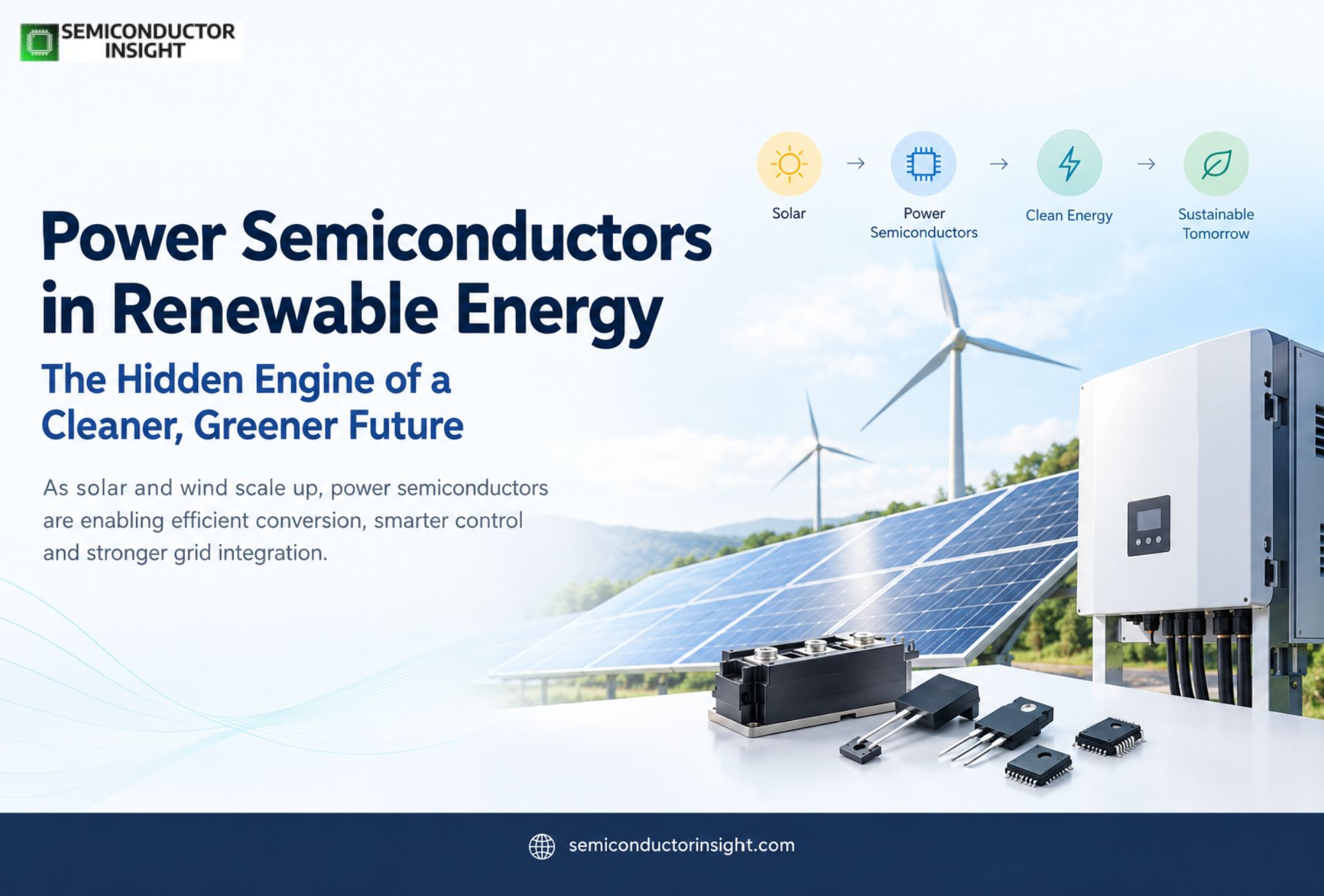
Renewable Power Hits New Records as renewable energy power semiconductor market Enters a New Phase
The renewable energy transition is increasingly becoming a power-electronics story. Solar panels and wind turbines may generate the electricity, but semiconductor devices determine how efficiently that electricity is switched, converted, controlled and delivered to the grid. As renewable installations become larger and more distributed, the role of power semiconductors is moving well beyond basic voltage conversion.
The International Energy Agency estimates that global renewable capacity additions reached around 800 GW in 2025, while solar PV additions exceeded 600 GW for the first time. Global installed solar PV capacity consequently reached approximately 2,800 GW.
The Semiconductor Layer behind Renewable Electricity
- A solar module generates direct current, while most grids operate on alternating current. That gap creates a fundamental requirement for power electronics.
Solar panels → DC collection → Power semiconductor switching → Inverter → AC output → Grid
- Power MOSFETs, IGBTs, diodes and increasingly wide-bandgap SiC and GaN devices perform the high-speed switching required inside these systems.
- Their electrical characteristics influence conversion losses, thermal management, switching frequency, inverter size and ultimately the usable output of renewable installations.
- The U.S. Department of Energy describes power electronics as the critical link between photovoltaic arrays and the electricity grid, highlighting their role in power-flow control and grid integration.
600 GW of Solar Changes the Component Equation
The scale of solar deployment is becoming difficult to separate from semiconductor demand. In 2025, solar PV accounted for more than three-quarters of newly added renewable capacity worldwide. The IEA also recorded solar generation increasing by approximately 600 TWh during the year, the largest annual electricity-generation increase from any single source outside post-crisis recovery periods.
That expansion creates several semiconductor-intensive conversion points:
- Central and string solar inverters
- Microinverters and power optimizers
- Battery energy-storage converters
- DC-DC converters
- Grid-connected power-conditioning systems
- Wind turbine converters
- Solid-state transformer architectures
The growth is therefore not simply about installing more renewable generators. Each additional installation can require another layer of switching and control electronics.
For additional report info, feel free to view our most recent edition: https://semiconductorinsight.com/report/renewable-energy-power-semiconductor-market/
Why Silicon Carbide Is Moving Into the Spotlight?
Silicon remains deeply established in power electronics, but higher-voltage and higher-efficiency applications are encouraging adoption of wide-bandgap materials.
Silicon carbide can operate at higher temperatures and switching frequencies while reducing certain conduction and switching losses. These characteristics are particularly useful in high-power solar inverters, battery storage systems and grid equipment where reducing heat and physical size can have system-level benefits.
- In February 2025, Infineon announced the release of its first products manufactured using 200 mm SiC wafer technology, with the devices targeting high-voltage applications including renewable energy, electric vehicles and trains.
The development matters because wafer diameter affects manufacturing economics and production scalability, while renewable systems increasingly demand higher power density.
A Solar Inverter Is Becoming More Than a Converter
Modern inverters are increasingly expected to perform grid-support functions rather than simply transform DC electricity into AC electricity.
NREL identifies grid-forming inverters as an important area of development as power systems become increasingly dominated by inverter-based resources. Unlike traditional grid-following systems, grid-forming technologies can provide operating characteristics needed for systems with very high levels of inverter-based generation.
This changes semiconductor requirements because switching devices must operate within increasingly sophisticated control architectures.
The technology chain is moving from:
Generation → Conversion
Toward:
Generation → Conversion → Sensing → Fast switching → Digital control → Grid support
Battery Storage Adds another Semiconductor Demand Point
Solar expansion is also increasing the importance of energy storage. The IEA reports that around 24 GW of utility-scale battery storage additions in 2025 were co-located directly with renewable projects. Australia alone added nearly 8 GW of battery storage during the year, including around 4.2 GW of utility-scale installations.
Battery systems require bidirectional power conversion. Semiconductor switches must therefore manage charging and discharging while maintaining voltage, current and thermal limits.
This creates additional demand for:
SiC MOSFETs → High-voltage switching → DC/DC conversion → Bidirectional inverter → Battery → Grid
The combination of solar generation and storage effectively creates two major power-conversion pathways within one energy system.
GaN Finds Its Own Renewable-Energy Niche
Gallium nitride is not necessarily competing with SiC across every renewable application. Its high-frequency switching capability makes it attractive for smaller, high-density power converters, auxiliary power supplies, microinverters and selected residential energy systems.
Infineon currently highlights silicon, GaN and SiC solutions across solar power optimizers, hybrid inverters and microinverter designs, illustrating how different semiconductor materials are being matched to different power levels and architectures.
The market is consequently developing as a multi-material ecosystem rather than a single-technology replacement cycle.
The Grid Is Becoming a Semiconductor Application
Renewable penetration is changing the electrical characteristics of the grid itself. NREL is developing medium-voltage power-electronics architectures using wide-bandgap devices, including SiC systems intended for applications around the 15-kV class. These concepts include direct conversion for photovoltaic systems, battery storage and electric vehicles.
That creates a longer-term shift in the role of power semiconductors. Instead of sitting only inside a solar inverter, semiconductor-based conversion could increasingly become part of distribution-level infrastructure.
2026 Development Signals to Watch
- Higher voltage: SiC devices are moving toward demanding high-voltage applications.
- Higher switching frequency: Faster switching can support smaller magnetic components and more compact converter architectures.
- Greater power density: Manufacturers are attempting to deliver more watts from smaller inverter packages.
- Bidirectional conversion: Battery storage requires controlled energy movement in both directions.
- Grid-forming capability: Inverters are being developed to contribute more actively to grid stability.
- Larger wafer manufacturing: The transition toward 200 mm SiC production demonstrates the semiconductor industry’s effort to improve scalable manufacturing.
Where the Market Is Heading in 2026?
Renewable energy power semiconductor market is increasingly defined by the intersection of two rapidly changing systems: renewable generation and semiconductor technology.
The IEA expects global renewable capacity to expand by almost 4,600 GW between 2025 and 2030, with solar PV representing nearly 80% of worldwide renewable capacity expansion.
For semiconductor manufacturers, this means the opportunity extends beyond selling an individual transistor or diode. Device performance now influences inverter efficiency, thermal architecture, system footprint, storage integration and grid functionality.
As renewable installations move toward higher power density and more intelligent grid interaction, power semiconductors are becoming one of the defining hardware layers connecting clean-energy generation with the modern electricity network.

Comments (0)