AI Wind Turbine Condition Monitoring Sensor Interface IC Market Insights
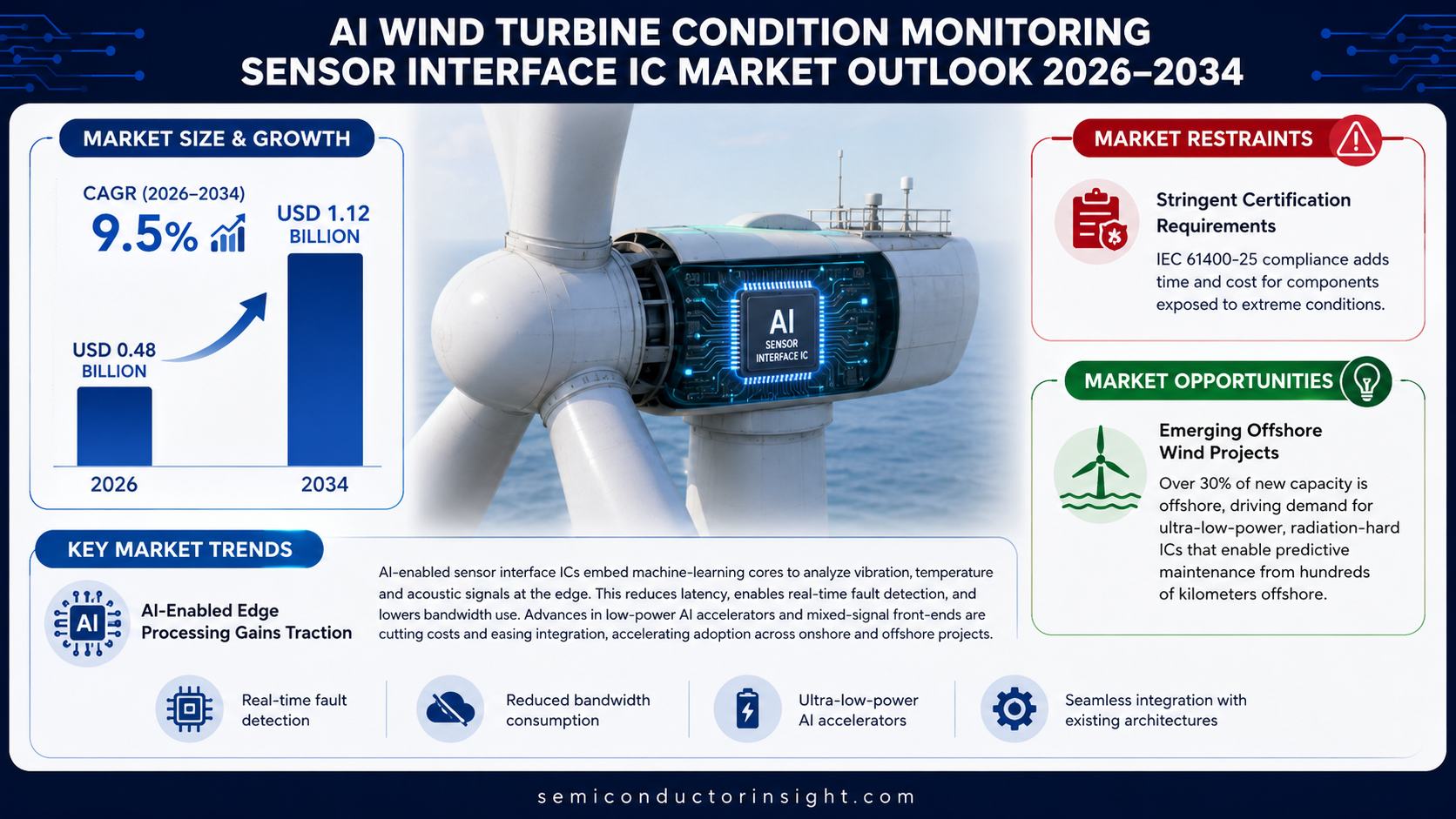
Global AI Wind Turbine Condition Monitoring Sensor Interface IC market size was valued at USD 0.45 billion in 2025. The market is projected to grow from USD 0.48 billion in 2026 to USD 1.12 billion by 2034, exhibiting a CAGR of 9.5% during the forecast period.
AI‑enabled sensor interface integrated circuits (ICs) are specialized semiconductor components that collect vibration, temperature, and acoustic data from wind turbine drivetrain and blade systems, process the signals using embedded machine‑learning algorithms, and transmit actionable diagnostics to control centers.
The market is accelerating because renewable energy capacity is expanding rapidly worldwide, and operators seek predictive maintenance to reduce downtime and O&M costs. Furthermore, advances in low‑power AI accelerators and edge computing are lowering integration costs, while major players such as Texas Instruments, Analog Devices, NXP Semiconductors,and STMicroelectronics are launching dedicated condition‑monitoring families and forming strategic partnerships with turbine OEMs.
MARKET DRIVERS
Rising Renewable Energy Installations
The global push toward carbon neutrality has accelerated wind farm deployments, with installed capacity projected to exceed 1,200 GW by 2030. This expansion creates a pressing need for real‑time condition monitoring to maximize turbine uptime and protect large capital investments.
Advancements in AI‑Powered Diagnostics
Recent breakthroughs in machine‑learning algorithms enable predictive analytics that identify blade fatigue, gearbox wear, and electrical faults up to six months in advance. AI‑enhanced sensor interface ICs are now able to process high‑frequency vibration data on‑chip, reducing latency and bandwidth costs.
➤ Industry analysts estimate that AI‑driven monitoring solutions could cut operational expenditures for wind farms by up to 12 % annually.
Combined, these drivers position AI Wind Turbine Condition Monitoring Sensor Interface IC Market for a compound annual growth rate above 10 % through 2035, as operators seek smarter, more resilient assets.
MARKET CHALLENGES
High Development Costs
Designing ASICs that integrate AI inference, low‑power consumption, and harsh‑environment tolerance requires substantial R&D investment. Smaller OEMs often lack the financial bandwidth to adopt next‑gen ICs, slowing market penetration.
Other Challenges
Integration with Legacy Turbine Systems
Many existing turbines were built around analog signal conditioning modules. Retrofitting them with advanced sensor interface ICs necessitates complex firmware updates and mechanical redesigns, which can delay deployment schedules.
MARKET RESTRAINTS
Stringent Certification Requirements
Regulatory bodies in Europe and North America mandate rigorous testing for electronic components exposed to extreme temperatures, vibration, and moisture. Achieving IEC 61400‑25 compliance adds both time and cost, restraining rapid adoption of new AI‑enabled ICs.
MARKET OPPORTUNITIES
Emerging Offshore Wind Projects
Offshore installations, which now account for over 30 % of new capacity, demand higher reliability due to limited access for maintenance. AI Wind Turbine Condition Monitoring Sensor Interface IC Market can capitalize on this by offering ultra‑low‑power, radiation‑hard designs that extend sensor lifespans and enable predictive maintenance from hundreds of kilometers offshore.
AI Wind Turbine Condition Monitoring Sensor Interface IC Market Trends
AI‑Enabled Edge Processing Gains Traction
The rapid expansion of renewable energy installations is driving turbine operators to adopt smarter diagnostic solutions. AI‑enabled sensor interface integrated circuits now embed compact machine‑learning cores that can analyze vibration, temperature and acoustic signals directly on the turbine hub. By moving inference to the edge, these ICs eliminate latency associated with cloud‑based analytics, enable real‑time fault detection, and reduce bandwidth consumption. The convergence of ultra‑low‑power AI accelerators with advanced mixed‑signal front‑ends is lowering the bill of materials, while standardized communication protocols simplify integration into existing control architectures. As a result, AI Wind Turbine Condition Monitoring Sensor Interface IC Market is seeing accelerated adoption across on‑shore and offshore projects, with operators prioritizing predictive maintenance to curb downtime and operating expenses.
Other Trends
Power‑Efficient AI Accelerators
Manufacturers are concentrating on silicon designs that deliver high inference throughput at sub‑100 mW power envelopes. Techniques such as dynamic voltage scaling, event‑driven processing, and sparsity‑aware neural networks allow the IC to remain dormant until a vibration anomaly exceeds a defined threshold. This approach extends the service life of turbine electronics exposed to harsh offshore environments and reduces the cooling requirements on the nacelle. Companies like Texas Instruments and STMicroelectronics have announced families of sensor interface chips that combine precision ADCs with dedicated AI inference blocks, providing a single‑chip solution that replaces traditional discrete sensor boards and external processors.
OEM Collaboration and Ecosystem Expansion
Strategic partnerships between semiconductor vendors and wind turbine OEMs are reshaping the supply chain. By co‑developing reference designs, IC manufacturers ensure that the sensor interface aligns with the mechanical layout and control software of leading turbine platforms. These collaborations accelerate time‑to‑market for new models and create a unified ecosystem where firmware updates can be delivered over‑the‑air, enhancing long‑term performance. In parallel, industry consortia are standardizing data models for condition‑monitoring, facilitating interoperability across different turbine brands. Together, these initiatives are solidifying AI Wind Turbine Condition Monitoring Sensor Interface IC Market as a cornerstone of next‑generation renewable energy asset management.
COMPETITIVE LANDSCAPE
Key Industry Players
AI‑Driven Sensors Accelerate Turbine Reliability
AI Wind Turbine Condition Monitoring Sensor Interface IC market is anchored by a handful of semiconductor leaders that have introduced dedicated AI‑enabled families. Texas Instruments leverages its ultra‑low‑power MSP430 and C2000 platforms to embed vibration and temperature diagnostics directly on turbine blades, while Analog Devices combines high‑precision delta‑sigma converters with on‑chip machine‑learning inference engines for drivetrain health monitoring. NXP Semiconductors focuses on secure edge processing through its S32K and i.MX series, enabling real‑time fault detection across distributed turbine networks. STMicroelectronics rounds out the core group by offering the MEMS‑compatible STM32 line, which integrates analog front‑ends with AI accelerators to reduce latency in acoustic‑based blade analysis. Collectively, these firms shape market structure through extensive OEM partnerships, robust design‑in ecosystems, and aggressive road‑maps that lock in volume production for the next decade.
Beyond the dominant quartet, a broader set of niche players is expanding functional coverage and geographic reach. Infineon Technologies supplies automotive‑grade power management ICs that are repurposed for turbine pitch‑control loops. Renesas Electronics contributes mixed‑signal solutions optimized for harsh offshore environments. Microchip Technology offers programmable analog front‑ends that simplify sensor integration. ON Semiconductor delivers high‑efficiency voltage regulators crucial for low‑power edge nodes. Bosch Sensortec provides precision MEMS sensors for vibration capture, while TDK supplies compact inductors and capacitors for power‑dense modules. AMS AG and Skyworks Solutions enhance optical and RF telemetry, respectively, and Murata Manufacturing adds miniature ceramic filters to improve signal integrity. These companies collectively enrich the ecosystem, fostering competition that drives innovation and price efficiency across the AI wind‑turbine monitoring value chain.
List of Key AI Wind Turbine Condition Monitoring Sensor Interface IC Companies Profiled
- Texas Instruments
- Analog Devices
- NXP Semiconductors
- STMicroelectronics
- Infineon Technologies
- Renesas Electronics
- Microchip Technology
- ON Semiconductor
- Bosch Sensortec
- TDK
- AMS AG
- Skyworks Solutions
- Murata Manufacturing
- Silicon Labs
- Cypress Semiconductor
Segment Analysis:
| Segment Category | Sub-Segments | Key Insights |
| By Type |
|
Digital AI Sensor ICs
|
| By Application |
|
Blade Condition Monitoring
|
| By End User |
|
Wind Farm Operators
|
| By Power Architecture |
|
Low‑Power Edge AI ICs
|
| By Integration Approach |
|
Fully Integrated Smart Sensors
|
Regional Analysis: AI Wind Turbine Condition Monitoring Sensor Interface IC Market
European offshore projects prioritize sensor interface ICs that can withstand harsh marine conditions while delivering high‑resolution vibration and temperature data. This drives a niche market for rugged, low‑latency chips that support AI‑based fault detection, reducing downtime for high‑value assets.
EU directives encouraging grid stability and emissions reduction incentivize operators to adopt predictive maintenance platforms. Integrated sensor ICs become essential components for meeting these compliance milestones, fostering rapid technology diffusion.
The convergence of digital twin models with AI monitoring hinges on high‑fidelity data streams from sensor interface ICs. European firms invest heavily in this synergy, creating new revenue streams through data‑as‑a‑service offerings.
Close partnerships between semiconductor fabs and turbine OEMs accelerate custom IC development, ensuring compatibility with emerging communication standards such as IEC 61850 and 5G‑enabled edge nodes.
North America
North America benefits from substantial onshore wind capacity and a growing emphasis on AI‑enabled asset management. Utilities are deploying sensor interface ICs that interface with cloud‑based analytics platforms, enabling large‑scale fleet monitoring. The market is shaped by strong investment in grid modernization, and regulatory frameworks that reward reduced outage times. Although the region lags slightly behind Europe in offshore activity, its extensive onshore infrastructure creates a robust demand base for cost‑effective, high‑performance monitoring chips.
Asia‑Pacific
Asia‑Pacific exhibits rapid expansion of wind farms, particularly in China, India, and Japan. The region focuses on scaling AI monitoring solutions to manage vast turbine inventories. Sensor interface ICs are selected for their low power draw and ability to integrate with emerging IoT networks, supporting remote diagnostics in remote locations. Market dynamics are influenced by government subsidies and ambitious renewable targets, prompting a shift toward more sophisticated condition monitoring approaches.
South America
South America’s wind sector is emerging, with Brazil leading deployment efforts. Operators are beginning to adopt AI‑driven condition monitoring to improve turbine availability in challenging climates. The emphasis is on affordable sensor interface ICs that can be retrofitted to existing fleets, providing incremental performance gains without extensive capital outlay. Market growth is propelled by increasing foreign investment and a regulatory push toward renewable integration.
Middle East & Africa
In the Middle East & Africa, wind projects are still nascent, yet interest is rising due to diversification away from oil‑centric economies. Pilot programs are employing AI sensor interface ICs to demonstrate reliability in high‑temperature and desert environments. Partnerships with European technology providers are common, fostering knowledge transfer and laying groundwork for future expansion as regional power policies evolve.
Report Scope
This market research report provides a comprehensive analysis of the AI Wind Turbine Condition Monitoring Sensor Interface IC Market , covering the forecast period 2026–2034. It offers detailed insights into market dynamics, technological advancements, competitive landscape, and key trends shaping the industry.
Key focus areas of the report include:
- Market Overview: The report begins with an overview outlining its current market scenario, key growth indicators, and industry transformation drivers. It discusses macroeconomic factors, demand–supply balance, regulatory landscape, and the strategic role of semiconductors in powering advancements across industries such as automotive, telecommunications, consumer electronics, and industrial automation.
- Market Size & Forecast: Historical data and future projections for revenue, unit shipments, and market value across major regions and segments.
- Segmentation Analysis: Detailed breakdown by product type, technology, application, and end-user industry to identify high-growth segments and investment opportunities.
- Regional Insights: Insights into market performance across North America, Europe, Asia-Pacific, Latin America, and the Middle East & Africa, including country-level analysis where relevant.
- Competitive Landscape: Profiles of leading market participants, including their product offerings, R&D focus, manufacturing capacity, pricing strategies, and recent developments such as mergers, acquisitions, and partnerships.
- Technology Trends & Innovation: Assessment of emerging technologies, integration of AI/IoT, semiconductor design trends, fabrication techniques, and evolving industry standards.
- Market Drivers & Restraints: Evaluation of factors driving market growth along with challenges, supply chain constraints, regulatory issues, and market-entry barriers.
- Stakeholder Insights: Insights for component suppliers, OEMs, system integrators, investors, and policymakers regarding the evolving ecosystem and strategic opportunities.
Primary and secondary research methods are employed, including interviews with industry experts, data from verified sources, and real-time market intelligence to ensure the accuracy and reliability of the insights presented.
FREQUENTLY ASKED QUESTIONS:
What is the current market size of AI Wind Turbine Condition Monitoring Sensor Interface IC Market?
-> AI Wind Turbine Condition Monitoring Sensor Interface IC market size is projected to grow from USD 0.48 billion in 2026 to USD 1.12 billion by 2034.
Which key companies operate in AI Wind Turbine Condition Monitoring Sensor Interface IC Market?
-> Key players include Texas Instruments, Analog Devices, NXP Semiconductors, and STMicroelectronics, among others.
What are the key growth drivers?
-> Key growth drivers include rapid expansion of renewable energy capacity, demand for predictive maintenance, and advances in low‑power AI accelerators and edge computing.
Which region dominates the market?
-> The provided reference does not specify a dominant region.
What are the emerging trends?
-> Emerging trends include integration of AI/edge computing in sensor ICs, strategic partnerships between semiconductor firms and turbine OEMs, and development of ultra‑low‑power AI accelerators.

Get Sample Report PDF for Exclusive Insights
Report Sample Includes
- Table of Contents
- List of Tables & Figures
- Charts, Research Methodology, and more...
 Download Sample Report PDF