
Reed Relay Market Evolution with AI Chips, EV Electronics, and High-Frequency Semiconductors
In semiconductor ecosystems, switching precision defines system accuracy, reliability, and long-term performance. Even solid-state switches find it difficult to completely replace the role that reed relays play. Despite ordinary relays, reed relays ensure exceptionally robust switching behaviour and nearly zero contamination since their magnetically actuated contacts are protected inside glass envelopes.
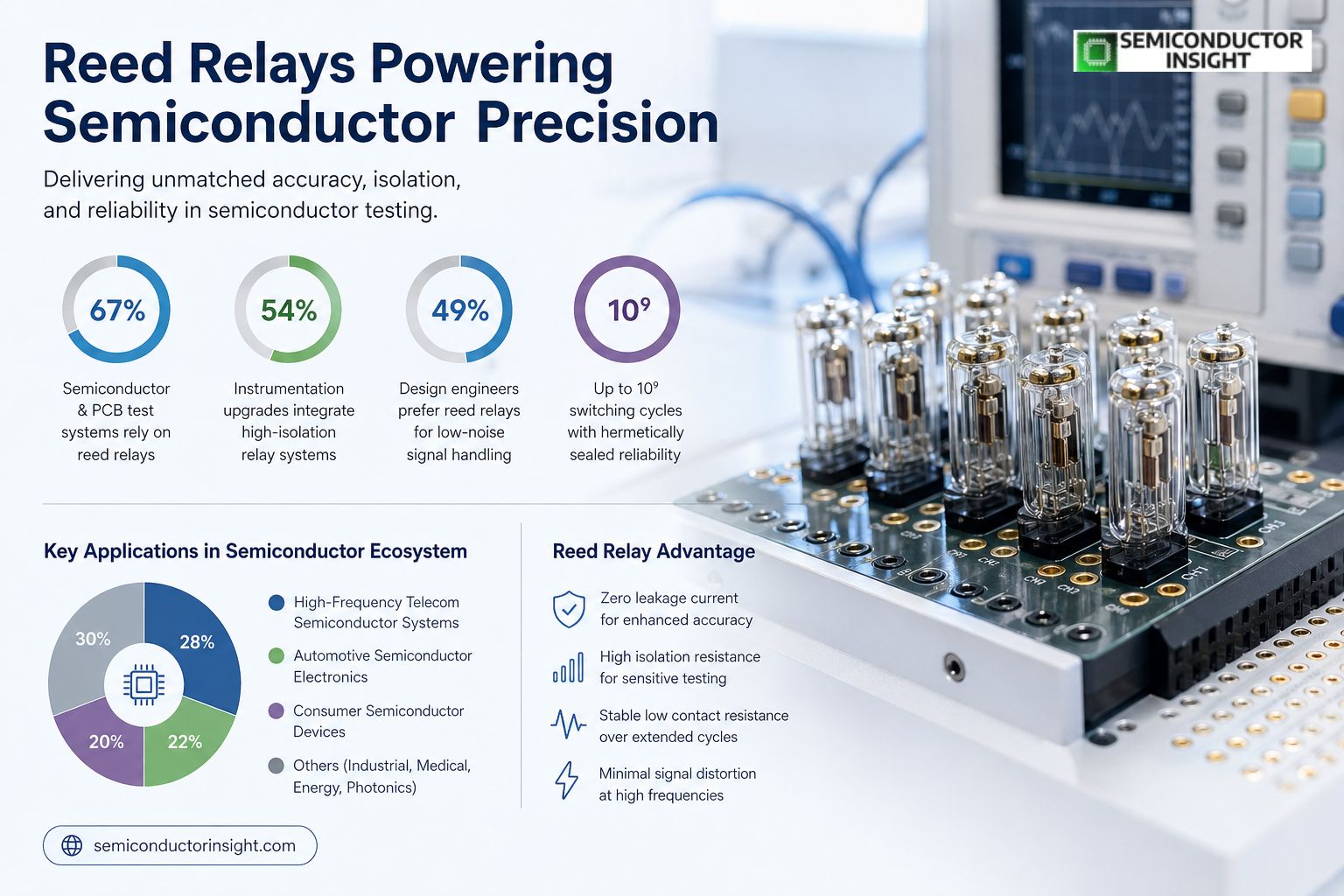
This hermetically sealed design allows reed relays to deliver up to 10⁹ switching cycles, making them indispensable in semiconductor testing environments where repeated signal routing is required without degradation.
Their ability to handle low-level analog signals without distortion makes them critical in IC validation, wafer probing, and failure analysis systems where even microvolt-level inaccuracies can distort outcomes.
Semiconductor Market Size Expansion Reflecting Reed Relay Demand
Reed relay market is no longer a niche segment. It is scaling alongside semiconductor demand curves globally.
This growth directly mirrors semiconductor industry expansion, especially in:
- AI chip validation
- Automotive semiconductor modules
- 5G infrastructure testing
- Power electronics calibration
Flow Architecture of Reed Relay Integration in Semiconductor Testing
Input Signal Source
↓
Signal Conditioning Circuit
↓
Reed Relay Switching Matrix
↓
Automated Test Equipment (ATE)
↓
Data Acquisition & Measurement System
↓
Error Detection / Calibration Loop
This architecture highlights why reed relays are preferred over semiconductor switches in testing setups. They provide true galvanic isolation, eliminating leakage currents that could corrupt measurements.
Dominance in Semiconductor Test Equipment and Signal Integrity
Reed relays are deeply embedded in semiconductor test platforms, where precision and reliability are essential. Around 67% of semiconductor and PCB testing systems rely on reed relays for accurate switching, while nearly 54% of instrumentation upgrades integrate high-isolation relay systems.
In addition, about 49% of design engineers prefer reed relays for low-noise signal handling. These numbers highlight an important reality: even as semiconductor chips continue to evolve rapidly, testing infrastructure still depends heavily on reed relay technology for dependable performance.
Semiconductor-Centric Application Segmentation
- High-Frequency Telecom Semiconductor Systems
- Telecommunication contributes nearly 28% of overall demand, driven by signal routing in RF and high-speed networks.
- Automotive Semiconductor Electronics
- With EV platforms expanding, reed relays are used in:
- Battery management IC testing
- ADAS sensor calibration
- Onboard semiconductor diagnostics
- Automotive accounts for roughly 22% of demand, growing with EV adoption.
- Consumer Semiconductor Devices
- Miniaturized electronics such as wearable and smart devices contribute about 20%, reflecting increasing integration density.
Semiconductor Design Advantage: Why Reed Relays Still Survive Against Solid-State
Despite ongoing advancements in MOSFET and MEMS switching technologies, reed relays continue to maintain a dominant position in specific semiconductor applications. Their preference in the industry is driven by several critical technical advantages, including zero leakage current compared to semiconductor switches, high isolation resistance essential for analog IC testing, stable low contact resistance over time, and minimal signal distortion during high-frequency measurements.
While solid-state switches may offer superior switching speeds, the precision and reliability provided by reed relays remain non-negotiable for rigorous semiconductor validation processes.
Innovation Layer: Reed Relays in Next-Gen Semiconductor Systems
Modern semiconductor environments are pushing reed relay innovation into new directions:
- integration into AI-driven test platforms
- deployment in quantum computing measurement systems
- use in high-voltage semiconductor testing up to 10 kV
Additionally, emerging designs focus on:
- reduced coil power consumption
- faster switching latency
- enhanced miniaturization for dense PCB layouts
Hidden Opportunity Zones in Semiconductor Supply Chains
A few under-discussed growth areas where reed relay demand is quietly accelerating:
- semiconductor failure analysis labs
- chip burn-in testing systems
- photonics and optoelectronics testing
- medical semiconductor devices (MRI, diagnostic chips)
- renewable energy semiconductor converters
These segments are less visible but highly profitable due to their precision requirements.
The semiconductor industry is shifting toward a landscape where validation accuracy is prioritized over sheer speed, positioning reed relays at a critical juncture for future technological development. This evolution is driven by several key indicators, most notably the rising complexity in chip architectures, a growing necessity for ultra-precise testing environments, and the continued expansion of both analog and mixed-signal semiconductors.
Furthermore, as EV and power semiconductor ecosystems scale, the demand for reliable switching remains high. Far from being rendered obsolete, reed relays are set to evolve into sophisticated, high-precision switching modules embedded deeper within next-generation testing architectures.

Comments (0)