Power Semiconductor Switches for Industrial and Energy Market, Trends, Business Strategies 2026-2034

Power Semiconductor Switches for Industrial and Energy Market was valued at USD 1723 million in 2025 and is expected to reach USD 2678 million by 2034, growing at a CAGR of 6.7% during the forecast period.

PDF Icon Download Sample Report PDF
  • Quick Dispatch

    All Orders

  • Secure Payment

    100% Secure Payment

Price range: $1,500.00 through $4,250.00

Clear

Power Semiconductor Switches for Industrial and Energy Market Insights

Global Power Semiconductor Switches for Industrial and Energy market size was valued at USD 1,723 million in 2025. The market is projected to grow from USD 1,838 million in 2026 to USD 2,678 million by 2034, exhibiting a CAGR of 6.7% during the forecast period.

Power Semiconductor Switches for Industrial and Energy applications are critical electronic components used to control and manage the flow of electrical power across a wide range of high-power applications, including industrial machinery, renewable energy systems, and power distribution grids. These devices , encompassing product types such as MOSFETs, IGBTs, Bipolar Power Transistors, and Thyristors , are engineered to handle large voltages and currents with high efficiency, making them indispensable to modern energy management, industrial automation, photovoltaic and wind power generation, and smart grid infrastructure.

The market is witnessing sustained growth driven by several converging factors, including the rapid global expansion of renewable energy installations, increasing industrial automation adoption, and rising investments in smart grid modernization. The accelerating transition toward energy-efficient power electronics is further reinforcing demand. Key manufacturers operating in Power Semiconductor Switches for Industrial and Energy Market include Infineon Technologies, onsemi, STMicroelectronics, Toshiba, Vishay, Fuji Electric, Renesas Electronics, Rohm, Nexperia, and Mitsubishi Electric, all of which maintain broad and competitive product portfolios serving diverse end-use industries globally.
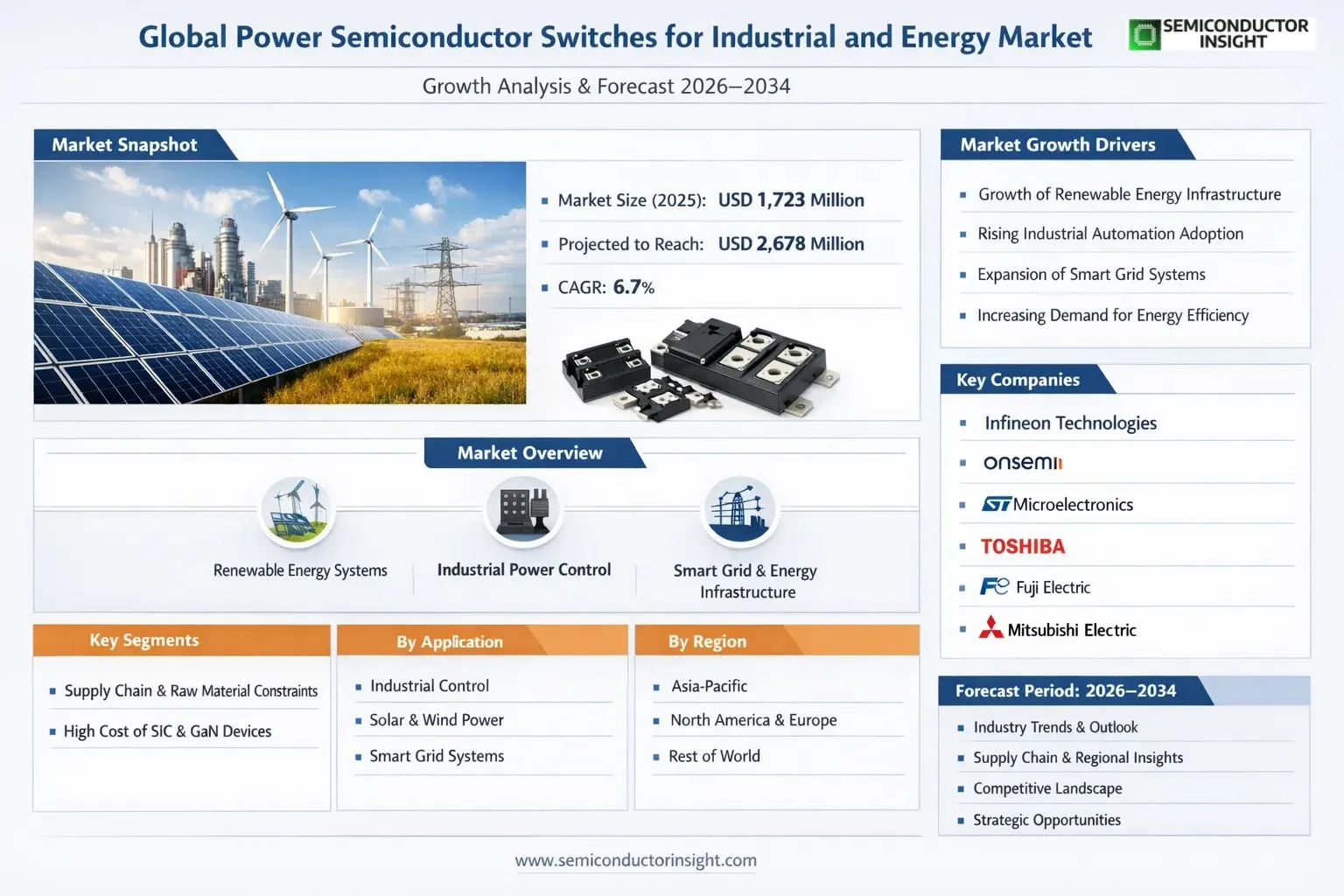
Power Semiconductor Switches for Industrial and Energy Market Insights

MARKET DRIVERS

Rising Demand for Energy Efficiency and Grid Modernization

Global transition toward energy-efficient industrial infrastructure is one of the most significant forces propelling Power Semiconductor Switches for Industrial and Energy Market. Industrial facilities worldwide are under mounting pressure to reduce energy consumption and carbon emissions, driving widespread adoption of advanced power switching devices such as IGBTs, MOSFETs, and silicon carbide (SiC)-based switches. These components enable precise control of electrical energy conversion, minimizing losses across motor drives, power supplies, and industrial automation systems. Governments across North America, Europe, and Asia-Pacific have introduced stringent energy efficiency mandates, further accelerating investment in high-performance power semiconductor solutions.

Rapid Expansion of Renewable Energy Infrastructure

The accelerating deployment of solar photovoltaic (PV) systems, wind energy installations, and battery energy storage systems (BESS) is creating robust demand for power semiconductor switches capable of managing high-frequency switching and high-voltage conversion. In renewable energy applications, these devices serve as the backbone of inverters and converters that interface generation sources with the utility grid. The shift toward wide-bandgap (WBG) semiconductors,particularly silicon carbide (SiC) and gallium nitride (GaN),is gaining strong momentum within this segment, as these materials offer superior thermal performance and switching efficiency compared to conventional silicon-based counterparts. Power Semiconductor Switches for Industrial and Energy Market is therefore closely tied to the pace of global renewable capacity additions.

The proliferation of electric vehicles (EVs) and EV charging infrastructure is generating substantial crossover demand for industrial-grade power semiconductor switches, as traction inverters and bidirectional on-board chargers require devices capable of sustained high-power, high-frequency operation under thermally demanding conditions.

Industrialization in emerging economies across Southeast Asia, India, and Latin America is driving fresh demand for factory automation, variable frequency drives (VFDs), and smart manufacturing systems,all of which rely heavily on power semiconductor switches. As these regions invest in upgrading legacy power infrastructure and building new industrial capacity, the addressable market for advanced switching devices continues to broaden, reinforcing the long-term growth trajectory of Power Semiconductor Switches for Industrial and Energy Market.

MARKET CHALLENGES

Supply Chain Vulnerabilities and Raw Material Constraints

Power Semiconductor Switches for Industrial and Energy Market faces persistent supply chain disruptions stemming from geopolitical tensions, concentrated semiconductor fabrication capacity, and limited sourcing of critical raw materials such as silicon carbide substrates and gallium nitride epitaxial wafers. Global semiconductor shortage experienced between 2020 and 2023 exposed deep structural fragilities in the power device supply chain, with lead times for certain IGBTs and SiC MOSFETs extending well beyond 50 weeks at peak disruption. Although capacity expansion programs by leading foundries and integrated device manufacturers (IDMs) are underway, meaningful supply-demand rebalancing remains a multi-year process, creating ongoing uncertainty for industrial OEMs and energy system integrators dependent on timely component availability.

Technical Complexity and System Integration Barriers

The migration from legacy silicon-based power switches to next-generation wide-bandgap devices introduces substantial engineering complexity at the system design level. SiC and GaN power switches operate at significantly higher switching frequencies and temperatures, requiring redesigned gate driver circuits, thermal management architectures, and electromagnetic compatibility (EMC) mitigation strategies. Many industrial end-users lack in-house expertise to manage this transition, resulting in longer design cycles and higher total development costs. This technical barrier is particularly pronounced among small and mid-sized manufacturers that cannot readily absorb the upfront engineering investment required to qualify and deploy advanced power semiconductor switches in new or retrofitted industrial systems.

Other Challenges

High Capital Investment in Fabrication

The manufacturing of wide-bandgap power semiconductor devices demands capital-intensive fabrication processes and specialized equipment, creating significant barriers to entry and limiting the number of credible suppliers capable of meeting growing industrial and energy market requirements at scale.

Thermal Management Complexity

As power densities increase in industrial converters and energy systems, effective thermal management of power semiconductor switches becomes increasingly critical. Inadequate heat dissipation leads to accelerated device degradation and reduced system reliability, necessitating costly cooling solutions that add to overall system cost and footprint.

Counterfeit Components and Quality Assurance

The proliferation of counterfeit power semiconductor devices in secondary markets poses a tangible risk to the reliability and safety of industrial and energy systems, compelling procurement teams to invest additional resources in component authentication and supply chain traceability programs.

MARKET RESTRAINTS

Elevated Costs of Wide-Bandgap Power Semiconductor Devices

Despite their performance advantages, SiC and GaN power semiconductor switches carry a substantial cost premium relative to conventional silicon IGBTs and MOSFETs. This price differential continues to restrain adoption, particularly in cost-sensitive industrial segments where procurement decisions are heavily influenced by bill-of-materials (BOM) economics. While manufacturing scale-up and process yield improvements are gradually narrowing the cost gap, SiC-based devices in comparable voltage and current ratings can still command a price multiple of two to four times that of silicon alternatives, limiting near-term penetration in price-competitive industrial equipment categories. Power Semiconductor Switches for Industrial and Energy Market must navigate this cost sensitivity as a fundamental constraint on the pace of technology transition.

Stringent Qualification and Reliability Requirements in Industrial Applications

Industrial and energy end-use environments impose rigorous qualification standards on power semiconductor switches, including extended thermal cycling endurance, high humidity and vibration resistance, and compliance with standards such as AEC-Q101 for automotive-adjacent applications and IEC-based reliability frameworks for grid-connected systems. The time and resources required to achieve full qualification of new power device technologies can span 18 to 36 months, significantly delaying the commercialization of next-generation switching solutions and creating a structural lag between technological innovation and market deployment. This qualification burden disproportionately affects new entrants and smaller device manufacturers seeking to compete in Power Semiconductor Switches for Industrial and Energy Market.

Concentration of Advanced Manufacturing Capacity

Advanced power semiconductor fabrication capacity remains geographically concentrated, with a significant proportion of global wafer processing and packaging for high-performance switching devices situated in East Asia. This concentration introduces supply security concerns for industrial and energy customers in North America and Europe, particularly as national governments reassess strategic dependencies in critical technology sectors. Efforts to reshore or near-shore power semiconductor manufacturing are ongoing, supported by policy initiatives such as the U.S. CHIPS and Science Act and the European Chips Act, but meaningful diversification of the supply base will require sustained multi-year investment before materially reducing geographic concentration risk in Power Semiconductor Switches for Industrial and Energy Market.

MARKET OPPORTUNITIES

Accelerating Adoption of Silicon Carbide and Gallium Nitride Technologies

The ongoing commercialization of silicon carbide (SiC) and gallium nitride (GaN) power semiconductor switches presents transformative growth opportunities across both industrial and energy end markets. SiC devices, operating effectively at voltages above 650V, are increasingly displacing silicon IGBTs in high-power industrial motor drives, solar inverters, and grid-scale energy storage converters, where their lower switching losses and higher operating temperatures deliver measurable efficiency gains and system size reductions. GaN switches are gaining traction in medium-power industrial power supplies and fast-charging applications. As manufacturing volumes scale and substrate costs decline, the value proposition of wide-bandgap power semiconductor switches will become accessible to progressively broader tiers of the industrial and energy market.

Growth in Smart Grid and Industrial IoT Applications

Global smart grid modernization wave and the expansion of Industrial Internet of Things (IIoT) infrastructure are generating substantial new demand for intelligent power management solutions underpinned by advanced power semiconductor switches. Smart grid systems require highly reliable, high-efficiency switching devices for solid-state transformers, flexible AC transmission systems (FACTS), and high-voltage direct current (HVDC) transmission links. Simultaneously, IIoT-enabled industrial facilities are deploying increasingly sophisticated motor control and power conversion systems that leverage the precision switching capabilities of modern power semiconductor devices. These intersecting megatrends position Power Semiconductor Switches for Industrial and Energy Market for sustained long-term demand growth.

Emerging Opportunities in Green Hydrogen Production and Energy Storage

Green hydrogen production via electrolysis and large-scale battery energy storage system (BESS) deployment represent emerging high-growth application areas for power semiconductor switches in the energy sector. Electrolyzer systems for green hydrogen require robust, high-efficiency DC power conversion stages where advanced switching devices are critical to system performance and operational cost competitiveness. Similarly, grid-scale BESS installations depend on power semiconductor switches within bidirectional DC-AC inverters and DC-DC converters to manage charge and discharge cycles with high precision and minimal energy loss. As green hydrogen capacity targets and energy storage mandates expand globally, these application segments are expected to become increasingly significant growth vectors for Power Semiconductor Switches for Industrial and Energy Market.

Strategic Partnerships and Vertical Integration Across the Value Chain

The competitive landscape of Power Semiconductor Switches for Industrial and Energy Market is increasingly characterized by strategic partnerships, joint ventures, and vertical integration initiatives aimed at securing material supply, scaling advanced fabrication capacity, and accelerating time-to-market for next-generation devices. Leading semiconductor manufacturers are forging long-term agreements with SiC substrate suppliers and investing in in-house substrate production capabilities to reduce supply risk and improve cost structures. Simultaneously, industrial and energy system OEMs are engaging in deeper co-development relationships with device manufacturers to optimize power semiconductor switches for specific application requirements, creating opportunities for differentiated, application-optimized product portfolios that command premium positioning in the evolving market landscape.

Trends

Accelerating Electrification and Energy Transition Driving Demand for Power Semiconductor Switches

Power Semiconductor Switches for Industrial and Energy Market is experiencing significant momentum, driven by Global shift toward electrification, renewable energy integration, and industrial automation. As industries worldwide prioritize energy efficiency and sustainability, demand for advanced switching devices , including MOSFETs, IGBTs, bipolar power transistors, and thyristors , has risen steadily. These components are central to managing high-voltage and high-current operations in applications ranging from industrial control systems to photovoltaic and wind power generation, as well as smart grid infrastructure. The transition to cleaner energy sources has placed particular emphasis on the performance requirements of these switches, pushing manufacturers to develop devices capable of operating at higher frequencies and temperatures while maintaining minimal switching losses.

Other Trends

Wide Bandgap Semiconductor Adoption

One of the most transformative trends shaping Power Semiconductor Switches for Industrial and Energy Market is the growing adoption of wide bandgap (WBG) materials such as silicon carbide (SiC) and gallium nitride (GaN). These materials offer superior thermal conductivity, higher breakdown voltage, and faster switching speeds compared to traditional silicon-based devices. Industrial energy conversion systems and renewable energy inverters are increasingly incorporating SiC MOSFETs and GaN transistors to achieve higher efficiency and reduced system size. Leading manufacturers including Infineon, STMicroelectronics, and onsemi have expanded their WBG product portfolios, reflecting the industry-wide recognition of these materials as the next frontier in power switching technology.

Smart Grid Expansion and Power Infrastructure Modernization

Global investments in smart grid infrastructure are creating sustained demand for high-performance power semiconductor switches. Utilities and grid operators are deploying advanced switching components to enable bidirectional power flow, grid stabilization, and integration of distributed energy resources. IGBT modules and thyristor-based systems remain critical in high-voltage direct current (HVDC) transmission and flexible AC transmission systems (FACTS), which are central to modern grid modernization projects across North America, Europe, and Asia. Countries such as China, Germany, and the United States are actively expanding their grid infrastructure, directly benefiting suppliers of power semiconductor switching devices.

Industrial Automation and Renewable Energy as Key Application Pillars

Industrial control and renewable energy generation remain the two dominant application pillars for power semiconductor switches. In industrial automation, variable frequency drives (VFDs), motor control units, and robotics systems rely heavily on efficient switching components to optimize energy consumption and operational precision. Simultaneously, the rapid expansion of photovoltaic and wind power generation globally has reinforced demand for robust, high-efficiency switching devices capable of handling the variable power characteristics inherent in renewable sources. Key market participants, including Mitsubishi Electric, Fuji Electric, Toshiba, Vishay, Renesas Electronics, Rohm, and Nexperia, continue to invest in R&D and capacity expansion to address evolving application requirements across both industrial and energy sectors.

COMPETITIVE LANDSCAPE

Key Industry Players

Power Semiconductor Switches for Industrial and Energy Market , Global Competitive Overview and Leading Manufacturer Profiles

Global Power Semiconductor Switches for Industrial and Energy market is characterized by the strong presence of a few dominant multinational corporations that command significant revenue share. Infineon Technologies leads the competitive landscape, leveraging its extensive portfolio of IGBTs, MOSFETs, and thyristors tailored for industrial automation, renewable energy inverters, and smart grid infrastructure. The company’s sustained investment in wide-bandgap semiconductor technologies , particularly silicon carbide (SiC) and gallium nitride (GaN) , reinforces its technological leadership. onsemi and STMicroelectronics closely follow, each offering a broad range of power switching devices optimized for photovoltaic and wind power generation systems, as well as industrial control applications. The top five global players collectively accounted for a substantial share of the market’s estimated USD 1,723 million valuation in 2025, with the market projected to reach USD 2,678 million by 2034, expanding at a CAGR of 6.7% over the forecast period. This concentration reflects the capital-intensive nature of semiconductor fabrication and the high barriers to entry associated with advanced power device development and certification.

Beyond the top-tier incumbents, several technologically specialized and regionally significant players contribute meaningfully to the competitive dynamics of this market. Toshiba and Mitsubishi Electric maintain strong footholds in the Asia-Pacific region, particularly across Japan and China, where industrial machinery and power grid modernization continue to drive robust demand for bipolar power transistors and thyristors. Fuji Electric and Renesas Electronics are recognized for their high-reliability IGBT modules used extensively in motor drives and industrial inverters. Rohm Semiconductor has been actively expanding its SiC MOSFET offerings, targeting next-generation energy efficiency requirements, while Vishay Intertechnology and Nexperia address cost-sensitive industrial segments with competitive discrete device portfolios. The MOSFET segment, in particular, is expected to witness accelerated growth through 2034, driven by proliferating demand across solar inverters, energy storage systems, and smart grid deployments. Competitive strategies across the landscape increasingly center on product differentiation through efficiency ratings, thermal performance, switching speed, and compatibility with advanced power conversion topologies.

List of Key Power Semiconductor Switches for Industrial and Energy Companies Profiled

Segment Analysis:

Segment Category Sub-Segments Key Insights
By Type
  • MOSFET
  • IGBT
  • Bipolar Power Transistors
  • Thyristors
IGBT (Insulated Gate Bipolar Transistor) holds a dominant position in the power semiconductor switches landscape for industrial and energy applications, driven by its exceptional ability to handle high voltage and high current conditions simultaneously.

  • IGBTs are widely preferred in applications requiring precise switching control at elevated power levels, making them indispensable in variable frequency drives, industrial motor controls, and inverter systems across renewable energy installations.
  • MOSFETs are rapidly gaining ground as a competitive segment, particularly due to their superior switching speed and lower conduction losses at medium voltage ranges, making them increasingly attractive for high-frequency power conversion systems and next-generation wide-bandgap device integration.
  • Thyristors continue to serve critical roles in legacy industrial infrastructure and high-power grid applications where robust, reliable switching under extreme electrical stress is paramount, maintaining steady demand from traditional utilities and heavy manufacturing sectors.
  • Bipolar Power Transistors, while representing a more mature technology, retain relevance in cost-sensitive industrial applications where simplicity of design and proven reliability outweigh the need for advanced switching performance.
By Application
  • Industrial Control
  • Photovoltaic and Wind Power Generation
  • Smart Grid
  • Others
Photovoltaic and Wind Power Generation emerges as the most dynamically expanding application segment, propelled by the accelerating global transition toward clean and renewable energy infrastructure.

  • The proliferation of utility-scale solar farms and offshore wind projects has created a sustained and growing demand for high-efficiency power semiconductor switches capable of managing energy conversion with minimal losses, directly supporting grid stability and energy yield optimization.
  • Industrial Control remains a foundational application segment, encompassing motor drives, robotics, CNC machinery, and process automation systems that rely on power semiconductor switches for precise, real-time power regulation and energy-efficient operations across manufacturing environments.
  • Smart Grid applications are experiencing a meaningful uptick in adoption as electricity distribution networks undergo digital transformation, requiring advanced switching devices that can facilitate bidirectional power flow, demand response management, and seamless integration of distributed energy resources.
  • Emerging applications across EV charging infrastructure, uninterruptible power supplies, and industrial heating systems further broaden the demand horizon for power semiconductor switches beyond traditional categories.
By End User
  • Energy and Utilities
  • Industrial Manufacturing
  • Transportation and E-Mobility
  • Others
Energy and Utilities represents the leading end-user segment, underpinned by the sweeping modernization of power generation, transmission, and distribution infrastructure worldwide.

  • Utility operators and independent power producers are increasingly deploying advanced power semiconductor switches to enhance the efficiency and reliability of both conventional and renewable power plants, reflecting an industry-wide imperative to reduce energy waste and operational costs.
  • Industrial Manufacturing constitutes a substantial and stable end-user base, as factories and processing plants integrate power semiconductor switches into automation systems, electric drives, and power conditioning equipment to achieve greater operational efficiency and regulatory compliance on energy consumption.
  • Transportation and E-Mobility is an emerging yet high-potential end-user category, as electrification of rail networks, commercial vehicles, and passenger cars drives significant demand for robust power switching solutions capable of managing the complex and dynamic power requirements of traction and charging systems.
By Voltage Rating
  • Low Voltage (Below 600V)
  • Medium Voltage (600V – 3,300V)
  • High Voltage (Above 3,300V)
Medium Voltage power semiconductor switches lead this segment, serving as the workhorses of industrial power conversion and distribution systems that demand a balanced combination of high switching performance and robust electrical insulation.

  • Medium voltage devices are extensively utilized in industrial motor drives, renewable energy inverters, and traction systems where the operating conditions require reliable and efficient power management across a broad range of load profiles and environmental conditions.
  • High Voltage switches are critically important in transmission-level grid infrastructure, HVDC (High Voltage Direct Current) links, and large-scale energy storage systems, where their ability to withstand extreme electrical stress determines the overall reliability and performance of the power network.
  • Low Voltage switches maintain a broad adoption base in auxiliary industrial controls, consumer power electronics, and embedded automation systems, benefiting from ongoing miniaturization trends and the integration of wide-bandgap semiconductor materials such as silicon carbide and gallium nitride to improve efficiency at lower voltage levels.
By Technology
  • Silicon (Si)-Based
  • Silicon Carbide (SiC)-Based
  • Gallium Nitride (GaN)-Based
Silicon (Si)-Based technology continues to dominate the market given its established manufacturing ecosystem, proven reliability across decades of industrial deployment, and its cost-competitive position relative to emerging wide-bandgap alternatives.

  • Despite the maturity of silicon technology, ongoing innovations in device architecture and packaging continue to extend its performance envelope, ensuring its relevance in cost-sensitive, high-volume industrial and energy applications for the foreseeable future.
  • Silicon Carbide (SiC)-based power semiconductor switches are experiencing rapid adoption growth as the technology matures and manufacturing yields improve, offering significant advantages in thermal performance, switching frequency, and energy efficiency that are particularly compelling for EV charging infrastructure, solar inverters, and industrial motor drives operating at elevated temperatures.
  • Gallium Nitride (GaN)-based switches represent the frontier of power semiconductor innovation, delivering exceptional switching speeds and compact form factors that make them highly attractive for high-frequency power conversion applications, though their adoption in heavy industrial and grid-scale energy segments remains in an early but promising stage of commercialization.

Regional Analysis: Power Semiconductor Switches for Industrial and Energy Market

Asia-Pacific

Asia-Pacific stands as the dominant force in Global power semiconductor switches for industrial and energy market, driven by an unparalleled convergence of manufacturing scale, rapid industrialization, and aggressive energy transition policies. Countries such as China, Japan, South Korea, and India are collectively reshaping demand dynamics, with each nation pursuing distinct yet complementary strategies that reinforce the region’s overall leadership position. China, in particular, has emerged as both the largest consumer and manufacturer of power semiconductor switches, underpinned by its vast renewable energy installations, electric vehicle ecosystem, and smart grid modernization initiatives. Japan and South Korea contribute through deep technological expertise, producing high-performance switching devices that serve both domestic and export markets. India is rapidly emerging as a high-growth sub-market, where government-led infrastructure electrification programs and industrial automation adoption are creating sustained demand for advanced switching solutions. The region benefits from vertically integrated supply chains, competitive manufacturing costs, and strong policy alignment between governments and industry stakeholders. As the energy sector increasingly demands efficient power conversion and control technologies, Asia-Pacific is positioned to maintain and extend its leading role in Power Semiconductor Switches for Industrial and Energy Market through the forecast period of 2026 to 2034.
China’s Manufacturing & Renewable Energy Push
China’s role in Power Semiconductor Switches for Industrial and Energy Market is anchored by its massive renewable energy buildout and state-backed semiconductor self-sufficiency programs. The country’s grid modernization efforts and EV charging infrastructure expansion are generating consistent, large-scale demand for advanced power switching devices, making it the single most influential national market in the Asia-Pacific region.
Japan & South Korea: Technology Leadership
Japan and South Korea maintain a competitive edge in Power Semiconductor Switches for Industrial and Energy Market through investments in wide-bandgap semiconductor technologies such as silicon carbide and gallium nitride. Their industrial automation sectors and precision electronics industries serve as key end-use drivers, while robust R&D ecosystems continue to push device efficiency and thermal performance boundaries.
India: Emerging High-Growth Sub-Market
India represents one of the fastest-evolving opportunities within the Asia-Pacific power semiconductor switches for industrial and energy market. National electrification missions, expanding metro rail networks, and growing industrial automation adoption are generating new demand vectors. Supportive policies promoting domestic electronics manufacturing are further encouraging localization of power semiconductor component supply chains across the country.
Southeast Asia: Industrial Diversification
Southeast Asian economies including Vietnam, Thailand, and Malaysia are gaining relevance in Power Semiconductor Switches for Industrial and Energy Market as industrial diversification accelerates. These nations are attracting foreign direct investment in electronics manufacturing and energy infrastructure, creating parallel demand for power switching components. Regional free trade frameworks are also enhancing supply chain integration with established regional technology leaders.

North America
North America represents a mature yet dynamically evolving landscape for Power Semiconductor Switches for Industrial and Energy Market. The United States leads regional demand, propelled by large-scale grid modernization investments, expanding data center infrastructure, and a well-established industrial automation sector. Federal-level policy frameworks supporting clean energy transitions and domestic semiconductor manufacturing are creating structural tailwinds for power switching device adoption. Canada contributes through its hydroelectric and renewable energy sectors, where efficient power conversion is critical. The region’s focus on reshoring semiconductor production capacity is gradually reducing import dependence and fostering a more resilient domestic supply chain. Industrial end-users across automotive, aerospace, and heavy manufacturing sectors are increasingly specifying advanced power semiconductor switches to improve energy efficiency and operational reliability, reinforcing North America’s position as a strategically significant market through the 2026–2034 forecast horizon.

Europe
Europe occupies a prominent position in Power Semiconductor Switches for Industrial and Energy Market, shaped by the region’s ambitious decarbonization agenda and well-developed industrial base. Germany, France, and the Nordic countries are at the forefront of integrating advanced switching technologies into renewable energy systems, industrial drives, and smart grid infrastructure. The European Union’s regulatory emphasis on energy efficiency and carbon neutrality is compelling industrial operators to upgrade legacy power electronics with high-performance switching solutions. The region also benefits from a strong automotive sector undergoing electrification, creating sustained demand for traction-grade power semiconductor switches. European manufacturers are investing in next-generation materials and device architectures to maintain technological competitiveness, while cross-border industrial partnerships are strengthening regional supply chain cohesion within this specialized market segment.

South America
South America presents a gradually maturing opportunity within Global power semiconductor switches for industrial and energy market. Brazil leads regional adoption, driven by its large hydroelectric and wind energy sectors that require reliable power conversion and switching infrastructure. Mining and heavy industry operations across Chile, Peru, and Colombia represent additional demand centers where robust power semiconductor switching technologies are essential for operational continuity and efficiency. While the region faces challenges related to economic volatility and infrastructure investment gaps, ongoing energy sector reforms and foreign investment in renewable energy projects are creating new market entry points. As industrial modernization efforts gain traction across South American economies, demand for efficient and durable power semiconductor switches is expected to grow in a measured but progressive manner.

Middle East & Africa
The Middle East and Africa region is emerging as an increasingly relevant participant in Power Semiconductor Switches for Industrial and Energy Market, supported by large-scale energy diversification programs and industrial development initiatives. Gulf Cooperation Council nations, particularly Saudi Arabia and the United Arab Emirates, are investing heavily in solar energy megaprojects and smart city infrastructure, both of which rely on advanced power semiconductor switching technologies for efficient energy management. Africa’s expanding electrification programs, particularly in Sub-Saharan nations, are creating foundational demand for power conversion systems equipped with reliable switching components. While the region currently represents a smaller share of global market activity, the long-term trajectory is constructive, as energy security priorities and sustainable development goals converge to drive adoption of power semiconductor switches for industrial and energy applications across diverse end-use sectors.

Report Scope

This market research report provides a comprehensive analysis of Power Semiconductor Switches for Industrial and Energy Market, covering the forecast period 2026–2034. It offers detailed insights into market dynamics, technological advancements, competitive landscape, and key trends shaping the industry.

Key focus areas of the report include:

  • Market Overview: The report begins with an overview outlining its current market scenario, key growth indicators, and industry transformation drivers. It discusses macroeconomic factors, demand–supply balance, regulatory landscape, and the strategic role of power semiconductor switches in powering advancements across industries such as industrial machinery, renewable energy systems, smart grids, and industrial automation.
  • Market Size & Forecast: Historical data and future projections for revenue, unit shipments, and market value across major regions and segments.
  • Segmentation Analysis: Detailed breakdown by product type (MOSFET, IGBT, Bipolar Power Transistors, Thyristors), application, and end-user industry to identify high-growth segments and investment opportunities.
  • Regional Insights: Insights into market performance across North America, Europe, Asia-Pacific, Latin America, and the Middle East & Africa, including country-level analysis where relevant.
  • Competitive Landscape: Profiles of leading market participants, including their product offerings, R&D focus, manufacturing capacity, pricing strategies, and recent developments such as mergers, acquisitions, and partnerships.
  • Technology Trends & Innovation: Assessment of emerging technologies, integration of AI/IoT, semiconductor design trends, fabrication techniques, and evolving industry standards.
  • Market Drivers & Restraints: Evaluation of factors driving market growth along with challenges, supply chain constraints, regulatory issues, and market-entry barriers.
  • Stakeholder Insights: Insights for component suppliers, OEMs, system integrators, investors, and policymakers regarding the evolving ecosystem and strategic opportunities.

Primary and secondary research methods are employed, including interviews with industry experts, data from verified sources, and real-time market intelligence to ensure the accuracy and reliability of the insights presented.

FREQUENTLY ASKED QUESTIONS:

What is the current market size of Power Semiconductor Switches for Industrial and Energy Market?

-> Power Semiconductor Switches for Industrial and Energy Market was valued at USD 1723 million in 2025 and is expected to reach USD 2678 million by 2034, growing at a CAGR of 6.7% during the forecast period.

Which key companies operate in Power Semiconductor Switches for Industrial and Energy Market?

-> Key players include Infineon, onsemi, STMicroelectronics, Toshiba, Vishay, Fuji Electric, Renesas Electronics, Rohm, Nexperia, and Mitsubishi Electric, among others.

What are the key growth drivers?

-> Key growth drivers include rising demand for industrial automation, expansion of renewable energy systems such as photovoltaic and wind power generation, smart grid infrastructure investments, and the need for efficient high-power electrical management across industrial and energy applications.

Which region dominates the market?

-> Asia-Pacific is a dominant and fast-growing region in Power Semiconductor Switches for Industrial and Energy Market, driven by strong manufacturing bases in China, Japan, South Korea, and India, while North America and Europe remain significant markets due to advanced industrial and energy infrastructure.

What are the emerging trends?

-> Emerging trends include increasing adoption of MOSFETs and IGBTs in high-efficiency power conversion, integration of power semiconductors in smart grid systems, growing photovoltaic and wind power generation applications, and advancements in wide-bandgap semiconductor materials for superior performance in industrial and energy environments.

Power Semiconductor Switches for Industrial and Energy Market, Trends, Business Strategies 2026-2034

Get Sample Report PDF for Exclusive Insights

Report Sample Includes

  • Table of Contents
  • List of Tables & Figures
  • Charts, Research Methodology, and more...
PDF Icon Download Sample Report PDF
SKU: c307556eb75d
Category:
License Type

Corporate License, Excel License, PDF and Excel Databook License

Download Sample Report

Table of Content

1 Introduction to Research & Analysis Reports
1.1 Power Semiconductor Switches for Industrial and Energy Market Definition
1.2 Market Segments
1.2.1 Segment by Type
1.2.2 Segment by Application
1.3 Global Power Semiconductor Switches for Industrial and Energy Market Overview
1.4 Features & Benefits of This Report
1.5 Methodology & Sources of Information
1.5.1 Research Methodology
1.5.2 Research Process
1.5.3 Base Year
1.5.4 Report Assumptions & Caveats
2 Global Power Semiconductor Switches for Industrial and Energy Overall Market Size
2.1 Global Power Semiconductor Switches for Industrial and Energy Market Size: 2025 VS 2034
2.2 Global Power Semiconductor Switches for Industrial and Energy Market Size, Prospects & Forecasts: 2021-2034
2.3 Global Power Semiconductor Switches for Industrial and Energy Sales: 2021-2034
3 Company Landscape
3.1 Top Power Semiconductor Switches for Industrial and Energy Players in Global Market
3.2 Top Global Power Semiconductor Switches for Industrial and Energy Companies Ranked by Revenue
3.3 Global Power Semiconductor Switches for Industrial and Energy Revenue by Companies
3.4 Global Power Semiconductor Switches for Industrial and Energy Sales by Companies
3.5 Global Power Semiconductor Switches for Industrial and Energy Price by Manufacturer (2021-2026)
3.6 Top 3 and Top 5 Power Semiconductor Switches for Industrial and Energy Companies in Global Market, by Revenue in 2025
3.7 Global Manufacturers Power Semiconductor Switches for Industrial and Energy Product Type
3.8 Tier 1, Tier 2, and Tier 3 Power Semiconductor Switches for Industrial and Energy Players in Global Market
3.8.1 List of Global Tier 1 Power Semiconductor Switches for Industrial and Energy Companies
3.8.2 List of Global Tier 2 and Tier 3 Power Semiconductor Switches for Industrial and Energy Companies
4 Sights by Type
4.1 Overview
4.1.1 Segment by Type – Global Power Semiconductor Switches for Industrial and Energy Market Size Markets, 2025 & 2034
4.1.2 MOSFET
4.1.3 IGBT
4.1.4 Bipolar Power Transistors
4.1.5 Thyristors
4.2 Segment by Type – Global Power Semiconductor Switches for Industrial and Energy Revenue & Forecasts
4.2.1 Segment by Type – Global Power Semiconductor Switches for Industrial and Energy Revenue, 2021-2026
4.2.2 Segment by Type – Global Power Semiconductor Switches for Industrial and Energy Revenue, 2027-2034
4.2.3 Segment by Type – Global Power Semiconductor Switches for Industrial and Energy Revenue Market Share, 2021-2034
4.3 Segment by Type – Global Power Semiconductor Switches for Industrial and Energy Sales & Forecasts
4.3.1 Segment by Type – Global Power Semiconductor Switches for Industrial and Energy Sales, 2021-2026
4.3.2 Segment by Type – Global Power Semiconductor Switches for Industrial and Energy Sales, 2027-2034
4.3.3 Segment by Type – Global Power Semiconductor Switches for Industrial and Energy Sales Market Share, 2021-2034
4.4 Segment by Type – Global Power Semiconductor Switches for Industrial and Energy Price (Manufacturers Selling Prices), 2021-2034
5 Sights by Application
5.1 Overview
5.1.1 Segment by Application – Global Power Semiconductor Switches for Industrial and Energy Market Size, 2025 & 2034
5.1.2 Industrial Control
5.1.3 Photovoltaic And Wind Power Generation
5.1.4 Smart Grid
5.2 Segment by Application – Global Power Semiconductor Switches for Industrial and Energy Revenue & Forecasts
5.2.1 Segment by Application – Global Power Semiconductor Switches for Industrial and Energy Revenue, 2021-2026
5.2.2 Segment by Application – Global Power Semiconductor Switches for Industrial and Energy Revenue, 2027-2034
5.2.3 Segment by Application – Global Power Semiconductor Switches for Industrial and Energy Revenue Market Share, 2021-2034
5.3 Segment by Application – Global Power Semiconductor Switches for Industrial and Energy Sales & Forecasts
5.3.1 Segment by Application – Global Power Semiconductor Switches for Industrial and Energy Sales, 2021-2026
5.3.2 Segment by Application – Global Power Semiconductor Switches for Industrial and Energy Sales, 2027-2034
5.3.3 Segment by Application – Global Power Semiconductor Switches for Industrial and Energy Sales Market Share, 2021-2034
5.4 Segment by Application – Global Power Semiconductor Switches for Industrial and Energy Price (Manufacturers Selling Prices), 2021-2034
6 Sights Region
6.1 By Region – Global Power Semiconductor Switches for Industrial and Energy Market Size, 2025 & 2034
6.2 By Region – Global Power Semiconductor Switches for Industrial and Energy Revenue & Forecasts
6.2.1 By Region – Global Power Semiconductor Switches for Industrial and Energy Revenue, 2021-2026
6.2.2 By Region – Global Power Semiconductor Switches for Industrial and Energy Revenue, 2027-2034
6.2.3 By Region – Global Power Semiconductor Switches for Industrial and Energy Revenue Market Share, 2021-2034
6.3 By Region – Global Power Semiconductor Switches for Industrial and Energy Sales & Forecasts
6.3.1 By Region – Global Power Semiconductor Switches for Industrial and Energy Sales, 2021-2026
6.3.2 By Region – Global Power Semiconductor Switches for Industrial and Energy Sales, 2027-2034
6.3.3 By Region – Global Power Semiconductor Switches for Industrial and Energy Sales Market Share, 2021-2034
6.4 North America
6.4.1 By Country – North America Power Semiconductor Switches for Industrial and Energy Revenue, 2021-2034
6.4.2 By Country – North America Power Semiconductor Switches for Industrial and Energy Sales, 2021-2034
6.4.3 United States Power Semiconductor Switches for Industrial and Energy Market Size, 2021-2034
6.4.4 Canada Power Semiconductor Switches for Industrial and Energy Market Size, 2021-2034
6.4.5 Mexico Power Semiconductor Switches for Industrial and Energy Market Size, 2021-2034
6.5 Europe
6.5.1 By Country – Europe Power Semiconductor Switches for Industrial and Energy Revenue, 2021-2034
6.5.2 By Country – Europe Power Semiconductor Switches for Industrial and Energy Sales, 2021-2034
6.5.3 Germany Power Semiconductor Switches for Industrial and Energy Market Size, 2021-2034
6.5.4 France Power Semiconductor Switches for Industrial and Energy Market Size, 2021-2034
6.5.5 U.K. Power Semiconductor Switches for Industrial and Energy Market Size, 2021-2034
6.5.6 Italy Power Semiconductor Switches for Industrial and Energy Market Size, 2021-2034
6.5.7 Russia Power Semiconductor Switches for Industrial and Energy Market Size, 2021-2034
6.5.8 Nordic Countries Power Semiconductor Switches for Industrial and Energy Market Size, 2021-2034
6.5.9 Benelux Power Semiconductor Switches for Industrial and Energy Market Size, 2021-2034
6.6 Asia
6.6.1 By Region – Asia Power Semiconductor Switches for Industrial and Energy Revenue, 2021-2034
6.6.2 By Region – Asia Power Semiconductor Switches for Industrial and Energy Sales, 2021-2034
6.6.3 China Power Semiconductor Switches for Industrial and Energy Market Size, 2021-2034
6.6.4 Japan Power Semiconductor Switches for Industrial and Energy Market Size, 2021-2034
6.6.5 South Korea Power Semiconductor Switches for Industrial and Energy Market Size, 2021-2034
6.6.6 Southeast Asia Power Semiconductor Switches for Industrial and Energy Market Size, 2021-2034
6.6.7 India Power Semiconductor Switches for Industrial and Energy Market Size, 2021-2034
6.7 South America
6.7.1 By Country – South America Power Semiconductor Switches for Industrial and Energy Revenue, 2021-2034
6.7.2 By Country – South America Power Semiconductor Switches for Industrial and Energy Sales, 2021-2034
6.7.3 Brazil Power Semiconductor Switches for Industrial and Energy Market Size, 2021-2034
6.7.4 Argentina Power Semiconductor Switches for Industrial and Energy Market Size, 2021-2034
6.8 Middle East & Africa
6.8.1 By Country – Middle East & Africa Power Semiconductor Switches for Industrial and Energy Revenue, 2021-2034
6.8.2 By Country – Middle East & Africa Power Semiconductor Switches for Industrial and Energy Sales, 2021-2034
6.8.3 Turkey Power Semiconductor Switches for Industrial and Energy Market Size, 2021-2034
6.8.4 Israel Power Semiconductor Switches for Industrial and Energy Market Size, 2021-2034
6.8.5 Saudi Arabia Power Semiconductor Switches for Industrial and Energy Market Size, 2021-2034
6.8.6 UAE Power Semiconductor Switches for Industrial and Energy Market Size, 2021-2034
7 Manufacturers & Brands Profiles
7.1 Infineon
7.1.1 Infineon Company Summary
7.1.2 Infineon Business Overview
7.1.3 Infineon Power Semiconductor Switches for Industrial and Energy Major Product Offerings
7.1.4 Infineon Power Semiconductor Switches for Industrial and Energy Sales and Revenue in Global (2021-2026)
7.1.5 Infineon Key News & Latest Developments
7.2 onsemi
7.2.1 onsemi Company Summary
7.2.2 onsemi Business Overview
7.2.3 onsemi Power Semiconductor Switches for Industrial and Energy Major Product Offerings
7.2.4 onsemi Power Semiconductor Switches for Industrial and Energy Sales and Revenue in Global (2021-2026)
7.2.5 onsemi Key News & Latest Developments
7.3 STMicroelectronics
7.3.1 STMicroelectronics Company Summary
7.3.2 STMicroelectronics Business Overview
7.3.3 STMicroelectronics Power Semiconductor Switches for Industrial and Energy Major Product Offerings
7.3.4 STMicroelectronics Power Semiconductor Switches for Industrial and Energy Sales and Revenue in Global (2021-2026)
7.3.5 STMicroelectronics Key News & Latest Developments
7.4 Toshiba
7.4.1 Toshiba Company Summary
7.4.2 Toshiba Business Overview
7.4.3 Toshiba Power Semiconductor Switches for Industrial and Energy Major Product Offerings
7.4.4 Toshiba Power Semiconductor Switches for Industrial and Energy Sales and Revenue in Global (2021-2026)
7.4.5 Toshiba Key News & Latest Developments
7.5 Vishay
7.5.1 Vishay Company Summary
7.5.2 Vishay Business Overview
7.5.3 Vishay Power Semiconductor Switches for Industrial and Energy Major Product Offerings
7.5.4 Vishay Power Semiconductor Switches for Industrial and Energy Sales and Revenue in Global (2021-2026)
7.5.5 Vishay Key News & Latest Developments
7.6 Fuji Electric
7.6.1 Fuji Electric Company Summary
7.6.2 Fuji Electric Business Overview
7.6.3 Fuji Electric Power Semiconductor Switches for Industrial and Energy Major Product Offerings
7.6.4 Fuji Electric Power Semiconductor Switches for Industrial and Energy Sales and Revenue in Global (2021-2026)
7.6.5 Fuji Electric Key News & Latest Developments
7.7 Renesas Electronics
7.7.1 Renesas Electronics Company Summary
7.7.2 Renesas Electronics Business Overview
7.7.3 Renesas Electronics Power Semiconductor Switches for Industrial and Energy Major Product Offerings
7.7.4 Renesas Electronics Power Semiconductor Switches for Industrial and Energy Sales and Revenue in Global (2021-2026)
7.7.5 Renesas Electronics Key News & Latest Developments
7.8 Rohm
7.8.1 Rohm Company Summary
7.8.2 Rohm Business Overview
7.8.3 Rohm Power Semiconductor Switches for Industrial and Energy Major Product Offerings
7.8.4 Rohm Power Semiconductor Switches for Industrial and Energy Sales and Revenue in Global (2021-2026)
7.8.5 Rohm Key News & Latest Developments
7.9 Nexperia
7.9.1 Nexperia Company Summary
7.9.2 Nexperia Business Overview
7.9.3 Nexperia Power Semiconductor Switches for Industrial and Energy Major Product Offerings
7.9.4 Nexperia Power Semiconductor Switches for Industrial and Energy Sales and Revenue in Global (2021-2026)
7.9.5 Nexperia Key News & Latest Developments
7.10 Mitsubishi Electric
7.10.1 Mitsubishi Electric Company Summary
7.10.2 Mitsubishi Electric Business Overview
7.10.3 Mitsubishi Electric Power Semiconductor Switches for Industrial and Energy Major Product Offerings
7.10.4 Mitsubishi Electric Power Semiconductor Switches for Industrial and Energy Sales and Revenue in Global (2021-2026)
7.10.5 Mitsubishi Electric Key News & Latest Developments
8 Global Power Semiconductor Switches for Industrial and Energy Production Capacity, Analysis
8.1 Global Power Semiconductor Switches for Industrial and Energy Production Capacity, 2021-2034
8.2 Power Semiconductor Switches for Industrial and Energy Production Capacity of Key Manufacturers in Global Market
8.3 Global Power Semiconductor Switches for Industrial and Energy Production by Region
9 Key Market Trends, Opportunity, Drivers and Restraints
9.1 Market Opportunities & Trends
9.2 Market Drivers
9.3 Market Restraints
10 Power Semiconductor Switches for Industrial and Energy Supply Chain Analysis
10.1 Power Semiconductor Switches for Industrial and Energy Industry Value Chain
10.2 Power Semiconductor Switches for Industrial and Energy Upstream Market
10.3 Power Semiconductor Switches for Industrial and Energy Downstream and Clients
10.4 Marketing Channels Analysis
10.4.1 Marketing Channels
10.4.2 Power Semiconductor Switches for Industrial and Energy Distributors and Sales Agents in Global
11 Conclusion
12 Appendix
12.1 Note
12.2 Examples of Clients
12.3 DisclaimerList of Tables
Table 1. Key Players of Power Semiconductor Switches for Industrial and Energy in Global Market
Table 2. Top Power Semiconductor Switches for Industrial and Energy Players in Global Market, Ranking by Revenue (2025)
Table 3. Global Power Semiconductor Switches for Industrial and Energy Revenue by Companies, (US$, Mn), 2021-2026
Table 4. Global Power Semiconductor Switches for Industrial and Energy Revenue Share by Companies, 2021-2026
Table 5. Global Power Semiconductor Switches for Industrial and Energy Sales by Companies, (Million Units), 2021-2026
Table 6. Global Power Semiconductor Switches for Industrial and Energy Sales Share by Companies, 2021-2026
Table 7. Key Manufacturers Power Semiconductor Switches for Industrial and Energy Price (2021-2026) & (US$/Unit)
Table 8. Global Manufacturers Power Semiconductor Switches for Industrial and Energy Product Type
Table 9. List of Global Tier 1 Power Semiconductor Switches for Industrial and Energy Companies, Revenue (US$, Mn) in 2025 and Market Share
Table 10. List of Global Tier 2 and Tier 3 Power Semiconductor Switches for Industrial and Energy Companies, Revenue (US$, Mn) in 2025 and Market Share
Table 11. Segment by Type – Global Power Semiconductor Switches for Industrial and Energy Revenue, (US$, Mn), 2025 & 2034
Table 12. Segment by Type – Global Power Semiconductor Switches for Industrial and Energy Revenue (US$, Mn), 2021-2026
Table 13. Segment by Type – Global Power Semiconductor Switches for Industrial and Energy Revenue (US$, Mn), 2027-2034
Table 14. Segment by Type – Global Power Semiconductor Switches for Industrial and Energy Sales (Million Units), 2021-2026
Table 15. Segment by Type – Global Power Semiconductor Switches for Industrial and Energy Sales (Million Units), 2027-2034
Table 16. Segment by Application – Global Power Semiconductor Switches for Industrial and Energy Revenue, (US$, Mn), 2025 & 2034
Table 17. Segment by Application – Global Power Semiconductor Switches for Industrial and Energy Revenue, (US$, Mn), 2021-2026
Table 18. Segment by Application – Global Power Semiconductor Switches for Industrial and Energy Revenue, (US$, Mn), 2027-2034
Table 19. Segment by Application – Global Power Semiconductor Switches for Industrial and Energy Sales, (Million Units), 2021-2026
Table 20. Segment by Application – Global Power Semiconductor Switches for Industrial and Energy Sales, (Million Units), 2027-2034
Table 21. By Region – Global Power Semiconductor Switches for Industrial and Energy Revenue, (US$, Mn), 2025 & 2034
Table 22. By Region – Global Power Semiconductor Switches for Industrial and Energy Revenue, (US$, Mn), 2021-2026
Table 23. By Region – Global Power Semiconductor Switches for Industrial and Energy Revenue, (US$, Mn), 2027-2034
Table 24. By Region – Global Power Semiconductor Switches for Industrial and Energy Sales, (Million Units), 2021-2026
Table 25. By Region – Global Power Semiconductor Switches for Industrial and Energy Sales, (Million Units), 2027-2034
Table 26. By Country – North America Power Semiconductor Switches for Industrial and Energy Revenue, (US$, Mn), 2021-2026
Table 27. By Country – North America Power Semiconductor Switches for Industrial and Energy Revenue, (US$, Mn), 2027-2034
Table 28. By Country – North America Power Semiconductor Switches for Industrial and Energy Sales, (Million Units), 2021-2026
Table 29. By Country – North America Power Semiconductor Switches for Industrial and Energy Sales, (Million Units), 2027-2034
Table 30. By Country – Europe Power Semiconductor Switches for Industrial and Energy Revenue, (US$, Mn), 2021-2026
Table 31. By Country – Europe Power Semiconductor Switches for Industrial and Energy Revenue, (US$, Mn), 2027-2034
Table 32. By Country – Europe Power Semiconductor Switches for Industrial and Energy Sales, (Million Units), 2021-2026
Table 33. By Country – Europe Power Semiconductor Switches for Industrial and Energy Sales, (Million Units), 2027-2034
Table 34. By Region – Asia Power Semiconductor Switches for Industrial and Energy Revenue, (US$, Mn), 2021-2026
Table 35. By Region – Asia Power Semiconductor Switches for Industrial and Energy Revenue, (US$, Mn), 2027-2034
Table 36. By Region – Asia Power Semiconductor Switches for Industrial and Energy Sales, (Million Units), 2021-2026
Table 37. By Region – Asia Power Semiconductor Switches for Industrial and Energy Sales, (Million Units), 2027-2034
Table 38. By Country – South America Power Semiconductor Switches for Industrial and Energy Revenue, (US$, Mn), 2021-2026
Table 39. By Country – South America Power Semiconductor Switches for Industrial and Energy Revenue, (US$, Mn), 2027-2034
Table 40. By Country – South America Power Semiconductor Switches for Industrial and Energy Sales, (Million Units), 2021-2026
Table 41. By Country – South America Power Semiconductor Switches for Industrial and Energy Sales, (Million Units), 2027-2034
Table 42. By Country – Middle East & Africa Power Semiconductor Switches for Industrial and Energy Revenue, (US$, Mn), 2021-2026
Table 43. By Country – Middle East & Africa Power Semiconductor Switches for Industrial and Energy Revenue, (US$, Mn), 2027-2034
Table 44. By Country – Middle East & Africa Power Semiconductor Switches for Industrial and Energy Sales, (Million Units), 2021-2026
Table 45. By Country – Middle East & Africa Power Semiconductor Switches for Industrial and Energy Sales, (Million Units), 2027-2034
Table 46. Infineon Company Summary
Table 47. Infineon Power Semiconductor Switches for Industrial and Energy Product Offerings
Table 48. Infineon Power Semiconductor Switches for Industrial and Energy Sales (Million Units), Revenue (US$, Mn) and Average Price (US$/Unit) & (2021-2026)
Table 49. Infineon Key News & Latest Developments
Table 50. onsemi Company Summary
Table 51. onsemi Power Semiconductor Switches for Industrial and Energy Product Offerings
Table 52. onsemi Power Semiconductor Switches for Industrial and Energy Sales (Million Units), Revenue (US$, Mn) and Average Price (US$/Unit) & (2021-2026)
Table 53. onsemi Key News & Latest Developments
Table 54. STMicroelectronics Company Summary
Table 55. STMicroelectronics Power Semiconductor Switches for Industrial and Energy Product Offerings
Table 56. STMicroelectronics Power Semiconductor Switches for Industrial and Energy Sales (Million Units), Revenue (US$, Mn) and Average Price (US$/Unit) & (2021-2026)
Table 57. STMicroelectronics Key News & Latest Developments
Table 58. Toshiba Company Summary
Table 59. Toshiba Power Semiconductor Switches for Industrial and Energy Product Offerings
Table 60. Toshiba Power Semiconductor Switches for Industrial and Energy Sales (Million Units), Revenue (US$, Mn) and Average Price (US$/Unit) & (2021-2026)
Table 61. Toshiba Key News & Latest Developments
Table 62. Vishay Company Summary
Table 63. Vishay Power Semiconductor Switches for Industrial and Energy Product Offerings
Table 64. Vishay Power Semiconductor Switches for Industrial and Energy Sales (Million Units), Revenue (US$, Mn) and Average Price (US$/Unit) & (2021-2026)
Table 65. Vishay Key News & Latest Developments
Table 66. Fuji Electric Company Summary
Table 67. Fuji Electric Power Semiconductor Switches for Industrial and Energy Product Offerings
Table 68. Fuji Electric Power Semiconductor Switches for Industrial and Energy Sales (Million Units), Revenue (US$, Mn) and Average Price (US$/Unit) & (2021-2026)
Table 69. Fuji Electric Key News & Latest Developments
Table 70. Renesas Electronics Company Summary
Table 71. Renesas Electronics Power Semiconductor Switches for Industrial and Energy Product Offerings
Table 72. Renesas Electronics Power Semiconductor Switches for Industrial and Energy Sales (Million Units), Revenue (US$, Mn) and Average Price (US$/Unit) & (2021-2026)
Table 73. Renesas Electronics Key News & Latest Developments
Table 74. Rohm Company Summary
Table 75. Rohm Power Semiconductor Switches for Industrial and Energy Product Offerings
Table 76. Rohm Power Semiconductor Switches for Industrial and Energy Sales (Million Units), Revenue (US$, Mn) and Average Price (US$/Unit) & (2021-2026)
Table 77. Rohm Key News & Latest Developments
Table 78. Nexperia Company Summary
Table 79. Nexperia Power Semiconductor Switches for Industrial and Energy Product Offerings
Table 80. Nexperia Power Semiconductor Switches for Industrial and Energy Sales (Million Units), Revenue (US$, Mn) and Average Price (US$/Unit) & (2021-2026)
Table 81. Nexperia Key News & Latest Developments
Table 82. Mitsubishi Electric Company Summary
Table 83. Mitsubishi Electric Power Semiconductor Switches for Industrial and Energy Product Offerings
Table 84. Mitsubishi Electric Power Semiconductor Switches for Industrial and Energy Sales (Million Units), Revenue (US$, Mn) and Average Price (US$/Unit) & (2021-2026)
Table 85. Mitsubishi Electric Key News & Latest Developments
Table 86. Power Semiconductor Switches for Industrial and Energy Capacity of Key Manufacturers in Global Market, 2024-2026 (Million Units)
Table 87. Global Power Semiconductor Switches for Industrial and Energy Capacity Market Share of Key Manufacturers, 2024-2026
Table 88. Global Power Semiconductor Switches for Industrial and Energy Production by Region, 2021-2026 (Million Units)
Table 89. Global Power Semiconductor Switches for Industrial and Energy Production by Region, 2027-2034 (Million Units)
Table 90. Power Semiconductor Switches for Industrial and Energy Market Opportunities & Trends in Global Market
Table 91. Power Semiconductor Switches for Industrial and Energy Market Drivers in Global Market
Table 92. Power Semiconductor Switches for Industrial and Energy Market Restraints in Global Market
Table 93. Power Semiconductor Switches for Industrial and Energy Raw Materials
Table 94. Power Semiconductor Switches for Industrial and Energy Raw Materials Suppliers in Global Market
Table 95. Typical Power Semiconductor Switches for Industrial and Energy Downstream
Table 96. Power Semiconductor Switches for Industrial and Energy Downstream Clients in Global Market
Table 97. Power Semiconductor Switches for Industrial and Energy Distributors and Sales Agents in Global Market

List of Figures
Figure 1. Power Semiconductor Switches for Industrial and Energy Product Picture
Figure 2. Power Semiconductor Switches for Industrial and Energy Segment by Type in 2025
Figure 3. Power Semiconductor Switches for Industrial and Energy Segment by Application in 2025
Figure 4. Global Power Semiconductor Switches for Industrial and Energy Market Overview: 2025
Figure 5. Key Caveats
Figure 6. Global Power Semiconductor Switches for Industrial and Energy Market Size: 2025 VS 2034 (US$, Mn)
Figure 7. Global Power Semiconductor Switches for Industrial and Energy Revenue: 2021-2034 (US$, Mn)
Figure 8. Power Semiconductor Switches for Industrial and Energy Sales in Global Market: 2021-2034 (Million Units)
Figure 9. The Top 3 and 5 Players Market Share by Power Semiconductor Switches for Industrial and Energy Revenue in 2025
Figure 10. Segment by Type – Global Power Semiconductor Switches for Industrial and Energy Revenue, (US$, Mn), 2025 & 2034
Figure 11. Segment by Type – Global Power Semiconductor Switches for Industrial and Energy Revenue Market Share, 2021-2034
Figure 12. Segment by Type – Global Power Semiconductor Switches for Industrial and Energy Sales Market Share, 2021-2034
Figure 13. Segment by Type – Global Power Semiconductor Switches for Industrial and Energy Price (US$/Unit), 2021-2034
Figure 14. Segment by Application – Global Power Semiconductor Switches for Industrial and Energy Revenue, (US$, Mn), 2025 & 2034
Figure 15. Segment by Application – Global Power Semiconductor Switches for Industrial and Energy Revenue Market Share, 2021-2034
Figure 16. Segment by Application – Global Power Semiconductor Switches for Industrial and Energy Sales Market Share, 2021-2034
Figure 17. Segment by Application -Global Power Semiconductor Switches for Industrial and Energy Price (US$/Unit), 2021-2034
Figure 18. By Region – Global Power Semiconductor Switches for Industrial and Energy Revenue, (US$, Mn), 2025 & 2034
Figure 19. By Region – Global Power Semiconductor Switches for Industrial and Energy Revenue Market Share, 2021 VS 2025 VS 2034
Figure 20. By Region – Global Power Semiconductor Switches for Industrial and Energy Revenue Market Share, 2021-2034
Figure 21. By Region – Global Power Semiconductor Switches for Industrial and Energy Sales Market Share, 2021-2034
Figure 22. By Country – North America Power Semiconductor Switches for Industrial and Energy Revenue Market Share, 2021-2034
Figure 23. By Country – North America Power Semiconductor Switches for Industrial and Energy Sales Market Share, 2021-2034
Figure 24. United States Power Semiconductor Switches for Industrial and Energy Revenue, (US$, Mn), 2021-2034
Figure 25. Canada Power Semiconductor Switches for Industrial and Energy Revenue, (US$, Mn), 2021-2034
Figure 26. Mexico Power Semiconductor Switches for Industrial and Energy Revenue, (US$, Mn), 2021-2034
Figure 27. By Country – Europe Power Semiconductor Switches for Industrial and Energy Revenue Market Share, 2021-2034
Figure 28. By Country – Europe Power Semiconductor Switches for Industrial and Energy Sales Market Share, 2021-2034
Figure 29. Germany Power Semiconductor Switches for Industrial and Energy Revenue, (US$, Mn), 2021-2034
Figure 30. France Power Semiconductor Switches for Industrial and Energy Revenue, (US$, Mn), 2021-2034
Figure 31. U.K. Power Semiconductor Switches for Industrial and Energy Revenue, (US$, Mn), 2021-2034
Figure 32. Italy Power Semiconductor Switches for Industrial and Energy Revenue, (US$, Mn), 2021-2034
Figure 33. Russia Power Semiconductor Switches for Industrial and Energy Revenue, (US$, Mn), 2021-2034
Figure 34. Nordic Countries Power Semiconductor Switches for Industrial and Energy Revenue, (US$, Mn), 2021-2034
Figure 35. Benelux Power Semiconductor Switches for Industrial and Energy Revenue, (US$, Mn), 2021-2034
Figure 36. By Region – Asia Power Semiconductor Switches for Industrial and Energy Revenue Market Share, 2021-2034
Figure 37. By Region – Asia Power Semiconductor Switches for Industrial and Energy Sales Market Share, 2021-2034
Figure 38. China Power Semiconductor Switches for Industrial and Energy Revenue, (US$, Mn), 2021-2034
Figure 39. Japan Power Semiconductor Switches for Industrial and Energy Revenue, (US$, Mn), 2021-2034
Figure 40. South Korea Power Semiconductor Switches for Industrial and Energy Revenue, (US$, Mn), 2021-2034
Figure 41. Southeast Asia Power Semiconductor Switches for Industrial and Energy Revenue, (US$, Mn), 2021-2034
Figure 42. India Power Semiconductor Switches for Industrial and Energy Revenue, (US$, Mn), 2021-2034
Figure 43. By Country – South America Power Semiconductor Switches for Industrial and Energy Revenue Market Share, 2021-2034
Figure 44. By Country – South America Power Semiconductor Switches for Industrial and Energy Sales, Market Share, 2021-2034
Figure 45. Brazil Power Semiconductor Switches for Industrial and Energy Revenue, (US$, Mn), 2021-2034
Figure 46. Argentina Power Semiconductor Switches for Industrial and Energy Revenue, (US$, Mn), 2021-2034
Figure 47. By Country – Middle East & Africa Power Semiconductor Switches for Industrial and Energy Revenue, Market Share, 2021-2034
Figure 48. By Country – Middle East & Africa Power Semiconductor Switches for Industrial and Energy Sales, Market Share, 2021-2034
Figure 49. Turkey Power Semiconductor Switches for Industrial and Energy Revenue, (US$, Mn), 2021-2034
Figure 50. Israel Power Semiconductor Switches for Industrial and Energy Revenue, (US$, Mn), 2021-2034
Figure 51. Saudi Arabia Power Semiconductor Switches for Industrial and Energy Revenue, (US$, Mn), 2021-2034
Figure 52. UAE Power Semiconductor Switches for Industrial and Energy Revenue, (US$, Mn), 2021-2034
Figure 53. Global Power Semiconductor Switches for Industrial and Energy Production Capacity (Million Units), 2021-2034
Figure 54. The Percentage of Production Power Semiconductor Switches for Industrial and Energy by Region, 2025 VS 2034
Figure 55. Power Semiconductor Switches for Industrial and Energy Industry Value Chain
Figure 56. Marketing Channels