
Rapid Innovation in Artificial Intelligence and Machine Learning Market Transforming Digital Ecosystems
The semiconductor industry is undergoing one of its most transformative phases, driven by the rapid acceleration of artificial intelligence (AI) and machine learning (ML). What was once a niche application of specialized processors has now become the backbone of global computing infrastructure.
From hyperscale data centres to edge devices and autonomous systems, AI-enabled chips are redefining how semiconductors are designed, manufactured, and deployed.
Before Proceeding, Feel Free to Overlook Our Updated Relevant Report: https://semiconductorinsight.com/report/artificial-intelligence-ai-chips-market/
The Rise of AI-Centric Silicon Architectures
- Traditional CPUs are no longer sufficient for handling the massive parallel workloads required by machine learning models. This has led to the rise of GPUs, NPUs, ASICs, and other specialized AI accelerators. These chips are optimized for matrix computations, enabling faster training and real-time inference.
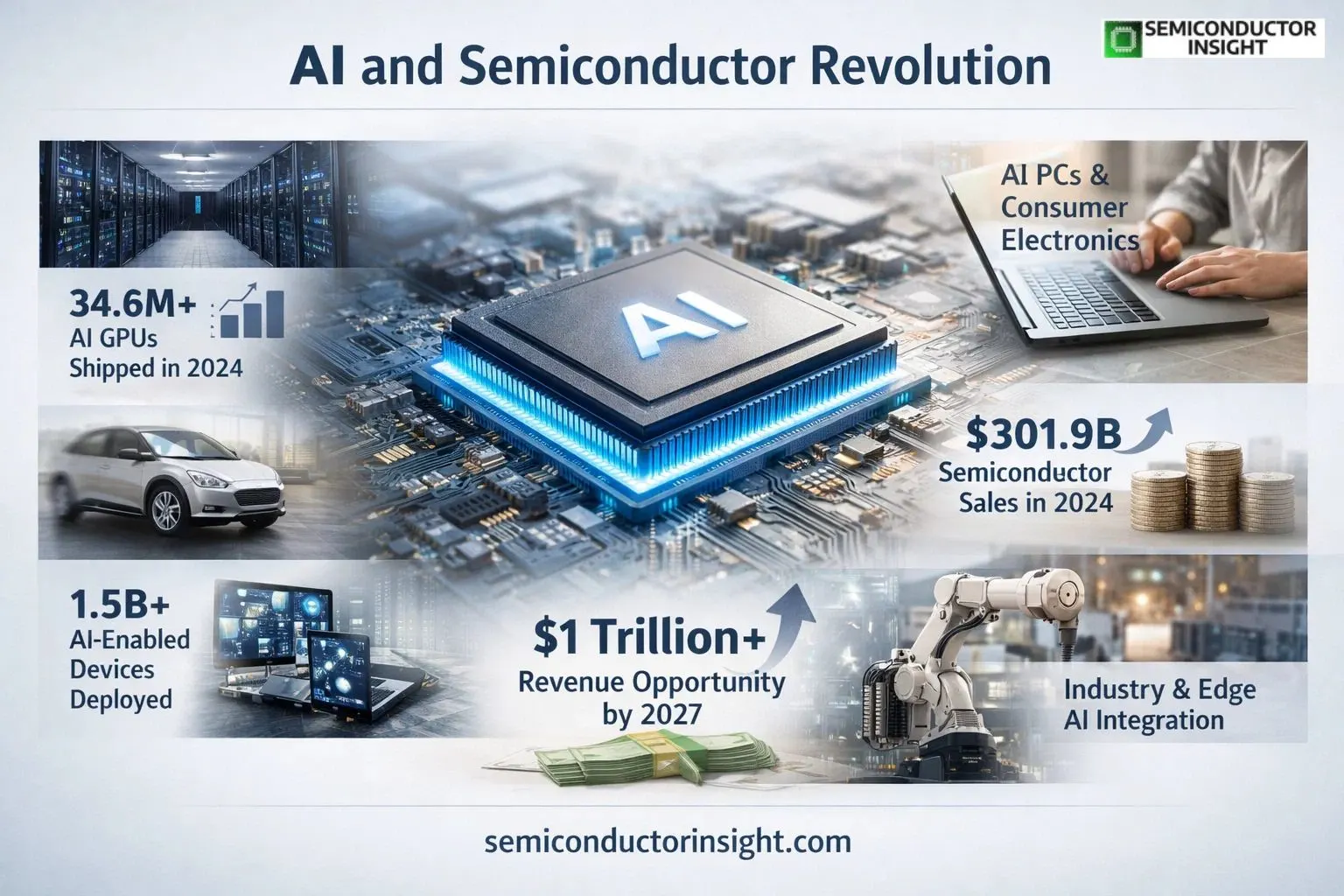
- A striking example is the shipment scale of AI hardware. In 2024 alone, over 34.6 million GPUs were shipped globally, with approximately 2.5 million dedicated AI GPUs contributing nearly $25 billion in revenue.
- AMD followed with 1.8 million AI GPUs, while Intel contributed 1.2 million AI chips, indicating a multi-vendor ecosystem rapidly scaling to meet demand.
- Despite representing less than 2% of total wafer volume, AI chips generated nearly 20% of semiconductor industry revenue, highlighting their extremely high value density. This shift clearly signals that future semiconductor growth will be driven more by performance efficiency than sheer volume.
Data Centres Becoming AI Factories
Modern data centres are no longer just storage and compute facilities they are evolving into AI production hubs. AI accelerators used in servers alone accounted for $21 billion in value in 2024, with expectations to exceed $33 billion by 2028.
Large-scale AI systems are also pushing the limits of infrastructure. A single advanced AI supercomputer in 2025 used nearly 200,000 AI chips, consumed 300 megawatts of power, and required investments of around $7 billion in hardware. This level of scale illustrates how semiconductors are now central to industrial-scale AI deployment.
At a broader level, advanced computing chips alone contributed $301.9 billion in semiconductor sales, growing nearly 40% year-over-year, driven almost entirely by AI workloads.
Edge Intelligence and the Explosion of Smart Devices
While data centres dominate headlines, the real volume expansion is happening at the edge. AI is increasingly embedded into everyday devices smartphones, surveillance systems, industrial sensors, and vehicles.
Asia alone has deployed over 1.5 billion AI-enabled connected devices, with 1.5 million AI chipset units shipped in a single regional segment, representing about 36% global share. Additionally, more than 1 million edge cameras now use AI-specific processors for real-time analytics.
In automotive applications, over 50,000 AI-enabled vehicles were produced with integrated chipsets handling functions like driver assistance and infotainment. These numbers highlight how AI semiconductors are moving beyond centralized computing into distributed intelligence.
AI PCs and Consumer Electronics Shift
The consumer electronics segment is also undergoing a major transition. AI-enabled personal computers are no longer experimental by 2024, they accounted for 22% of total PC shipments, and projections indicate that 100% of enterprise PC purchases will be AI-capable by 2026.
This shift is powered by integrated neural processing units (NPUs), allowing devices to run AI workloads locally without relying entirely on cloud infrastructure. As a result, semiconductor companies are redesigning chip architectures to balance performance, power efficiency, and real-time processing.
The Inference Wave Reshaping Chip Design
- A major shift is currently underway from training-focused chips to inference-optimized processors.
- While training requires massive compute clusters, inference focuses on deploying AI models in real-time applications such as chatbots, recommendation systems, and autonomous systems.
- Industry leaders are now designing chips specifically for inference workloads, which can deliver up to 35x faster response performance compared to traditional systems. This transition is expected to unlock new revenue streams and significantly expand the adoption of AI across industries.
- At the same time, projections suggest that AI chip demand could generate over $1 trillion in revenue opportunity by 2027, signaling an unprecedented expansion phase for semiconductor companies.
Industrial Integration and Real-World Deployments
AI semiconductors are no longer confined to tech companies. Industries such as healthcare, manufacturing, banking, and retail are integrating AI chips into their core operations.
Factories are deploying AI-enabled systems with over 180,000 rack units dedicated to compute workloads, improving automation and predictive maintenance. In finance, AI chips power fraud detection and algorithmic trading, while in healthcare they enable faster diagnostics and imaging analysis.
This widespread adoption is transforming semiconductors from a supporting technology into a central driver of digital transformation across sectors.
Artificial intelligence and machine learning market within semiconductors is not just growing it is redefining the economics, architecture, and scale of the entire industry. With high-value chips, massive deployment volumes, and expanding real-world applications, AI is positioning semiconductors at the core of the next technological era.

Comments (0)