

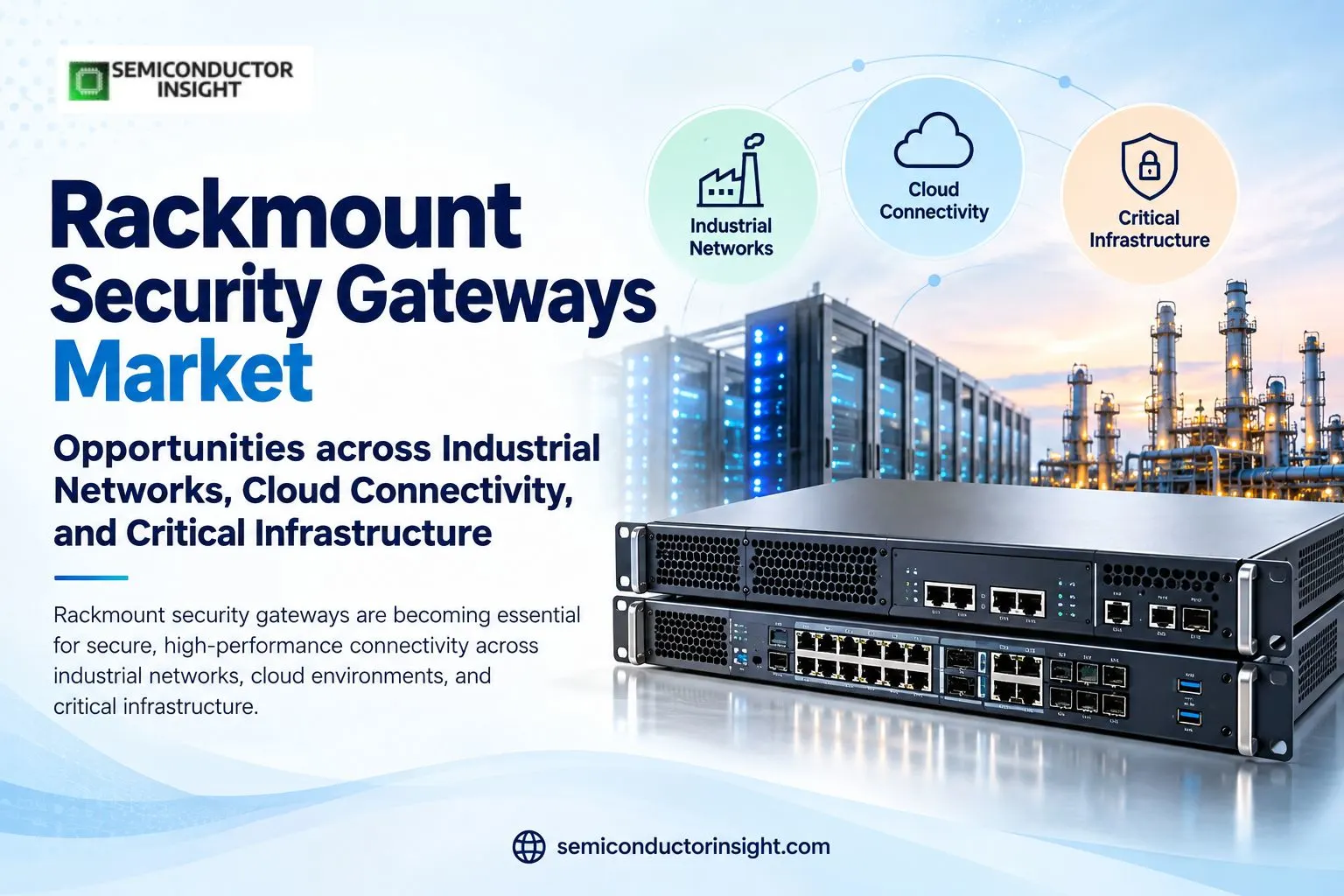
Rackmount Security Gateways Market Opportunities across Industrial Networks, Cloud Connectivity, and Critical Infrastructure
Modern data centres must process growing volumes of traffic while protecting business applications, customer information, and connected infrastructure. As organisations expand hybrid cloud environments and deploy more connected devices, network security appliances must deliver both high-speed connectivity and detailed threat inspection.
Rackmount security gateways occupy an important position in this infrastructure, combining firewall protection, virtual private network connectivity, intrusion prevention, and centralised traffic management within equipment designed for standard server racks.
Why the Network Edge Has Become a Critical Security Layer?
- Enterprise networks no longer operate within a single office or data centre. Employees connect remotely, applications run across multiple cloud environments, and industrial systems exchange data with external platforms. These changes create additional entry points that security teams must continuously monitor.
- In February 2025, the US Cybersecurity and Infrastructure Security Agency (CISA), alongside international cybersecurity partners, published guidance specifically addressing the protection of network edge devices, including firewalls and VPN gateways.
- The recommendations emphasise timely security updates, restricted administrative access, effective monitoring, and secure device configuration. This guidance demonstrates why gateway security is increasingly a lifecycle-management concern rather than simply a hardware purchasing decision.
Inside the Rackmount Gateway Architecture
A rackmount security gateway typically integrates several functions into a compact appliance. Its network interfaces receive and transmit traffic, while dedicated processors or acceleration technologies help inspect packets, establish encrypted connections, and enforce security policies.
- The 1U and 2U form factors are particularly relevant to server-room planning because they allow equipment to be installed in standard racks. However, physical dimensions alone do not determine suitability. Port density, redundant power supplies, cooling requirements, expansion capacity, and management interfaces can all influence deployment decisions.
Security performance also depends on which functions are enabled. A device that delivers high firewall throughput under basic conditions may handle substantially less traffic when intrusion prevention, application inspection, and encrypted-session processing operate simultaneously.
What Product Specifications Reveal About Real-World Capacity?
Cisco’s Secure Firewall 1200 Series illustrates how rackmount security hardware is being designed for different enterprise workloads. According to the manufacturer’s published specifications, the rackmount 1230 and 1240 models provide firewall throughput of up to 13 Gbps and 18 Gbps, respectively, while the 1250 model reaches up to 24 Gbps. The same product documentation lists TLS decryption throughput of 2.5 Gbps, 3.2 Gbps, and 4.1 Gbps for these respective models.
- These figures highlight an important distinction: encrypted traffic inspection can have a different performance ceiling from ordinary firewall processing.
- Buyers should evaluate throughput under comparable security configurations instead of relying on the largest headline number.
To find out more, feel free to browse our latest updated report: https://semiconductorinsight.com/report/rackmount-security-gateways-market/
Zero Trust Is Changing the Gateway’s Job
Traditional perimeter security often assumed that devices inside a corporate network could be trusted more readily than external connections. Zero trust changes that assumption by requiring access decisions to reflect identity, device status, policy, and the resource being requested.
- In June 2025, the US National Institute of Standards and Technology (NIST) published its SP 1800-35 practice guide for implementing zero trust architecture.
- Developed with 24 technology collaborators, the project documented 19 example implementations.
- These examples demonstrate how organisations can combine existing security technologies to protect distributed resources.
For rackmount gateway deployments, this approach supports more granular access policies, network segmentation, and integration with identity and monitoring systems. A gateway remains one component of a wider architecture, rather than a standalone solution to every security requirement.
Protecting Industrial Networks and Connected Infrastructure
Manufacturing facilities, healthcare organisations, financial institutions, and telecommunications operators have different traffic patterns and security priorities. Industrial environments may need to protect operational technology without disrupting time-sensitive processes, while financial institutions may prioritise secure connectivity and detailed audit records.
Gateway selection therefore requires attention to application compatibility, network segmentation, logging, and failover behaviour. In critical environments, maintenance planning and firmware support are equally important because an unsupported appliance can remain a security exposure even when its hardware continues to function.
The Next Design Priorities for Rackmount Security Gateways
- As network architectures evolve, gateway development is increasingly concerned with encrypted traffic visibility, higher interface speeds, centralised policy management, and integration with zero trust controls.
- Artificial intelligence infrastructure and high-density computing also make capacity planning more important, particularly where east-west traffic moves between internal servers rather than simply entering from the internet.
For rackmount security gateways market, meaningful progress will depend on balancing processing capacity with effective inspection, manageable power consumption, dependable software support, and clear operational visibility. Organisations that evaluate these factors together will be better positioned to protect expanding digital infrastructure without treating raw throughput as the only measure of security performance.

Comments (0)