MARKET INSIGHTS
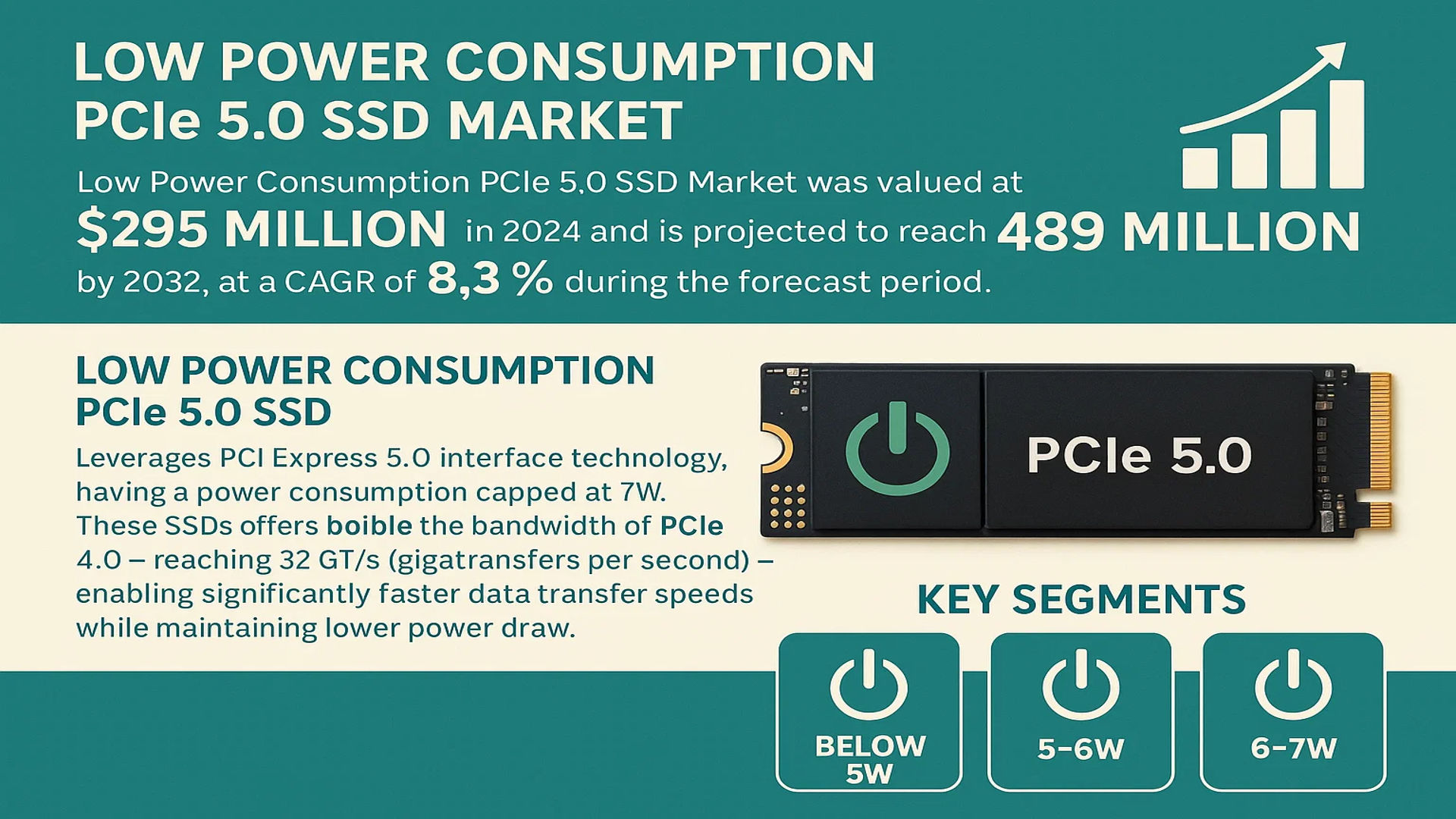
The global Low Power Consumption PCIe 5.0 SSD Market was valued at 295 million in 2024 and is projected to reach US$ 489 million by 2032, at a CAGR of 8.3% during the forecast period.
Low Power Consumption PCIe 5.0 SSD is a solid-state drive leveraging PCI Express 5.0 interface technology, designed specifically for energy efficiency with power consumption capped at 7W. These SSDs offer double the bandwidth of PCIe 4.0 – reaching 32 GT/s (gigatransfers per second) – enabling significantly faster data transfer speeds while maintaining lower power draw. Key segments include variants with power consumption below 5W, 5-6W, and 6-7W.
Market growth is driven by increasing demand for high-performance storage in data centers, enterprise systems, and edge computing applications where energy efficiency is critical. The sub-5W segment is gaining particular traction due to its suitability for portable devices and IoT applications. Major players like Samsung Semiconductor and Micron Technology are actively developing advanced NAND flash technologies to optimize power-performance ratios. Emerging applications in AI/ML workloads and 5G infrastructure are further accelerating adoption, with North America and Asia-Pacific leading regional deployments.
MARKET DYNAMICS
MARKET DRIVERS
Exponential Growth in Data-Intensive Applications to Accelerate Adoption
The increasing demand for low-power PCIe 5.0 SSDs is closely tied to the rapid expansion of data-intensive workloads across industries. With the global datasphere projected to grow at a compound annual rate exceeding 20%, enterprises are prioritizing storage solutions that combine high bandwidth with energy efficiency. PCIe 5.0 SSDs, offering transfer speeds up to 32 GT/s and power consumption under 7W, directly address this need by enabling faster processing while maintaining thermal efficiency in data centers.
Energy Efficiency Mandates Driving Product Innovation
Stringent global regulations regarding power consumption in computing infrastructure are compelling manufacturers to develop ultra-efficient storage solutions. The latest PCIe 5.0 SSDs deliver up to 40% better performance-per-watt compared to previous generations, making them particularly attractive for hyperscale data centers where energy costs can account for nearly 30% of operational expenses. This improved efficiency directly translates to significant cost savings in large-scale deployments.
For instance, leading cloud service providers have implemented strict power budgets that incentivize adoption of components with sub-7W TDP ratings, creating strong demand for compliant PCIe 5.0 solutions.
Advancements in Enterprise Workloads Fueling Technology Adoption
The shift toward artificial intelligence and machine learning workloads in enterprise environments is generating demand for high-performance, low-power storage solutions. Modern AI training sets regularly exceed 100TB in size, requiring storage infrastructure capable of sustaining high throughput with minimal latency. Low-power PCIe 5.0 SSDs are increasingly becoming the preferred choice for edge AI deployments where thermal constraints limit traditional high-performance solutions.
MARKET RESTRAINTS
Compatibility Issues with Legacy Systems Restricting Adoption
The transition to PCIe 5.0 SSDs presents significant backward compatibility challenges that are slowing market penetration. While the latest processors and chipsets support the new standard, many existing systems still utilize PCIe 3.0 or 4.0 interfaces. This creates a mismatch where end users must upgrade entire system architectures to realize the full benefits of PCIe 5.0 storage, substantially increasing total cost of ownership.
Supply Chain Constraints Impacting Product Availability
The semiconductor industry continues to face material shortages and manufacturing capacity challenges that affect PCIe 5.0 SSD production yields. Advanced NAND flash memory and controller components required for low-power designs have particularly tight supply, leading to extended lead times. These constraints are most pronounced for enterprise-grade solutions where quality and reliability requirements are highest.
Lead times for certain PCIe 5.0 controller chips have exceeded 30 weeks in recent quarters, delaying product launches and deployment timelines across the industry.
MARKET CHALLENGES
Thermal Management Complexities in High-Density Deployments
While PCIe 5.0 SSDs offer improved power efficiency, their high-performance nature still generates substantial heat in constrained environments. Data centers deploying these drives in U.2 or E1.S form factors must implement advanced cooling solutions to maintain optimal operating temperatures, adding both cost and complexity to system designs. The challenge is particularly acute in edge computing installations where space constraints limit cooling options.
Cost Premium Over Previous Generation Solutions
The price differential between PCIe 5.0 SSDs and previous generation alternatives remains significant, creating adoption barriers in cost-sensitive segments. Enterprise-grade PCIe 5.0 solutions currently carry a 35-45% price premium over comparable PCIe 4.0 products, while consumer models show even wider gaps. This pricing dynamic has led many organizations to defer upgrades until costs decrease or application requirements demand the additional performance.
MARKET OPPORTUNITIES
Emerging Edge Computing Applications Creating New Demand
The rapid expansion of edge computing infrastructure presents substantial growth opportunities for low-power PCIe 5.0 SSDs. With edge data centers expected to account for over 20% of all data center capacity within five years, there is growing need for storage solutions that combine high performance with minimal power draw. These requirements align perfectly with the capabilities of PCIe 5.0 technology, particularly in 5G network applications where latency and thermal constraints are critical factors.
Next-Gen Gaming Consoles Driving Consumer Segment Growth
The gaming industry’s transition toward PCIe 5.0 storage architectures is creating significant market expansion opportunities. Next-generation consoles and gaming PCs increasingly leverage low-power SSDs to reduce system heat generation without compromising load times or texture streaming performance. This trend is expected to accelerate as game developers optimize titles specifically for PCIe 5.0 bandwidth capabilities, creating a virtuous cycle of hardware and software innovation.
Several major gaming platforms have announced PCIe 5.0 SSD support in their next product cycles, signaling strong future demand in this segment.
Automotive Data Systems Presenting New Deployment Scenarios
The automotive industry’s increasing reliance on high-performance computing for autonomous driving and advanced infotainment systems represents a promising growth avenue. Vehicle manufacturers are evaluating PCIe 5.0 SSDs for their combination of ruggedness, power efficiency, and high bandwidth capabilities. These applications require storage solutions that can operate reliably in extreme temperature ranges while delivering the performance needed for real-time sensor processing.
LOW POWER CONSUMPTION PCIE 5.0 SSD MARKET TRENDS
Rising Demand for High-Performance, Energy-Efficient Storage Solutions Fuels Market Growth
The global Low Power Consumption PCIe 5.0 SSD market is experiencing significant growth, driven by the increasing demand for high-performance storage solutions that minimize energy usage. With data center power consumption becoming a critical concern, PCIe 5.0 SSDs offering sub-7W power draw are gaining traction as an efficient alternative to traditional storage options. The market, valued at $295 million in 2024, is projected to reach $489 million by 2032, growing at a CAGR of 8.3%. This growth is further accelerated by PCIe 5.0’s doubled bandwidth (32 GT/s) compared to PCIe 4.0, making it ideal for applications requiring rapid data transfer while maintaining low power profiles.
Other Trends
Enterprise and Data Center Adoption
Enterprise data centers are increasingly adopting low-power PCIe 5.0 SSDs to balance performance needs with sustainability goals. The ability to reduce energy consumption without compromising speed is particularly appealing for hyperscale cloud providers, where even marginal power savings translate into significant operational cost reductions. In 2024, computers and data backup applications accounted for over 45% of the market share, with automation equipment and camera systems emerging as high-growth segments due to stringent power constraints in edge computing and IoT deployments.
Technological Innovations Driving Competition
Leading manufacturers like Micron Technology, Samsung Semiconductor, and KIOXIA are pushing technological boundaries with sub-5W PCIe 5.0 SSDs that maintain peak performance. Recent product launches feature advanced NAND architectures and controller optimizations to minimize idle power consumption, addressing demand from mobile workstations and thin-client devices. The <5W segment is projected to grow at an accelerated pace, as manufacturers leverage 3D NAND scaling and improved error correction algorithms to achieve power efficiencies previously unattainable with PCIe 4.0 solutions.
COMPETITIVE LANDSCAPE
Key Industry Players
Technology Leaders Drive Innovation in the PCIe 5.0 SSD Market
The global Low Power Consumption PCIe 5.0 SSD market is characterized by intense competition among established semiconductor manufacturers and emerging tech innovators. Samsung Semiconductor and Micron Technology currently dominate the sector, leveraging their advanced NAND flash memory technologies and economies of scale to maintain market leadership. Both companies have demonstrated remarkable capability in transitioning from PCIe 4.0 to 5.0 architectures while maintaining power efficiency below 7W.
KIOXIA (formerly Toshiba Memory) has emerged as a formidable contender, particularly in Asian markets, through strategic partnerships with laptop manufacturers and data center operators. Meanwhile, Yangtze Memory Technologies, China’s national memory champion, is rapidly gaining ground with competitively priced solutions tailored for the domestic market.
The industry’s competitive intensity is further amplified by continuous product innovations. Market leaders are investing heavily in 3D NAND technology and advanced controller designs to achieve better performance-per-watt ratios. Recent product launches from Team Group Inc and Lexar demonstrate how smaller players are carving out niches in specialized segments like industrial automation and edge computing.
Looking forward, the competitive landscape is expected to evolve with several undercurrents: consolidation activities among second-tier manufacturers, increasing vertical integration by hyperscalers, and geopolitical factors affecting supply chain strategies. Companies that can balance performance innovations with energy efficiency while navigating these complexities will likely emerge as long-term winners.
List of Key Low Power Consumption PCIe 5.0 SSD Manufacturers
- Micron Technology (U.S.)
- Lexar (Longsys Electronics) (China)
- KIOXIA (Japan)
- Samsung Semiconductor (South Korea)
- Sandisk (Western Digital) (U.S.)
- Team Group Inc (Taiwan)
- Yangtze Memory Technologies (China)
- TWSC (Taiwan)
Segment Analysis:
By Type
Less than 5W Segment Leads Due to Rising Demand for Energy-Efficient Storage Solutions
The market is segmented based on power consumption into:
- Power Consumption: Less than 5W
- Power Consumption: 5-6W
- Power Consumption: 6-7W
By Application
Computers Segment Dominates With Increasing Adoption in High-Performance Computing
The market is segmented based on application into:
- Computers
- Subtypes: High-performance workstations, gaming PCs, enterprise servers
- Cameras
- Automation Equipment
- Data Backup
- Others
By Storage Capacity
500GB-1TB Segment Shows Strong Growth Potential for Balanced Performance and Cost
The market is segmented based on storage capacity into:
- Below 500GB
- 500GB-1TB
- 1TB-2TB
- Above 2TB
By End-User
Enterprise IT Segment Leads With Growing Data Center Upgrades
The market is segmented based on end-user into:
- Enterprise IT
- Subtypes: Data centers, cloud service providers
- Manufacturing
- Media & Entertainment
- Consumer Electronics
- Others
Regional Analysis: Low Power Consumption PCIe 5.0 SSD Market
Asia-Pacific
The Asia-Pacific region dominates the global low-power PCIe 5.0 SSD market, driven by China’s aggressive semiconductor manufacturing expansion and Japan-South Korea’s technological leadership in storage solutions. China’s Yangtze Memory Technologies has emerged as a key player, supported by government subsidies under the “Made in China 2025” initiative. The region benefits from concentrated electronics manufacturing hubs demanding energy-efficient components for laptops, data centers, and IoT devices. However, market fragmentation exists with established players like Samsung Semiconductor and KIOXIA competing against cost-competitive Chinese alternatives. The increasing adoption of AI-driven computing and 5G infrastructure presents significant growth opportunities, though tariff tensions and supply chain localization policies create operational complexities.
North America
North America represents high-value demand with strong adoption in enterprise storage and hyperscale data centers, where power efficiency translates to substantial operational cost savings. The U.S. leads in R&D investments, with companies like Micron Technology driving innovations in sub-5W SSD solutions. Regulatory pressures for greener data center operations and the proliferation of edge computing applications accelerate market growth. Technology partnerships between SSD manufacturers and cloud service providers (AWS, Microsoft Azure) are reshaping product development priorities. While the market shows robust growth, component shortages and China trade restrictions occasionally disrupt supply chains, prompting some manufacturers to explore nearshoring options.
Europe
Europe’s market focuses on sustainable computing solutions, with EU data center energy efficiency directives (EU Code of Conduct) pushing adoption of low-power storage. Germany and UK lead in industrial automation applications, where PCIe 5.0 SSDs enable real-time data processing with minimal energy overhead. The region sees increasing demand from automotive manufacturers implementing advanced driver-assistance systems (ADAS) requiring reliable, low-power storage. However, strict data privacy regulations and preference for established suppliers create high entry barriers. Recent developments include collaborations between research institutions and corporations to develop ultra-low-power SSD architectures optimized for European climate-neutral data center initiatives.
South America
The South American market remains nascent but shows growth potential in Brazil’s financial technology sector and Argentina’s emerging data center landscape. Price sensitivity leads to preference for PCIe 4.0 solutions, though increasing cloud service penetration gradually drives demand for next-gen SSDs. Infrastructure limitations and import dependencies hinder wider adoption, with most products sourced from Asian manufacturers. Local assembly initiatives in Brazil aim to reduce costs, while energy efficiency awareness grows among enterprise buyers. Market education about TCO (Total Cost of Ownership) benefits will be crucial for overcoming initial price resistance to PCIe 5.0 solutions.
Middle East & Africa
This emerging market sees selective adoption in UAE and Saudi Arabia’s smart city projects and oil/gas sector digitalization. Dubai’s data center hub development attracts global providers offering energy-efficient infrastructure solutions. The lack of local manufacturing and reliance on imports creates pricing challenges, though government initiatives to boost technology sectors show promise. South Africa leads in enterprise adoption, particularly for financial services and mining automation. Market growth faces hurdles from power infrastructure inconsistencies and preference for proven legacy systems, but increasing investments in AI and 5G present long-term opportunities for PCIe 5.0 SSD implementations.
Report Scope
This market research report provides a comprehensive analysis of the global Low Power Consumption PCIe 5.0 SSD market, covering the forecast period 2024–2032. It offers detailed insights into market dynamics, technological advancements, competitive landscape, and key trends shaping the industry.
Key focus areas of the report include:
- Market Size & Forecast: Historical data and future projections for revenue, unit shipments, and market value across major regions and segments. The global Low Power Consumption PCIe 5.0 SSD market was valued at USD 295 million in 2024 and is projected to reach USD 489 million by 2032, growing at a CAGR of 8.3%.
- Segmentation Analysis: Detailed breakdown by power consumption levels (less than 5W, 5-6W, 6-7W), application (computers, cameras, automation equipment, data backup, others), and end-user industry.
- Regional Outlook: Insights into market performance across North America, Europe, Asia-Pacific, Latin America, and the Middle East & Africa, with specific focus on the U.S. and China as key markets.
- Competitive Landscape: Profiles of leading market participants including Micron Technology, KIOXIA, Samsung Semiconductor, and Yangtze Memory Technologies, covering their product portfolios, market shares, and strategic initiatives.
- Technology Trends & Innovation: Assessment of PCIe 5.0 interface advancements, energy-efficient designs, and emerging applications in data centers and edge computing.
- Market Drivers & Restraints: Evaluation of factors driving market growth including demand for high-speed storage solutions and energy efficiency, along with challenges like supply chain constraints and high production costs.
- Stakeholder Analysis: Strategic insights for component manufacturers, OEMs, system integrators, and investors regarding market opportunities and competitive positioning.
The report employs both primary and secondary research methodologies, including interviews with industry experts and analysis of verified market data, to ensure accuracy and reliability.
FREQUENTLY ASKED QUESTIONS:
What is the current market size of Global Low Power Consumption PCIe 5.0 SSD Market?
-> Low Power Consumption PCIe 5.0 SSD Market was valued at 295 million in 2024 and is projected to reach US$ 489 million by 2032, at a CAGR of 8.3% during the forecast period.
Which key companies operate in Global Low Power Consumption PCIe 5.0 SSD Market?
-> Key players include Micron Technology, KIOXIA, Samsung Semiconductor, Sandisks, Team Group Inc, and Yangtze Memory Technologies.
What are the key growth drivers?
-> Key growth drivers include increasing demand for high-performance storage, data center expansion, and energy efficiency requirements in computing devices.
Which region dominates the market?
-> Asia-Pacific is the fastest-growing market, driven by semiconductor manufacturing in China and South Korea, while North America leads in technology adoption.
What are the emerging trends?
-> Emerging trends include ultra-low power designs for mobile applications, integration with AI workloads, and development of PCIe 5.0 ecosystem components.

Get Sample Report PDF for Exclusive Insights
Report Sample Includes
- Table of Contents
- List of Tables & Figures
- Charts, Research Methodology, and more...
 Download Sample Report PDF