
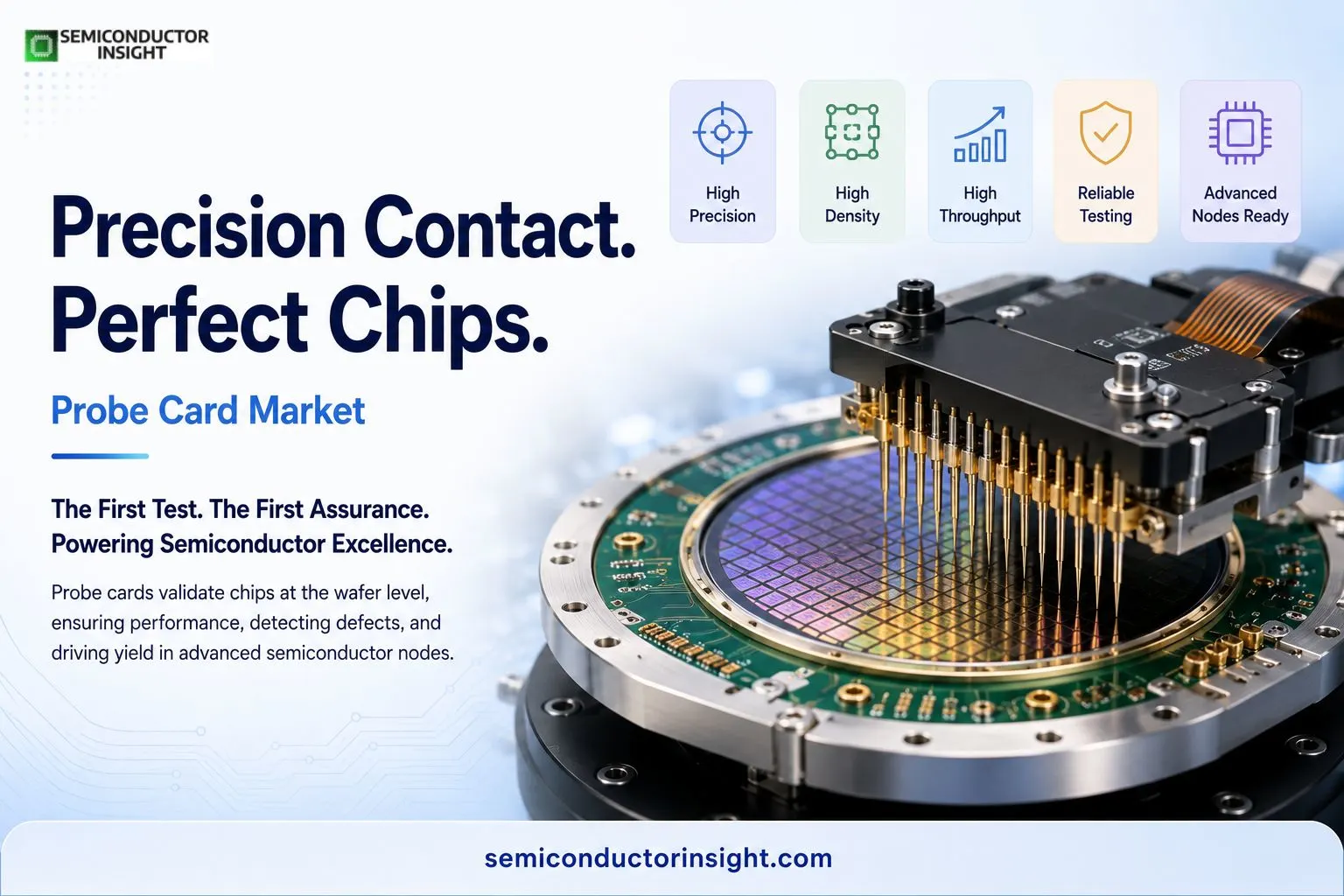
Probe Card Market Responding to the Surge in Automotive Semiconductor Demand
In the semiconductor production chain, probe cards serve as the first checkpoint where chip functionality is validated at the wafer level. Before chips are diced and packaged, probe cards establish electrical contact with microscopic pads on wafers to test performance and detect defects.
As chip architectures evolve toward smaller nodes and higher transistor density, the importance of precision testing has intensified. Probe cards are no longer simple contact tools but highly engineered systems designed to match the complexity of modern integrated circuits.
Scaling with Transistor Density and Node Shrinkage
The shift toward advanced nodes such as 5nm and below has significantly increased the number of input and output pads on wafers. A single advanced logic wafer can contain tens of thousands of contact points requiring simultaneous testing.
This has led to the development of high-density probe cards capable of handling extremely fine pitch sizes. For example, advanced probe cards now operate at pitches below 40 microns, enabling accurate testing of densely packed chip designs used in AI processors and high-performance computing systems.
Wafer Volumes and Testing Demand Expanding Rapidly
Global semiconductor fabrication continues to scale, directly influencing probe card demand. According to data from industry associations and government-backed semiconductor reports, global wafer capacity exceeded 30 million wafers per month in recent years, with new fabrication plants under construction in Asia, the United States, and Europe.
Each wafer undergoes multiple testing cycles, significantly amplifying the need for durable and high-performance probe cards. In high-volume memory production, a single probe card may be used to test thousands of wafers before replacement, highlighting both its importance and wear-intensive nature.
Evolving Chip Demands Driving Next-Generation Probe Card Innovation
- The rapid advancement of automotive electronics alongside the surge in artificial intelligence and data infrastructure is significantly transforming requirements in probe card market.
- Modern electric vehicles now integrate thousands of semiconductor components, particularly in safety-critical systems such as advanced driver assistance and battery management. These applications demand extremely high reliability, where even the smallest defect is unacceptable under harsh operating conditions.
- At the same time, the growing adoption of AI-driven workloads and large-scale data centres is accelerating the production of complex, high-value chips such as GPUs and custom accelerators. These devices require precise wafer-level testing to ensure performance and efficiency, as even minor inaccuracies can lead to substantial yield losses.
- Together, these trends are pushing probe card development toward enhanced durability, superior signal integrity, and consistent electrical performance across extended and high-frequency testing cycles.
- As chip complexity continues to rise, probe cards are becoming increasingly critical in ensuring both product quality and manufacturing efficiency in high-growth sectors.
Integration with Automated Test Ecosystems
Probe cards are now part of fully automated testing ecosystems within semiconductor fabs. They are integrated with wafer probers and automated test equipment to deliver high-throughput and repeatable testing processes.
A modern semiconductor facility can process thousands of wafers daily, with probe cards operating continuously under tightly controlled conditions. This integration ensures consistent data collection and real-time feedback, enabling manufacturers to quickly identify and address process variations.
At Last before Ending, Don’t Forget to Browse Our Recent Exclusive Report for Detailed Insights: https://semiconductorinsight.com/report/probe-card-market/
Industrial Examples Reflecting Current Momentum
- Leading semiconductor manufacturers are investing heavily in testing infrastructure as part of broader expansion strategies.
- In the United States, new fabrication facilities supported by government initiatives are incorporating advanced probe card systems to support domestic chip production.
- In Asia, large-scale memory manufacturers are deploying high-density probe cards to handle increased wafer volumes driven by global demand for storage and computing power.
- These developments highlight the growing strategic importance of probe card technology in the semiconductor ecosystem.
As semiconductor manufacturing becomes increasingly data-driven, probe cards are playing a key role in enabling accurate and reliable testing at scale. Their ability to adapt to changing chip designs, higher frequencies, and stricter quality standards positions them as indispensable tools in modern fabrication. With ongoing advancements in materials, design, and automation, probe cards are set to remain central to ensuring the performance and reliability of next-generation semiconductor devices.

Comments (0)