
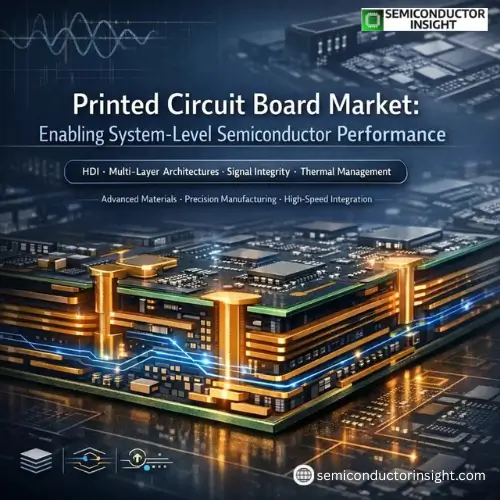
Printed Circuit Board Market: The Silent Backbone of Semiconductor Innovation
In the semiconductor world, attention often gravitates toward chips, nodes, and processing power. Yet, beneath every functioning electronic system lies a quieter enabler the printed circuit board (PCB). Without PCBs, even the most advanced semiconductor devices would remain isolated components rather than integrated systems. As electronics become denser, faster, and more application-specific, the PCB market is evolving from a supporting role into a strategic pillar of semiconductor design and manufacturing.
Printed circuit board market today reflects how electronics are being re-engineered at a system level. It is no longer just about connecting components; it is about managing heat, signal integrity, power distribution, and miniaturization simultaneously.
Why PCBs Are Becoming More Critical Than Ever?
Modern semiconductor devices operate at higher frequencies and tighter tolerances than ever before. This places new demands on PCB materials, layer structures, and layout precision. A poorly designed board can negate the performance advantages of an advanced chip, making PCB engineering a decisive factor in overall system reliability.
As a result, PCBs are increasingly co-designed alongside semiconductors rather than treated as a downstream step. This shift is particularly evident in high-speed computing, automotive electronics, and advanced communication equipment, where signal loss or electromagnetic interference can directly affect performance.
The Move toward High-Density and Multi-Layer Architectures
One of the defining characteristics of the current printed circuit board market is the rapid adoption of high-density interconnect (HDI) and multi-layer designs. Compact consumer devices, data center hardware, and industrial controllers all require boards that can support complex routing within limited space.
Rather than increasing board size, manufacturers are stacking functionality vertically through additional layers and microvias. This approach supports higher component density while improving electrical performance. However, it also raises manufacturing complexity, pushing PCB suppliers to invest in advanced fabrication and inspection technologies.
Material Innovation Is Driving Differentiation
Traditional PCB materials are no longer sufficient for all semiconductor applications. High-frequency and high-power systems demand substrates with better thermal stability, lower dielectric loss, and higher mechanical reliability.
This has led to growing use of specialized laminates, ceramic-based materials, and metal-core PCBs. These materials help manage heat dissipation and signal integrity, especially in power electronics and RF applications. The market is therefore shifting toward value-driven solutions rather than commodity boards, favoring suppliers with material science expertise.
Manufacturing Precision and Yield Matter More Than Volume
While PCB production remains a high-volume industry, precision has become just as important as scale. Semiconductor applications often require boards with extremely tight tolerances, consistent impedance control, and flawless layer alignment.
Even minor defects can lead to signal degradation or early system failure. This has increased demand for automated optical inspection, X-ray analysis, and process control systems within PCB manufacturing facilities. In this environment, quality assurance is not just a compliance requirement it is a competitive advantage.
Limited Snapshot: Key Forces Shaping the Market
Without overloading details, a few structural forces stand out:
- Rising semiconductor integration levels
- Growth in automotive electronics and electrification
- Expansion of data centers and networking infrastructure
Each of these areas relies heavily on advanced PCB designs to translate chip performance into real-world functionality.
Feel Free to Reach Our Most Recent Updates of the Report:
https://semiconductorinsight.com/report/printed-circuit-board-market/
Regional Production Patterns Influence Supply Chains
The printed circuit board market remains geographically concentrated, with Asia-Pacific accounting for a large share of global production. This concentration has prompted electronics companies to reassess supply chain resilience, especially for critical semiconductor applications.
In response, some regions are encouraging local PCB manufacturing to support domestic semiconductor ecosystems. While this does not immediately shift global dominance, it is reshaping long-term investment strategies and partnerships within the market.
PCBs and Sustainability Expectations
Environmental considerations are also beginning to influence PCB design and manufacturing. Reduced chemical usage, improved material recovery, and longer product lifecycles are becoming part of supplier evaluations. Although sustainability is not yet the primary buying factor, it is increasingly part of strategic discussions, particularly for large electronics manufacturers.
Closing Perspective
The printed circuit board market may not command the spotlight, but its importance within the semiconductor value chain is undeniable. As chips become more powerful and specialized, PCBs must evolve in parallel supporting performance, reliability, and integration at every level. Rather than being a passive component, the modern PCB is an active contributor to semiconductor innovation, shaping how electronic systems are built, scaled, and deployed across industries.

Comments (0)