Market Insights
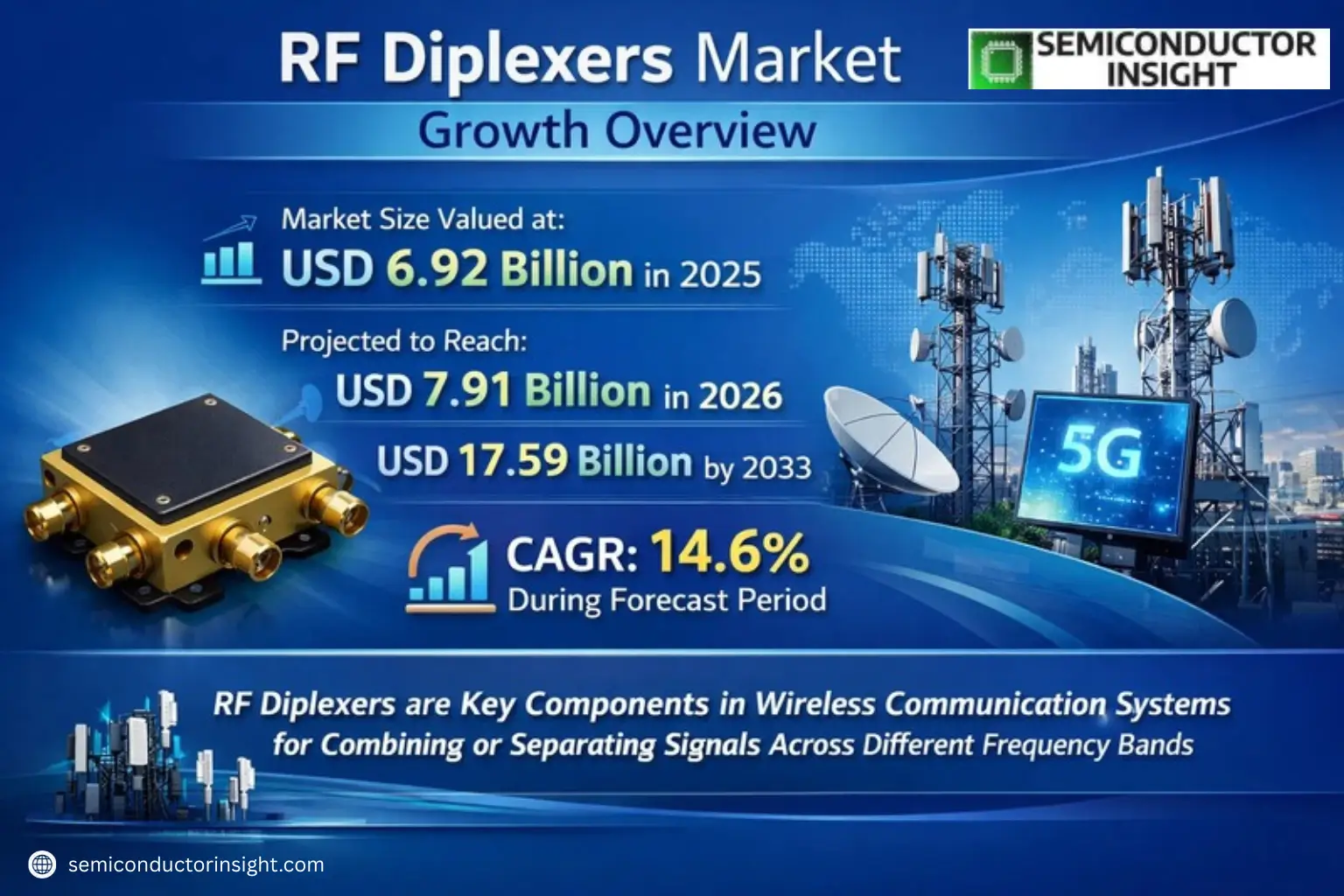
Global RF Diplexers Market size was valued at USD 6.92 billion in 2025 and is projected to grow from USD 7.91 billion in 2026 to USD 17.59 billion by 2033, exhibiting a CAGR of 14.6% during the forecast period.
RF diplexers are specialized components used in wireless communication systems to enable multiple transmitters to operate on a single antenna by combining or separating signals across different frequency bands. These devices play a critical role in optimizing signal transmission efficiency, reducing interference, and enhancing overall system performance in applications such as smartphones, tablets, automotive electronics, and IoT devices.
The market is experiencing robust growth due to increasing demand for high-frequency communication technologies like 5G, rising adoption of advanced consumer electronics, and expanding applications in automotive radar systems. Furthermore, innovations in ceramic-based diplexers which dominate the market with a 45% share are driving cost efficiencies and miniaturization. Key players such as TDK, Murata Manufacturing, and Taiyo Yuden collectively hold over 40% of the global market share, leveraging their expertise in materials science and RF component design.
MARKET DRIVERS
Increasing Demand for Wireless Communication
RF Diplexers Market is experiencing significant growth due to the rising adoption of wireless communication technologies. With the global expansion of 5G networks, RF diplexers play a critical role in enabling efficient frequency separation and signal management. The market is projected to grow at a CAGR of 7.2% from 2023 to 2030.
Advancements in Telecommunications Infrastructure
Telecom operators are heavily investing in modernizing infrastructure, increasing the demand for high-performance RF diplexers. These components are essential for base stations, ensuring seamless signal transmission across multiple frequency bands. The increasing deployment of small cells also contributes to market expansion.
Additionally, the Internet of Things (IoT) ecosystem is expanding rapidly, requiring robust RF components to handle diverse communication protocols. This trend is further accelerating RF diplexer adoption across industrial and consumer applications.
MARKET CHALLENGES
Design and Manufacturing Complexities
Designing RF diplexers for high-frequency applications presents significant technical challenges. Ensuring minimal insertion loss and high isolation between bands requires advanced materials and precision manufacturing, increasing production costs.
Other Challenges
Intellectual Property Concerns
The competitive RF Diplexers Market sees frequent patent disputes, particularly concerning frequency band allocation and filter design innovations, which can hinder smaller manufacturers.
Supply Chain Constraints
Disruptions in the semiconductor supply chain have led to component shortages, impacting RF diplexer production timelines and increasing lead times for critical telecommunications projects.
MARKET RESTRAINTS
High Cost of Advanced RF Components
The sophisticated materials and manufacturing processes required for high-performance RF diplexers result in elevated product costs. This pricing pressure limits adoption among cost-sensitive applications, particularly in emerging markets where budget constraints are more pronounced.
MARKET OPPORTUNITIES
Emerging Applications in Satellite Communications
The growing satellite communication sector presents substantial opportunities for RF diplexer manufacturers. With increasing deployments of LEO satellites and earth observation systems, demand for space-grade RF components is expected to grow by 9.1% annually through 2030.
Military and Defense Modernization Programs
Government investments in electronic warfare systems and military communications are driving demand for ruggedized RF diplexers. The defense sector accounted for 28% of the RF Diplexers Market share in 2023, with growth expected to accelerate due to global geopolitical tensions.
RF Diplexers Market Trends
Accelerated Growth in RF Diplexers Demand
Global RF Diplexers market is experiencing rapid expansion, projected to grow from USD 6.9 billion in 2025 to USD 17.6 billion by 2033 at a 14.6% CAGR. This surge is driven by increasing adoption in wireless communication devices and automotive electronics. The market demonstrates strong regional demand patterns, with China dominating at 30% share followed by North America and Japan collectively holding 45%.
Other Trends
Ceramic Type Dominance
Ceramic-based RF Diplexers maintain market leadership with 45% share due to superior performance in signal isolation and thermal stability. Manufacturers continue to invest in advanced ceramic materials to enhance frequency response and miniaturization capabilities for next-generation applications.
Application Sector Growth
Smartphones represent the largest application segment, consuming approximately 35% of RF Diplexer production. Emerging demand from automobile electronics is creating new opportunities, particularly for 5G-connected vehicles and advanced driver assistance systems (ADAS).
Competitive Landscape Shifts
Four leading manufacturers (TDK, M/A-Com, Taiyo Yuden, and Walsin) control over 40% market share through technological innovation in compact designs. Recent industry developments include strategic acquisitions by Murata and Broadcom to strengthen their RF component portfolios. Price competition is intensifying as Chinese manufacturers expand their global footprint.
Regional Market Developments
Asia-Pacific remains the production and consumption hub, with Southeast Asian nations emerging as cost-effective manufacturing alternatives to China. European markets are prioritizing high-performance RF Diplexers for industrial IoT applications, while North America leads in automotive-grade component innovation.
COMPETITIVE LANDSCAPE
Key Industry Players
Technological Innovation Drives Intense Competition in RF Diplexers Market
RF Diplexers Market is dominated by global electronics component manufacturers, with TDK Corporation leading the sector with its advanced ceramics-based solutions. Along with M/A-Com Technology Solutions, Taiyo Yuden, and Walsin Technology Corporation, these four players collectively control over 40% of the global market share. The competitive landscape features strong Japanese and Chinese manufacturers capitalizing on growing smartphone and automotive electronics demand.
Specialist component suppliers like Johanson Technology and Yageo compete through niche RF solutions, while semiconductor giants such as STMicroelectronics and Broadcom leverage their system-level expertise. The market shows increasing consolidation, with Murata Manufacturing’s acquisitions strengthening its position in high-frequency applications. Regional players like TOKYO KEIKI maintain strong positions in local markets through customized solutions.
List of Key RF Diplexers Companies Profiled
- TDK Corporation
- M/A-Com Technology Solutions
- Taiyo Yuden
- Walsin Technology Corporation
- Murata Manufacturing
- Yageo Corporation
- Johanson Technology
- STMicroelectronics
- AVX Corporation
- TOKYO KEIKI
- Pulse Electronics
- Broadcom (Avago)
- Samsung Electro-Mechanics
- Vishay Intertechnology
- EPCOS (TDK Group)
Segment Analysis:
| Segment Category | Sub-Segments | Key Insights |
| By Type |
|
Ceramics Type dominates due to:
|
| By Application |
|
Smart Phone segment leads because:
|
| By End User |
|
Consumer Electronics OEMs show strongest demand because:
|
| By Frequency Range |
|
Sub-6 GHz remains dominant due to:
|
| By Integration Level |
|
Integrated Modules show strongest growth because:
|
Regional Analysis: Global RF Diplexers Market
North America maintains technological superiority with advanced R&D facilities focusing on broadband diplexers for 5G base stations and military communications systems. The presence of leading semiconductor companies accelerates product innovation cycles.
The region’s substantial defense budget drives specialized diplexer development for radar systems and secure military communications, creating premium-priced, high-performance product segments with stringent reliability requirements.
Aggressive 5G rollout across major cities creates sustained demand for compact diplexers capable of handling multiple frequency bands while maintaining signal integrity in dense urban deployments.
FCC spectrum allocation policies and telecom standards push manufacturers to develop diplexers with better isolation characteristics and lower insertion losses to meet evolving regulatory requirements.
Asia-Pacific
The Asia-Pacific region shows the fastest growth in RF diplexer adoption, fueled by massive 5G infrastructure projects across China, South Korea, and Japan. Local manufacturers are gaining prominence by offering cost-competitive solutions for mid-band frequencies. The region benefits from integrated electronics manufacturing ecosystems that reduce production costs while maintaining quality. Emerging applications in automotive radar systems and consumer electronics present new opportunities, with China’s semiconductor self-sufficiency initiatives potentially reshaping the regional supply chain dynamics for RF components.
Europe
Europe maintains steady growth in the RF Diplexers Market, with strong emphasis on automotive and industrial applications. The region’s focus on energy-efficient telecom equipment drives innovation in low-power diplexer designs. Germany and France lead in specialized applications for automotive radar and industrial IoT, while Nordic countries show strong adoption for base station equipment. European manufacturers differentiate through precision engineering and adherence to strict environmental regulations, creating niche markets for high-reliability components.
Middle East & Africa
The Middle Eastern market is characterized by premium telecommunications infrastructure projects, particularly in Gulf countries investing heavily in smart city initiatives. RF diplexer demand is growing for both terrestrial and satellite communication networks. Africa shows emerging potential with improving mobile penetration, though price sensitivity remains a key market characteristic, favoring cost-optimized diplexer solutions for base station deployments in expanding networks.
South America
South America presents moderate growth opportunities, with Brazil leading in telecommunications infrastructure development. The region shows increasing demand for diplexers in hybrid fiber-coaxial networks and private mobile networks. Market growth is constrained by economic volatility but benefits from gradual digital transformation across major industries and government initiatives to improve broadband connectivity in urban areas.
Report Scope
This market research report provides a comprehensive analysis of the RF Diplexers Market, covering the forecast period 2026–2033. It offers detailed insights into market dynamics, technological advancements, competitive landscape, and key trends shaping the industry.
Key focus areas of the report include:
- Market Overview: The report begins with an overview outlining its current market scenario, key growth indicators, and industry transformation drivers. It discusses macroeconomic factors, demand–supply balance, regulatory landscape, and the strategic role of semiconductors in powering advancements across industries such as automotive, telecommunications, consumer electronics, and industrial automation.
- Market Size & Forecast: Historical data and future projections for revenue, unit shipments, and market value across major regions and segments.
- Segmentation Analysis: Detailed breakdown by product type, technology, application, and end-user industry to identify high-growth segments and investment opportunities.
- Regional Insights: Insights into market performance across North America, Europe, Asia-Pacific, Latin America, and the Middle East & Africa, including country-level analysis where relevant.
- Competitive Landscape: Profiles of leading market participants, including their product offerings, R&D focus, manufacturing capacity, pricing strategies, and recent developments such as mergers, acquisitions, and partnerships.
- Technology Trends & Innovation: Assessment of emerging technologies, integration of AI/IoT, semiconductor design trends, fabrication techniques, and evolving industry standards.
- Market Drivers & Restraints: Evaluation of factors driving market growth along with challenges, supply chain constraints, regulatory issues, and market-entry barriers.
- Stakeholder Insights: Insights for component suppliers, OEMs, system integrators, investors, and policymakers regarding the evolving ecosystem and strategic opportunities.
Primary and secondary research methods are employed, including interviews with industry experts, data from verified sources, and real-time market intelligence to ensure the accuracy and reliability of the insights presented.
FREQUENTLY ASKED QUESTIONS:
What is the current market size of RF Diplexers Market?
-> RF Diplexers Market size was valued at USD 6.92 billion in 2025 and is projected to grow from USD 7.91 billion in 2026 to USD 17.59 billion by 2033, exhibiting a CAGR of 14.6% during the forecast period.
Which key companies operate in RF Diplexers Market?
-> Key players include TDK, M/A-Com Technology Solutions, Walsin Technology Corporation, Taiyo Yuden, Murata Manufacturing, Yageo, Johanson Technology, STMicroelectronics, AVX, TOKYO KEIKI, Pulse Electronics, and Avago (Broadcom). Global top four manufacturers hold a share over 40%.
What are the key growth drivers?
-> Key growth drivers include increasing demand for smart phones, notebook and tablets, automobile electronics, and advancements in telecommunications infrastructure.
Which region dominates the market?
-> China is the largest market with a share over 30%, followed by Japan and North America, which collectively hold over 45% of the market share.
What are the major product segments?
-> The Ceramics Type segment dominates with a share of about 45%, followed by Crystal Type and others.
What are the key application areas?
-> The largest application is Smart phone, followed by Notebook and Tablet, and Automobile electronics.
Get Sample Report PDF for Exclusive Insights
Report Sample Includes
- Table of Contents
- List of Tables & Figures
- Charts, Research Methodology, and more...
 Download Sample Report PDF