Key Statistics
Key Takeaways
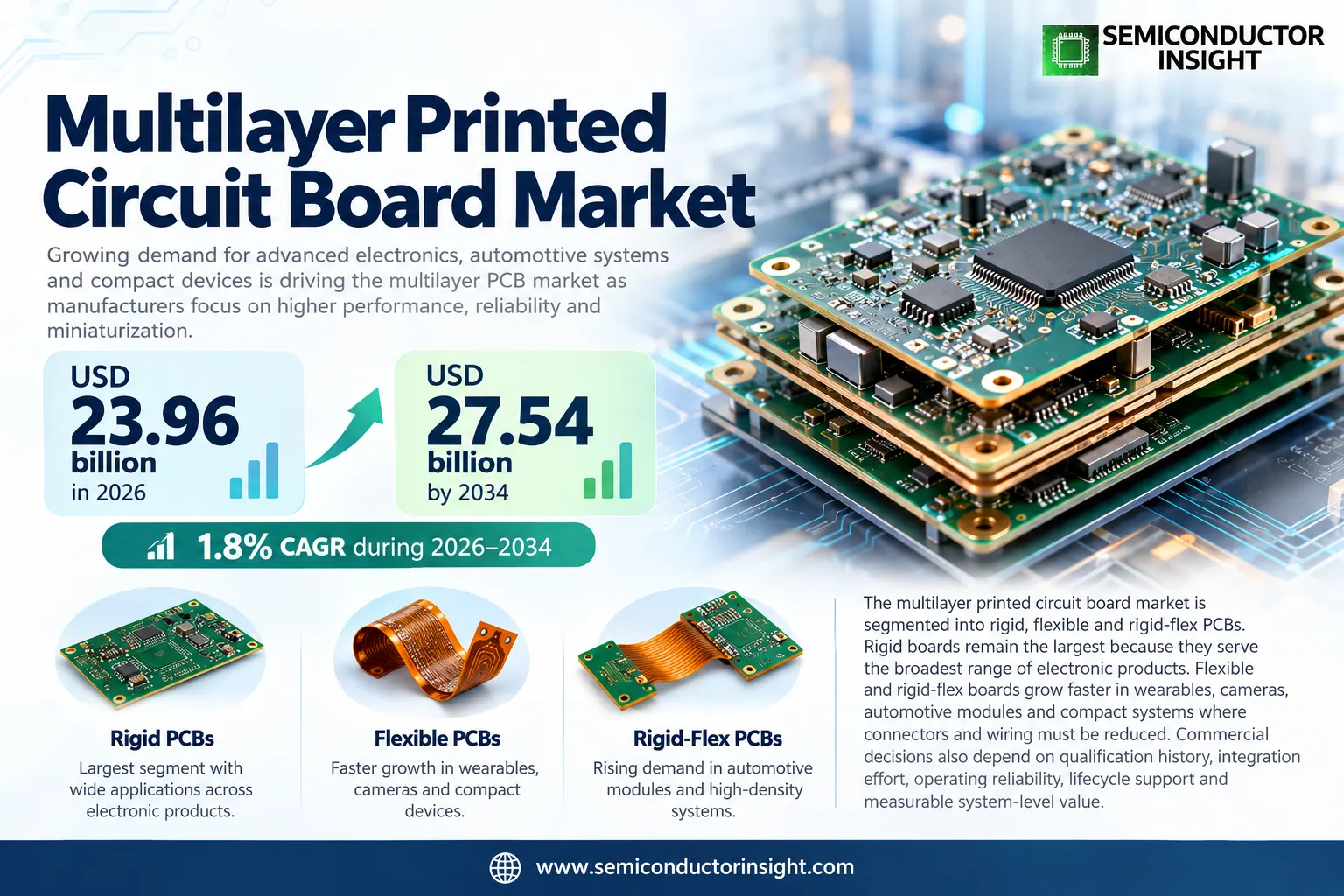
- Market size: The market is valued at USD 23.55 billion in 2025 and is projected to reach USD 27.54 billion by 2034, representing a 1.8% CAGR during 2026–2034.
- Rigid PCBs remain the largest type, while flexible and rigid-flex structures grow faster in compact electronics and vehicles.
- 4-8 layer boards are the largest layer-count category, balancing cost and routing density across mainstream electronics.
- Asia Pacific accounts for more than 60% of global demand, supported by electronics manufacturing in China, Taiwan, South Korea and Japan.
- HDI is the strongest technology-growth segment, driven by AI servers, 5G, automotive electronics and device miniaturization.
Multilayer Printed Circuit Board Market Overview
Multilayer printed circuit board market is valued at USD 23.55 billion in 2025 and is projected to reach USD 27.54 billion by 2034, expanding at a 1.8% CAGR during 2026–2034. The 2026 market level is USD 23.96 billion. Asia Pacific dominates through electronics manufacturing scale and an integrated PCB supply chain. Market value grows moderately overall, but higher-layer-count and HDI products capture increasing value in AI, telecom and automotive systems.
Multilayer PCBs contain three or more conductive copper layers laminated with dielectric materials to create dense electrical interconnection within a compact board. They are used in smartphones, servers, vehicles, industrial controls, medical devices and aerospace systems. Performance depends on layer registration, via integrity, impedance control, copper quality, laminate properties, thermal reliability and the ability to manufacture fine lines at high yield.
Technology development is shifting toward HDI, sequential lamination, low-loss materials, embedded components and higher layer counts. AI servers and hyperscale networks demand high-speed signal integrity and power delivery, while automotive electronics add thermal and reliability requirements. TTM’s September 2026 India showcase explicitly highlighted high-speed PCB technology for AI and hyperscale data centers as a major design focus.
Commercial competition is segmented by complexity. Commodity 4-6 layer boards face strong pricing pressure, while 12+ layer, high-frequency, HDI and high-reliability boards command premium pricing because process windows are tighter and customer qualification is longer. Global customers increasingly seek manufacturing diversification beyond one country, creating opportunities in Southeast Asia, India and North America.
Segment Analysis: By Type
By type, the market is segmented into rigid, flexible and rigid-flex PCBs. Rigid boards remain the largest because they serve the broadest range of electronic products. Flexible and rigid-flex boards grow faster in wearables, cameras, automotive modules and compact systems where connectors and wiring must be reduced. Commercial decisions in the Multilayer Printed Circuit Board market also depend on qualification history, integration effort, operating reliability, lifecycle support and measurable system-level value.
| Type | Commercial role |
|---|---|
| Rigid PCBs | Largest mainstream category for servers, consumer, industrial and automotive electronics. |
| Flexible PCBs | Thin bendable interconnect for compact devices, cameras and displays. |
| Rigid-Flex PCBs | Integrated rigid and flexible sections for high-reliability compact assemblies. |
Additional Segmentation: By Layer Count
Layer count is a major cost and complexity driver. Four-to-eight-layer boards represent the largest mainstream segment, 8-12 layers serve more complex automotive and industrial systems, and 12+ layers grow in servers, networking, aerospace and high-performance computing where routing density and signal integrity are critical. Commercial decisions in the Multilayer Printed Circuit Board market also depend on qualification history, integration effort, operating reliability, lifecycle support and measurable system-level value.
| Layer Count | Demand characteristics |
|---|---|
| 4-8 Layer Boards | Mainstream consumer, industrial and automotive electronics. |
| 8-12 Layer Boards | Higher-density control, communication and vehicle systems. |
| 12+ Layer Boards | AI servers, networking, aerospace and other high-complexity electronics. |
Segment Analysis: By Application
By application, consumer electronics remains the largest volume segment, while automotive and industrial demand grows with electrification and automation. Medical and aerospace markets are smaller but higher value because qualification, traceability and reliability requirements are stricter. Commercial decisions in the Multilayer Printed Circuit Board market also depend on qualification history, integration effort, operating reliability, lifecycle support and measurable system-level value.
| Application | Demand characteristics |
|---|---|
| Consumer Electronics | Smartphones, computing, appliances and connected devices. |
| Automotive Electronics | ADAS, infotainment, battery systems and body electronics. |
| Industrial Equipment | Automation, drives, robotics and control systems. |
| Medical Devices | Diagnostic, monitoring and therapeutic electronics. |
| Aerospace & Defense | High-reliability avionics, radar and mission electronics. |
Additional Segmentation: By Technology
Technology segmentation separates standard multilayer boards from HDI, integrated-passive and embedded-component architectures. HDI has the strongest growth momentum because microvias and fine lines support more routing in less area. Embedded components can reduce parasitics and save space but require more complex fabrication and test. Commercial decisions in the Multilayer Printed Circuit Board market also depend on qualification history, integration effort, operating reliability, lifecycle support and measurable system-level value.
| Technology | Commercial relevance |
|---|---|
| Standard Multilayer | Conventional through-hole and multilayer structures for broad electronics. |
| High-Density Interconnect (HDI) | Microvias, fine lines and sequential build-up for dense high-speed systems. |
| Integrated Passive Devices | Passive functionality integrated into board structures. |
| Embedded Components | Resistors, capacitors or active components embedded within PCB layers. |
Regional Analysis
Asia Pacific dominates with more than 60% global share, while North America remains strong in high-reliability and advanced-computing boards and Europe in automotive applications. Other regions are smaller but benefit from supply-chain diversification and electronics investment. Commercial decisions in the Multilayer Printed Circuit Board market also depend on qualification history, integration effort, operating reliability, lifecycle support and measurable system-level value.
Why does regional demand differ across the Multilayer Printed Circuit Board market?
Regional demand reflects both PCB fabrication and downstream electronics manufacturing. Asia Pacific combines raw materials, board factories and OEM assembly, creating unmatched scale. North America and Europe retain design leadership and premium niches, while Mexico, Southeast Asia and India attract diversification investment. Commercial decisions in the Multilayer Printed Circuit Board market also depend on qualification history, integration effort, operating reliability, lifecycle support and measurable system-level value.
| Region | Position | Demand profile | Supplier-selection factor |
|---|---|---|---|
| Asia Pacific | Largest / fastest | Consumer, server, automotive | Scale and integrated supply chain |
| North America | High-value | AI, aerospace, medical | Advanced design and reliability |
| Europe | Strategic | Automotive, industrial | Quality and sustainability |
| South America | Emerging | Automotive and electronics | Regional assembly |
| Middle East & Africa | Emerging | Telecom and defense | Imported PCB dependence |
Competitive Landscape
Nippon Mektron, TTM Technologies, Unimicron, Young Poong, HannStar, Compeq, Tripod, Samsung Electro-Mechanics, Ibiden, AT&S and other suppliers compete across different complexity tiers. Asia dominates high-volume output, while U.S., Japanese and European players retain strength in premium and high-reliability boards. Commercial decisions in the Multilayer Printed Circuit Board market also depend on qualification history, integration effort, operating reliability, lifecycle support and measurable system-level value.
TTM’s 2026 technology messaging emphasizes high-speed PCBs for AI and hyperscale data centers, reflecting the industry’s shift toward signal-integrity, power-delivery and thermal-management differentiation. These requirements raise layer counts and material complexity. Commercial decisions in the Multilayer Printed Circuit Board market also depend on qualification history, integration effort, operating reliability, lifecycle support and measurable system-level value.
Supply-chain diversification is increasingly strategic. Customers want qualified capacity across several countries, which favors global manufacturers with factories in North America, China, Southeast Asia and Europe. This reduces geopolitical risk but requires duplicated process qualification. Commercial decisions in the Multilayer Printed Circuit Board market also depend on qualification history, integration effort, operating reliability, lifecycle support and measurable system-level value.
| Competitive tier | Representative companies | Primary differentiation |
|---|---|---|
| Global advanced PCB leaders | TTM, Unimicron, AT&S, Ibiden | High-layer-count, HDI, AI/server and automotive capability. |
| High-volume Asian suppliers | Compeq, Tripod, HannStar, Young Poong | Scale, consumer electronics and cost competitiveness. |
| Flexible / specialty leaders | Nippon Mektron and specialist suppliers | Flex, rigid-flex and compact high-reliability interconnect. |
Key companies profiled
Nippon Mektron, TTM Technologies, Unimicron, Young Poong Group, HannStar Board, Compeq, Tripod, Samsung Electro-Mechanics, Ibiden, AT&S, Meiko and other PCB manufacturers are included in the competitive scope. Commercial decisions in the Multilayer Printed Circuit Board market also depend on qualification history, integration effort, operating reliability, lifecycle support and measurable system-level value.
Production Capacity Analysis
Capacity depends on copper-clad laminate, drilling, imaging, plating, lamination, solder mask, surface finish, AOI and electrical test. Higher-layer boards require more lamination cycles and tighter registration, reducing effective throughput compared with simple boards. Commercial decisions in the Multilayer Printed Circuit Board market also depend on qualification history, integration effort, operating reliability, lifecycle support and measurable system-level value.
Advanced AI and networking PCBs also require low-loss laminates and high-speed test capability. Suppliers are investing in new factories and equipment, but qualified capacity can lag physical expansion because customers must validate reliability and signal performance. Commercial decisions in the Multilayer Printed Circuit Board market also depend on qualification history, integration effort, operating reliability, lifecycle support and measurable system-level value.
Market Dynamics
The market is driven by 5G, AI computing, automotive electrification, consumer electronics and industrial automation. Growth is restrained by manufacturing complexity, copper and laminate cost and supply-chain concentration. HDI, 12+ layer boards and high-speed AI/server products offer the strongest premium opportunities. Commercial decisions in the Multilayer Printed Circuit Board market also depend on qualification history, integration effort, operating reliability, lifecycle support and measurable system-level value.
Market Drivers
| Driver | Impact | Commercial mechanism |
|---|---|---|
| AI and high-performance computing | High | Servers require more layers and tighter high-speed routing. |
| Automotive electronics | High | EVs and ADAS increase electronic content per vehicle. |
| 5G infrastructure | Medium-High | Base stations and network equipment need high-frequency multilayer PCBs. |
| Device miniaturization | Medium | More functions must fit into smaller electronics. |
AI and high-performance computing
Accelerator systems and switches carry very high data rates and power, increasing demand for low-loss laminates, controlled impedance and advanced layer stacks. Commercial decisions in the Multilayer Printed Circuit Board market also depend on qualification history, integration effort, operating reliability, lifecycle support and measurable system-level value. Buyers therefore evaluate technical performance together with manufacturability, supply continuity and the cost of maintaining the solution across its intended service life.
Automotive electronics
Battery systems, radar, cameras and centralized controllers require multilayer boards with strong thermal and reliability performance. Commercial decisions in the Multilayer Printed Circuit Board market also depend on qualification history, integration effort, operating reliability, lifecycle support and measurable system-level value. Buyers therefore evaluate technical performance together with manufacturability, supply continuity and the cost of maintaining the solution across its intended service life.
5G infrastructure
Higher frequencies increase material and signal-integrity requirements, favoring advanced low-loss boards. Commercial decisions in the Multilayer Printed Circuit Board market also depend on qualification history, integration effort, operating reliability, lifecycle support and measurable system-level value. Buyers therefore evaluate technical performance together with manufacturability, supply continuity and the cost of maintaining the solution across its intended service life.
Device miniaturization
HDI microvias and fine lines allow denser routing without increasing board area, supporting smartphones, wearables and compact industrial systems. Commercial decisions in the Multilayer Printed Circuit Board market also depend on qualification history, integration effort, operating reliability, lifecycle support and measurable system-level value. Buyers therefore evaluate technical performance together with manufacturability, supply continuity and the cost of maintaining the solution across its intended service life.
Market Restraints
| Restraint | Impact | Commercial consequence |
|---|---|---|
| Manufacturing complexity | High | Layer registration and via reliability become harder as stack count rises. |
| Material cost | Medium-High | Copper foil and low-loss laminates influence board pricing. |
| Supply-chain concentration | Medium-High | A large share of PCB output remains concentrated in Asia. |
| Cyclical electronics demand | Medium | Consumer and infrastructure spending affects factory utilization. |
Manufacturing complexity
More layers require repeated lamination, drilling and plating. Yield loss increases rapidly if alignment or via quality is poor. Commercial decisions in the Multilayer Printed Circuit Board market also depend on qualification history, integration effort, operating reliability, lifecycle support and measurable system-level value. Buyers therefore evaluate technical performance together with manufacturability, supply continuity and the cost of maintaining the solution across its intended service life.
Material cost
Advanced materials used in high-frequency and AI applications can be materially more expensive than standard FR-4. Commercial decisions in the Multilayer Printed Circuit Board market also depend on qualification history, integration effort, operating reliability, lifecycle support and measurable system-level value. Buyers therefore evaluate technical performance together with manufacturability, supply continuity and the cost of maintaining the solution across its intended service life.
Supply-chain concentration
Geopolitical or logistics disruptions can affect global electronics production, encouraging multi-region qualification. Commercial decisions in the Multilayer Printed Circuit Board market also depend on qualification history, integration effort, operating reliability, lifecycle support and measurable system-level value. Buyers therefore evaluate technical performance together with manufacturability, supply continuity and the cost of maintaining the solution across its intended service life.
Cyclical electronics demand
Weak smartphone, PC or telecom cycles can reduce commodity board demand even when long-term electronics content rises. Commercial decisions in the Multilayer Printed Circuit Board market also depend on qualification history, integration effort, operating reliability, lifecycle support and measurable system-level value. Buyers therefore evaluate technical performance together with manufacturability, supply continuity and the cost of maintaining the solution across its intended service life.
Market Opportunities
AI server PCBs
Very high layer counts and low-loss materials can capture significant value growth as AI infrastructure expands. Commercial decisions in the Multilayer Printed Circuit Board market also depend on qualification history, integration effort, operating reliability, lifecycle support and measurable system-level value. Buyers therefore evaluate technical performance together with manufacturability, supply continuity and the cost of maintaining the solution across its intended service life.
HDI automotive
Centralized vehicle computing and ADAS increase fine-line and microvia demand. Commercial decisions in the Multilayer Printed Circuit Board market also depend on qualification history, integration effort, operating reliability, lifecycle support and measurable system-level value. Buyers therefore evaluate technical performance together with manufacturability, supply continuity and the cost of maintaining the solution across its intended service life.
Regional diversification
New capacity in India, Southeast Asia and North America can attract customers seeking resilient supply. Commercial decisions in the Multilayer Printed Circuit Board market also depend on qualification history, integration effort, operating reliability, lifecycle support and measurable system-level value. Buyers therefore evaluate technical performance together with manufacturability, supply continuity and the cost of maintaining the solution across its intended service life.
Embedded components
Integrating passive or active functions inside boards can reduce footprint and improve high-frequency performance. Commercial decisions in the Multilayer Printed Circuit Board market also depend on qualification history, integration effort, operating reliability, lifecycle support and measurable system-level value. Buyers therefore evaluate technical performance together with manufacturability, supply continuity and the cost of maintaining the solution across its intended service life.
Supply Chain Analysis
Materials. Copper foil, glass fabric, resin systems and low-loss laminates determine electrical and thermal performance. Advanced applications require tightly controlled dielectric properties. Commercial decisions in the Multilayer Printed Circuit Board market also depend on qualification history, integration effort, operating reliability, lifecycle support and measurable system-level value. Buyers therefore evaluate technical performance together with manufacturability, supply continuity and the cost of maintaining the solution across its intended service life.
Fabrication. Inner layers are imaged and etched, then laminated, drilled and plated. HDI uses laser microvias and sequential build-up cycles. Commercial decisions in the Multilayer Printed Circuit Board market also depend on qualification history, integration effort, operating reliability, lifecycle support and measurable system-level value. Buyers therefore evaluate technical performance together with manufacturability, supply continuity and the cost of maintaining the solution across its intended service life.
Assembly. EMS and OEM factories populate boards with semiconductors, connectors and passives and perform functional test. Board reliability directly affects system yield. Commercial decisions in the Multilayer Printed Circuit Board market also depend on qualification history, integration effort, operating reliability, lifecycle support and measurable system-level value. Buyers therefore evaluate technical performance together with manufacturability, supply continuity and the cost of maintaining the solution across its intended service life.
Deployment. Multilayer PCBs operate in smartphones, servers, vehicles, industrial equipment and aerospace systems. Product lifecycles range from months in consumer devices to decades in defense. Commercial decisions in the Multilayer Printed Circuit Board market also depend on qualification history, integration effort, operating reliability, lifecycle support and measurable system-level value. Buyers therefore evaluate technical performance together with manufacturability, supply continuity and the cost of maintaining the solution across its intended service life.
Recent Developments in the Multilayer Printed Circuit Board Market
Developments tracked through September 2026 and limited to events that materially affect technology, capacity, adoption or competition.
- 15 September 2026
TTM Technologies announced its electronica India 2026 showcase would include high-speed PCB technology for AI and hyperscale data centers, advanced interconnect and next-generation RF solutions. Source - 2026 Technology Focus
TTM continues to expand advanced interconnect capability for high-speed data-center, aerospace and automotive applications, reinforcing the market shift toward higher complexity rather than simple layer-count growth. Source - 2025–2026 Industry Trend
PCB manufacturers continue diversifying capacity across Southeast Asia, India and North America as customers reduce geographic concentration in electronics supply chains. Source
Report Scope & Segmentation
| Attribute | Scope |
|---|---|
| Base year | 2025 |
| Estimated year | 2026 |
| Forecast period | 2026–2034 |
| 2025 market size | USD 23.55 billion |
| 2026 estimated size | USD 23.96 billion |
| 2034 projected size | USD 27.54 billion |
| CAGR (2026–2034) | 1.8% |
| Largest market in 2025 | Asia Pacific |
| By Type | Rigid PCBs; Flexible PCBs; Rigid-Flex PCBs |
| By Application | Consumer Electronics; Automotive Electronics; Industrial Equipment; Medical Devices; Aerospace & Defense |
| By Layer Count | 4-8 Layer Boards; 8-12 Layer Boards; 12+ Layer Boards |
| By Technology | Standard Multilayer; HDI; Integrated Passive Devices; Embedded Components |
| Companies profiled | Nippon Mektron; TTM Technologies; Unimicron; Young Poong; HannStar; Compeq; Tripod; Samsung Electro-Mechanics; Ibiden; AT&S; Meiko |
Frequently Asked Questions
What is the multilayer PCB market size in 2025?
The global market is valued at USD 23.55 billion in 2025.
What is the market forecast for 2034?
The market is projected to reach USD 27.54 billion by 2034, representing a 1.8% CAGR during 2026–2034. The 2026 market level is USD 23.96 billion.
Which region leads the market?
Asia Pacific leads with more than 60% of global demand and the largest PCB manufacturing ecosystem.
Which type is largest?
Rigid PCBs remain the largest type, while flexible and rigid-flex boards grow faster in compact electronics.
Which layer count is largest?
4-8 layer boards are the largest mainstream segment, while 12+ layers grow in AI, networking and aerospace.
Which technology is growing fastest?
HDI has the strongest technology-growth momentum because microvias and fine lines support denser routing.
Who are the major suppliers?
TTM, Unimicron, AT&S, Nippon Mektron, Compeq, Tripod, Ibiden and other Asian manufacturers are important participants.
What drives market growth?
AI computing, automotive electronics, 5G and device miniaturization are the main drivers.
What limits market growth?
Manufacturing complexity, material cost, supply-chain concentration and electronics cyclicality are the main restraints.
What will shape the market through 2034?
HDI, higher layer counts, low-loss materials and geographically diversified manufacturing will shape market value.
Research Sources & Evidence Base
View research sources used in this market overview
- TTM Technologies — electronica India 2026 Advanced Interconnect Showcase. 2026 high-speed PCB and AI data-center evidence.
- TTM Technologies — Corporate Technology Portfolio. Advanced PCB, RF and interconnect capability context.
Get Sample Report PDF for Exclusive Insights
Report Sample Includes
- Table of Contents
- List of Tables & Figures
- Charts, Research Methodology, and more...