MARKET INSIGHTS
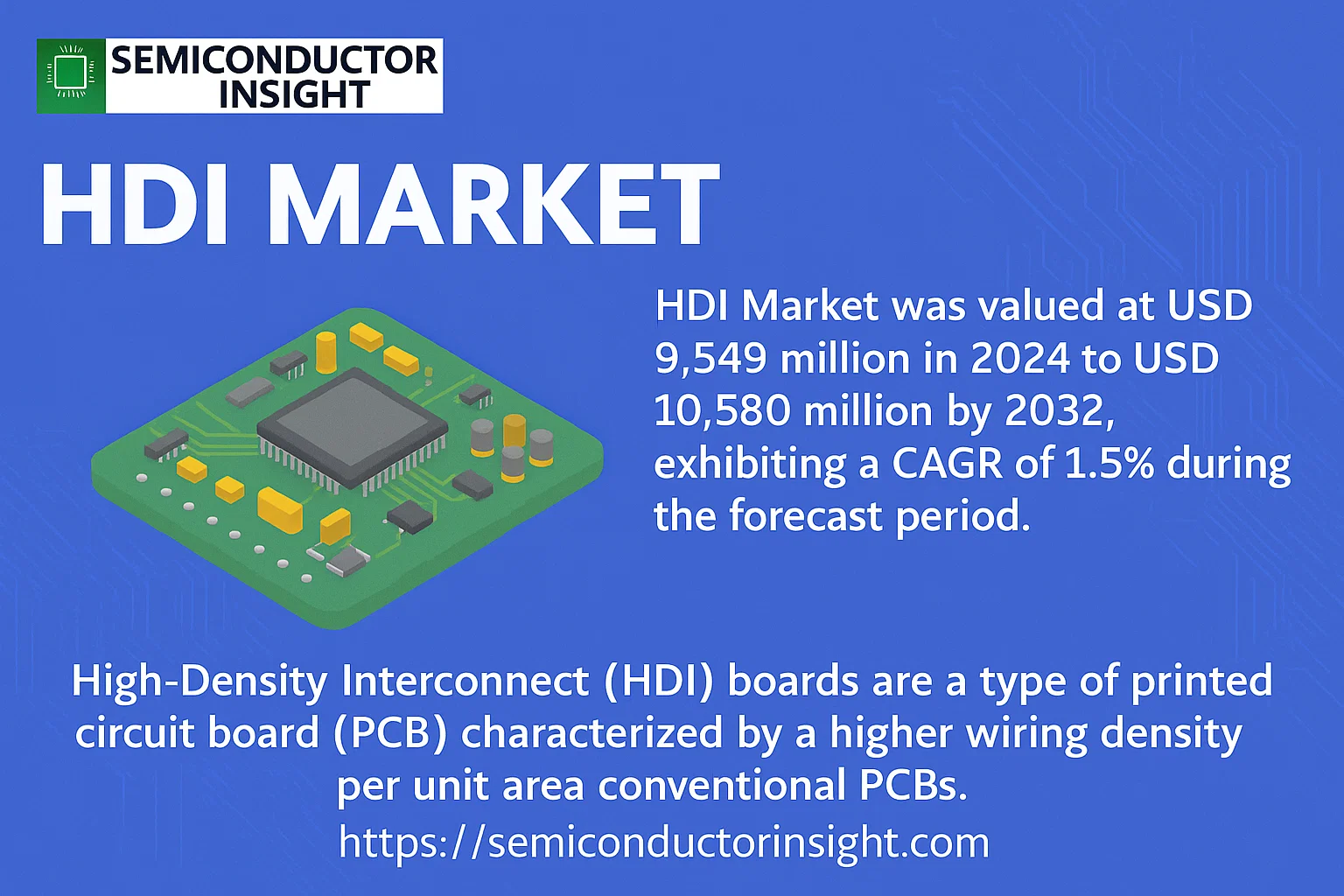
Global HDI Market was valued at USD 9,549 million in 2024 to USD 10,580 million by 2032, exhibiting a CAGR of 1.5% during the forecast period.
High-Density Interconnect (HDI) boards are a type of printed circuit board (PCB) characterized by a higher wiring density per unit area than conventional PCBs. They feature finer lines and spaces (under 100µm) and a higher connection pad density (over 20 pads/cm²), which enables the creation of more compact, lightweight, and high-performance electronic devices.
The market growth is primarily driven by the relentless demand for miniaturization in consumer electronics such as smartphones, tablets, and wearables. Furthermore, the expansion of 5G infrastructure and automotive electronics significantly contributes to market expansion. However, this growth faces challenges from the high manufacturing costs and technical complexities associated with HDI production. The competitive landscape is fragmented; Unimicron leads with a sales revenue share of approximately 8%. Other key players include Compeq, AT&S, SEMCO, Ibiden, TTM, and LG Innotek. Geographically, China dominates as the largest consumption area, accounting for about 48% of global demand. In terms of applications, the Telecommunications sector is the largest segment, representing 61% of all demand.
MARKET DRIVERS
Proliferation of Miniaturized Electronics
The relentless demand for smaller, lighter, and more powerful electronic devices is a primary driver for the High-Density Interconnect (HDI) market. Products such as smartphones, tablets, wearables, and advanced medical devices require HDI PCBs to accommodate more components in a reduced footprint. This trend is pushing manufacturers to adopt technologies like microvias, finer traces, and sequential build-up layers to achieve higher wiring density and improved electrical performance.
Adoption in Automotive Electronics
The automotive industry’s shift towards electric vehicles (EVs), advanced driver-assistance systems (ADAS), and in-vehicle infotainment is significantly boosting HDI demand. These applications require highly reliable and complex PCBs that can withstand harsh environments while supporting high-speed data transmission. The integration of numerous sensors, control units, and connectivity features necessitates the advanced capabilities of HDI technology.
➤ Global HDI Market is projected to grow at a CAGR of approximately 12.5% over the next five years, driven by these core industry demands.
Furthermore, the expansion of 5G infrastructure and Internet of Things (IoT) devices is creating substantial demand. 5G base stations and a vast array of connected IoT sensors rely on HDI boards for their high-frequency performance and compact design, establishing HDI as a critical enabling technology for next-generation connectivity.
MARKET CHALLENGES
High Manufacturing Complexity and Cost
The production of HDI boards involves intricate processes such as laser drilling for microvias, sequential lamination, and precise alignment, which require specialized equipment and highly skilled labor. This results in significantly higher manufacturing costs compared to standard PCBs. The capital investment for advanced HDI fabrication facilities is substantial, creating a barrier to entry for smaller players and putting pressure on profit margins across the industry.
Other Challenges
Material Selection and Thermal Management
As board densities increase, managing heat dissipation becomes more challenging. Selecting materials with suitable thermal and electrical properties that can also withstand the stresses of fine-line fabrication is a persistent technical hurdle. Material compatibility and reliability under high operating temperatures are critical concerns for manufacturers.
Supply Chain Vulnerabilities
The HDI market is susceptible to disruptions in the supply of specialized raw materials, such as high-grade laminates and copper foils, as well as critical manufacturing equipment. Geopolitical tensions and trade policies can lead to price volatility and availability issues, impacting production schedules and costs.
MARKET RESTRAINTS
Economic Sensitivity and Fluctuating End-User Demand
HDI Market is closely tied to the health of the consumer electronics and automotive sectors, which are highly sensitive to global economic conditions. During periods of economic downturn, demand for premium electronics and vehicles can contract rapidly, leading to reduced orders for HDI PCBs. This cyclicality makes long-term planning and capacity investment challenging for manufacturers.
Environmental and Regulatory Pressures
Stricter environmental regulations concerning the use of certain chemicals in the PCB manufacturing process, such as lead and halogenated flame retardants, add compliance costs and complexity. Regulations like the EU’s RoHS and REACH directives necessitate continuous investment in research and development for alternative, compliant materials and processes.
MARKET OPPORTUNITIES
Emerging Applications in AI and High-Performance Computing
The rapid growth of artificial intelligence, machine learning, and data centers presents a significant growth vector for the HDI market. Servers, GPUs, and specialized AI processors require the high-speed, high-density interconnects that HDI technology provides to handle massive data throughput and complex processing tasks efficiently.
Advancements in Substrate-Like PCBs (SLP)
The evolution towards Substrate-Like PCBs, which blur the line between traditional substrates and PCBs, represents a major opportunity. SLPs offer even higher density and are increasingly used in flagship smartphones and other compact devices. Mastering SLP manufacturing can provide a competitive edge and access to high-value market segments.
Medical and Aerospace Innovations
Advanced medical imaging equipment, portable diagnostic devices, and sophisticated avionics systems are increasingly adopting HDI technology for its reliability and miniaturization capabilities. The stringent performance requirements in these sectors create opportunities for manufacturers who can meet high-quality standards and deliver specialized solutions.
HDI Market Trends
Steady Growth Projected for Global HDI Market
Global High-Density Interconnect (HDI) market has demonstrated a trajectory of measured growth, with a valuation of D 9,549 million in 2024. Current projections indicate the market will expand to approximately D 10,580 million by 2032, reflecting a Compound Annual Growth Rate (CAGR) of 1.5% during the forecast period. This sustained growth is fundamentally driven by the continuous miniaturization and performance enhancement requirements across multiple high-tech industries. HDI PCBs, characterized by finer lines and spaces and a higher connection pad density than conventional boards, are essential for reducing the size and weight of electronic devices while simultaneously improving their electrical performance, making them indispensable in modern electronics.
Other Trends
Dominant Regional Consumption and Application Segments
A key trend shaping the HDI market is its geographic concentration. The China region stands as the largest consumption area globally, accounting for a dominant 48% of total market consumption. This reflects the region’s massive electronics manufacturing ecosystem. In terms of application, the Telecommunications sector is unequivocally the largest driver of demand, constituting 61% of the total. This is attributed to the ongoing global rollout of 5G infrastructure and the increasing complexity of networking equipment, which require the advanced capabilities of HDI technology for optimal performance and compact form factors.
Market Segmentation and Competitive Landscape
The HDI market is segmented by technology type, including HDI PCB (1+N+1), HDI PCB (2+N+2), and ELIC (Every Layer Interconnection), each catering to different levels of complexity and performance needs. The competitive landscape is fragmented, with Unimicron leading the industry with a sales revenue share of approximately 8%. The market features other significant players such as Compeq, AT&S, SEMCO, Ibiden, and TTM, alongside ZDT, Tripod, DAP, Unitech, Multek, and LG Innotek. The concentration of key manufacturers and the evolution of HDI types are critical trends influencing product development and strategic positioning within the global marketplace.
COMPETITIVE LANDSCAPE
Key Industry Players
Market Concentration and Strategic Positioning
Global HDI Market landscape is characterized by the dominance of a few major players, with Unimicron Technology Corporation leading the pack. Unimicron commands approximately 8% of the global sales revenue share, solidifying its position as the number one player in the industry. This leadership is built on its extensive manufacturing capabilities, technological expertise, and strong relationships with key customers in the consumer electronics and telecommunications sectors. The overall market structure is moderately concentrated, with the top five companies collectively holding a significant portion of the market share. Competition is intense, driven by continuous technological innovation, the need for miniaturization, and stringent quality requirements from end-users. The telecommunications application segment is the largest, accounting for 61% of total demand, which heavily influences the strategic focus of the leading manufacturers.
Beyond the top-tier players, a number of other significant companies hold influential positions in specific niches or geographic regions. Companies like Compeq, AT&S, and Ibiden are major global competitors with substantial revenue and advanced production facilities. Other key participants, including TTM Technologies, Zhen Ding Technology (ZDT), and Tripod Technology, compete effectively by focusing on specific HDI technologies such as 2+N+2 or ELIC (Every Layer Interconnection), or by catering to high-growth applications like automotive electronics. The market also features strong regional players, particularly in China, which is the largest consumption area accounting for 48% of global demand. This geographic concentration has fostered the growth of domestic manufacturers who compete on cost and local supply chain advantages.
List of Key HDI Companies Profiled
- Unimicron Technology Corporation
- Compeq Manufacturing Co., Ltd.
- AT&S Austria Technologie & Systemtechnik AG
- Samsung Electro-Mechanics (SEMCO)
- Ibiden Co., Ltd.
- TTM Technologies, Inc.
- Zhen Ding Technology Holding Limited (ZDT)
- Tripod Technology Corporation
- Daeduck Electronics Co., Ltd. (DAP)
- Unitech Printed Circuit Board Corp.
- Multek (a Flex company)
- LG Innotek
- Young Poong Group (KCC)
- Meiko Electronics Co., Ltd.
Segment Analysis:
| Segment Category | Sub-Segments | Key Insights |
| By Type |
|
HDI PCB (1+N+1) represents the most widely adopted technology due to its excellent balance of performance enhancement and cost-effectiveness for a broad range of consumer devices. This segment is characterized by its ability to provide the foundational benefits of HDI, such as size and weight reduction, without the significant complexities and expenses associated with more advanced builds, making it the technology of choice for mass-market electronics. The segment’s strong market position is driven by its versatility and suitability for manufacturers looking to upgrade from conventional PCBs. |
| By Application |
|
Telecommunications is the dominant application area for HDI, largely fueled by the relentless global demand for more advanced and compact communication infrastructure and devices. The sector’s leadership is underpinned by the critical need for high-speed data transfer and signal integrity in 5G network equipment, smartphones, and base stations, where HDI technology is essential for achieving the necessary performance in a smaller form factor. Continued investments in network upgrades and the proliferation of IoT devices are key drivers sustaining this segment’s leading market position. |
| By End User |
|
OEMs (Original Equipment Manufacturers) form the largest end-user segment, as they are the primary drivers of product design and specification, directly integrating HDI boards into their final branded products like smartphones, laptops, and networking hardware. This segment’s leadership is reinforced by the critical role HDI plays in enabling product differentiation through miniaturization and enhanced functionality, which are key competitive advantages. The strategic focus of major OEMs on innovation and performance directly translates into sustained, high-volume demand for advanced HDI solutions. |
| By Fabrication Complexity |
|
Standard HDI commands the most significant portion of the market, primarily because it meets the technical requirements for a vast majority of electronic devices while remaining the most economically viable and production-ready option for manufacturers. This segment’s dominance is attributed to its widespread adoption across high-volume applications where a balance between performance gains, reliability, and manufacturing cost is paramount. The maturity of the supply chain and manufacturing processes for standard HDI further solidifies its leading role in the industry landscape. |
| By Integration Level |
|
Standard HDI Boards are the leading category by integration level, serving as the core building blocks for the majority of compact electronic assemblies. Their leadership is anchored in their fundamental role in enabling the functionality of modern electronics, providing the essential interconnect density that bridges components without the extreme specialization of substrate-level integrations. This segment benefits from broad applicability and remains the primary choice for designers seeking to optimize space and performance across diverse product categories, from mobile devices to automotive electronics. |
Regional Analysis: HDI Market
The region’s unparalleled concentration of electronics manufacturing, from component suppliers to final assembly plants, creates an integrated ecosystem that constantly demands advanced HDI solutions. This clustering effect facilitates rapid prototyping, reduces time-to-market for new devices, and encourages collaboration between PCB fabricators and OEMs. The sheer volume of production necessitates efficient, high-yield HDI manufacturing processes.
A massive and tech-savvy consumer base in countries like China, South Korea, and Japan creates intense demand for the latest electronic gadgets, which are primary drivers of HDI technology. This demand pushes manufacturers to adopt the most advanced HDI techniques to enable device miniaturization, increased functionality, and improved performance, directly influencing market growth and technological trends.
Significant investments in research and development from both corporations and governments fuel continuous innovation in HDI processes, materials, and design rules. Leading universities and corporate R&D centers in the region are consistently pushing the boundaries of what is possible with HDI technology, developing solutions for next-generation applications like 5G infrastructure, AI servers, and advanced automotive systems.
The region boasts a mature and highly integrated supply chain for PCB materials, chemicals, and equipment, which reduces logistical complexities and costs for HDI manufacturers. Proximity to key suppliers of laminate, copper foil, and drilling/plating machinery ensures a steady flow of high-quality inputs and facilitates quicker adoption of new materials critical for advanced HDI production.
North America
North America maintains a strong position in the HDI market, characterized by its focus on high-reliability and high-performance applications. The region’s strength lies in demanding sectors such as aerospace, defense, medical devices, and high-end computing infrastructure. North American OEMs and PCB fabricators are leaders in developing HDI solutions that meet stringent quality, reliability, and longevity standards required for critical systems. The presence of major technology companies and data center operators drives demand for advanced server and networking equipment PCBs. While manufacturing volume may be lower than in Asia-Pacific, the value and technological sophistication of HDI boards produced are very high, with a significant emphasis on sophisticated designs involving high layer counts, advanced materials, and strict impedance control.
Europe
The European HDI market is driven by its strong automotive industrial base, industrial automation, and telecommunications sectors. European automotive manufacturers are increasingly integrating advanced driver-assistance systems (ADAS), infotainment, and electrification components, all of which rely heavily on HDI technology for compact and reliable PCBs. The region also has a notable presence in medical technology and industrial equipment, where HDI is essential for creating complex, high-density control systems. European fabricators are known for their expertise in high-quality manufacturing and adherence to strict environmental regulations, which influences material selection and processing techniques. Collaboration between research institutions and industry supports innovation in areas like embedded component technology and sustainable manufacturing practices for HDI.
South America
The HDI market in South America is a developing segment, with growth primarily centered in Brazil and, to a lesser extent, Argentina. The market is largely driven by domestic demand for consumer electronics, telecommunications infrastructure, and the regional automotive industry. Local manufacturing capabilities for HDI are still emerging, with many complex boards being imported to meet the needs of multinational corporations operating in the region. Government initiatives aimed at boosting local industrial production and technology adoption present potential for future growth. The market faces challenges related to economic volatility and infrastructure, but it represents a gradual expansion area as regional demand for sophisticated electronics increases.
Middle East & Africa
The HDI market in the Middle East & Africa is nascent but shows potential for growth, particularly in the Gulf Cooperation Council (GCC) countries and South Africa. Investment in telecommunications infrastructure, including the rollout of 5G networks, is a key driver. The region’s growing consumer electronics market and initiatives to diversify economies away from hydrocarbons are creating new demand. However, local HDI manufacturing capabilities are extremely limited, making the region largely import-dependent for advanced PCBs. Strategic investments in technology hubs and industrial zones could foster future development, but the market currently remains a niche segment within the global HDI landscape.
Report Scope
This market research report provides a comprehensive analysis of the HDI Market , covering the forecast period 2025–2032. It offers detailed insights into market dynamics, technological advancements, competitive landscape, and key trends shaping the industry.
Key focus areas of the report include:
- Market Overview: The report begins with an overview outlining its current market scenario, key growth indicators, and industry transformation drivers. It discusses macroeconomic factors, demand–supply balance, regulatory landscape, and the strategic role of semiconductors in powering advancements across industries such as automotive, telecommunications, consumer electronics, and industrial automation.
- Market Size & Forecast: Historical data and future projections for revenue, unit shipments, and market value across major regions and segments.
- Segmentation Analysis: Detailed breakdown by product type, technology, application, and end-user industry to identify high-growth segments and investment opportunities.
- Regional Insights: Insights into market performance across North America, Europe, Asia-Pacific, Latin America, and the Middle East & Africa, including country-level analysis where relevant.
- Competitive Landscape: Profiles of leading market participants, including their product offerings, R&D focus, manufacturing capacity, pricing strategies, and recent developments such as mergers, acquisitions, and partnerships.
- Technology Trends & Innovation: Assessment of emerging technologies, integration of AI/IoT, semiconductor design trends, fabrication techniques, and evolving industry standards.
- Market Drivers & Restraints: Evaluation of factors driving market growth along with challenges, supply chain constraints, regulatory issues, and market-entry barriers.
- Stakeholder Insights: Insights for component suppliers, OEMs, system integrators, investors, and policymakers regarding the evolving ecosystem and strategic opportunities.
Primary and secondary research methods are employed, including interviews with industry experts, data from verified sources, and real-time market intelligence to ensure the accuracy and reliability of the insights presented.
FREQUENTLY ASKED QUESTIONS:
What is the current market size of HDI Market?
-> Global HDI Market was valued at USD 9549 million in 2024 and is projected to reach USD 10580 million by 2032, at a CAGR of 1.5% during the forecast period.
Which key companies operate in HDI Market?
-> Key players include Unimicron, Compeq, AT&S, SEMCO, Ibiden, TTM, ZDT, Tripod, DAP, Unitech, Multek, and LG Innotek, among others. Unimicron is the market leader with approximately 8% sales revenue share.
What are the key growth drivers?
-> Key growth drivers include demand for smaller, lighter electronic devices with enhanced electrical performance, and increasing adoption in telecommunications and consumer electronics applications.
Which region dominates the market?
-> China is the largest consumption area, accounting for 48% of the total global HDI consumption.
What are the emerging trends?
-> Emerging trends include advancements in HDI PCB technology such as ELIC (Every Layer Interconnection), and the use of HDI boards to reduce size and weight while improving electrical performance in advanced electronic applications.

Get Sample Report PDF for Exclusive Insights
Report Sample Includes
- Table of Contents
- List of Tables & Figures
- Charts, Research Methodology, and more...
 Download Sample Report PDF