MARKET INSIGHTS
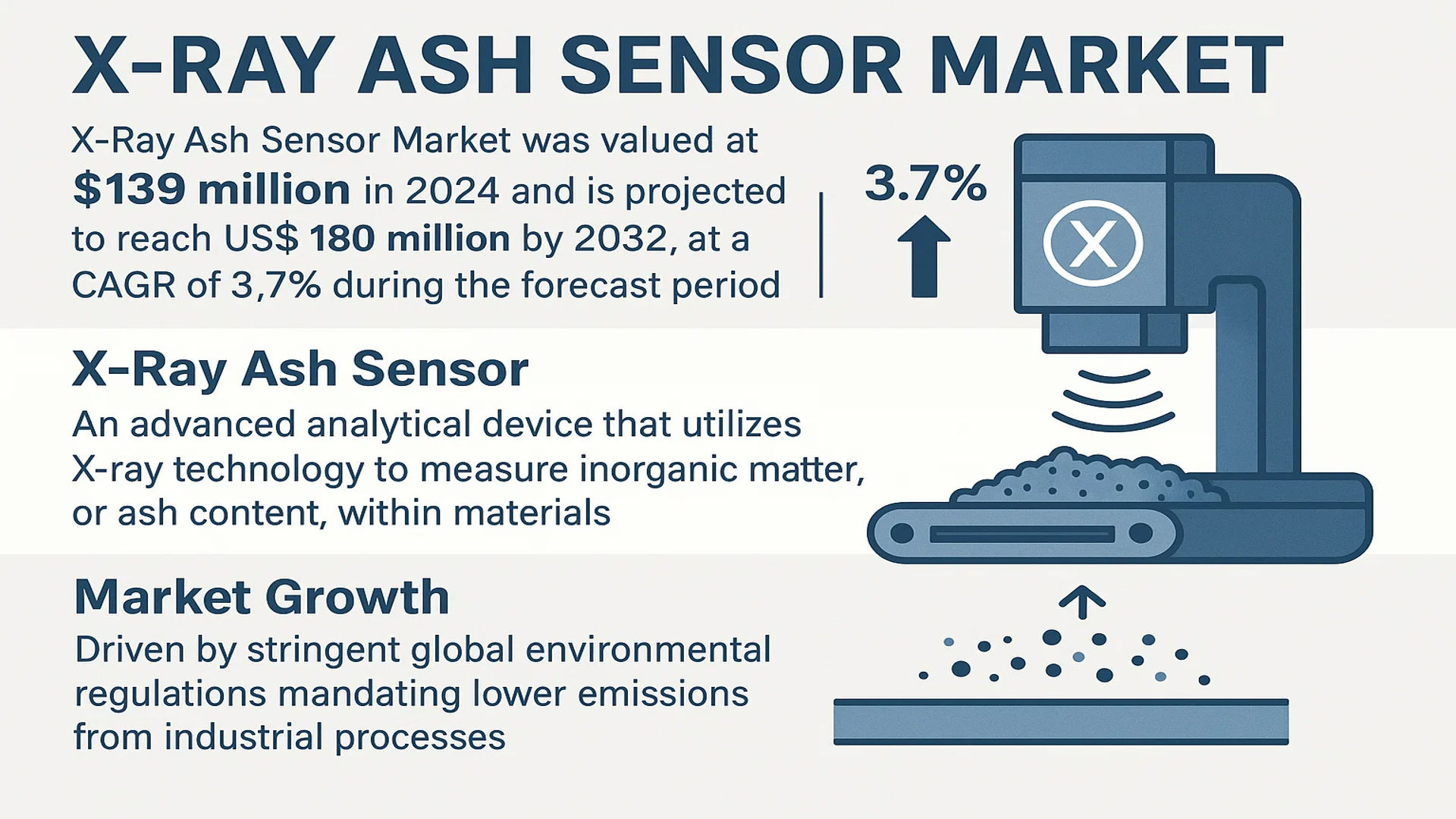
The global X-Ray Ash Sensor Market was valued at 139 million in 2024 and is projected to reach US$ 180 million by 2032, at a CAGR of 3.7% during the forecast period.
An X-ray ash sensor is an advanced analytical device that utilizes X-ray technology to accurately measure the inorganic matter, or ash content, within various materials. This non-contact, high-precision instrument operates by detecting the differential absorption rates of X-rays as they pass through a sample, providing rapid and reliable compositional analysis. These sensors are critical for quality control and process optimization in industries such as coal processing, cement manufacturing, food production, and environmental monitoring.
The market’s steady growth is primarily driven by stringent global environmental regulations mandating lower emissions from industrial processes, particularly in the power generation sector where coal ash content directly impacts combustion efficiency and pollution levels. Furthermore, the push for operational excellence and consistent product quality in capital-intensive industries like cement and papermaking is fueling the adoption of real-time monitoring solutions. Key market players, including ABB, Valmet, and Voith, are continuously innovating, with recent developments focusing on integrating artificial intelligence to enhance data processing accuracy and predictive maintenance capabilities.
MARKET DYNAMICS
MARKET DRIVERS
Stringent Environmental Regulations and Emission Control Standards to Drive Market Growth
The global push for environmental sustainability has resulted in increasingly stringent regulations governing industrial emissions and waste management. Governments worldwide are implementing policies that mandate precise monitoring of ash content in various industrial processes to minimize environmental impact. For instance, coal-fired power plants face regulatory pressure to reduce particulate matter emissions, with many regions imposing limits as low as 5-10 mg/Nm³ for new installations. X-ray ash sensors provide real-time, accurate measurement capabilities that enable industries to maintain compliance while optimizing their processes. The technology’s non-contact nature and high precision make it particularly valuable for continuous monitoring applications where traditional laboratory methods would be too slow or impractical.
Growing Demand for Process Optimization and Quality Control in Industrial Applications
Industrial sectors are increasingly prioritizing operational efficiency and product quality, driving adoption of advanced monitoring technologies like X-ray ash sensors. In cement manufacturing, precise ash content measurement directly impacts product quality and consistency, with even minor variations potentially affecting final product properties. The technology enables real-time adjustments to raw material mixtures, reducing waste and improving overall process efficiency. Similarly, in coal processing and power generation, accurate ash measurement allows for optimal combustion control, potentially improving thermal efficiency by 2-3% while reducing maintenance costs associated with ash buildup and equipment wear.
Furthermore, the food processing industry’s growing emphasis on quality assurance has created additional demand for ash content monitoring in products like flour, spices, and nutritional supplements, where ash content serves as an important quality indicator.
➤ For instance, major industry players have reported that implementing X-ray ash sensor technology can reduce quality-related production losses by up to 15% while improving overall equipment effectiveness through better process control.
The integration of these sensors with Industry 4.0 platforms and digital transformation initiatives further enhances their value proposition, enabling predictive maintenance and data-driven decision making across industrial operations.
MARKET CHALLENGES
High Initial Investment and Total Cost of Ownership to Challenge Market Penetration
While X-ray ash sensors offer significant operational benefits, their adoption faces substantial financial barriers. Advanced X-ray ash sensor systems typically require capital investments ranging from $50,000 to $200,000 per installation, depending on configuration and application requirements. This high initial cost presents a particular challenge for small and medium-sized enterprises operating with limited capital budgets. Beyond the purchase price, these systems require specialized installation, regular calibration, and ongoing maintenance by qualified technicians, adding to the total cost of ownership. The need for radiation shielding and compliance with safety regulations further increases implementation costs, particularly in retrofit applications where existing infrastructure may not accommodate these requirements easily.
Other Challenges
Technical Complexity and Integration Issues
Integrating X-ray ash sensors into existing industrial processes often presents significant technical challenges. These systems require careful calibration for different material types and compositions, and even minor changes in material characteristics can affect measurement accuracy. The sensors must interface with various control systems and data platforms, requiring specialized engineering expertise that may not be readily available in all organizations. Additionally, environmental factors such as temperature variations, vibration, and dust can impact sensor performance, necessitating additional protective measures and regular maintenance.
Safety and Regulatory Compliance Concerns
The use of X-ray technology inherently involves radiation safety considerations that create additional regulatory and operational complexities. Companies must implement comprehensive radiation protection programs, provide specialized training for personnel, and maintain detailed documentation for regulatory compliance. These requirements can be particularly challenging in regions with stringent radiation safety regulations, where compliance costs and administrative burdens may deter potential adopters despite the technology’s operational benefits.
MARKET RESTRAINTS
Limited Technical Expertise and Specialized Knowledge to Deter Market Expansion
The effective operation and maintenance of X-ray ash sensors require specialized technical knowledge that is not widely available across all industrial sectors. These systems demand understanding of both radiation physics and specific application requirements, creating a skills gap that hinders broader adoption. Many industrial facilities lack personnel with the necessary expertise to properly calibrate, maintain, and troubleshoot these sophisticated systems, leading to suboptimal performance or increased reliance on external service providers. The situation is exacerbated by the general shortage of qualified technicians in advanced manufacturing technologies, with industry surveys indicating that nearly 40% of industrial companies report difficulties in finding personnel with the required technical skills for maintaining advanced sensor systems.
Additionally, the rapid pace of technological advancement in sensor technology means that even existing technical staff require continuous training to stay current with latest developments and best practices, creating ongoing operational challenges for many organizations.
MARKET OPPORTUNITIES
Integration with Artificial Intelligence and Industry 4.0 Technologies to Create New Growth Pathways
The convergence of X-ray ash sensor technology with artificial intelligence and digitalization presents significant growth opportunities. AI-powered analytics can enhance measurement accuracy by compensating for material variations and environmental factors, while machine learning algorithms enable predictive maintenance capabilities that reduce downtime and improve reliability. The integration of these sensors with Industrial Internet of Things (IIoT) platforms allows for centralized monitoring of multiple measurement points and facilitates data-driven optimization across entire production facilities. This technological synergy is particularly valuable as industries increasingly adopt smart manufacturing approaches, where real-time data collection and analysis drive operational decisions.
Furthermore, the development of cloud-based monitoring and analytics services creates new business models for sensor manufacturers, transitioning from equipment sales to ongoing service relationships that provide continuous value to customers while generating recurring revenue streams.
Additionally, emerging applications in waste management and recycling present new market segments where ash content measurement is becoming increasingly important for process control and regulatory compliance, particularly as circular economy initiatives gain momentum globally.
X-RAY ASH SENSOR MARKET TRENDS
Integration of AI and IoT for Enhanced Process Optimization
The integration of Artificial Intelligence (AI) and the Internet of Things (IoT) is revolutionizing the capabilities of X-ray ash sensors, moving them beyond simple measurement devices to intelligent, predictive analytical systems. These advanced sensors now leverage machine learning algorithms to analyze historical and real-time data, enabling them to predict maintenance needs, calibrate themselves automatically, and identify subtle anomalies in material composition that precede quality deviations. This shift towards predictive analytics is crucial for capital-intensive industries like cement and power generation, where unplanned downtime can cost over $10,000 per hour. Furthermore, IoT connectivity allows for the centralized monitoring of multiple sensor units across a global operation, providing plant managers with a holistic, data-driven view of production efficiency and material quality from anywhere in the world. This trend is a direct response to the industry’s push for Industry 4.0, where smart, connected devices are becoming the standard for achieving new levels of operational excellence and cost savings.
Other Trends
Stringent Environmental Regulations Driving Adoption
Globally, tightening environmental regulations are a primary catalyst for the adoption of X-ray ash sensor technology, particularly in the coal-fired power sector. Regulations aimed at reducing particulate matter and greenhouse gas emissions mandate precise control over combustion efficiency, which is directly tied to the ash content of the feedstock. For instance, even a 1% reduction in ash content can lead to a significant decrease in unburned carbon and slagging, improving boiler efficiency and reducing emissions. This regulatory pressure is not just about compliance; it is also a major financial driver, as utilities face substantial fines for exceeding emission limits and can achieve considerable fuel savings through optimized combustion. Consequently, the demand for accurate, real-time ash monitoring is no longer optional but a necessity for operational and regulatory survival in these industries.
Expansion into New Application Areas Beyond Traditional Sectors
While historically dominant in coal and cement, the application spectrum for X-ray ash sensors is broadening significantly, creating new growth vectors for the market. The food processing industry, for example, is increasingly utilizing this technology to ensure product purity and quality control, such as measuring the ash content in flour, which is a key indicator of refinement and quality. Similarly, in the paper and pulp industry, these sensors are critical for monitoring the inorganic filler content in paper products, which affects both the quality and the cost of production. This expansion is fueled by a universal industry-wide demand for higher quality control standards and the economic need to minimize waste and optimize raw material usage. The technological versatility of modern sensors, which can be calibrated for a wide range of material densities and compositions, is what makes this cross-industry expansion both feasible and highly attractive to equipment manufacturers seeking new revenue streams.
COMPETITIVE LANDSCAPE
Key Industry Players
Companies Focus on Technological Innovation and Strategic Expansion to Capture Market Share
The global X-Ray Ash Sensor market exhibits a semi-consolidated competitive structure, characterized by the presence of established industrial automation giants and specialized technology firms. ABB and Valmet are recognized as dominant forces, leveraging their extensive experience in process automation and strong global distribution networks across key industries like pulp & paper and cement. Their market leadership is further solidified by comprehensive service offerings and long-standing client relationships.
emtec Electronic GmbH and Voith also command significant market share, primarily due to their deep domain expertise in specific applications such as papermaking. emtec’s focus on advanced diagnostic sensors for the paper industry and Voith’s integrated system solutions provide them with a competitive edge in these niche segments. Their growth is directly tied to the health of these end-markets and their ability to deliver high-precision, reliable measurement data.
Furthermore, these players are actively engaged in growth strategies, including new product development with enhanced features like improved algorithms for better accuracy and strategic partnerships with plant equipment manufacturers. Such initiatives are crucial for expanding their installed base and securing long-term service contracts.
Meanwhile, companies like Seltek and MCS Engineering are strengthening their positions by focusing on innovation and customization. They are investing in R&D to develop more cost-effective and user-friendly sensors, aiming to penetrate price-sensitive markets and smaller-scale operations. This approach allows them to address a segment of the market that seeks reliable performance without the premium cost associated with the largest suppliers.
List of Key X-Ray Ash Sensor Companies Profiled
- ABB Ltd. (Switzerland)
- Valmet Oyj (Finland)
- emtec Electronic GmbH (Germany)
- Voith GmbH & Co. KGaA (Germany)
- Jasch Industries (India)
- AQUAR-SYSTEM (Russia)
- Seltek (Turkey)
- MCS Engineering (Netherlands)
- Tasowheel (China)
Segment Analysis:
By Type
2-Component Measurement Segment Leads Due to Cost-Effectiveness and Widespread Industrial Adoption
The market is segmented based on type into:
- 2-Component Measurement
- 3-Component Measurement
- Others
By Application
Coal Industry Segment Dominates Owing to Stringent Environmental Regulations and Need for Efficient Combustion
The market is segmented based on application into:
- Coal Industry
- Cement Production
- Food Processing
- Environmental Monitoring
- Others
By End-User Industry
Energy and Power Sector Holds Largest Share Driven by Demand for High-Quality Coal and Emission Control
The market is segmented based on end-user industry into:
- Energy and Power
- Manufacturing
- Food and Beverage
- Environmental Services
- Others
By Technology
Online Real-Time Monitoring Systems Gain Traction for Process Optimization and Quality Assurance
The market is segmented based on technology into:
- Online Real-Time Monitoring Systems
- Portable Handheld Devices
- Laboratory Benchtop Analyzers
Regional Analysis: X-Ray Ash Sensor Market
Asia-Pacific
The Asia-Pacific region dominates the global X-Ray Ash Sensor market, accounting for over 45% of total market share by volume in 2024. This leadership position is driven by massive industrialization, particularly in China and India, where coal remains a primary energy source. China’s commitment to reducing emissions from its coal-fired power plants, which number over 1,100 nationwide, has accelerated the adoption of advanced monitoring technologies like X-ray ash sensors. These sensors are critical for optimizing combustion efficiency and ensuring compliance with the country’s increasingly stringent environmental standards. India’s expanding cement industry, projected to reach 550 million tons of annual production capacity by 2025, similarly relies on these sensors for precise raw material quality control. While cost sensitivity remains a factor, the region’s rapid industrial growth and regulatory pressures are creating sustained demand for these high-precision instruments.
North America
North America represents a mature yet steadily growing market for X-Ray Ash Sensors, characterized by stringent regulatory frameworks and a strong focus on operational efficiency. The U.S. Environmental Protection Agency’s Cross-State Air Pollution Rule and Mercury and Air Toxics Standards compel power generation facilities to continuously monitor and control emissions, driving adoption of advanced ash measurement technologies. The region’s well-established pulp and paper industry, which consumes approximately 70 million tons of paper annually, utilizes these sensors for quality control in recycling processes. Furthermore, ongoing modernization of industrial infrastructure, including the integration of Industry 4.0 technologies, supports the replacement of older measurement systems with more accurate X-ray-based solutions. While the initial investment is significant, the long-term operational benefits and regulatory compliance justify the expenditure for most medium and large-scale operators.
Europe
Europe’s market for X-Ray Ash Sensors is shaped by its ambitious environmental policies and high industrial standards. The EU’s Industrial Emissions Directive and Best Available Techniques Reference Documents create a regulatory environment that favors advanced monitoring technologies. Germany’s strong manufacturing sector, particularly in cement production where it ranks among Europe’s top producers, utilizes these sensors for quality assurance and process optimization. The region’s focus on circular economy principles has also increased the importance of accurate material characterization in waste-to-energy plants and recycling facilities. While the market is relatively saturated compared to Asia-Pacific, technological innovation and the need to upgrade aging industrial equipment continue to drive steady demand. European manufacturers are particularly focused on developing sensors with enhanced connectivity and data analytics capabilities to integrate with smart factory systems.
South America
South America’s X-Ray Ash Sensor market is emerging, with growth primarily driven by the mining and mineral processing sectors. Chile and Peru, as leading copper producers, utilize these sensors in their concentrator plants to monitor ore quality and optimize processing parameters. Brazil’s cement industry, the largest in the region with an annual production capacity exceeding 70 million tons, represents another significant application area. However, market expansion faces challenges due to economic volatility and limited regulatory enforcement in some countries. The high cost of advanced sensor technology often puts it out of reach for smaller operations, though multinational corporations operating in the region typically implement these systems to maintain global quality standards. As environmental awareness increases and regulations tighten, particularly in countries like Chile with its progressive environmental policies, adoption of X-ray ash sensors is expected to gradually increase.
Middle East & Africa
The Middle East & Africa region presents a developing market for X-Ray Ash Sensors, with growth opportunities primarily in the cement and mining sectors. Countries like Saudi Arabia and the UAE are investing heavily in infrastructure development, driving cement production and creating demand for quality control technologies. South Africa’s well-established mining industry, particularly in coal and platinum group metals, utilizes these sensors for process optimization and quality assurance. However, market penetration is limited by budget constraints and less stringent environmental regulations compared to other regions. The focus tends to be on basic functionality rather than advanced features, though this is gradually changing as multinational companies bring global standards to their operations in the region. Long-term growth potential exists as environmental concerns gain prominence and industrial processes become more sophisticated, but progress will likely be slower than in other regions.
Report Scope
This market research report provides a comprehensive analysis of the global and regional X-Ray Ash Sensor markets, covering the forecast period 2025–2032. It offers detailed insights into market dynamics, technological advancements, competitive landscape, and key trends shaping the industry.
Key focus areas of the report include:
- Market Size & Forecast: Historical data and future projections for revenue, unit shipments, and market value across major regions and segments.
- Segmentation Analysis: Detailed breakdown by product type, technology, application, and end-user industry to identify high-growth segments and investment opportunities.
- Regional Outlook: Insights into market performance across North America, Europe, Asia-Pacific, Latin America, and the Middle East & Africa, including country-level analysis where relevant.
- Competitive Landscape: Profiles of leading market participants, including their product offerings, R&D focus, manufacturing capacity, pricing strategies, and recent developments such as mergers, acquisitions, and partnerships.
- Technology Trends & Innovation: Assessment of emerging technologies, integration of AI/IoT, semiconductor design trends, fabrication techniques, and evolving industry standards.
- Market Drivers & Restraints: Evaluation of factors driving market growth along with challenges, supply chain constraints, regulatory issues, and market-entry barriers.
- Stakeholder Analysis: Insights for component suppliers, OEMs, system integrators, investors, and policymakers regarding the evolving ecosystem and strategic opportunities.
Primary and secondary research methods are employed, including interviews with industry experts, data from verified sources, and real-time market intelligence to ensure the accuracy and reliability of the insights presented.
FREQUENTLY ASKED QUESTIONS:
What is the current market size of Global X-Ray Ash Sensor Market?
-> X-Ray Ash Sensor Market was valued at 139 million in 2024 and is projected to reach US$ 180 million by 2032, at a CAGR of 3.7% during the forecast period.
Which key companies operate in Global X-Ray Ash Sensor Market?
-> Key players include emtec Electronic GmbH, Voith, ABB, Valmet, Jasch Industries, AQUAR-SYSTEM, Seltek, MCS Engineering, and Tasowheel, among others.
What are the key growth drivers?
-> Key growth drivers include stringent environmental regulations, demand for process optimization in coal and cement industries, and increasing adoption of real-time monitoring solutions.
Which region dominates the market?
-> Asia-Pacific is the fastest-growing region, while Europe remains a dominant market due to established industrial infrastructure.
What are the emerging trends?
-> Emerging trends include integration of AI and IoT for enhanced data analytics, development of cost-effective sensors, and focus on sustainable manufacturing processes.

Get Sample Report PDF for Exclusive Insights
Report Sample Includes
- Table of Contents
- List of Tables & Figures
- Charts, Research Methodology, and more...