
Practical Wins Delivered by Smart Sensor (IO-Link) with Embedded MCU Market in Daily Operations
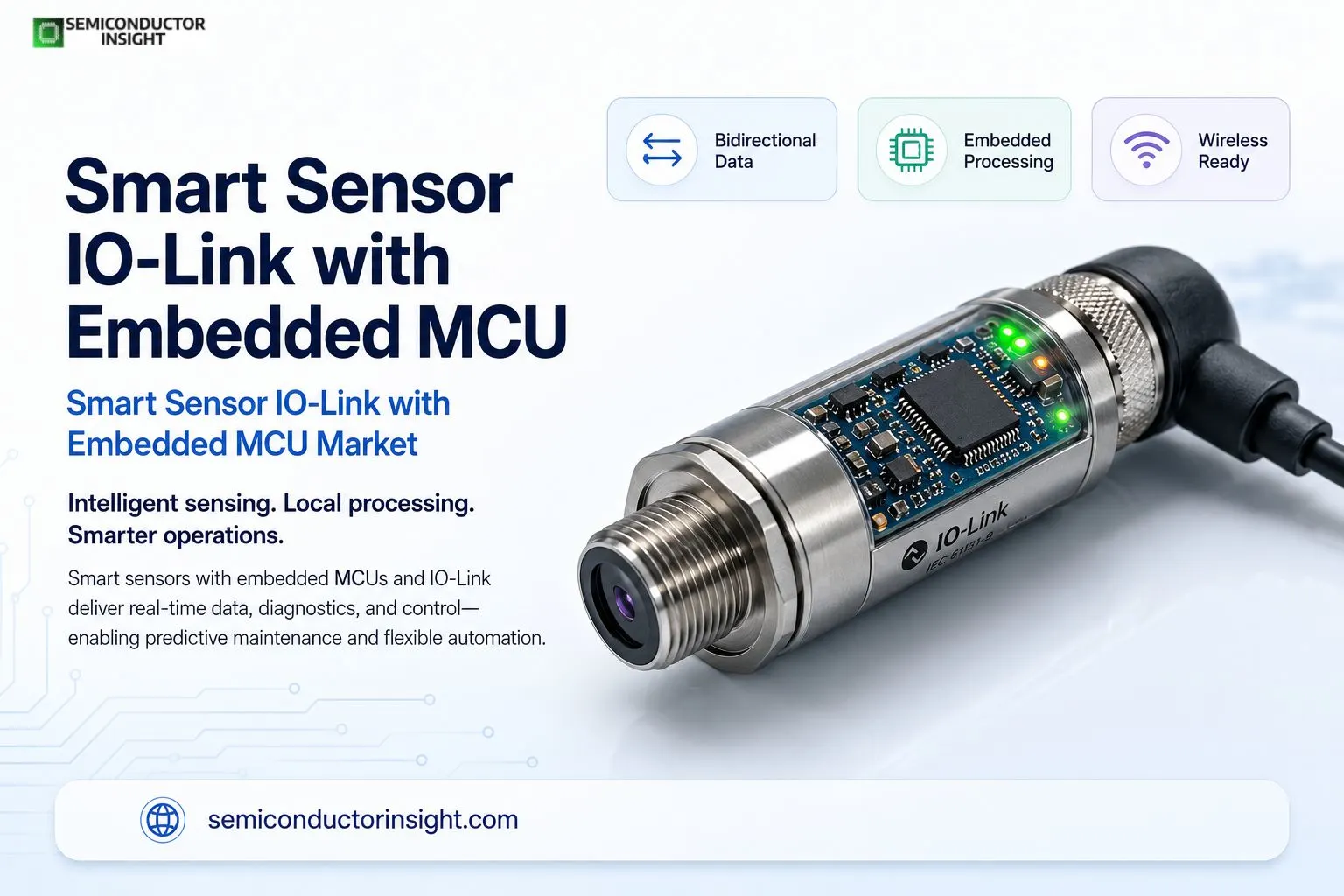
Industrial facilities worldwide increasingly rely on intelligent components that gather detailed data while handling local processing. At the centre sits the integration of smart sensors using the IO-Link protocol paired directly with embedded microcontrollers. This combination delivers point-to-point digital communication that goes far beyond traditional analogue or simple switching signals, turning ordinary sensors into active participants in automated decision-making.
- IO-Link, standardised under IEC 61131-9, creates a bidirectional link between sensors or actuators and higher-level controllers.
- Devices equipped with embedded MCUs can perform on-device calculations, store parameter sets, and transmit rich diagnostic information such as temperature readings, vibration levels, or operating cycles without needing constant central intervention.
- This architecture supports three communication speeds up to 230.4 kbaud over short distances, typically using standard M12 connectors, making installation straightforward while maintaining compatibility with existing fieldbuses and industrial Ethernet systems.
One standout aspect involves the rapid adoption of wireless extensions. IO-Link Wireless removes cabling constraints in dynamic environments where machines move or fixtures change frequently. In packaging operations, companies like Rotzinger have implemented these solutions in linear transport track systems, reducing mechanical complexity by eliminating belts, gears, and extensive wiring.
Similar retrofits at facilities such as Ulmer Schokoladen allow quick production line repositioning without days of downtime for cable management. These examples demonstrate how embedded MCUs combined with wireless IO-Link masters maintain deterministic, low-latency performance even in mobile setups.
Don’t Forget to Surf Our Updated Report for More Detailed Analysis: https://semiconductorinsight.com/report/smart-sensor-io-link-with-embedded-mcu-market/
Real Instances of On-Edge Processing Delivering Immediate Value
- Take automotive component manufacturing, where smart sensors monitor tool wear during high-speed assembly.
- An embedded MCU processes vibration and temperature data locally, triggering alerts or adjustments before issues escalate.
- This approach has helped plants achieve smoother changeovers and higher overall equipment effectiveness.
- In food and beverage lines, pressure and level sensors with integrated processing ensure fill consistency while sending quality metrics upward for centralised analysis.
- STMicroelectronics offers dedicated transceivers and STM32 microcontrollers tailored for these applications, enabling compact sensor modules that handle both communication and local intelligence.
- Their evaluation kits show modular sensor boards performing real-time data handling in industrial settings.
- Other implementations pair similar components for condition monitoring in large facilities, where sensors continuously feed data streams that support predictive maintenance algorithms running partly at the edge.
Global Spread and Growing Installed Base
By the end of 2025, roughly 9.7 million new IO-Link devices and master ports entered service around the world, bringing the cumulative total to about 71 million nodes. This expansion spans manufacturing hubs in Europe, Asia, and North America, with strong uptake in automotive, packaging, and process industries. The technology’s interoperability, supported by standardised IODD files, allows mixed-vendor environments to function smoothly, which proves especially useful for companies operating global production networks.
In Germany and surrounding regions, pilot projects quickly moved to series production for modular lines. Asian electronics manufacturers integrate these sensors into robotics cells for greater adaptability. North American facilities often focus on retrofitting existing equipment to gain diagnostic depth without full system overhauls. Across all regions, the ability to reconfigure parameters remotely during operation stands out as a major operational advantage.
Emerging Capabilities Expanding the Possibilities
- Safety extensions add functional safety layers while preserving core communication, opening doors for protective devices like light curtains in collaborative settings. Edge AI features in newer MCUs allow preliminary pattern recognition directly in the sensor, reducing bandwidth needs to cloud platforms.
- Demonstrations include miniature racetrack setups at trade events where multiple IO-Link devices from different makers feed live data for visualisation, proving seamless multi-vendor cooperation in practice.
- Semiconductor advancements continue to shrink power consumption and package sizes. Ultra-low-power modes help battery or energy-harvesting solutions in remote monitoring spots. Integration of MEMS sensors with processing cores creates highly functional units that fit into tight spaces on robotic arms or mobile guided vehicles.
Everyday Impact on Operations and People
Operators appreciate simpler device replacement because the master automatically recognises and parameterises new sensors. Maintenance teams use detailed diagnostics to schedule work during planned stops rather than facing unexpected breakdowns. Engineers designing new lines benefit from standardised cabling that cuts installation time and inventory variety. These practical gains accumulate into measurable improvements in uptime, quality consistency, and responsiveness to market changes.
As production demands greater flexibility and transparency, the fusion of smart IO-Link sensing with embedded MCUs continues to evolve from a connectivity solution into a foundational building block for adaptive, data-driven manufacturing. Facilities adopting these technologies position themselves to handle smaller batch sizes, faster product switches, and tighter integration between shop floor and enterprise systems. The momentum visible in current deployments suggests this market segment will keep delivering tangible advantages to industries navigating an increasingly connected industrial landscape.

Comments (0)