
MARKET INSIGHTS
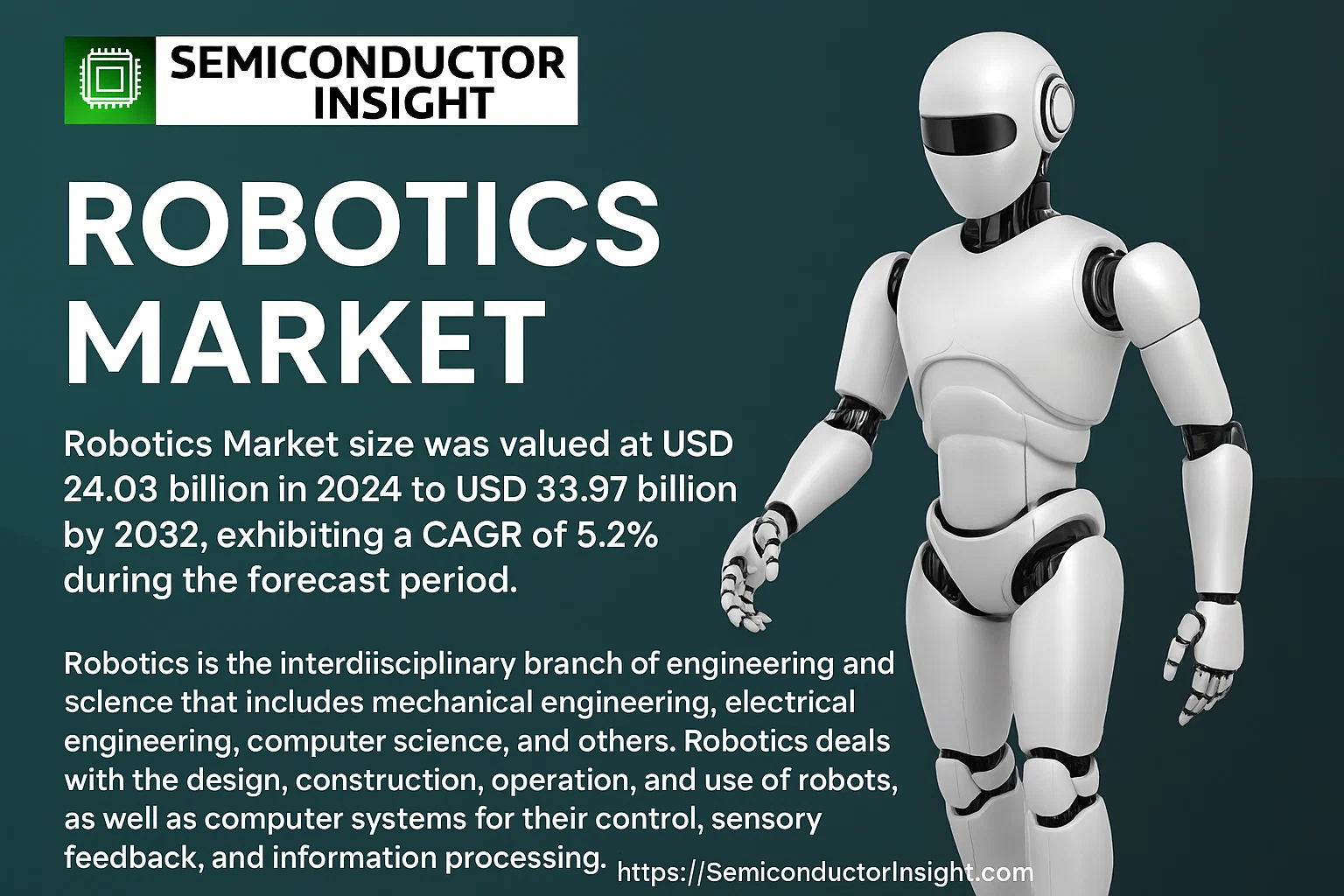
Global Robotics Market size was valued at USD 24.03 billion in 2024 to USD 33.97 billion by 2032, exhibiting a CAGR of 5.2% during the forecast period.
Robotics is the interdisciplinary branch of engineering and science that includes mechanical engineering, electrical engineering, computer science, and others. Robotics deals with the design, construction, operation, and use of robots, as well as computer systems for their control, sensory feedback, and information processing.
The market is experiencing steady growth due to several factors, including increased automation across manufacturing sectors, rising demand for collaborative robots in logistics and healthcare, and growing investments in Industry 4.0 technologies. Additionally, advancements in artificial intelligence and machine learning are contributing to market expansion by enabling more sophisticated autonomous systems. Initiatives by key players are also expected to fuel market growth; for instance, FANUC continues to expand its industrial robot portfolio with enhanced precision models for electronics assembly. ABB, Yaskawa, KUKA, and iRobot are some of the key players that operate in the market with diverse product ranges spanning industrial arms to consumer cleaning robots.
MARKET DRIVERS
Accelerated Industrial Automation
The relentless push for efficiency and cost reduction in manufacturing is a primary driver. Industries are increasingly adopting industrial robots for tasks like welding, assembly, and material handling to boost productivity and maintain competitive advantage in a global market. The demand is particularly strong in the automotive and electronics sectors.
Technological Advancements in AI and Sensing
The integration of advanced artificial intelligence, machine learning, and sophisticated sensor technologies is creating a new generation of smarter, more adaptive robots. These robots can perform complex tasks with greater autonomy, learn from their environments, and work safely alongside humans, expanding their applications beyond traditional caged operations.
Furthermore, rising labor costs and persistent shortages of skilled workers in many developed economies are compelling businesses to turn to robotic solutions to ensure operational continuity and manage expenses.
MARKET CHALLENGES
High Initial Investment and Integration Complexity
The significant upfront cost of robotic systems, which includes the robots themselves, peripheral equipment, and system integration services, remains a major barrier to adoption, especially for small and medium-sized enterprises (SMEs). Integrating these systems into existing legacy workflows and IT infrastructure can be a complex and costly undertaking.
Other Challenges
Skills Gap and Workforce Training
There is a pronounced shortage of personnel skilled in robotics programming, operation, and maintenance. Companies face challenges in both finding qualified workers and reskilling their existing workforce to effectively manage and collaborate with robotic systems.
Safety and Regulatory Hurdles
Ensuring the safe operation of robots, particularly collaborative robots working in close proximity to humans, requires adherence to strict and often evolving safety standards and regulations. Navigating this regulatory landscape can slow down deployment.
MARKET RESTRAINTS
Cybersecurity Vulnerabilities
As robots become more connected through the Industrial Internet of Things (IIoT), they become potential targets for cyberattacks. A security breach could lead to production stoppages, data theft, or even physical damage, creating significant operational and financial risks for adopters and restraining market growth.
Concerns over Job Displacement
Persistent public and political concerns about robots displacing human workers can lead to resistance from employees and unions, and sometimes result in regulatory scrutiny or policies that slow the pace of automation adoption in certain regions or industries.
MARKET OPPORTUNITIES
Expansion into New Application Areas
There is substantial growth potential for robotics beyond traditional industrial settings. Key emerging segments include healthcare (surgical robots, rehabilitation robots), agriculture (autonomous tractors, harvesting robots), and consumer services (cleaning robots, delivery robots), each representing a multi-billion dollar opportunity.
Robotics-as-a-Service (RaaS) Model
The adoption of subscription-based RaaS models is lowering the barrier to entry by converting large capital expenditures into manageable operational expenses. This model makes advanced robotics accessible to a broader range of businesses and is expected to be a key growth vector for the market.
Advancements in Collaborative Robots (Cobots)
The development of safer, more flexible, and easier-to-program collaborative robots continues to open up new applications where humans and robots work side-by-side. This is creating significant opportunities in small-batch manufacturing and assembly tasks that were previously not economically feasible to automate.
Robotics Market Trends
Steady Market Expansion and Regional Dynamics
Global Robotics Market is on a trajectory of consistent growth, with its valuation of D 24,030 million in 2024 projected to increase to D 33,970 million by 2032. This expansion, representing a compound annual growth rate (CAGR) of 5.2%, reflects the deepening integration of robotics across industrial and service sectors. A significant regional trend is the dominance of China, which currently accounts for over 16% of the global market. This consumption leadership is driven by the country’s massive manufacturing base and aggressive industrial automation policies. The competitive landscape is concentrated, with key global players including FANUC, ABB, Yaskawa, and KUKA. Notably, FANUC leads the industrial segment, holding approximately 9% of the global revenue share for specific robot types, underscoring the importance of established technological expertise in market leadership.
Other Trends
Diversification into Service Robotics
Beyond traditional industrial automation, a major trend is the robust growth in the service robotics segment. The market is distinctly segmented into Industrial Robots, Service Robots for Professional use, and Service Robots for Personal/Domestic use. Professional service robots are increasingly deployed in commercial, military, and logistics applications, performing tasks from warehouse automation to remote exploration. Simultaneously, the personal service robotics segment, including products from companies like iRobot and Ecovacs, is experiencing rapid consumer adoption for applications such as household cleaning and companionship.
Segment-Specific Growth Drivers
Analysis by application reveals targeted growth drivers. The industrial segment continues to be the largest, fueled by the need for efficiency, precision, and 24/7 operational capacity in manufacturing. The commercial segment is witnessing accelerated adoption in areas like healthcare, hospitality, and retail, where robots assist with tasks from surgery to customer service. Furthermore, technological advancements in artificial intelligence and machine learning are enabling more collaborative robots (cobots) that can work safely alongside humans, opening new application areas and driving demand. These trends, combined with regional developments across North America, Europe, and Asia-Pacific, indicate a dynamic and evolving market with significant long-term potential.
COMPETITIVE LANDSCAPE
Key Industry Players
A Market Dominated by Industrial Robotics Giants and Expanding Service Robot Innovators
Global Robotics Market is characterized by the strong presence of established industrial robotics titans, with FANUC Corporation leading the pack. It is the world’s largest manufacturer, accounting for approximately 9% of global revenues. The market structure is highly consolidated, with the top five companies holding a significant revenue share. Major players like ABB, Yaskawa, and KUKA form the core of this segment, providing advanced robotic arms and automation solutions primarily to the automotive, electronics, and heavy industries. These companies compete on technological innovation, reliability, and global service networks, with China emerging as the largest consumption region, accounting for over 16% of the global market. The industrial segment continues to drive a substantial portion of the market’s value, which is projected to grow from USD 24,030 million in 2024 to USD 33,970 million by 2032.
Beyond the industrial behemoths, a dynamic and rapidly growing segment of the market consists of companies specializing in service robots. This includes both professional service robots for commercial and military applications, and service robots for personal use, such as domestic cleaning. In the personal robotics niche, iRobot has been a longstanding leader with its Roomba vacuum cleaners. The market has seen intense competition with the emergence of strong contenders like Ecovacs and Neato Robotics. Furthermore, large consumer electronics conglomerates such as Samsung and LG are increasingly investing in robotics, expanding the competitive field. This segment is characterized by rapid innovation in AI, navigation, and human-robot interaction, catering to a diversifying set of applications from logistics and healthcare to household chores.
List of Key Robotics Companies Profiled
- FANUC
- ABB
- Yaskawa
- KUKA
- OTC Daihen
- Panasonic
- Kawasaki Heavy Industries
- Nachi-Fujikoshi
- Epson
- Mitsubishi Electric
- Denso
- Yamaha Motor
- Toshiba
- iRobot
- Ecovacs
- Samsung
- LG Electronics
Segment Analysis:
| Segment Category | Sub-Segments | Key Insights |
| By Type |
|
Industrial Robots represent the dominant category, characterized by their well-established presence in manufacturing and logistics. These systems are critical for automation in hostile environments and for performing high-precision, repetitive tasks. Their leading position is driven by strong demand from the automotive and electronics industries for assembly, welding, and material handling. The sub-segment of Service Robots for Personnel is, however, experiencing the most dynamic growth, fueled by rising consumer adoption of robotic vacuum cleaners and personal assistance devices, creating a significant expansion opportunity alongside the stable industrial base. |
| By Application |
|
Industrial applications continue to lead the Robotics Market, heavily reliant on industrial robots for manufacturing process optimization. This segment benefits from long-standing integration and a clear return on investment for tasks like automotive assembly and palletizing. The Commercial application is a rapidly evolving frontier, with robotics being deployed in areas such as logistics in warehouses, hospitality for cleaning services, and retail for inventory management. The Personal application, including domestic robots, is gaining substantial traction due to increasing consumer acceptance and the growing smart home ecosystem, indicating a shift towards broader societal integration beyond traditional industrial settings. |
| By End User |
|
Automotive & Manufacturing has historically been the foundational end-user segment, demanding high-volume, precision robotics for assembly lines. This sector’s maturity and continuous pursuit of efficiency solidify its leading consumption. The Logistics & Warehousing segment is emerging as a critical growth driver, increasingly adopting autonomous mobile robots and automated guided vehicles to manage e-commerce fulfillment and supply chain complexities. Meanwhile, the Healthcare sector is leveraging robotics for surgical assistance, rehabilitation, and hospital logistics, representing a high-value application area with stringent performance requirements and significant future potential. |
| By Technology |
|
Traditional Industrial Robots remain the technological backbone for heavy-duty, high-speed automation in controlled environments. However, Collaborative Robots (Cobots) are rapidly gaining prominence due to their flexibility, ease of programming, and ability to work safely alongside human workers, opening up automation for small and medium-sized enterprises. The advancement of AI-Powered Robots represents the most significant technological frontier, enabling machines to perform complex tasks requiring perception, decision-making, and adaptation in unstructured environments, which is critical for expanding robotic applications beyond pre-programmed functions. |
| By Operational Environment |
|
Structured Environments, such as factory floors with fixed layouts, are where robotics deployment is most mature and reliable, dominated by traditional industrial robots. The market is witnessing a significant shift towards Semi-Structured Environments like warehouses and hospitals, where robots must navigate dynamic but partially predictable spaces, driving demand for advanced sensors and navigation software. The ultimate challenge and growth opportunity lie in Unstructured Environments, such as public spaces or outdoor settings, where robotics applications are still in nascent stages but hold immense potential for services like last-mile delivery and agricultural automation, requiring robust AI and perceptual capabilities. |
Regional Analysis: Robotics Market
Asia-Pacific
China’s Robotics Market is characterized by massive government investment and rapid adoption across its vast manufacturing base, particularly in automotive and electronics. The focus is on upgrading towards fully automated production lines, supported by strong local manufacturing of robotic arms and components, making it the world’s largest market for industrial robots by volume.
Japan remains a global leader in high-precision and advanced robotics, with expertise spanning industrial automation, collaborative robots (cobots), and sophisticated humanoid robots. Strong R&D capabilities, coupled with societal needs from an aging population for service and care robots, drive sustained innovation and a highly sophisticated domestic market.
South Korea exhibits an exceptionally high penetration of robotics, especially in its world-leading electronics and semiconductor industries. The market is propelled by large conglomerates investing heavily in automation to maintain competitive advantage, alongside significant government support for smart factory initiatives and the development of next-generation service robots.
Southeast Asian nations are emerging as significant growth markets, attracting manufacturing relocation and investment in automation. Countries like Singapore, Thailand, and Vietnam are rapidly adopting industrial robotics to enhance productivity and establish themselves as key links in the global supply chain, supported by favorable government policies and growing foreign direct investment.
North America
The North American Robotics Market is characterized by strong adoption in the automotive sector and a rapid expansion into logistics, e-commerce, and healthcare. The United States leads the region, driven by significant investments from large technology and retail companies automating their warehouses and supply chains. There is a strong emphasis on collaborative robots that can work safely alongside humans, as well as significant R&D in areas like autonomous mobile robots for material handling and surgical robotics. Canada contributes with notable research in AI and robotics from its academic institutions, with growth in applications for natural resources and aerospace. The market is mature and innovation-driven, with a focus on software, AI integration, and robotic solutions for non-traditional sectors.
Europe
Europe maintains a robust and technologically advanced Robotics Market, with Germany serving as the regional powerhouse, particularly in industrial automation for its prestigious automotive and engineering industries. There is a strong focus on high-quality, precision engineering and the development of Industry 4.0 standards. Other key markets include Italy, with its strong manufacturing base for robotics, and France, which is advancing in service and personal robotics. The European market is distinguished by stringent safety regulations and a collaborative approach to research through EU-funded projects, fostering innovation in areas like cobots and agile production systems. Sustainability and human-robot collaboration are central themes driving development across the continent.
South America
The Robotics Market in South America is still in a developing phase but shows promising growth potential, primarily led by Brazil. Adoption is concentrated in the automotive and agricultural sectors, where automation is used to improve efficiency and productivity. The market faces challenges related to economic volatility and higher investment costs, but there is growing interest from multinational corporations and local governments to modernize industrial processes. Argentina and Chile are also showing increased activity, particularly in mining robotics and food processing. The region’s growth is expected to be gradual, focusing on practical applications that offer clear returns on investment.
Middle East & Africa
The Robotics Market in the Middle East and Africa is nascent but evolving rapidly, with growth hotspots in the Gulf Cooperation Council (GCC) countries, particularly the United Arab Emirates and Saudi Arabia. Driven by visions for economic diversification away from oil, these nations are investing heavily in robotics for sectors like logistics, hospitality, and healthcare. Dubai, for instance, is a notable hub for service robots. In Africa, South Africa is the most advanced market, with applications primarily in mining and manufacturing. The broader region presents significant long-term potential, though growth is uneven and heavily dependent on government initiatives and infrastructure development.
Report Scope
This market research report provides a comprehensive analysis of the Robotics Market, covering the forecast period 2025–2032. It offers detailed insights into market dynamics, technological advancements, competitive landscape, and key trends shaping the industry.
Key focus areas of the report include:
- Market Overview: The report begins with an overview outlining its current market scenario, key growth indicators, and industry transformation drivers. It discusses macroeconomic factors, demand–supply balance, regulatory landscape, and the strategic role of robotics in powering advancements across industries such as automotive, industrial automation, commercial services, and personal applications.
- Market Size & Forecast: Historical data and future projections for revenue, unit shipments, and market value across major regions and segments.
- Segmentation Analysis: Detailed breakdown by product type, technology, application, and end-user industry to identify high-growth segments and investment opportunities.
- Regional Insights: Insights into market performance across North America, Europe, Asia-Pacific, Latin America, and the Middle East & Africa, including country-level analysis where relevant.
- Competitive Landscape: Profiles of leading market participants, including their product offerings, R&D focus, manufacturing capacity, pricing strategies, and recent developments such as mergers, acquisitions, and partnerships.
- Technology Trends & Innovation: Assessment of emerging technologies, integration of AI/IoT, robotic design trends, control systems, and evolving industry standards.
- Market Drivers & Restraints: Evaluation of factors driving market growth along with challenges, supply chain constraints, regulatory issues, and market-entry barriers.
- Stakeholder Insights: Insights for component suppliers, OEMs, system integrators, investors, and policymakers regarding the evolving ecosystem and strategic opportunities.
Primary and secondary research methods are employed, including interviews with industry experts, data from verified sources, and real-time market intelligence to ensure the accuracy and reliability of the insights presented.
FREQUENTLY ASKED QUESTIONS:
What is the current market size of Robotics Market?
-> Robotics Market size was valued at USD 24.03 billion in 2024 to USD 33.97 billion by 2032, exhibiting a CAGR of 5.2% during the forecast period.
Which key companies operate in Robotics Market?
-> Key players include FANUC, ABB, Yaskawa, KUKA, Panasonic, Kawasaki, iRobot, Ecovacs, LG, Samsung, and Sharp, among others.
What are the key growth drivers?
-> Key growth drivers include advancements in AI and IoT integration, increasing automation across industrial and commercial sectors, and rising demand for service robots in professional and personal applications.
Which region dominates the market?
-> China is the largest consumption region, accounting for more than 16% of the global Robotics market.
What are the emerging trends?
-> Emerging trends include development of service robots for diverse applications, integration of advanced sensory feedback systems, and the expansion of robotics into new commercial and personal use cases.

Get Sample Report PDF for Exclusive Insights
Report Sample Includes
- Table of Contents
- List of Tables & Figures
- Charts, Research Methodology, and more...
 Download Sample Report PDF



