
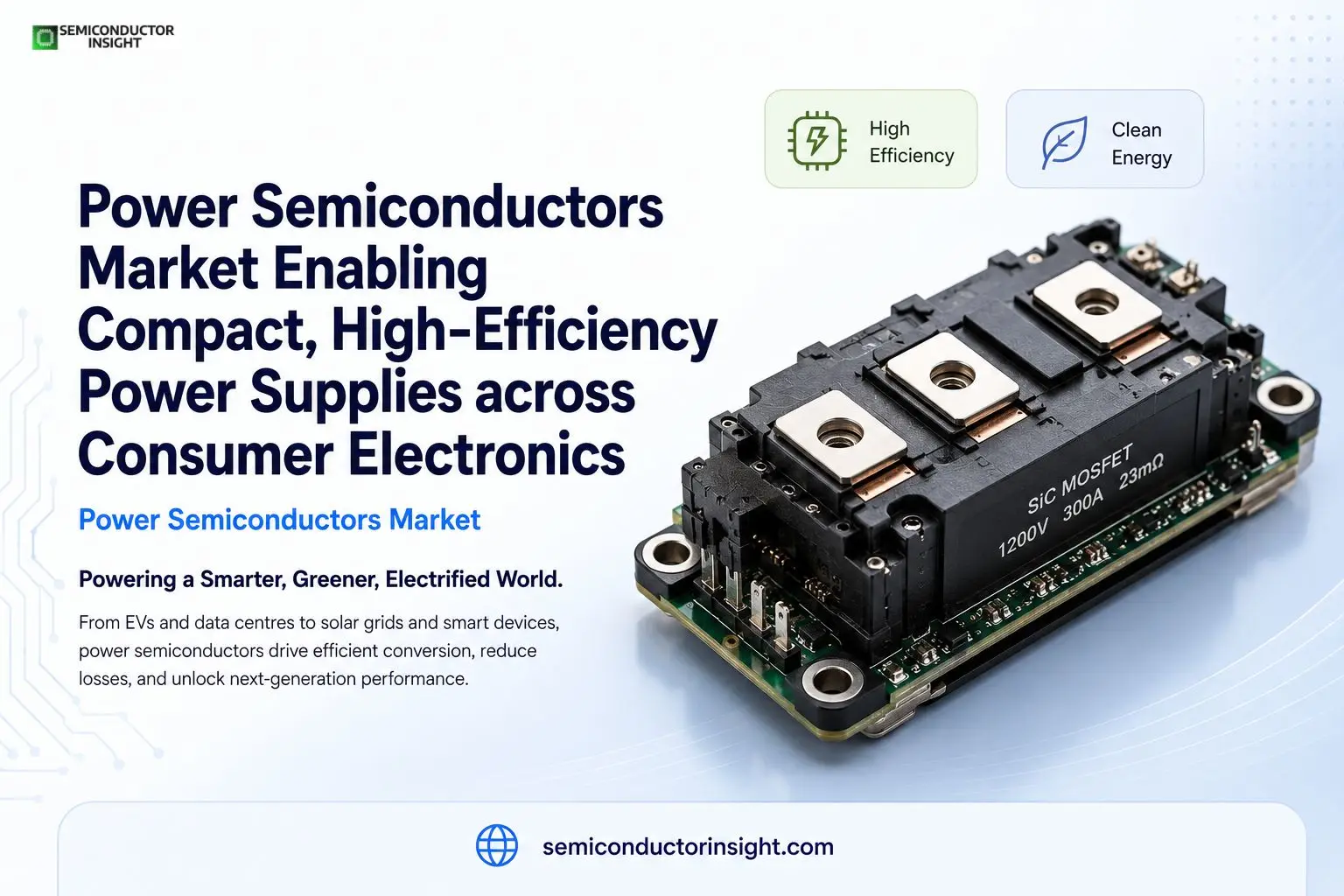
Power Semiconductors Market Enabling Compact, High‑Efficiency Power Supplies across Consumer Electronics
Power semiconductors are no longer niche components tucked away inside power supplies; they sit at the nerve centre of the world’s push toward electrification, energy efficiency, and low‑carbon infrastructure. In everyday terms, these devices control, convert, and regulate flows of electricity in everything from electric cars and solar farms to industrial motors and consumer gadgets, making the power semiconductors market one of the most quietly transformative segments in the broader semiconductor industry.
Wolfspeed’s AI data centre SiC revenue grew 50% sequentially in Q2 FY2026, after completing shutdown of its 150mm Durham fab ahead of schedule shifting entirely to its 200mm Mohawk Valley plant. In March 2026 it launched the industry’s first commercially available 10,000V SiC MOSFET, targeting grid modernisation and AI data centre infrastructure.
From silicon to wide‑band gap materials
Traditional silicon‑based power devices such as IGBTs and MOSFETs still dominate many industrial and automotive systems, but the real shift is happening in materials. Wide‑band gap semiconductors especially silicon carbide and gallium nitride have gained traction because they tolerate higher voltages, operate at higher temperatures, and switch at much higher frequencies.
This means engineers can design smaller, lighter, and more efficient converters, which is especially important in battery‑driven platforms such as electric vehicles and drones. For example, several mainstream EV platforms now use silicon carbide‑based inverters, reducing power losses by several percentage points and improving real‑world range without enlarging the battery pack.
Clean Mobility Advancements in Energy Supply Systems
In the automotive sector, the power semiconductors market is tightly linked to the growth of EVs and associated charging networks. Onboard chargers, traction inverters, DC‑DC converters, and battery‑management systems all rely on power devices to manage bidirectional flows of energy.
As average EV battery capacities rise into the 70-100 kWh range and charging stations target 150-350 kW output, thermal management and switching efficiency become decisive differentiators. Real‑world deployments of high‑power DC fast‑charging stations in Europe, North America, and parts of Asia are pushing for modular architectures built around stacks of fast‑switching power semiconductors, capable of handling currents in the hundreds of amperes while maintaining stable voltage profiles.
The EV pull: chips per vehicle surge
- Semiconductor cost per ICE car: $500-600. Per EV in 2025: over $1,500. Expected by 2030: $2,000+. Every EV shift triples the silicon demand per unit. Source: Deloitte / IEA
- Global EV sales hit 20.7 million units in 2025 over 25% of new-car sales worldwide for the first time, per IEA Global EV Outlook 2025. Q1 2025 alone: 4 million+ units sold, up 35% YoY.
- 5 million+ public charge points worldwide by end-2024 (IEA). Ultra-fast 150kW+ chargers grew ~50% in 2024. Each fast charger is a power semiconductor-dense system.
- March 2025: Hyundai Motor expanded partnership with Infineon to co-develop power semiconductors for EVs. Wolfspeed secured Toyota as a customer for onboard charging SiC systems in 2026.
You Can Go Through Our Latest Updated Insights Here: https://semiconductorinsight.com/report/global-power-semiconductors-market/
Enabling renewable energy and grid‑scale systems
On the grid side, the power semiconductors market underpins the expansion of solar and wind installations. Power inverters convert variable DC output from solar panels into clean AC grid‑compliant power, while wind turbines use sophisticated converters to match generator output with grid frequency.
In many large‑scale projects, total inverter capacity can exceed several hundred megawatts, and the volume of power semiconductor chips in these systems runs into the hundreds of thousands per installation. Beyond generation, high‑voltage‑direct‑current (HVDC) links and flexible AC transmission systems increasingly rely on advanced thyristors, IGBT‑based valves, and modular multilevel converters to manage long‑distance power flows with lower losses than conventional AC lines.
Data centres and cloud‑powered power systems
The rise of cloud computing and AI‑driven services has also reshaped the power semiconductors market. Modern data centres draw enormous amounts of power, often in the megawatt scale for single campuses, and they must balance efficiency, reliability, and density.
Power distribution units, server‑level voltage regulators, and backup‑power systems increasingly integrate high‑frequency power semiconductors to minimize losses during AC‑DC and DC‑DC conversion. Some operators report energy‑use‑effectiveness ratios improved by single‑digit percentages simply by upgrading power‑conversion stages with better‑switching semiconductor stacks, translating into noticeable reductions in cooling load and operational cost.
Consumer and appliance‑level electrification
- At the consumer level, trends from fast‑charging smartphones to high‑power kitchen appliances and HVAC systems are quietly expanding the power semiconductors market. Universal chargers compliant with modern USB‑PD standards often use gallium nitride‑based converters to achieve compact designs with multi‑port, multi‑watt output.
- Similarly, inverter‑based air conditioners and heat pumps use advanced power devices to modulate compressor speed instead of running units in simple on‑off cycles, which can reduce household‑level energy consumption by 20% or more across typical usage patterns. These small‑scale but high‑volume applications together form a substantial slice of the global power semiconductor inventory.
Emerging system‑level architectures
Beyond individual components, the power semiconductors market is aligning with broader system‑level architectures such as modular power electronics, integrated power modules, and multi‑material die‑stacks. Engineers are combining silicon carbide and gallium nitride in hybrid modules, blending high‑voltage blocking capability with ultra‑fast switching, while also integrating control logic and sensing circuits into single packages.
This co‑design approach is particularly evident in EV powertrains, where compact traction modules integrate dozens of power dies, gate drivers, and protection circuits into a single housing, reducing wiring complexity and thermal interfaces.
Overall, the power semiconductors market today reflects more than just a component business it is a core enabler of how societies generate, transport, and consume electricity in an increasingly electrified world.

Comments (0)