
PCIe Gen5 vs. Gen6 Data Center SSDs in 2026 Which Storage Architecture Wins
The SSD in a data center is now more than just a quicker substitute for a hard drive. The expectations for storage are evolving due to the introduction of generative AI, retrieval systems, large datasets, and increasingly dense processing racks. Large datasets must be moved swiftly, latency must be predictable, and increasing amounts of training and inference data must be stored without taking up an excessive amount of rack space.
This shift is particularly visible in AI infrastructure. NVIDIA’s GB200 NVL72, for example, combines 72 Blackwell GPUs and 36 Grace CPUs in one liquid-cooled rack-scale system, with the NVLink architecture providing up to 130 TB/s of aggregate NVLink bandwidth. Storage does not operate at that exact interface speed, but the architecture illustrates how rapidly data movement has become a central consideration in AI system design.
For More Detailed Insights, You Can Surf Our Latest Report Here: https://semiconductorinsight.com/report/data-center-ssds-market/
The new storage problem is density
- For conventional enterprise workloads, adding more servers has often been a straightforward way to increase capacity. AI-scale facilities are making that approach increasingly expensive in terms of space, power, cooling and infrastructure overhead.
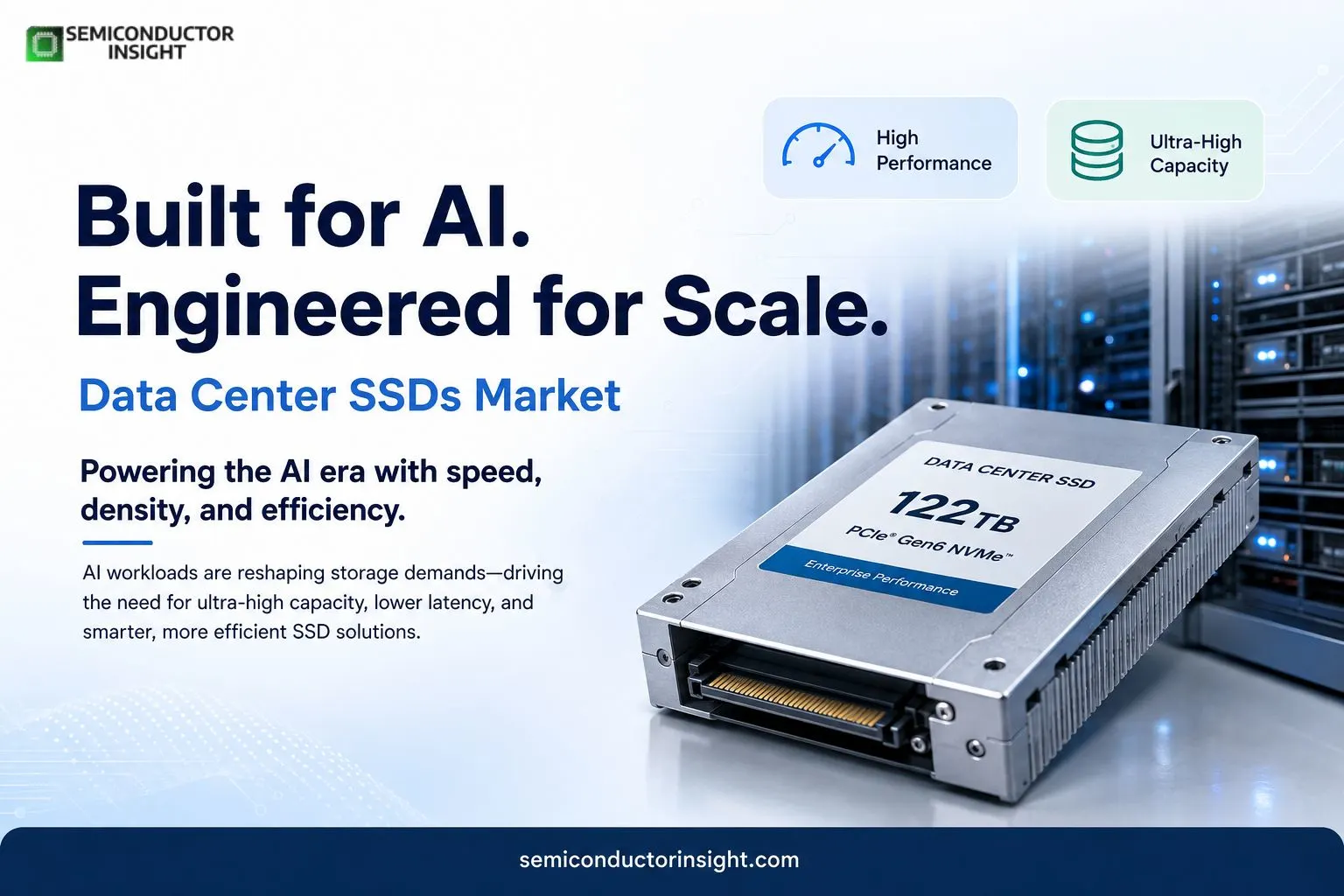
- This is why high-capacity SSDs are attracting attention. Micron’s 6600 ION family now reaches 245TB in the E3.L form factor and 122TB in E3.S, with the company positioning the drives for AI, cloud and data-center environments. Micron states that the 245TB configuration can provide more than 4.9PB of capacity per 1U, while the 122TB E3.S version can provide more than 2.4PB per 1U.
- The implication is significant: storage capacity can grow without increasing the physical number of drives at the same rate.
AI is creating several different SSD workloads
There is no single ‘AI workload’ from a storage perspective. Training datasets, checkpoints, vector databases, inference caches, content repositories and conventional enterprise applications place different demands on SSDs.
Training can require repeated access to very large datasets, while inference may prioritize low latency and predictable quality of service. Data lakes and archival-style repositories, meanwhile, can place greater emphasis on capacity and cost per terabyte.
That is why the market is moving toward multiple SSD classes rather than one universal drive architecture.
Training data → High throughput → Fast dataset delivery
Inference → Low latency → Rapid retrieval
Data lakes → High capacity → efficient storage density
Enterprise applications → QoS + endurance → Consistent performance
This workload segmentation is becoming increasingly important as AI infrastructure moves from experimental deployments toward permanent production environments.
PCIe Gen6 changes the performance conversation
The interface connecting an SSD to the host system is becoming almost as important as NAND itself. Micron introduced its 9650 as a PCIe Gen6 data-center SSD, reporting sequential performance of up to 28 GB/s. The company also positioned the drive for demanding AI and cloud workloads.
The progression from PCIe Gen4 to Gen5 and now Gen6 reflects a broader industry requirement: storage must increasingly keep pace with processors, accelerators and networking infrastructure.
A faster interface does not automatically make every workload faster. Software stacks, queue depth, workload type, CPU architecture and storage access patterns remain important. But as bottlenecks move through the system, reducing the time required to move data between storage and compute becomes increasingly valuable.
QLC is finding a different role in AI infrastructure
- High-capacity QLC NAND is particularly interesting because it changes the economics of storing enormous datasets. QLC stores four bits per cell, allowing manufacturers to achieve greater density than lower-bit-per-cell NAND technologies.
- Micron’s 122TB 6600 ION uses G9 QLC NAND and is designed for read-intensive applications such as data lakes, AI training datasets and content repositories.
- Micron reports a workload endurance specification of up to 0.3 drive writes per day, illustrating why high-capacity QLC drives are aimed at specific workload profiles rather than indiscriminately replacing every enterprise SSD.
- This creates an important distinction in Data Center SSDs Market: the highest-capacity drive is not necessarily the best choice for write-heavy transactional workloads.
A 1 exabyte deployment reveals the scale
At AI scale, even small improvements in drive density become significant. Micron estimates that a 1 exabyte deployment using its 122TB-class SSDs could eliminate approximately 25,000 36TB nearline HDDs under the company’s comparison assumptions. It also reports more than 3,000 times the IOPS of the compared densest HDD configuration at rack level.
These are vendor-reported comparisons rather than universal industry benchmarks, but they demonstrate the engineering problem facing hyperscale operators: once storage reaches exabyte territory, the physical footprint of the storage system becomes an infrastructure issue in its own right.
Data center power is making storage efficiency harder to ignore
- Storage is only one part of a data center’s energy profile, but the broader power situation is becoming increasingly important.
- The U.S. Department of Energy reported that U.S. data-center electricity consumption is projected to double or potentially triple by 2028, driven in part by AI and other expanding digital workloads.
- That puts greater emphasis on performance per watt, capacity per rack and the number of infrastructure components required for a given amount of usable storage.
- A high-density SSD therefore offers value beyond its headline terabyte figure. Fewer drives can potentially mean fewer servers, fewer PCIe connections, less rack space and reduced cooling requirements.
Storage is moving closer to the AI pipeline
The next development is not simply about making SSDs larger. Storage is becoming increasingly integrated into the architecture surrounding accelerators, networking and memory.
AI systems can generate enormous intermediate datasets, model checkpoints and retrieval indexes. As models become more complex, the ability to feed data into compute resources without creating idle time becomes a system-level optimization problem.
This creates a new architecture:
NAND → SSD Controller → PCIe → CPU / Accelerator → High-Speed Network → AI Cluster
Each layer can become a bottleneck. Consequently, SSD manufacturers are competing not only on capacity but also on latency, endurance, QoS, security, power efficiency and interface bandwidth.
Security is moving into the drive itself
Enterprise and hyperscale storage also increasingly requires hardware-level security. Modern data-center SSDs can incorporate self-encrypting-drive capabilities, secure firmware authentication and hardware roots of trust.
Micron’s current data-center SSD portfolio, for example, includes security capabilities such as SPDM 1.2, self-encrypting-drive functionality and firmware verification features, alongside support for Open Compute Project specifications on selected products.
For cloud providers, this matters because storage devices hold training datasets, customer information, application databases and model-related data. Performance therefore has to coexist with data protection.
The SSD is becoming an infrastructure component
The most important change in Data Center SSDs Market is that storage is no longer being designed in isolation. AI accelerators determine how quickly data must arrive. Networking determines how quickly clusters can exchange information. Cooling determines rack density. Power availability determines how much infrastructure can be deployed.
The SSD sits directly inside that chain.
With 122TB-class drives already available, 245TB capacity entering high-density configurations and PCIe Gen6 pushing data-center storage toward 28 GB/s-class sequential performance, the direction is clear: the next generation of storage is being designed around the physical and computational realities of AI-scale data centers rather than around traditional enterprise storage alone.

Comments (0)