Data Center SSDs Market Insights
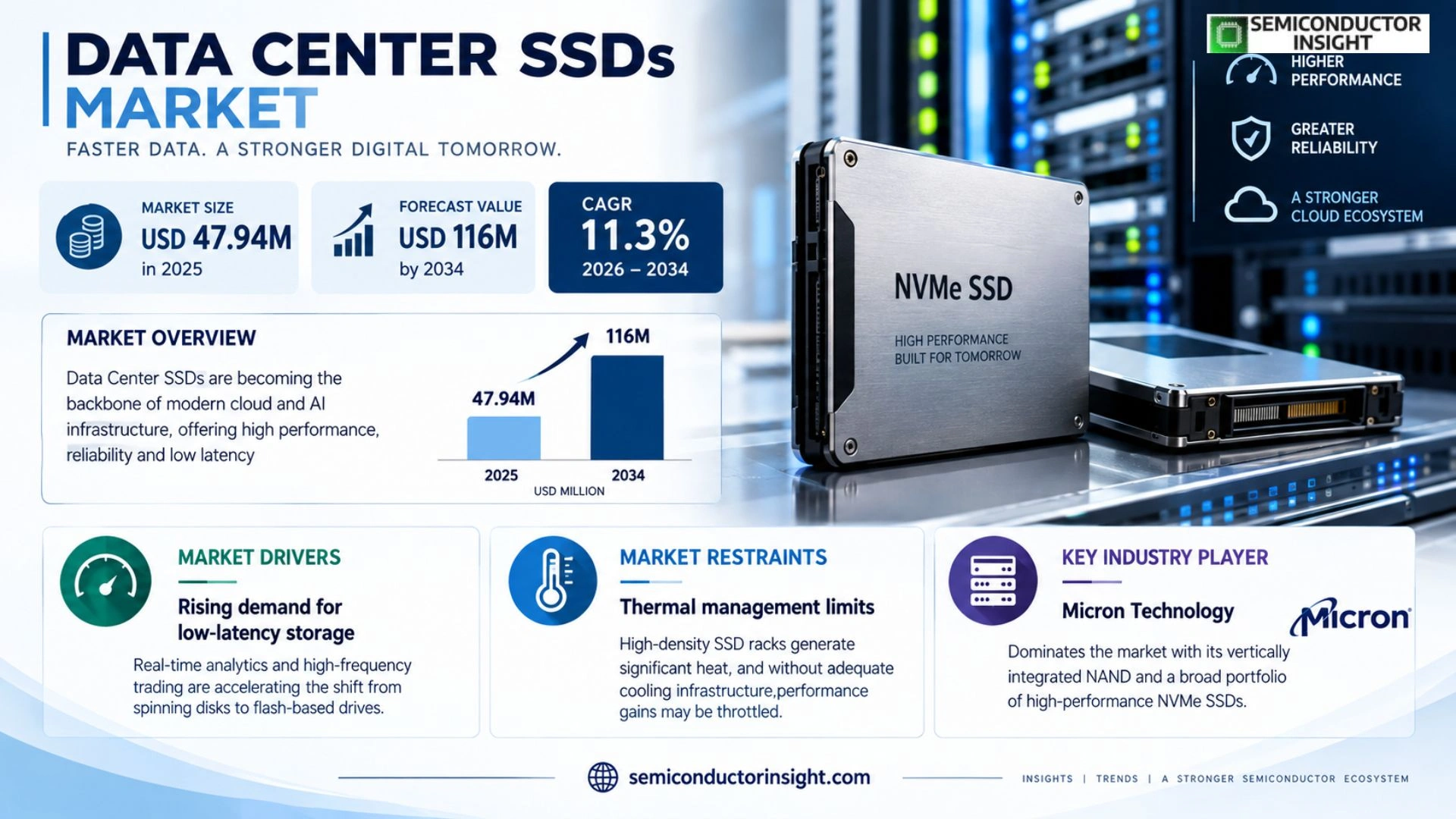
Data Center SSDs market was valued at USD 47.94 million in 2025 and is projected to reach USD 116 million by 2034, exhibiting a CAGR of 11.3% during the forecast period.
Data Center SSDs (Solid State Drives) are enterprise‑grade storage devices built for data‑center environments, delivering high‑speed, low‑latency performance and robust reliability for servers and cloud infrastructure. Compared with consumer SSDs, they provide higher endurance, superior thermal stability, advanced error‑correction mechanisms, power‑loss protection, and support protocols such as NVMe and SAS, enabling intensive workloads like AI training, big‑data analytics, virtualization and high‑performance computing.
The expansion of cloud services, increasing AI workloads, and the shift toward all‑flash data centers are fueling demand for these drives; adoption of NVMe interfaces and PCIe Gen4/Gen5 standards further enhances their appeal. North America and Asia‑Pacific lead adoption rates, while manufacturers are pursuing higher capacity QLC NAND and more efficient controllers to improve cost efficiency.
MARKET DRIVERS
Rising Demand for Low‑Latency Storage
The surge in real‑time analytics and high‑frequency trading pushes operators to replace spinning disks with flash‑based drives. Low‑latency I/O translates directly into faster transaction processing, a competitive edge that many cloud providers now consider indispensable. Consequently, Data Center SSDs Market is experiencing a noticeable shift in procurement priorities.
Shift Toward All‑Flash Architectures
Enterprises are redesigning tiered storage hierarchies, moving critical workloads onto all‑flash arrays. The elasticity offered by NVMe over Fabrics enables dense compute clusters while keeping power consumption in check. This architectural transition fuels recurring revenue streams for vendors and expands the addressable base of Data Center SSDs Market.
➤ “Enterprises are accelerating SSD adoption to meet AI workloads, and the speed advantage is no longer optional.”
Beyond performance, the reliability envelope of modern SSDs,featuring advanced error‑correction and wear‑leveling,has alleviated long‑standing concerns about endurance. Reduced failure rates lower total cost of ownership, prompting data‑center managers to favor flash solutions over legacy disks.
MARKET CHALLENGES
Capital Expenditure Constraints
Although flash delivers clear operational benefits, the upfront price premium remains a hurdle for organizations with tight budget cycles. Decision‑makers must justify the investment against other IT priorities, often resulting in phased migration strategies that dilute the pace of adoption.
Other Challenges
Supply Chain Volatility
Global component shortages have intermittently throttled production capacity. When lead times extend, data‑center projects face scheduling risks, prompting some operators to revert to legacy storage as a stop‑gap measure.
MARKET RESTRAINTS
Thermal Management Limits
High‑density SSD racks generate significant heat, challenging existing cooling infrastructures. Facilities that cannot retrofit adequate airflow or liquid‑cooling solutions may encounter throttling, which curtails the performance gains that flash promises. This technical ceiling imposes a practical restraint on broader deployment.
MARKET OPPORTUNITIES
Emerging Edge‑Data Center Deployments
Edge locations, from telecom hubs to autonomous‑vehicle processing nodes, require compact yet performant storage. The compact form factor and low power draw of SSDs align perfectly with these constraints, opening a niche where Data Center SSDs Market can capture significant incremental demand. Providers that tailor firmware for low‑latency, intermittent‑connectivity scenarios stand to differentiate themselves markedly.
Data Center SSDs Market Trends
NVMe and PCIe Gen5 Accelerate Performance
Data Center SSDs Market is seeing a decisive move toward NVMe‑based interfaces coupled with the latest PCIe Gen5 specifications. Enterprises deploying hyperscale cloud services report that the extra bandwidth trims latency on database queries and AI model training, translating into measurable throughput gains. Vendors have responded by integrating advanced controllers that negotiate multiple lanes, allowing a single drive to sustain several million IOPS. This hardware evolution aligns with the shift from hybrid storage to all‑flash configurations, where the reliability envelope of enterprise‑grade SSDs outweighs the legacy HDD footprint. As a result, data center operators are re‑architecting storage tiers to capitalize on the speed advantage.
Other Trends
Cost Pressures and QLC NAND Introduction
Price sensitivity is reshaping procurement strategies across Data Center SSDs Market. In 2025, average unit pricing hovered around US$2,500, yet profit margins still ranged between 20 % and 40 %, reflecting a delicate balance between cost and performance. The adoption of QLC NAND has emerged as a pragmatic response, delivering higher capacities at lower per‑gigabyte cost while preserving endurance levels acceptable for bulk‑storage workloads. Manufacturers are pairing QLC stacks with sophisticated wear‑leveling algorithms and power‑loss protection to mitigate reliability concerns. This cost‑optimization pathway enables hyperscale operators to expand flash footprints without inflating CapEx, thereby supporting the broader transition to all‑flash data centers.
Geographic Expansion and Disaggregated Architecture
Regional growth patterns are influencing supply chain decisions within Data Center SSDs Market. North America maintains leadership in early‑stage adoption of disaggregated storage, while Asia‑Pacific accelerates deployment through large‑scale cloud expansions. The disaggregated model, which separates compute from storage, benefits from the low‑power profile and high IOPS density of modern SSDs, allowing data centers to scale storage independently of server farms. Consequently, vendors are establishing production lines closer to key demand hubs, reducing lead times and logistical complexity. This geographic realignment not only shortens time‑to‑market for new drive generations but also enhances resilience against regional disruptions, reinforcing the strategic importance of flexible architecture.
COMPETITIVE LANDSCAPE
Key Industry Players
Data Center SSDs Competitive Overview
Micron Technology dominates the upper tier of the data‑center SSD market, leveraging its vertically integrated NAND fabrication and a broad portfolio that spans high‑performance NVMe U.2, PCIe Gen4/5, and endurance‑optimized QLC models. The company’s 2025 production capacity of roughly 25 k units and a gross‑margin band of 20‑40 % give it the financial flexibility to invest in next‑generation 176‑layer NAND and proprietary controller firmware. Micron’s strategy of aligning closely with hyperscale cloud operators,through joint‑development programs and volume‑discount structures,creates a defensible position that forces newer entrants to rely on strategic partnerships or contract fabs to gain market traction. The overall market architecture features a handful of integrated device manufacturers (IDMs) that control both silicon and package assembly, complemented by a thin layer of pure‑play storage vendors that focus on controller innovation and value‑added software stacks.
Beyond the IDM core, a diverse set of niche players injects competitive pressure by targeting specific segment needs. Samsung Electronics and SK Hynix, both equipped with advanced 3‑D V‑NAND processes, are expanding their QLC‑based product lines to address cost‑sensitive cloud workloads while preserving latency targets. Kioxia distinguishes itself through its emphasis on high‑endurance SLC/TLC hybrids for AI‑training clusters. Western Digital’s acquisition of SanDisk’s enterprise business has yielded a combined portfolio that spans SATA, SAS, and NVMe form factors, serving legacy data‑center refresh cycles. Kingston Technology and ADATA focus on mid‑range NVMe modules that appeal to regional hyperscalers seeking rapid deployment. Seagate and Intel pursue differentiated controller architectures, with Intel emphasizing off‑load compute integration and Seagate leveraging its HDD heritage to offer hybrid flash solutions. OEMs such as Dell Technologies and HPE act as system integrators, bundling SSDs from the aforementioned manufacturers into turnkey servers, thereby influencing demand patterns through reference designs. This mosaic of capabilities ensures that the market remains fluid, with each participant carving out niches around performance, endurance, or pricing levers.
List of Key Data Center SSDs Companies Profiled
- Micron Technology
- Samsung Electronics
- SK Hynix
- Kioxia
- Western Digital
- SanDisk (Western Digital)
- Kingston Technology
- ADATA
- Seagate Technology
- Intel Corporation
- Toshiba Memory
- Dell Technologies
- Hewlett Packard Enterprise (HPE)
Segment Analysis:
| Segment Category | Sub-Segments | Key Insights |
| By Type |
|
NVMe SSDs are the dominant choice for modern data centers because they deliver ultra‑low latency and high IOPS over PCIe interfaces.
|
| By Application |
|
Cloud Data Centers drive the bulk of SSD adoption as hyperscale operators seek to replace HDDs with all‑flash solutions.
|
| By End User |
|
Cloud Service Providers prioritize SSDs to guarantee SLA compliance for latency‑sensitive services.
|
| By Storage Media |
|
TLC / QLC emerge as cost‑effective choices for capacity‑driven workloads while still meeting enterprise reliability standards.
|
| By System Architecture |
|
Disaggregated architecture is reshaping data‑center storage by decoupling compute nodes from flash resources.
|
Regional Analysis: Data Center SSDs Market
North America
Fortune‑500 enterprises are standardizing on all‑flash storage to eliminate performance bottlenecks in mission‑critical applications. Their procurement cycles increasingly favor vendors that can demonstrate end‑to‑end security integration, a factor that accelerates adoption curves across financial services and healthcare sectors.
Leading cloud providers are extending their footprint in the western United States, leveraging high‑density SSD arrays to support AI inference workloads. This expansion creates a feedback loop where infrastructure upgrades stimulate demand for higher endurance drives.
The rise of 5G and low‑latency services has prompted operators to deploy smaller, SSD‑rich facilities near population centers. These edge nodes demand compact, power‑optimized solutions, reshaping product roadmaps for many manufacturers.
Recent disruptions have motivated data‑center owners to diversify component sourcing, favoring suppliers with robust North American manufacturing footprints. This shift reduces lead times and aligns with sustainability goals.
Europe
European data‑center operators are navigating a complex regulatory tapestry that emphasizes energy efficiency and data protection. Companies are gravitating toward SSD solutions that balance high throughput with reduced power draw, aligning with the EU’s climate‑neutral objectives. In addition, the emergence of sovereign cloud initiatives in Germany and France is prompting local players to partner with vendors offering on‑premise firmware customization, a move that differentiates providers capable of meeting stringent compliance demands.
Asia‑Pacific
The Asia‑Pacific region exhibits a blend of rapid digital transformation and cost‑sensitivity. Enterprises in Japan and South Korea prioritize ultra‑low latency for fintech and gaming, while markets such as India and Southeast Asia focus on price‑elastic storage options to support burgeoning cloud adoption. Vendors that can deliver modular SSD platforms,allowing incremental scaling,are positioned to capture a sizable share of this heterogeneous demand landscape.
South America
South American data‑center growth is driven by expanding broadband penetration and government‑led initiatives to localize cloud services. Operators are adopting SSD arrays that can withstand higher ambient temperatures typical of the region, reducing reliance on extensive cooling infrastructure. Strategic partnerships between local telcos and global SSD manufacturers are fostering a more resilient supply chain, which in turn accelerates market maturity.
Middle East & Africa
In the Middle East, sovereign data‑center projects are capital‑intensive, favoring high‑performance SSDs that can handle intensive analytics workloads for oil & gas and financial services. Meanwhile, Africa’s nascent cloud market is emphasizing affordability and ruggedness, leading providers to engineer SSDs with extended temperature tolerances and simplified firmware update mechanisms. These divergent priorities underscore the need for flexible product portfolios that can address both premium and entry‑level segments within the region.
Report Scope
This market research report provides a comprehensive analysis of the Data Center SSDs Market , covering the forecast period 2026–2034. It offers detailed insights into market dynamics, technological advancements, competitive landscape, and key trends shaping the industry.
Key focus areas of the report include:
- Market Overview: The report begins with an overview outlining its current market scenario, key growth indicators, and industry transformation drivers. It discusses macroeconomic factors, demand–supply balance, regulatory landscape, and the strategic role of semiconductors in powering advancements across industries such as automotive, telecommunications, consumer electronics, and industrial automation.
- Market Size & Forecast: Historical data and future projections for revenue, unit shipments, and market value across major regions and segments.
- Segmentation Analysis: Detailed breakdown by product type, technology, application, and end-user industry to identify high-growth segments and investment opportunities.
- Regional Insights: Insights into market performance across North America, Europe, Asia-Pacific, Latin America, and the Middle East & Africa, including country-level analysis where relevant.
- Competitive Landscape: Profiles of leading market participants, including their product offerings, R&D focus, manufacturing capacity, pricing strategies, and recent developments such as mergers, acquisitions, and partnerships.
- Technology Trends & Innovation: Assessment of emerging technologies, integration of AI/IoT, semiconductor design trends, fabrication techniques, and evolving industry standards.
- Market Drivers & Restraints: Evaluation of factors driving market growth along with challenges, supply chain constraints, regulatory issues, and market-entry barriers.
- Stakeholder Insights: Insights for component suppliers, OEMs, system integrators, investors, and policymakers regarding the evolving ecosystem and strategic opportunities.
Primary and secondary research methods are employed, including interviews with industry experts, data from verified sources, and real-time market intelligence to ensure the accuracy and reliability of the insights presented.
FREQUENTLY ASKED QUESTIONS:
What is the current market size of Data Center SSDs Market?
-> Data Center SSDs market is projected to reach USD 116 million by 2034, exhibiting a CAGR of 11.3% during the forecast period.
Which key companies operate in Data Center SSDs Market?
-> Key players include Micron, SK Hynix, Samsung Electronics, Kioxia, Kingston Technology, SanDisk, Western Digital, ADATA, Phison Electronics, and HUAWEI.
What are the key growth drivers?
-> Key growth drivers include the rapid expansion of cloud computing, AI workloads, big data analytics, hyperscale data center deployments, and the need for high‑performance, low‑latency storage solutions.
Which region dominates the market?
-> North America holds the largest market share, while Asia‑Pacific is the fastest‑growing region.
What are the emerging trends?
-> Emerging trends include higher‑capacity SSDs, improved endurance through QLC NAND, advanced controllers, widespread adoption of NVMe over PCIe Gen4/Gen5, and the shift toward all‑flash data center architectures.
Get Sample Report PDF for Exclusive Insights
Report Sample Includes
- Table of Contents
- List of Tables & Figures
- Charts, Research Methodology, and more...
 Download Sample Report PDF