QLC Solid State Drive (SSD) Market Insights
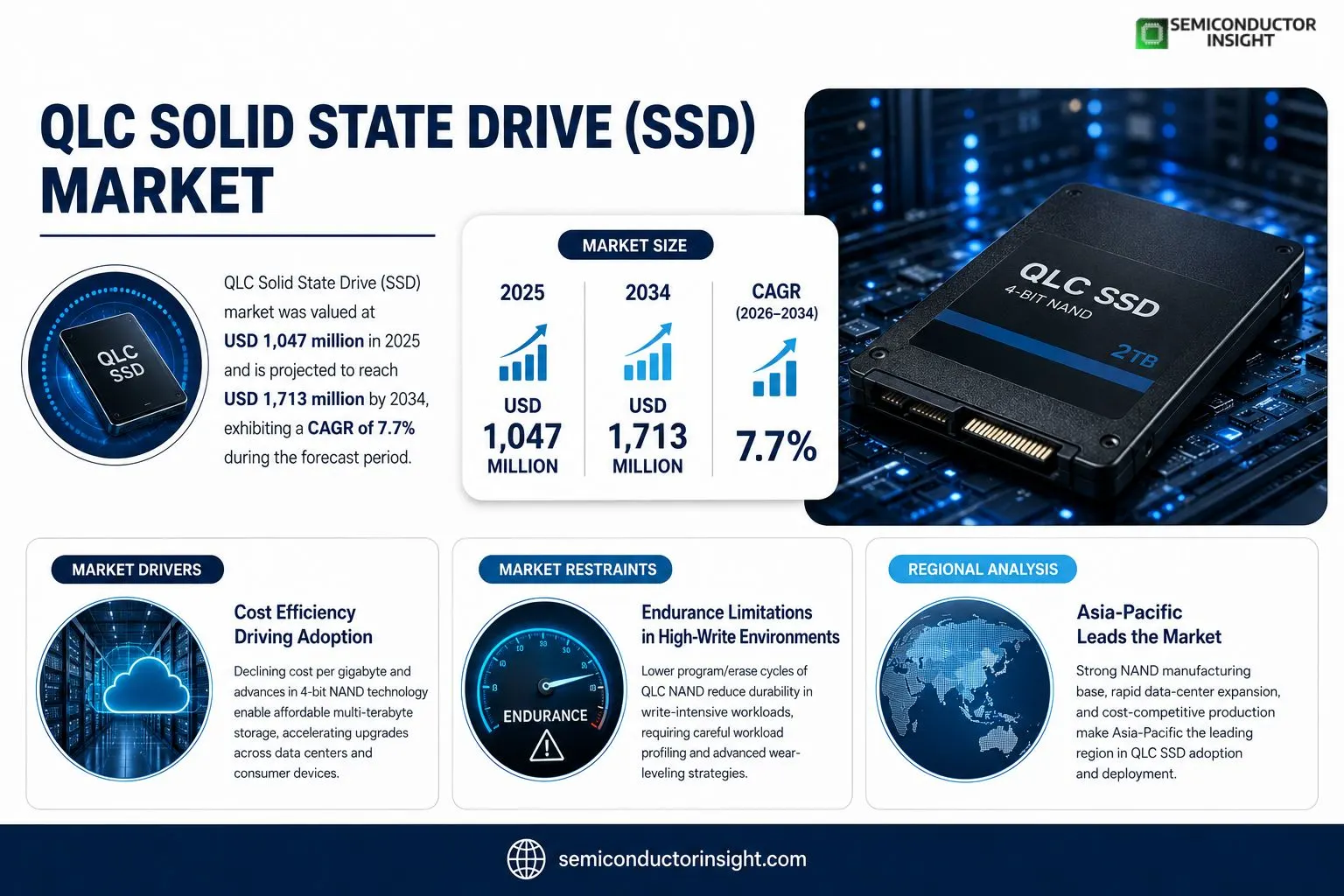
QLC Solid State Drive (SSD) Market was valued at USD 1,047 million in 2025 and is projected to reach USD 1,713 million by 2034, exhibiting a CAGR of 7.7% during the forecast period.
Quad‑cell solid‑state drives (QLC) employ four‑level cell flash memory technology, enabling each cell to store four bits of data. Compared with MLC and TLC alternatives, QLC offers a substantially lower cost per gigabyte while delivering reduced write endurance and peak performance; therefore it is best suited for capacity‑sensitive, read‑heavy and write‑light scenarios such as data archiving, cold storage repositories and high‑capacity consumer products.The upward trajectory is driven by exploding data volumes across cloud services, video surveillance expansion and AI training workloads that require inexpensive high‑capacity storage. Manufacturers mitigate endurance limitations through sophisticated controller algorithms and caching techniques, while an integrated supply chainfrom NAND fabs to system integratorscompresses pricing further. Recent joint ventures between NAND producers and OEMs have accelerated deployment of QLC solutions targeting enterprise cold‑data tiers.
MARKET DRIVERS
Cost efficiency driving adoption
QLC Solid State Drive (SSD) Market benefits from a sharp decline in cost per gigabyte, a trend that has made multi‑terabyte storage affordable for midsize data centers. Manufacturers have leveraged advances in NAND stacking and controller algorithms, delivering price points that undercut traditional hard‑disk solutions while preserving the performance envelope expected of flash devices. This price elasticity encourages organizations to replace legacy arrays with QLC‑based solutions, freeing budget for other strategic initiatives.
Capacity pressures from data‑intensive workloads
Growth in video streaming, backup archives, and cloud object storage creates a relentless appetite for raw capacity. QLC SSDs, with their ability to pack four bits per cell, align naturally with these volume‑heavy use cases. Clients that previously relied on a combination of SATA HDDs and lower‑density SSD tiers now find a single‑vendor offering that satisfies both space and performance criteria. The resulting consolidation simplifies procurement and reduces total cost of ownership.
➤ “When capacity outweighs endurance, QLC becomes the logical choice for most enterprise workloads.”
Beyond hardware economics, software‑defined storage stacks are evolving to offload write‑intensive tasks to higher‑endurance tiers, leaving QLC drives to handle read‑dominant or cold‑data streams. This architectural shift reinforces the market’s momentum, as IT leaders recognize a tangible pathway to scale storage without proportionally inflating operational expenses.
MARKET CHALLENGES
Endurance limitations in high‑write environments
QLC NAND’s reduced program/erase cycles remain a concern for applications that generate frequent write bursts, such as transactional databases or real‑time analytics platforms. While firmware wear‑leveling has improved, the underlying cell chemistry still dictates a lower write endurance ceiling compared with MLC or TLC alternatives. Organizations must therefore conduct rigorous workload profiling to avoid premature degradation.
Other Challenges
Write‑amplification management
Manufacturers counteract amplified writes through sophisticated caching and over‑provisioning strategies. However, mismatches between host I/O patterns and drive heuristics can still lead to unnecessary cell wear, prompting the need for tighter integration between storage controllers and operating system drivers.
MARKET RESTRAINTS
Thermal constraints in dense server environments
As QLC SSDs proliferate in high‑density racks, their power dissipation profile begins to challenge existing cooling architectures. The cumulative heat output, especially under bursty workloads, can push ambient temperatures beyond safe operating limits. Vendors are responding with enhanced heat‑spreaders and dynamic throttling, yet the additional engineering effort translates into higher upfront costs that may temper rapid uptake in hyperscale facilities.
MARKET OPPORTUNITIES
AI inference platforms seeking high‑capacity, low‑cost storage
Inference workloads for generative AI models demand terabytes of model parameters and intermediate data, yet they exhibit a relatively low write intensity after initial loading. QLC SSDs are uniquely positioned to satisfy this pattern, offering the necessary capacity at a fraction of the cost of premium TLC drives. Early adopters are already piloting QLC‑based storage tiers within AI pipelines, a move that could unlock a sizable revenue channel for vendors willing to certify reliability under AI‑specific workloads.
QLC Solid State Drive (SSD) Market Trends
Cost Efficiency and Capacity Emphasis
QLC Solid State Drive (SSD) Market is being reshaped by the stark cost advantage that quad‑cell architecture offers. In 2025, manufacturers delivered roughly 1.85 million units at an average price near $620, translating to a unit‑cost that is markedly lower than competing MLC and TLC solutions. This pricing pressure has narrowed the gap between premium SSDs and traditional hard drives, prompting system integrators to consider QLC for high‑capacity, read‑oriented workloads. Gross margins hover around 18 %, yet firms that own NAND fabs achieve margins close to 25 % because they control the dominant cost componentapproximately 62 % of the bill of materials. High utilization rates, measured at about 79 % of design capacity, demonstrate that end‑users are filling drives to near‑full density, reinforcing the value proposition of inexpensive, large‑scale storage.
Other Trends
Technology Optimisation and Firmware Advances
While endurance and raw throughput have traditionally limited QLC appeal, recent controller innovations and smarter caching algorithms are mitigating those concerns. By offloading write‑intensive bursts to DRAM or SLC cache zones, manufacturers sustain acceptable latency for consumer and edge devices. Enhanced error‑correction schemes also extend usable life cycles, making the drives viable for write‑light archival tasks. The cost‑share of controller chipsabout 10 % of the totalhas been reduced through integration of consolidated System‑on‑Chip designs, further lowering the entry price. These technical refinements are encouraging brand‑level differentiation; companies that master firmware tuning can market “enterprise‑grade” QLC products without sacrificing their price advantage.
Enterprise Cold‑Data and Edge Deployment
Demand from data centers, cloud service operators, and video‑surveillance platforms is translating into a noticeable shift toward QLC as the preferred storage tier for cold data. The downstream list now includes large‑scale archival warehouses, AI training repositories, and edge compute nodes where capacity outweighs write intensity. Policy incentives that promote digital‑economy expansion and the ongoing rollout of new data‑center facilities accelerate this trend. Manufacturers with in‑house NAND production leverage their scale to offer bundled solutions that combine QLC SSDs with optimized power‑management circuitry, addressing the heightened reliability expectations of enterprise clients. As the industry pursues a dual path of cost reduction and performance fine‑tuning, QLC SSDs are poised to occupy a central role in the storage hierarchy, especially where massive, low‑cost capacity is the decisive factor.
COMPETITIVE LANDSCAPE
Key Industry Players
Competitive Overview of the QLC SSD Market
The market is anchored by a handful of vertically integrated manufacturers that control NAND wafer production, controller design, and final drive assembly. Samsung and Micron dominate the upstream segment, leveraging sub‑10 nm process nodes to drive the QLC cost curve below that of competing TLC and MLC solutions. Their scale enables a gross margin cushion of roughly 25 %, allowing aggressive pricing that fuels adoption in data‑center tier‑1 cloud operators and consumer‑grade high‑capacity notebooks. Western Digital, after its recent acquisition of Kioxia’s NAND assets, has positioned itself as a hybrid player, combining proprietary controller IP with an extensive channel network that reaches both enterprise OEMs and large‑scale system integrators. Intel’s entry through its 3D‑XPoint‑inspired architecture remains limited, but its focus on performance‑tuned QLC modules for edge AI workloads adds a distinct layer to the competitive mix, prompting other firms to accelerate firmware and caching innovations.Beyond the tier‑one tier, a cadre of niche manufacturers exploits differentiated design philosophies and regional market access. Kingston and Sabrent concentrate on value‑oriented consumer drives, coupling modest performance envelopes with bundled software that enhances perceived reliability. VisionTek and Unirex Technologies have carved out a presence in surveillance and video‑archival solutions, where read‑heavy, write‑light profiles match QLC’s strengths. Phison’s controller expertise powers several white‑label brands, while Team Group and HIKSEMI supply cost‑effective drives to emerging Asian PC assemblers. Companies such as Solidigm (spun out from Intel) and YMTC are investing heavily in next‑generation 176‑layer QLC stacks, signaling a future where cost advantage may be further hardened. The overall landscape reflects a split between scale‑driven cost leaders and agile specialists that focus on firmware, niche applications, or regional channel leverage.
List of Key QLC SSD Companies Profiled
- Samsung
- Micron
- Western Digital
- Kioxia
- Intel
- Kingston
- Sabrent
- VisionTek
- Unirex Technologies
- Phison
- Team Group Inc
- HIKSEMI
- Solidigm
- YMTC
- Seagate
Segment Analysis:
| Segment Category | Sub-Segments | Key Insights |
| By Type |
|
Consumer‑grade high‑capacity SSDs
|
| By Application |
|
Data‑center archiving and cold‑storage
|
| By End User |
|
Cloud service providers
|
| By Performance Tier |
|
Read‑Optimized
|
| By Value‑Chain Role |
|
NAND flash memory chip manufacturers
|
Regional Analysis: QLC Solid State Drive (SSD) Market
North America
Large‑scale data‑center operators are allocating a growing share of storage budgets to QLC, capitalising on its cost‑per‑gigabyte advantage while mitigating latency concerns through intelligent caching layers.
Home‑office users upgrading to high‑resolution media archives find QLC SSDs appealing, as they deliver terabyte‑scale capacities without the price premium of TLC or MLC alternatives.
Recent investments in wafer‑fab upgrades across the United States reduce dependency on overseas sources, strengthening regional resilience against geopolitical shocks.
Data‑sovereignty rules compel multinational firms to store sensitive information on‑premises, prompting a shift toward locally produced QLC SSD solutions.
Europe
European manufacturers are emphasizing energy‑efficiency standards, prompting QLC SSD developers to optimise power‑draw during idle periods. This focus dovetails with the EU’s Green Deal, encouraging firms to adopt storage that maximises capacity while minimising environmental impact. Regional cloud providers are experimenting with hybrid models that blend QLC with higher‑performance NAND tiers, delivering flexible SLAs for mixed‑workload environments. The market also reflects a cautious but steady acceptance of QLC technology, as data‑privacy regulations such as GDPR incentivise careful data‑localisation strategies, fostering demand for domestically sourced solutions.
Asia‑Pacific
In Asia‑Pacific, rapid digitisation across manufacturing and entertainment sectors creates a fertile ground for QLC SSDs, especially where large video archives and IoT data streams dominate. Suppliers are targeting price‑sensitive OEMs, offering QLC‑based modules that align with the region’s cost‑conscious procurement practices. Concurrently, government‑backed initiatives to expand broadband and 5G infrastructure stimulate storage upgrades in telecom networks, where QLC’s high density proves advantageous. Competitive pressures drive local chip makers to accelerate process‑node refinements, aiming to close the performance gap with established players.
South America
South American economies are witnessing a gradual shift from legacy HDD deployments to solid‑state solutions as e‑commerce and fintech sectors expand. While overall market size remains modest, the allure of lower total cost of ownership encourages enterprises to pilot QLC SSDs for archival workloads. Regional distributors report increasing interest from educational institutions seeking affordable, high‑capacity storage for research data sets. Supply constraints are alleviated by emerging partnerships with North American manufacturers, facilitating more predictable delivery schedules.
Middle East & Africa
The Middle East & Africa region is leveraging QLC SSDs to support burgeoning smart‑city projects and oil‑and‑gas data analytics platforms. Energy‑intensive industries appreciate the balance QLC offers between capacity and power efficiency, aligning with sustainability targets. In several African markets, mobile‑first strategies drive demand for compact, high‑capacity storage in edge devices, positioning QLC as a viable option. Although infrastructure challenges persist, targeted investments in data‑center capacity are gradually creating a more conducive environment for QLC adoption.
Report Scope
This market research report provides a comprehensive analysis of the QLC Solid State Drive (SSD) Market , covering the forecast period 2026–2034. It offers detailed insights into market dynamics, technological advancements, competitive landscape, and key trends shaping the industry.
Key focus areas of the report include:
- Market Overview: The report begins with an overview outlining its current market scenario, key growth indicators, and industry transformation drivers. It discusses macroeconomic factors, demand–supply balance, regulatory landscape, and the strategic role of semiconductors in powering advancements across industries such as automotive, telecommunications, consumer electronics, and industrial automation.
- Market Size & Forecast: Historical data and future projections for revenue, unit shipments, and market value across major regions and segments.
- Segmentation Analysis: Detailed breakdown by product type, technology, application, and end-user industry to identify high-growth segments and investment opportunities.
- Regional Insights: Insights into market performance across North America, Europe, Asia-Pacific, Latin America, and the Middle East & Africa, including country-level analysis where relevant.
- Competitive Landscape: Profiles of leading market participants, including their product offerings, R&D focus, manufacturing capacity, pricing strategies, and recent developments such as mergers, acquisitions, and partnerships.
- Technology Trends & Innovation: Assessment of emerging technologies, integration of AI/IoT, semiconductor design trends, fabrication techniques, and evolving industry standards.
- Market Drivers & Restraints: Evaluation of factors driving market growth along with challenges, supply chain constraints, regulatory issues, and market-entry barriers.
- Stakeholder Insights: Insights for component suppliers, OEMs, system integrators, investors, and policymakers regarding the evolving ecosystem and strategic opportunities.
Primary and secondary research methods are employed, including interviews with industry experts, data from verified sources, and real-time market intelligence to ensure the accuracy and reliability of the insights presented.
FREQUENTLY ASKED QUESTIONS:
What is the current market size of QLC Solid State Drive (SSD) Market?
-> QLC Solid State Drive (SSD) Market was valued at USD 1047 million in 2025 and is expected to reach USD 1713 million by 2034, growing at a CAGR of 7.7% during the forecast period.
Which key companies operate in QLC Solid State Drive (SSD) Market?
-> Key players include Micron, Western Digital, Intel, Kingston, Samsung, Seagate, Kioxia, Solidigm, Visiontek, Unirex Technologies, Sabrent, Transcend, YMTC, Phison, Team Group Inc, Lenovo, HIKSEMI, among others.
What are the key growth drivers?
-> Key growth drivers include rapid expansion of data centers and cloud storage, increasing demand for low‑cost high‑capacity storage, advancements in high‑level NAND process technologies, controller optimization algorithms, and improved caching techniques. Policy support for the digital economy and continuous data‑center construction also stimulate market growth.
Which region dominates the market?
-> The reference does not identify a single dominant region; the market is ly distributed with significant activity in North America, Europe, and Asia, driven by large‑scale data storage and cloud expansion needs across these regions.
What are the emerging trends?
-> Emerging trends include performance optimization through firmware and caching design, expansion of QLC SSDs into enterprise‑level cold‑data and edge storage scenarios, and ongoing cost‑driven technology optimization to broaden application reach.
Get Sample Report PDF for Exclusive Insights
Report Sample Includes
- Table of Contents
- List of Tables & Figures
- Charts, Research Methodology, and more...
 Download Sample Report PDF