Disk Array Controller ICs Market Insights
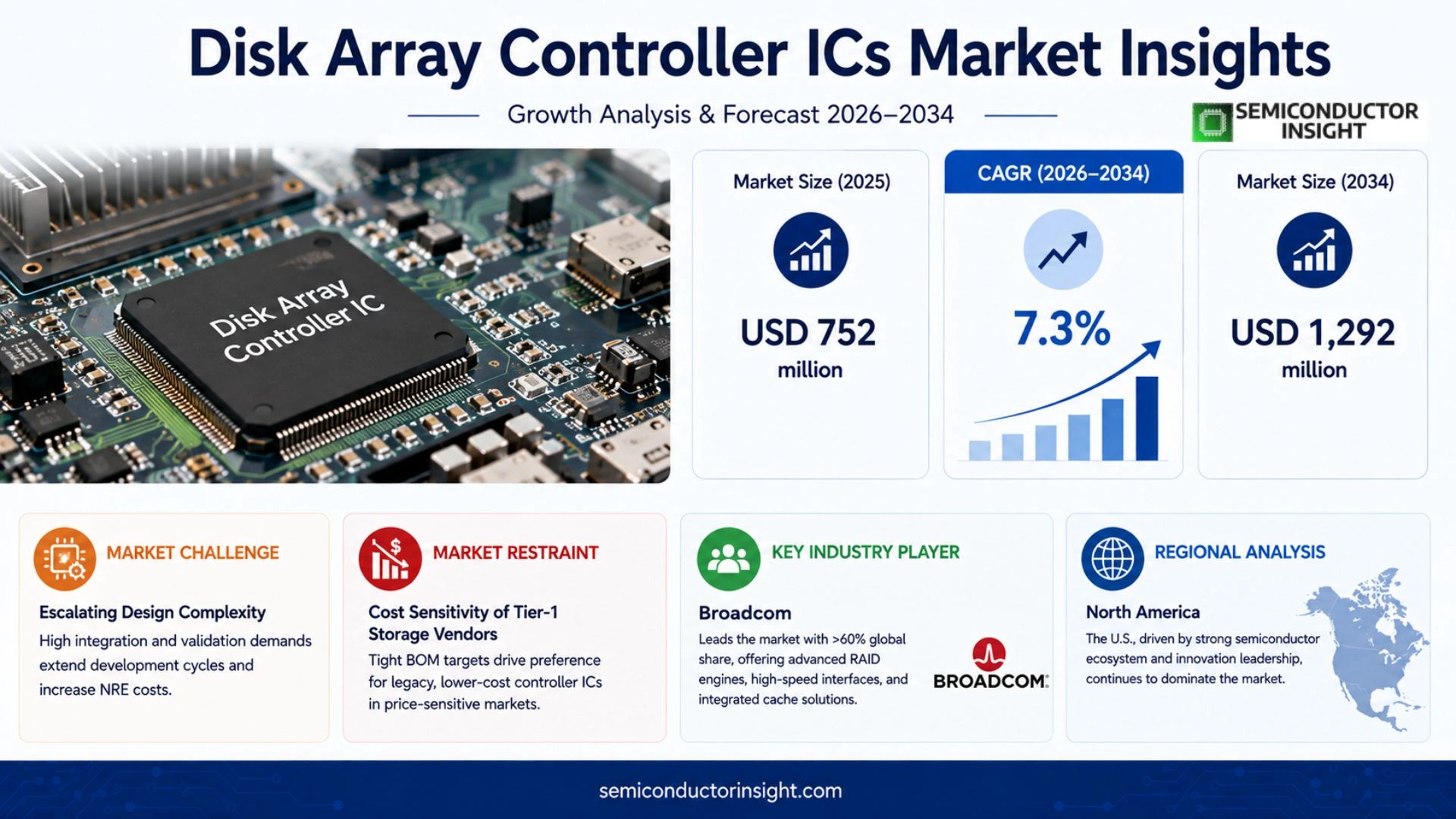
Disk Array Controller ICs market was valued at USD 752 million in 2025 and is projected to reach USD 1,292 million by 2034, exhibiting a CAGR of 7.3% during the forecast period.
Disk array controller ICs are specialized integrated circuits that coordinate multiple storage devices such as HDDs or SSDs. They perform data management, I/O scheduling, RAID logic processing and hardware‑level data protection. Typical designs embed high‑speed host interfaces, backend storage links, RAID engines, cache management and error‑correction modules to enable functions like data striping, mirroring, parity calculation and array rebuilding.
MARKET DRIVERS
Increasing Data‑Center Tiering Requirements
The surge in hyperscale cloud deployments is forcing operators to layer storage tiers more aggressively. Controllers optimized for mixed‑media workloads can balance latency‑critical SSD caches against high‑capacity HDD banks, delivering cost‑effective capacity while preserving response times. This engineering nuance fuels demand for more capable Disk Array Controller ICs, as vendors scramble to differentiate their platforms.
Shift Toward NVMe‑Over‑Fabric Architectures
Enterprises are migrating from traditional SAS/SATA back‑ends to NVMe‑over‑fabric (NoF) topologies. The move compels controller designers to embed PCIe‑Gen4/Gen5 switching logic and robust error‑correction schemes directly into the ASIC. As a result, procurement cycles now prioritize chips that can sustain multi‑terabyte per second bandwidths without compromising power efficiency.
➤ “Controller intelligence is becoming the primary lever for performance scaling, not simply raw bandwidth.”
Finally, the relentless growth of AI‑driven analytics workloads introduces irregular I/O patterns that traditional controllers struggle to handle. Adaptive queue‑management and predictive wear‑leveling, baked into modern controller IP, are now decisive factors when OEMs evaluate next‑generation silicon for Disk Array Controller ICs Market.
MARKET CHALLENGES
Escalating Design Complexity
Integrating high‑speed serdes, advanced ECC, and multi‑protocol support onto a single die pushes validation timelines beyond the typical 12‑month cycle. Smaller design teams often lack the resources to conduct exhaustive silicon‑level testing, leading to longer time‑to‑market and higher NRE costs.
Other Challenges
Supply‑Chain Volatility
The semiconductor ecosystem continues to experience fluctuations in raw material availability, particularly for high‑purity silicon wafers needed for high‑density controller arrays. Manufacturers that cannot secure stable feedstock risk production throttles, which in turn can erode customer confidence.
MARKET RESTRAINTS
Cost Sensitivity of Tier‑1 Storage Vendors
While performance premiums justify higher pricing for sophisticated controller ICs, many Tier‑1 storage vendors operate under strict bill‑of‑materials targets. When margin pressure intensifies, they may opt for legacy, lower‑cost parts, dampening broader market momentum.
Regulatory Compliance Overheads
Emerging data‑sovereignty regulations compel manufacturers to embed encryption engines and secure boot capabilities directly within the controller. Implementing these features adds silicon real‑estate and design verification steps, which can deter smaller players from entering the arena.
Additionally, the rise of software‑defined storage solutions that abstract hardware specifics reduces reliance on highly specialized controller chips, potentially curbing the upside for pure‑hardware suppliers.
MARKET OPPORTUNITIES
Edge‑Computing Deployments
Edge locations demand compact, low‑latency storage fabrics that can operate in constrained power envelopes. Controllers that integrate on‑chip power‑management and support both NVMe and legacy interfaces enable OEMs to ship versatile edge appliances, opening a niche yet rapidly expanding revenue stream for Disk Array Controller ICs Market.
Customizable IP Licensing Models
Foundries are increasingly offering modular IP blocks that allow system integrators to license only the features they need,be it advanced RAID levels, AI‑accelerated data reduction, or built‑in telemetry. This pay‑as‑you‑grow approach lowers entry barriers and encourages adoption among startups targeting specialized storage verticals.
Lastly, the convergence of compute and storage in disaggregated architectures creates a demand for controllers that can act as both data processors and storage managers. Companies that embed programmable logic alongside traditional controller cores position themselves to capture a share of the next wave of data‑center consolidation.
Disk Array Controller ICs Market Trends
Data‑Center Expansion Intensifies Demand for Advanced Controllers
The surge in hyperscale data‑center construction, coupled with ever‑larger cloud workloads, forces storage architects to prioritize throughput and resilience. Modern AI and analytics pipelines generate petabytes of I/O daily, a regime that strains legacy host‑bus solutions. By integrating high‑speed PCIe lanes, sophisticated RAID engines, and on‑chip cache, Disk Array Controller ICs deliver the deterministic latency required for real‑time processing. This functional depth explains why OEMs are replacing generic host adapters with purpose‑built controllers: the hardware layer now shoulders tasks that software once handled, shaving seconds off rebuild times and reducing CPU overhead. As enterprises migrate legacy HDD fleets to enterprise‑grade SSDs, the need for controllers that can negotiate both SATA and NVMe protocols grows, positioning Disk Array Controller ICs Market as a pivotal enabler of next‑generation storage stacks.
Other Trends
Shift Toward PCIe 5.0 and Beyond
PCIe 5.0 adoption is reshaping controller design roadmaps. The doubled lane bandwidth compared with PCIe 4.0 unlocks new cache‑centric architectures that can sustain multi‑terabyte per second streams without throttling. Chip vendors are embedding larger SRAM banks and more aggressive error‑correction schemes to exploit this headroom, allowing arrays to balance parity calculations and hot‑spare management in a single silicon die. Early adopters report up to a 30 % reduction in latency for tier‑1 database workloads, a benefit that reverberates through service‑level agreements. Consequently, supply chains are seesawing toward higher‑density packages that accommodate the thermal envelope of these power‑hungry devices, while design teams reevaluate board‑level layout to minimize trace loss.
Security and Fault‑Tolerance as Competitive Levers
Regulatory pressure around data integrity and ransomware resilience has elevated encryption and self‑healing capabilities from optional extras to baseline expectations. Controllers now embed AES‑256 engines and real‑time integrity checks, enabling transparent data‑at‑rest protection without performance penalties. Simultaneously, advanced wear‑leveling and predictive failure analysis are being baked into firmware, allowing systems to pre‑emptively migrate data away from degrading media. For service providers, these features translate into reduced downtime costs and stronger compliance postures, while for hyperscalers they support multi‑tenant isolation at the silicon level. The resulting market dynamic pushes manufacturers to differentiate on security‑centric silicon, reinforcing the strategic relevance of Disk Array Controller ICs Market in a threat‑aware computing era.
COMPETITIVE LANDSCAPE
Key Industry Players
Disk Array Controller ICs: Competitive Overview
Broadcom commands more than 60 % of global shipments, a position earned through a portfolio that bundles advanced RAID engines, high‑speed host interfaces and integrated cache subsystems. Its breadth across PCIe, SAS and SATA platforms gives OEMs a single‑source solution, cushioning them against supply‑chain volatility and simplifying firmware support. The scale of Broadcom’s operation permits aggressive pricing and sustained R&D investment, which in turn raises the bar for entry‑level competitors. Customers with mission‑critical data‑center workloads gravitate toward Broadcom’s silicon because of its proven reliability record and the depth of technical assistance that accompanies each product generation. This concentration of market power shapes the overall pricing environment and influences how quickly emerging interface standards, such as PCIe 5.0, are adopted across the ecosystem.
Beyond the market leader, a coalition of specialized firms sustains a vibrant competitive fabric. Microchip Technology leverages its cost‑effective design expertise to address mid‑range storage arrays, while Marvell’s high‑performance controllers target hyperscale data‑center deployments that demand low latency and extensive parallelism. Intel integrates controller logic with its processor families, creating a differentiated value proposition for platforms that prioritize unified silicon. Hangzhou Hualan Microelectronics has expanded its presence in the Chinese domestic market, capitalizing on regional demand for domestically sourced components. Texas Instruments supplies precision analog front‑ends essential for signal integrity, whereas Samsung and SK hynix embed controller functions within their SSD lines to streamline product stacks. Additional contributors such as Toshiba, Renesas Electronics, Analog Devices, STMicroelectronics and NXP Semiconductors enrich the market with niche innovations in error‑correction, power efficiency and emerging interface support, collectively ensuring that customers retain alternatives to the dominant supplier.
List of Key Disk Array Controller ICs Companies Profiled
- Broadcom
- Microchip Technology
- Marvell Technology Group
- Intel Corporation
- Hangzhou Hualan Microelectronics
- Texas Instruments
- Samsung Electronics
- SK hynix
- Toshiba
- Renesas Electronics
- Analog Devices
- STMicroelectronics
- NXP Semiconductors
- Western Digital
- Seagate Technology
Segment Analysis:
| Segment Category | Sub-Segments | Key Insights |
| By Type |
|
RAID Controller IC
|
| By Application |
|
SAN
|
| By End User |
|
Data Centers
|
| By Interface |
|
PCIe
|
| By Storage Media |
|
SSDs
|
Regional Analysis: Disk Array Controller ICs Market
North America
Investment in next‑generation controller silicon is accelerating, with firms leveraging advanced process nodes to embed AI‑assisted wear‑leveling and predictive failure analytics directly on chip, yielding notable efficiency gains for enterprise storage arrays.
Recent geopolitical shifts have motivated North American makers to diversify material sources, establishing secondary vendor relationships that cushion the market against single‑point disruptions in critical components such as DRAM and NAND substrates.
Enterprises transitioning to all‑flash and NVMe‑over‑Fabric infrastructures are opting for controller ICs that can handle higher queue depths, prompting vendors to refine firmware stacks that support simultaneous multi‑host access without compromising latency.
Emerging data‑localization statutes are influencing design choices, as manufacturers embed encryption cores within controllers to meet compliance requirements while maintaining performance parity with non‑encrypted pathways.
Europe
European manufacturers are capitalizing on a strong tradition of precision engineering, embedding robust error‑correction capabilities into controller ICs to serve highly regulated sectors such as finance and healthcare. The region’s emphasis on sustainability drives the integration of power‑management features that reduce the total cost of ownership for large‑scale storage deployments. Collaborative research initiatives across Germany, France, and the Netherlands foster cross‑border innovation, allowing firms to pool expertise in mixed‑signal design and software‑defined storage. While the market size lags behind North America, the depth of standards compliance and incremental performance improvements position Europe as a credible challenger, especially for customers prioritizing reliability and environmental credentials.
Asia‑Pacific
Asia‑Pacific’s rapid digital transformation fuels demand for high‑density storage arrays, prompting local chipset producers to accelerate roadmap timelines for controller ICs. The region benefits from proximity to leading memory fabricators, enabling tighter integration and shorter lead times for co‑design projects. Yet, variability in infrastructure quality across countries creates heterogeneous adoption patterns,mature economies like Japan and South Korea push the envelope with AI‑optimized controllers, while emerging markets focus on cost‑effective solutions for expanding data centers. Supply‑chain agility, supported by flexible manufacturing hubs, allows the region to respond swiftly to shifting customer specifications, though intellectual‑property considerations remain a strategic concern for multinational players.
South America
Growth in Brazil’s cloud services sector and Chile’s renewable‑energy‑backed data centers is reshaping demand for resilient storage controller ICs. Vendors are tailoring product portfolios to address bandwidth constraints common in the region, emphasizing error‑tolerant designs that sustain performance under less predictable power conditions. Partnerships with local system integrators enable customized firmware adaptations that align with regional standards for data protection. Although overall market depth is modest, the emergence of niche use‑cases,such as edge computing for agricultural monitoring,creates pockets of opportunity for specialized controller solutions.
Middle East & Africa
The Middle East’s push toward sovereign cloud infrastructures fuels interest in secure, high‑performance controller ICs capable of meeting stringent encryption and audit requirements. Investment in large‑scale hyperscale facilities, particularly in the United Arab Emirates and Saudi Arabia, drives demand for controllers that can handle intensive I/O workloads while maintaining energy efficiency. In Africa, nascent data‑center development concentrates on cost‑sensitive deployments, prompting vendors to offer stripped‑down controller variants that prioritize reliability over advanced feature sets. Collaborative efforts between regional telecom operators and semiconductor firms aim to establish a localized supply base, potentially reducing dependency on distant manufacturers and fostering a modest yet strategic market foothold.
Report Scope
This market research report provides a comprehensive analysis of the Disk Array Controller ICs Market , covering the forecast period 2026–2034. It offers detailed insights into market dynamics, technological advancements, competitive landscape, and key trends shaping the industry.
Key focus areas of the report include:
- Market Overview: The report begins with an overview outlining its current market scenario, key growth indicators, and industry transformation drivers. It discusses macroeconomic factors, demand–supply balance, regulatory landscape, and the strategic role of semiconductors in powering advancements across industries such as automotive, telecommunications, consumer electronics, and industrial automation.
- Market Size & Forecast: Historical data and future projections for revenue, unit shipments, and market value across major regions and segments.
- Segmentation Analysis: Detailed breakdown by product type, technology, application, and end-user industry to identify high-growth segments and investment opportunities.
- Regional Insights: Insights into market performance across North America, Europe, Asia-Pacific, Latin America, and the Middle East & Africa, including country-level analysis where relevant.
- Competitive Landscape: Profiles of leading market participants, including their product offerings, R&D focus, manufacturing capacity, pricing strategies, and recent developments such as mergers, acquisitions, and partnerships.
- Technology Trends & Innovation: Assessment of emerging technologies, integration of AI/IoT, semiconductor design trends, fabrication techniques, and evolving industry standards.
- Market Drivers & Restraints: Evaluation of factors driving market growth along with challenges, supply chain constraints, regulatory issues, and market-entry barriers.
- Stakeholder Insights: Insights for component suppliers, OEMs, system integrators, investors, and policymakers regarding the evolving ecosystem and strategic opportunities.
Primary and secondary research methods are employed, including interviews with industry experts, data from verified sources, and real-time market intelligence to ensure the accuracy and reliability of the insights presented.
FREQUENTLY ASKED QUESTIONS:
What is the current market size of Disk Array Controller ICs Market?
-> Disk Array Controller ICs market is projected to reach USD 1,292 million by 2034, exhibiting a CAGR of 7.3% during the forecast period.
Which key companies operate in Disk Array Controller ICs Market?
-> Key players include Broadcom, Microchip, Marvell, Intel, Hangzhou Hualan Microelectronics.
What are the key growth drivers?
-> Key growth drivers include expansion of data centers, upgrade of enterprise storage infrastructure, rapid growth in cloud computing, big data and AI workloads, adoption of enterprise SSDs, advancement of high‑speed PCIe interfaces, and increasing requirements for data security and business continuity.
Which region dominates the market?
-> North America leads the market due to a high concentration of data centers and enterprise IT spending, while Asia-Pacific shows the fastest growth trajectory.
What are the emerging trends?
-> Emerging trends include hardware‑based RAID optimization, integration of AI/ML workload acceleration, migration to PCIe 5.0 and beyond, enhanced cache architectures, and advanced data protection and fault‑tolerance features.
Get Sample Report PDF for Exclusive Insights
Report Sample Includes
- Table of Contents
- List of Tables & Figures
- Charts, Research Methodology, and more...
 Download Sample Report PDF