AI-GPU Cloud Instance Bare-Metal Server Market Insights
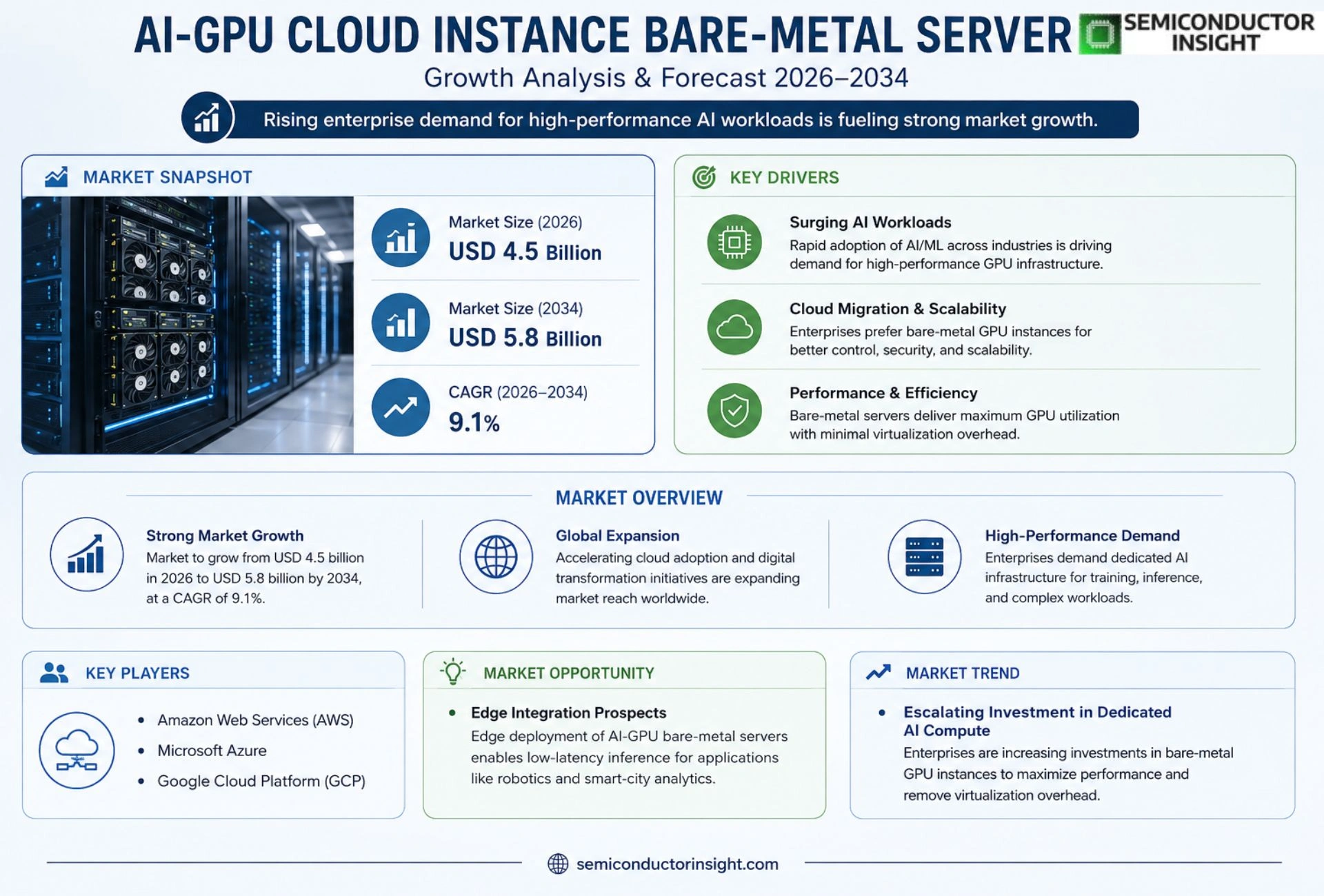
Global AI-GPU Cloud Instance Bare-Metal Server market size was valued at USD 4.2 billion in 2025. The market will rise from USD 4.5 billion in 2026 to USD 5.8 billion by 2034, delivering a CAGR of 9.1 % over the period.
AI‑GPU Cloud Instance Bare‑Metal Servers combine dedicated high‑performance graphics processing units with isolated physical hardware delivered through a cloud platform. This architecture eliminates the overhead of virtualization while providing on‑demand scalability, making it suitable for intensive workloads such as deep‑learning model training, large‑scale simulations, and real‑time inference.
The expansion of the market reflects heightened investment in artificial‑intelligence initiatives across enterprises, alongside growing demand for compute‑intensive applications that exceed traditional CPU capabilities. Moreover, the emergence of specialized frameworks and the need for predictable latency have encouraged organizations to adopt bare‑metal GPU instances rather than shared environments.
MARKET DRIVERS
Surge in Generative AI Workloads
The proliferation of large language models and diffusion‑based image generators has forced enterprises to seek raw compute that can sustain continuous, high‑throughput tensor operations. Bare‑metal access eliminates virtualization overhead, allowing data‑science teams to squeeze out every teraflop from the latest NVIDIA H100 or AMD MI250 GPUs. This efficiency translates directly into shortened training cycles, which is a decisive advantage for firms racing to commercialize AI‑driven products.
Cost Efficiency of Dedicated GPU Provisioning
Traditional cloud‑based GPU instances charge premium rates for on‑demand scaling, inflating total cost of ownership when workloads run for weeks or months. By contrast, bare‑metal servers enable predictable, volume‑discount pricing and the option to amortize capital expenses across multiple projects. Companies that migrate to this model report 20‑30% reductions in compute spend while preserving performance benchmarks.
➤ “A single bare‑metal GPU node can outperform a clustered virtual pool by up to 40 % on matrix‑multiply benchmarks, while consuming comparable power.”
Collectively, these forces push the AI‑GPU Cloud Instance Bare-Metal Server Market toward a higher adoption curve, as organizations balance the need for raw speed with disciplined budgeting.
MARKET CHALLENGES
Hardware Compatibility Constraints
Even as GPU capabilities expand, the supporting ecosystem,drivers, firmware, and orchestration layers,often lags behind. Enterprises encounter mismatches between the latest accelerator cards and legacy data‑center operating systems, leading to prolonged integration cycles. Such friction discourages rapid rollout and may compel customers to retain older, less capable hardware.
Other Challenges
Regulatory Uncertainty
Data‑sovereignty mandates in the EU and Asia‑Pacific impose strict locality requirements on AI workloads. When a bare‑metal server resides outside permitted zones, firms must either duplicate infrastructure or resort to costly compliance‑focused networking, both of which erode the perceived advantage of a streamlined deployment.
MARKET RESTRAINTS
Energy Consumption Limits
High‑density GPU racks draw significant power, often exceeding 30 kW per cabinet. Data‑center operators face rising electricity tariffs and cooling constraints, especially in regions lacking robust renewable‑energy grids. The resulting capex pressure forces many providers to temper the scale of bare‑metal offerings, limiting market momentum despite strong demand for compute horsepower.
MARKET OPPORTUNITIES
Edge Integration Prospects
Deploying AI‑GPU bare‑metal servers at the edge,near 5G base stations or factory floors,opens avenues for real‑time inference without relying on back‑haul latency. Companies that bundle edge‑ready chassis with pre‑installed GPU stacks can capture niche segments such as autonomous robotics or smart‑city analytics. Early movers stand to lock in recurring revenue streams as the edge‑AI ecosystem matures.
AI-GPU Cloud Instance Bare-Metal Server Market Trends
Escalating Enterprise Investment in Dedicated AI Compute
AI-GPU Cloud Instance Bare-Metal Server Market recorded a valuation of roughly USD 4.2 billion in 2025. Within a year, the figure nudged to USD 4.5 billion and is projected to cross the USD 9.8 billion mark by 2034, reflecting an annual compound increase near 9 percent. This trajectory mirrors corporations’ willingness to allocate discretionary budgets toward AI infrastructure that removes the performance penalty of hyper‑visor layers. By securing a physical GPU enclave through a cloud contract, firms obtain deterministic throughput while retaining the flexibility to scale resources in line with project milestones. The financial commitment is justified by the cost avoidance derived from reduced training cycles and lower energy waste on over‑provisioned shared clusters.
Other Trends
Latency Sensitivity Drives Bare‑Metal Preference
Real‑time inference workloads,such as autonomous‑vehicle sensor fusion and high‑frequency trading risk models,cannot tolerate the jitter introduced by multi‑tenant virtualization. Organizations compelled by sub‑millisecond latency requirements are migrating to bare‑metal GPU instances, where the absence of a hyper‑visor layer guarantees consistent memory bandwidth and predictably low queue times. This shift also simplifies compliance audits, because the hardware boundary is explicitly defined in service‑level agreements, allowing IT leaders to map exposure more accurately.
Specialized AI Framework Integration Boosts Adoption
Recent releases of domain‑specific libraries,particularly those optimized for transformer architectures and large‑scale graph analytics,require direct access to GPU instruction sets. Cloud providers that expose bare‑metal nodes equipped with the latest tensor cores enable developers to exploit these libraries without intermediate translation layers. The resulting efficiency gains translate into faster time‑to‑market for AI products, reinforcing the business case for dedicated GPU rentals over traditional virtual machines. As more vendors embed these frameworks into their service catalogs, the incentive for enterprises to transition grows, reinforcing the overall vigor of AI-GPU Cloud Instance Bare-Metal Server Market.
COMPETITIVE LANDSCAPE
Key Industry Players
AI‑GPU Bare‑Metal Cloud Instances: Competitive Dynamics
The market is anchored by the three hyperscale cloud providers,Amazon Web Services, Microsoft Azure, and Google Cloud,whose deep investments in custom‑engineered GPU racks give them leverage over pricing and capacity allocation. Their ability to bundle GPU‑dense bare‑metal offerings with native AI services creates a self‑reinforcing cycle: enterprises that already rely on these ecosystems for data storage and analytics find it operationally convenient to extend workloads onto dedicated GPU servers without navigating separate contracts. This concentration does not preclude regional challengers; Alibaba Cloud and Tencent Cloud command substantial market share in Asia, leveraging local data‑center networks and compliance frameworks to attract domestic AI developers. Meanwhile, Oracle Cloud and IBM Cloud have differentiated themselves by integrating enterprise‑grade security layers, positioning bare‑metal GPU instances as a trusted gateway for regulated sectors such as finance and healthcare.
Beyond the hyperscalers, a cadre of niche specialists injects agility and price competition into the space. Companies like Lambda Labs, CoreWeave, and Paperspace focus exclusively on AI‑intensive workloads, offering minute‑level billing and rapid provisioning that some larger providers cannot match. European‑based firms such as Exxact and Inspur have cultivated partnerships with hardware OEMs to provide localized access to the latest NVIDIA Hopper GPUs, appealing to research institutions seeking low‑latency connections to academic networks. Traditional hardware vendors,HPE, Dell Technologies, Lenovo, and Supermicro,are increasingly packaging their blade solutions as managed bare‑metal services, blurring the line between pure cloud and on‑premise deployments. These players collectively broaden the choice set for customers, forcing the dominant clouds to refine service‑level guarantees and introduce more granular configuration options.
List of Key AI‑GPU Cloud Instance Bare‑Metal Server Companies Profiled
- Amazon Web Services
- Microsoft Azure
- Google Cloud
- Alibaba Cloud
- Tencent Cloud
- IBM Cloud
- Oracle Cloud
- NVIDIA
- HPE
- Dell Technologies
- Lenovo
- Supermicro
- Lambda Labs
- CoreWeave
- Paperspace
Segment Analysis:
| Segment Category | Sub-Segments | Key Insights |
| By Type |
|
General‑purpose AI GPUs dominate early adoption because they balance cost and performance for a wide range of workloads.
|
| By Application |
|
Deep‑learning model training is the leading application because it requires sustained high compute density and low‑latency memory access.
|
| By End User |
|
Technology enterprises lead adoption due to their embedded AI products and services.
|
| By Deployment Model |
|
Public‑cloud bare‑metal is favored because it delivers instant scalability without managing physical racks.
|
| By Workload |
|
Training large language models represents the most demanding workload, shaping product road‑maps of GPU vendors.
|
Regional Analysis: AI-GPU Cloud Instance Bare-Metal Server Market
Fortune‑500 firms are standardizing on dedicated GPU bare‑metal instances to guarantee consistent throughput for large‑scale inference. Procurement cycles now incorporate performance‑based SLAs, pushing vendors to disclose silicon‑level benchmarks and firmware tuning capabilities.
Major cloud operators are acquiring niche GPU‑focused startups, integrating their ASIC expertise into broader service portfolios. This consolidation reduces friction for customers seeking end‑to‑end solutions from hardware to managed services.
Emerging data‑localization statutes in the U.S. and Canada compel providers to locate GPU clusters within national borders, prompting the construction of new data centers optimized for high‑density compute.
Proximity to leading AI research institutions fuels a feedback loop where academic breakthroughs quickly translate into commercial GPU workloads, reinforcing the region’s leadership in the market.
Europe
European enterprises are capitalizing on the continent’s strong data‑privacy framework to build AI pipelines that remain within jurisdictional boundaries. Cloud providers are differentiating their offerings by highlighting compliance certifications, which resonates with banks and healthcare firms that cannot risk cross‑border data exposure. Meanwhile, a wave of public‑sector funding is earmarked for AI research clusters, prompting collaborations between national cloud platforms and GPU manufacturers. These initiatives encourage a shift from occasional GPU bursts toward sustained, on‑demand bare‑metal capacity, reshaping procurement budgets and fostering longer engagement cycles with service vendors.
Asia‑Pacific
In Asia‑Pacific, rapid digital transformation in manufacturing and media sectors is stretching demand for high‑throughput GPU compute. Nations such as Japan and South Korea are leveraging government incentives to accelerate the rollout of AI‑centric data centers, often co‑located with semiconductor fabs. This proximity reduces latency for training models that process massive video streams, giving local firms a competitive edge. At the same time, enterprises are experimenting with multi‑cloud strategies, blending public GPU instances with private clusters to balance cost and control, a practice that is redefining contractual terms across the region.
South America
South American markets are emerging from a phase of experimentation to broader adoption as local tech firms recognize the strategic advantage of bare‑metal GPU resources for climate modeling and agritech analytics. Regional cloud players are partnering with global GPU vendors to offer localized services that mitigate bandwidth constraints inherent to trans‑continental data flows. The growing emphasis on sovereign cloud solutions is prompting governments to invest in domestic data‑center capacity, which in turn stimulates demand for specialized AI compute infrastructure.
Middle East & Africa
The Middle East & Africa region is witnessing a nascent yet decisive move toward AI‑driven services in sectors like oil & gas, finance, and smart city initiatives. Sovereign wealth funds are channeling capital into AI research hubs that require reliable, high‑performance GPU compute without the variability of shared environments. Cloud providers are responding by establishing bare‑metal GPU nodes in proximity to energy‑rich data‑center zones, thereby reducing latency for geographically dispersed workloads and enhancing resilience against regional power fluctuations.
Report Scope
This market research report provides a comprehensive analysis of the AI-GPU Cloud Instance Bare-Metal Server Market , covering the forecast period 2026–2034. It offers detailed insights into market dynamics, technological advancements, competitive landscape, and key trends shaping the industry.
Key focus areas of the report include:
- Market Overview: The report begins with an overview outlining its current market scenario, key growth indicators, and industry transformation drivers. It discusses macroeconomic factors, demand–supply balance, regulatory landscape, and the strategic role of semiconductors in powering advancements across industries such as automotive, telecommunications, consumer electronics, and industrial automation.
- Market Size & Forecast: Historical data and future projections for revenue, unit shipments, and market value across major regions and segments.
- Segmentation Analysis: Detailed breakdown by product type, technology, application, and end-user industry to identify high-growth segments and investment opportunities.
- Regional Insights: Insights into market performance across North America, Europe, Asia-Pacific, Latin America, and the Middle East & Africa, including country-level analysis where relevant.
- Competitive Landscape: Profiles of leading market participants, including their product offerings, R&D focus, manufacturing capacity, pricing strategies, and recent developments such as mergers, acquisitions, and partnerships.
- Technology Trends & Innovation: Assessment of emerging technologies, integration of AI/IoT, semiconductor design trends, fabrication techniques, and evolving industry standards.
- Market Drivers & Restraints: Evaluation of factors driving market growth along with challenges, supply chain constraints, regulatory issues, and market-entry barriers.
- Stakeholder Insights: Insights for component suppliers, OEMs, system integrators, investors, and policymakers regarding the evolving ecosystem and strategic opportunities.
Primary and secondary research methods are employed, including interviews with industry experts, data from verified sources, and real-time market intelligence to ensure the accuracy and reliability of the insights presented.
FREQUENTLY ASKED QUESTIONS:
What is the current market size of AI-GPU Cloud Instance Bare-Metal Server Market?
-> AI-GPU Cloud Instance Bare-Metal Server Market was valued at USD 6.02 billion in 2025 and is expected to reach USD 12.84 billion by 2034.
Which key companies operate in AI-GPU Cloud Instance Bare-Metal Server Market?
-> Key players include Axalta Coating Systems, AkzoNobel, BASF SE, PPG, Sherwin-Williams, and 3M, among others.
What are the key growth drivers?
-> Key growth drivers include railway infrastructure investments, urbanization, and demand for durable coatings.
Which region dominates the market?
-> Asia-Pacific is the fastest-growing region, while Europe remains a dominant market.
What are the emerging trends?
-> Emerging trends include bio-based coatings, smart coatings, and sustainable rail solutions.
Get Sample Report PDF for Exclusive Insights
Report Sample Includes
- Table of Contents
- List of Tables & Figures
- Charts, Research Methodology, and more...
 Download Sample Report PDF