AI Infrastructure Processing Unit (IPU) Market Insights
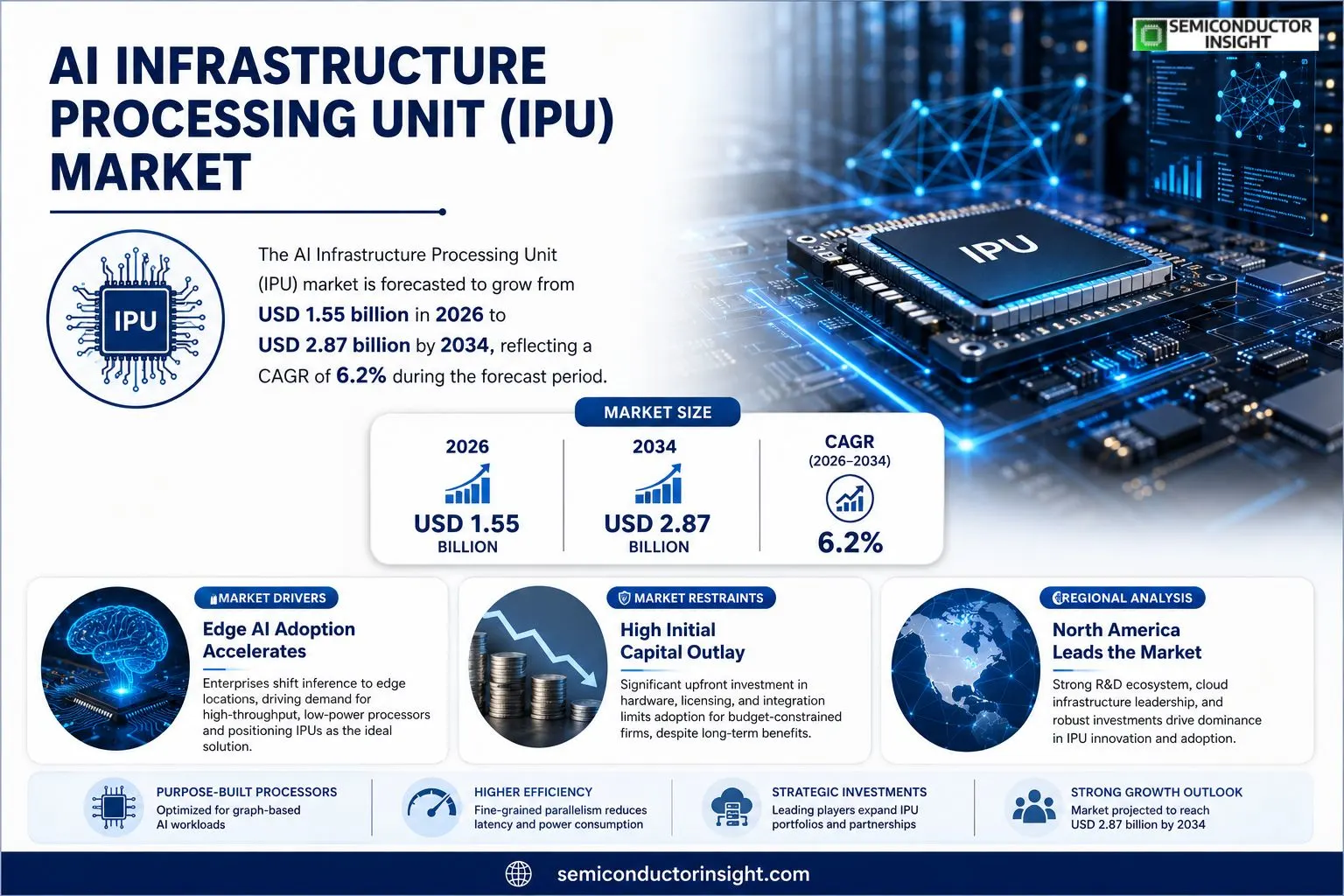
AI Infrastructure Processing Unit (IPU) market size was valued at USD 1.45 billion in 2025. The market is forecasted to increase from USD 1.55 billion in 2026 to USD 2.87 billion by 2034, reflecting a CAGR of approximately 6.2% during the forecast period.
AI Infrastructure Processing Units are purpose‑built processors that accelerate machine‑learning workloads, especially graph‑based neural networks and large‑scale model training. Unlike conventional GPUs, IPUs provide fine‑grained parallelism and on‑chip memory architectures that minimise data‑movement latency, delivering more efficient inference and training for deep‑learning applications.The market is gaining momentum because investment in AI compute infrastructure continues to rise and large language models are being deployed across autonomous vehicles, finance and healthcare sectors. Recent milestones include Graphcore’s launch of its third‑generation IPU in early 2024 and Nvidia’s acquisition of an IPU specialist aimed at broadening its AI hardware portfolio. Key players such as Graphcore, Cerebras Systems, SambaNova Systems and Intel are expanding their IPU portfolios through strategic partnerships and ecosystem development.
MARKET DRIVERS
Edge AI Adoption Accelerates
Enterprises are relocating inference workloads from centralized data centers to edge locations to reduce latency. The shift creates a demand for processors that can deliver high throughput with low power envelopes, a niche where the AI Infrastructure Processing Unit (IPU) excels. Companies that prioritize real‑time responsiveness are increasingly selecting IPUs to avoid the bottlenecks of traditional GPUs.
Specialized Compute Architecture Gains Traction
Unlike general‑purpose accelerators, IPUs are engineered for graph‑centric machine‑learning models. This architectural focus translates into faster convergence for deep‑learning workloads, allowing firms to shorten development cycles and allocate resources more efficiently. The performance edge drives both start‑ups and incumbent vendors to incorporate IPUs into their AI pipelines.
➤ “Organizations that align their hardware stack with model topology see measurable cost reductions and higher model fidelity.”
Beyond performance, the ecosystem surrounding IPUsspanning software toolkits, libraries, and cloud offeringshas matured, lowering entry barriers for developers. This ecosystem effect amplifies adoption rates as more teams can prototype and deploy solutions without extensive hardware expertise.
MARKET CHALLENGES
Talent Gap in Specialized Programming
IPUs require programmers to master distinct programming models and parallelism concepts. The scarcity of engineers proficient in these techniques hampers rapid deployment, especially for organizations transitioning from CPU‑centric development environments.
Other Challenges
Supply‑Chain Volatility
Fluctuations in semiconductor manufacturing capacity, driven by geopolitical tensions and raw‑material shortages, can delay product roll‑outs and increase component costs, affecting project timelines.
MARKET RESTRAINTS
High Initial Capital Outlay
Deploying IPU‑based solutions often entails a sizable upfront investment in hardware, licensing, and integration services. For budget‑constrained firms, the cost premium relative to conventional accelerators can discourage adoption.Additionally, many enterprises operate within legacy infrastructure ecosystems that lack seamless compatibility with IPU interfaces, necessitating costly redesigns of existing pipelines.The return on investment horizon for IPU projects can extend beyond typical budgeting cycles, prompting decision‑makers to favor lower‑risk, incremental upgrades instead.
MARKET OPPORTUNITIES
Expansion into Autonomous Systems
Autonomous vehicles and robotics demand deterministic compute with minimal latency. IPUs, with their ability to process sparse tensors efficiently, are well‑positioned to become the processing backbone for next‑generation perception stacks. Companies that forge early partnerships with OEMs can secure long‑term supply contracts.Another avenue lies in the rise of foundation models that require massive parallelism. IPU manufacturers that provide optimized kernels and model‑parallel frameworks can capture a share of the burgeoning generative‑AI market.Finally, the growth of federated learning frameworks presents a niche where on‑device, power‑efficient IPUs can execute secure training without exposing raw data, opening revenue streams for vendors focused on privacy‑preserving AI.
AI Infrastructure Processing Unit (IPU) Market Trends
Accelerated Graph‑Based Neural Networks Drive Adoption
The IPU segment is gaining traction as firms that rely on graph‑centric neural models seek higher efficiency. In 2025 the market was valued at roughly USD 1.45 billion; projections show it will reach about USD 2.87 billion by 2034, implying a steady compound growth of just over six percent per annum. This expansion is linked directly to the architectural advantage of IPUs: fine‑grained parallelism and on‑chip memory dramatically cut data‑movement latency, delivering faster training cycles for large‑scale models. Financial services, autonomous‑vehicle developers, and health‑care analytics groups are re‑architecting their AI pipelines, often inserting IPU clusters alongside or in place of conventional GPU farms to unlock lower cost per inference and tighter time‑to‑insight.
Other Trends
Strategic Consolidation and Ecosystem Expansion
Corporate activity over the past year highlights a shift from niche innovation to broader market integration. Graphcore’s third‑generation IPU, released early in 2024, introduced a 30 % increase in on‑chip bandwidth and a revamped interconnect fabric that simplifies multi‑node scaling. Meanwhile, Nvidia’s purchase of an IPU specialist signals an intention to weave graph‑processing primitives into its existing AI stack, offering customers a more unified hardware portfolio. Parallel moves by Cerebras, SambaNova and Intel involve deepening ties with major cloud providers, embedding IPU‑as‑a‑service offerings into public‑cloud marketplaces. These partnerships lower the barrier for developers, accelerate software ecosystem growth, and create feedback loops that further solidify IPU relevance across diverse AI workloads.
Investment Surge Fuels Capacity Growth
Funding streams directed at AI compute infrastructure have risen sharply, with venture capital and corporate R&D allocations earmarking billions for next‑generation processors. This capital influx shortens silicon‑design cycles and underwrites the construction of dedicated IPU data centers that can host models exceeding a trillion parameters. As enterprises scale such models, the total‑cost‑of‑ownership calculus increasingly favors IPUs because their architecture reduces power consumption per training epoch and curtails the need for excessive memory provisioning. The resulting economic logic compels senior technology leaders to embed IPUs in long‑term roadmaps, shaping procurement strategies and influencing talent acquisition focused on graph‑based deep‑learning expertise.
COMPETITIVE LANDSCAPE
Key Industry Players
Competitive Dynamics of the AI Infrastructure Processing Unit Market
Graphcore commands the most visible share of the IPU segment, leveraging its third‑generation architecture to attract cloud providers and large‑scale enterprises that demand high‑throughput graph processing. The firm’s strategy of bundling software stacks with hardware has forged a de‑facto ecosystem, compelling rivals to align their roadmaps with Graphcore’s data‑flow model. The market exhibits a tiered structure: a handful of vertically integrated innovators dominate system‑level design, while a broader group of semiconductor specialists offers differentiated silicon for niche workloads such as autonomous‑driving inference or real‑time analytics.Beyond Graphcore, the field is populated by a diverse set of challengers. Cerebras Systems exploits its wafer‑scale engine to deliver unprecedented memory bandwidth, positioning itself as a partner for massive model training. SambaNova Systems pairs configurable IPUs with a cloud‑native stack, targeting enterprise AI labs that value rapid prototyping. Intel’s acquisition of a boutique IPU firm has expanded its portfolio beyond GPUs, allowing cross‑selling through existing data‑center relationships. Qualcomm and AMD have begun shipping prototype IPUs aimed at edge devices, while Huawei’s HiSilicon division is piloting a custom IPU for telecom AI. Additional playersincluding Google (TPU‑adjacent research), IBM, Mythic, Groq, Tenstorrent, and GraphenAIcontribute specialized IPU designs that address latency‑critical or power‑constrained segments, enriching the competitive tapestry.
List of Key AI Infrastructure Processing Unit Companies Profiled
- Graphcore
- Cerebras Systems
- SambaNova Systems
- Intel Corporation
- Qualcomm
- Advanced Micro Devices (AMD)
- Huawei Technologies Co., Ltd.
- Google (TPU research group)
- IBM
- Mythic
- Groq
- Tenstorrent
- GraphenAI
- Xilinx
Segment Analysis:
| Segment Category | Sub-Segments | Key Insights |
| By Type |
|
Graph‑centric IPUs dominate early adoption because they excel at handling irregular data structures, provide fine‑grained parallelism, and minimize data‑movement latency; they enable rapid training of graph neural networks; they foster ecosystem growth through specialized software stacks. |
| By Application |
|
Autonomous vehicle perception emerges as a leading application due to its demand for real‑time graph processing, the need for low‑latency inference, and the strategic importance of safety‑critical decision making; the technology also accelerates simulation environments for training complex driving models; collaboration between chip makers and OEMs fuels rapid innovation. |
| By End User |
|
Enterprise AI teams are the primary adopters, seeking scalable training infrastructure, tighter integration with existing data pipelines, and the ability to run sophisticated large‑language models; they value the performance‑per‑watt advantage of IPUs; strategic partnerships with cloud providers make deployment smoother. |
| By Architecture |
|
On‑chip memory‑centric designs lead because they dramatically reduce data‑transfer bottlenecks, enable tighter coupling between compute and storage, and support emerging graph‑based algorithms; this architectural focus promotes lower energy consumption while delivering higher throughput for deep‑learning workloads. |
| By Innovation |
|
Third‑generation IPU chips are driving market momentum as they deliver higher compute density, improved programmability, and stronger support for large‑scale model training; the rise of integrated software ecosystems simplifies developer adoption; acquisitions by major players reinforce confidence and expand the talent pool. |
Regional Analysis: AI Infrastructure Processing Unit (IPU) Market
Institutional investors are allocating sizable funds to IPU‑focused startups, attracted by the prospect of hardware that can handle increasingly complex neural networks without prohibitive power consumption. Corporate venture arms of semiconductor giants also participate, aiming to secure early access to novel architectures and embed them in next‑generation data‑center offerings.
The region benefits from a dense network of universities offering specialized coursework in parallel processing and neuromorphic computing. Coupled with a thriving community of open‑source contributors, this talent pool shortens the learning curve for companies integrating IPUs into existing AI pipelines.
While federal guidelines on AI safety are evolving, current policies encourage experimentation with advanced hardware under controlled environments. This regulatory posture reduces compliance overhead for early adopters, fostering a quicker transition from prototype to production.
Domestic fabs and mature foundry partnerships mitigate exposure to semiconductor shortages. Companies are diversifying component sources, ensuring that IPU rollouts remain on schedule despite broader industry volatility.
Europe
European nations are aligning public research initiatives with private sector ambitions to foster IPU innovation. Collaborative programs between universities in Germany, the UK, and France focus on energy‑efficient chip designs that meet stringent EU sustainability standards. At the same time, automotive manufacturers leverage IPUs to accelerate perception algorithms for autonomous driving, treating hardware differentiation as a competitive advantage in a market constrained by regulatory harmonization.
Asia-Pacific
In the Asia‑Pacific, rapid adoption is driven by aggressive government subsidies for AI‑related hardware and a burgeoning ecosystem of contract manufacturers capable of delivering custom silicon at scale. Chinese and South Korean firms are experimenting with hybrid IPU‑GPU solutions to meet the high throughput demands of language model services, positioning the region as a crucible for large‑scale deployment scenarios.
South America
South American markets are witnessing nascent interest as local fintech and agritech companies explore IPUs to enhance real‑time analytics on low‑bandwidth edge devices. Partnerships with North American startups provide technology transfer pathways, while regional incubators nurture talent that can adapt IPU architectures to sector‑specific challenges such as remote sensing and predictive maintenance.
Middle East & Africa
Investments in AI research centers across the United Arab Emirates and South Africa have sparked curiosity about IPU potential for smart city initiatives. Pilot projects focus on optimizing video analytics for surveillance and traffic management, where the ability of IPUs to process large visual datasets locally reduces latency and bandwidth costs, setting the stage for broader adoption across public‑sector deployments.
Report Scope
This market research report provides a comprehensive analysis of the AI Infrastructure Processing Unit (IPU) Market , covering the forecast period 2026–2034. It offers detailed insights into market dynamics, technological advancements, competitive landscape, and key trends shaping the industry.
Key focus areas of the report include:
- Market Overview: The report begins with an overview outlining its current market scenario, key growth indicators, and industry transformation drivers. It discusses macroeconomic factors, demand–supply balance, regulatory landscape, and the strategic role of semiconductors in powering advancements across industries such as automotive, telecommunications, consumer electronics, and industrial automation.
- Market Size & Forecast: Historical data and future projections for revenue, unit shipments, and market value across major regions and segments.
- Segmentation Analysis: Detailed breakdown by product type, technology, application, and end-user industry to identify high-growth segments and investment opportunities.
- Regional Insights: Insights into market performance across North America, Europe, Asia-Pacific, Latin America, and the Middle East & Africa, including country-level analysis where relevant.
- Competitive Landscape: Profiles of leading market participants, including their product offerings, R&D focus, manufacturing capacity, pricing strategies, and recent developments such as mergers, acquisitions, and partnerships.
- Technology Trends & Innovation: Assessment of emerging technologies, integration of AI/IoT, semiconductor design trends, fabrication techniques, and evolving industry standards.
- Market Drivers & Restraints: Evaluation of factors driving market growth along with challenges, supply chain constraints, regulatory issues, and market-entry barriers.
- Stakeholder Insights: Insights for component suppliers, OEMs, system integrators, investors, and policymakers regarding the evolving ecosystem and strategic opportunities.
Primary and secondary research methods are employed, including interviews with industry experts, data from verified sources, and real-time market intelligence to ensure the accuracy and reliability of the insights presented.
FREQUENTLY ASKED QUESTIONS:
What is the current market size of AI Infrastructure Processing Unit (IPU) Market?
-> AI Infrastructure Processing Unit (IPU) Market was valued at USD 1.45 billion in 2025 and is expected to reach USD 2.87 billion by 2034.
Which key companies operate in AI Infrastructure Processing Unit (IPU) Market?
-> Key players include Graphcore, Cerebras Systems, SambaNova Systems, Intel, and Nvidia, among others.
What are the key growth drivers?
-> Key growth drivers include rising investment in AI compute infrastructure, widespread deployment of large language models, and growing demand for high‑performance inference in autonomous vehicles, finance, and healthcare.
Which region dominates the market?
-> North America currently holds the largest market share, while Asia‑Pacific is emerging as the fastest‑growing region.
What are the emerging trends?
-> Emerging trends include third‑generation IPU releases, convergence of IPU and GPU architectures, edge‑AI acceleration, and expanding ecosystem partnerships for AI model optimization.
Get Sample Report PDF for Exclusive Insights
Report Sample Includes
- Table of Contents
- List of Tables & Figures
- Charts, Research Methodology, and more...
 Download Sample Report PDF