
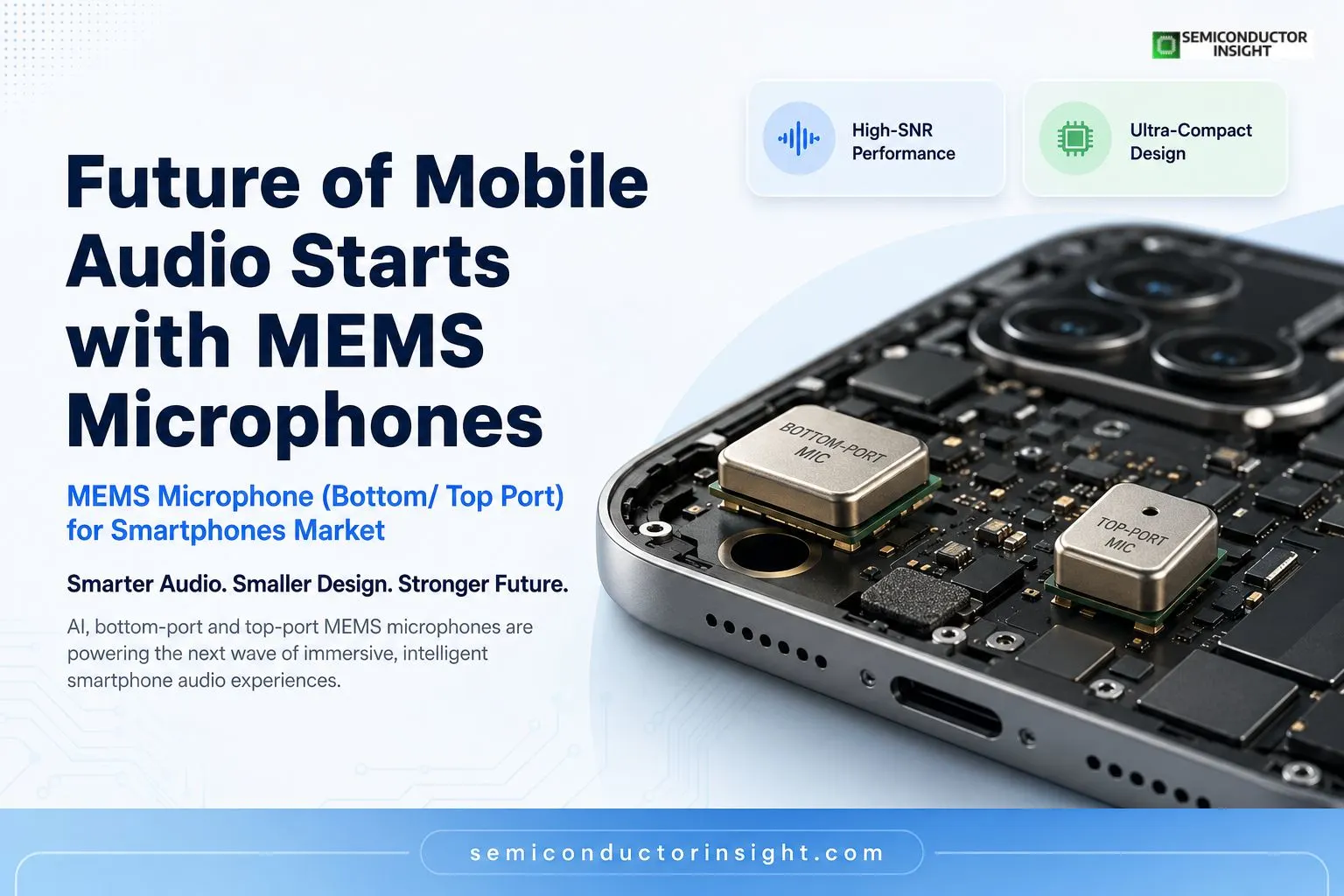
Noise Cancellation Advancements in MEMS Microphone (Bottom/ Top Port) for the Smartphones Market
The competition in the smartphone market is no longer limited to processor speed and camera resolution. Since audio quality has become a key differentiator, semiconductor manufacturers are being forced to develop MEMS microphone technology at a quick pace. Advanced smartphone features like spatial audio recording, AI voice isolation, active noise reduction, and real-time language translation now rely heavily on bottom-port and top-port MEMS microphones.
Modern flagship smartphones increasingly integrate multiple MEMS microphones to improve directional sound capture and voice clarity. Semiconductor companies such as STMicroelectronics and Analogue Devices are focusing on ultra-compact microphone architectures with high signal-to-noise ratio performance to meet the growing demand for immersive mobile audio experiences.
- According to technical insights published by EDN and semiconductor engineering platforms, MEMS microphones continue replacing traditional electret condenser microphones because of their small footprint, SMT compatibility, and superior durability under thermal stress.
Bottom-Port vs. Top-Port Architecture in Smartphones
Bottom-port MEMS microphones remain widely used in smartphones because they provide stable acoustic performance and simplified shielding from external interference. In this design, sound enters through the PCB opening beneath the microphone package. Engineers favour this approach for compact handset layouts and reliable low-frequency audio pickup.
Top-port microphones, however, are gaining strong attention in premium smartphones. Their direct acoustic path reduces sound resonance issues and improves high-frequency response. New packaging technologies have significantly improved the performance limitations that previously affected top-port structures.
Technical analyses from semiconductor audio specialists show that newer top-port architectures support flatter frequency response and better acoustic transparency, especially for cinematic smartphone video recording and AI-powered speech enhancement systems.
AI Voice Processing Creates Demand for High-SNR MEMS Designs
- Artificial intelligence is reshaping smartphone audio hardware requirements. AI-based assistants, real-time transcription tools, and computational photography systems rely heavily on clean voice input. This has increased demand for high-SNR MEMS microphones capable of filtering environmental disturbances.
- Leading smartphone manufacturers are now deploying multi-microphone arrays with beamforming technology. These arrays isolate human speech while suppressing wind noise, crowd sounds, and traffic interference. High dynamic range microphones also support better voice pickup during 4K and 8K video recording.
- Industry engineering reports highlight that some premium smartphones now integrate up to six MEMS microphones for spatial recording and advanced noise suppression.
- This shift is driving semiconductor companies toward wafer-level packaging innovations, lower standby current consumption, and enhanced sensitivity optimisation.
Wafer-Level Packaging Accelerates Miniaturisation
Space inside smartphones is becoming increasingly limited as brands prioritise larger batteries, periscope camera systems, and AI accelerators. MEMS microphone suppliers are therefore investing heavily in wafer-level packaging technologies.
Wafer-level packaging reduces component size while improving manufacturing efficiency and acoustic consistency. It also enables thinner PCB integration, an important advantage for foldable smartphones and ultra-slim flagship devices.
Semiconductor packaging specialists indicate that advanced packaging techniques are now essential for integrating microphones closer to smartphone edges without compromising audio performance.
The integration of resonance dampers and embedded dust filters within MEMS packages is also improving long-term reliability for smartphones operating in humid or dusty environments.
Explore the full report details in our recently refreshed edition anytime: https://semiconductorinsight.com/report/mems-microphone-bottom-top-port-for-smartphones-market/
Semiconductor Supply Chains Enter a New Phase
The MEMS microphone ecosystem is evolving alongside broader semiconductor supply chain restructuring. Asian semiconductor manufacturing hubs, including Taiwan, South Korea, Vietnam, and China, continue dominating high-volume smartphone assembly and MEMS fabrication.
At the same time, governments are supporting domestic semiconductor expansion programs to strengthen sensor manufacturing resilience. This includes investments in advanced packaging facilities and localised chip fabrication infrastructure.
Industry developments in 2025 also show increasing competition among audio semiconductor vendors focused on ultra-miniaturised microphone systems for AR glasses, AI smartphones, and wearable ecosystems.
Emerging Smartphone Audio Trends
Several emerging trends are expected to shape the next phase of the MEMS microphone semiconductor landscape:
- AI-powered environmental sound recognition
- Voice-controlled on-device AI assistants
- Spatial audio capture for immersive video
- Real-time multilingual translation
- Enhanced waterproof and dustproof microphone packaging
- Low-power always-on voice sensing
These trends are pushing smartphone OEMs toward higher microphone counts and more advanced semiconductor audio architectures.
MEMS Microphone (Bottom/ Top Port) for Smartphones Market is undergoing rapid transformation as AI computing, semiconductor packaging, and premium audio experiences converge. Bottom-port microphones continue offering strong reliability and integration flexibility, while top-port designs are advancing rapidly with improved acoustic engineering.
As smartphone brands race to deliver studio-grade audio capture and smarter voice interfaces, MEMS microphone technology is becoming one of the most critical semiconductor components inside next-generation mobile devices. Continuous innovation in wafer-level packaging, beamforming, and high-SNR sensor design will define the competitive future of smartphone audio systems.

Comments (0)