
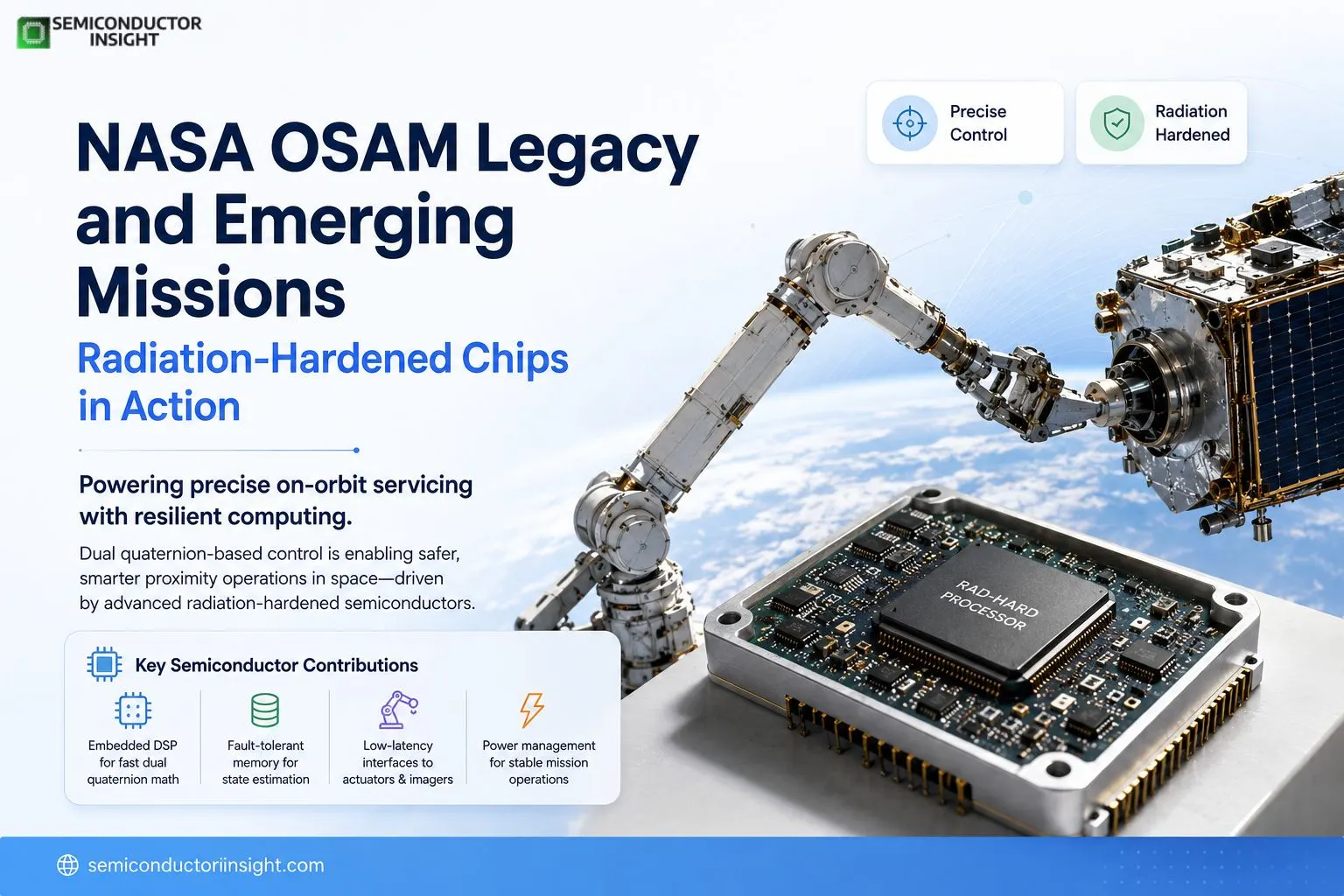
NASA OSAM Legacy and Emerging Missions 2026: Radiation-Hardened Chips in Action
Dual quaternions offer a compact mathematical framework that unifies position and orientation control for rigid bodies in three-dimensional space. This approach proves especially valuable for spacecraft engaged in delicate proximity operations during on-orbit servicing, where precise relative pose tracking prevents collisions and ensures successful docking or manipulation. Dual quaternions combine translation and rotation into a single representation, eliminating computing cost and enhancing numerical stability in real-time control systems.
Space agencies and industry players increasingly adopt these methods for missions involving robotic arms, rendezvous, and capture of client satellites. Government reports from NASA highlight how such algorithms support tasks like refueling, repair, and assembly in orbit, extending satellite lifespans and reducing space debris risks. Recent demonstrations emphasize the need for high-reliability computing hardware capable of executing complex dual quaternion-based controllers under radiation exposure and microgravity constraints.
Don’t Forget to Surf Our Updated Report for More Detailed Analysis: https://semiconductorinsight.com/report/dual-quaternion-based-pose-control-for-spacecraft-on-orbit-servicing-market/
Mathematical Foundations and Implementation in Spacecraft Systems
- Dual quaternions extend standard quaternions by incorporating dual numbers, allowing simultaneous encoding of rotational and translational motion.
- A unit dual quaternion represents a screw displacement, making it ideal for modeling the combined 6-degree-of-freedom dynamics of a servicer spacecraft and its robotic manipulator.
- Researchers at institutions collaborating with NASA and ESA have developed control laws using dual quaternion feedback for global asymptotic stability in pose tracking, even for tumbling targets.
- In practice, these algorithms run on embedded processors within the spacecraft’s guidance, navigation, and control (GNC) subsystem. The formulation simplifies constraint handling in multi-body systems, such as a spacecraft-mounted robotic arm interacting with a non-cooperative satellite.
- Case studies from JPL and academic papers show dual quaternion tools enabling smoother trajectory planning and force control during contact phases of servicing operations.
Representation of Dual Quaternion Pose Control Loop Sensor Data (Cameras + LIDAR) → Dual Quaternion Estimation (Kalman Filter) → Error Computation in Unified Pose Space → Control Law Application (PD or Sliding Mode) → Actuator Commands to Thrusters/Robotic Joints → Feedback Loop.
Semiconductor Hardware Enabling Advanced Control Algorithms
Radiation-hardened semiconductors form the critical backbone for deploying dual quaternion computations in space. These chips must withstand total ionizing dose effects, single event upsets, and latch-up while delivering sufficient processing power for real-time matrix operations and filtering inherent to dual quaternion math.
Processors like radiation-tolerant Arm Cortex variants and FPGAs provide the low-power, high-reliability platforms needed for onboard execution. For instance, specialized microcontrollers integrate fault-tolerant features that maintain algorithm integrity during solar particle events.
Ongoing work at facilities supporting NASA missions focuses on 22nm FinFET processes with enhanced layout techniques to shrink die area while preserving radiation tolerance.
Typical Requirements for Space-Grade Processors in Pose Control Applications
- Radiation Tolerance: >100 krad(Si) TID, SEU immunity
- Computational Load: Real-time dual quaternion propagation (8D operations)
- Power Budget: Milliwatt range for extended missions
- Volume/Weight: Compact SoCs for CubeSat to large satellite integration
Recent advancements include softer error tolerant flip-flops and custom cell libraries that reduce size and energy penalties compared to older triple modular redundancy approaches.
Current Global Scenarios and Mission Examples
NASA’s efforts in on-orbit servicing, though some programs like OSAM-1 faced adjustments, continue to drive technology maturation through related initiatives in in-space assembly and manufacturing. Robotic systems tested on the International Space Station and planned demonstrations showcase the transition from human-in-the-loop to autonomous operations relying on precise pose estimation.
ESA’s RISE mission with D-Orbit, targeted around 2026 timelines, aims to demonstrate rendezvous and docking in geostationary orbit, where dual quaternion frameworks could optimize relative navigation. Astroscale and other operators pursue active debris removal and life-extension services, incorporating advanced vision-based pose determination that benefits from efficient algorithmic implementations on rad-hard silicon.
- In 2025-2026, commercial players integrate these technologies into constellations, with increased focus on GEO servicing for high-value communication satellites. Chinese and international research groups publish on coordinated control using dual quaternions for multi-spacecraft formations, underscoring global momentum.
Integration Challenges and Hardware-Software Co-Design
Implementing dual quaternion control requires tight coupling between algorithms and underlying semiconductor architecture. FPGAs offer reconfigurability for custom dual number arithmetic units, while multicore radiation-hardened processors handle parallel tasks like sensor fusion and predictive control.
Ongoing case studies emphasize verification through hardware-in-the-loop simulations that replicate orbital dynamics. Innovations in radiation hardening by design such as guard rings and optimized transistor geometries allow greater use of commercial processes adapted for space, balancing performance and resilience.
Unique Graphic Pointer: Key Semiconductor Contributions
- Embedded DSP blocks for fast dual quaternion multiplication
- Fault-tolerant memory for state estimation buffers
- Low-latency interfaces to robotic actuators and imagers
- Power management ICs maintaining stability during thrust maneuvers
These elements ensure algorithms perform reliably over multi-year missions without ground intervention.
Emerging Applications in Sustainable Space Operations
As orbital activity intensifies with mega-constellations and lunar gateways, dual quaternion-based pose control supported by advanced semiconductors enables safer proximity operations. This supports refueling, module assembly, and debris mitigation key to long-term space sustainability.
Government websites detail how such technologies reduce reliance on expendable satellites and promote circular space economy principles. Experiments on platforms like the ISS validate control strategies that could scale to deeper space missions, including asteroid proximity operations.
The convergence of sophisticated mathematical modeling with resilient semiconductor hardware marks a pivotal shift in spacecraft servicing capabilities. As missions grow more ambitious, the underlying electronics continue to evolve, providing the computational foundation for precise, autonomous orbital maneuvers worldwide.

Comments (0)