
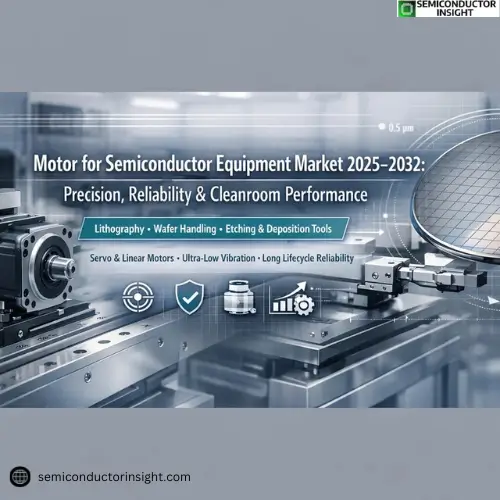
Motor for Semiconductor Equipment Market: Precision Powering the World’s Most Sensitive Manufacturing
In semiconductor manufacturing, motion is never just motion. Every rotation, micro-adjustment, and controlled stop inside fabrication equipment directly affects yield, defect rates, and production uptime. Motors used in semiconductor equipment operate in environments where tolerance margins are measured in microns, contamination is unacceptable, and reliability is non-negotiable.
The motor for semiconductor equipment market exists at the intersection of precision engineering, materials science, and advanced automation. Unlike general industrial motors, these systems are purpose-built to function flawlessly inside lithography tools, wafer handling systems, etching chambers, deposition platforms, and inspection equipment.
As fabrications expand capacity and migrate toward advanced process nodes, motors are becoming strategic components rather than background hardware.
Defining the Market Scope
Motors for semiconductor equipment include servo motors, stepper motors, linear motors, spindle motors, and vacuum-compatible drive systems designed specifically for wafer fabrication and packaging tools. These motors must deliver:
- Ultra-smooth motion control
- High repeatability over millions of cycles
- Minimal particle generation
- Thermal stability under continuous operation
The market is driven not by volume production alone, but by process criticality and tool integration depth.
Why Semiconductor Equipment Motors are Fundamentally Different?
Traditional industrial motors prioritize torque and durability. Semiconductor motors prioritize precision, cleanliness, and synchronization. Many operate in vacuum or controlled environments where lubricants, outgassing, or electromagnetic interference can disrupt processes.
In advanced fabrications, motors are often embedded deep within tool architecture. Replacing or servicing them can require full system downtime, making long-term reliability a purchasing priority rather than a secondary consideration.
This reality has shifted buyer focus from upfront cost to lifecycle performance, pushing suppliers to deliver motors with validated endurance, predictive diagnostics, and stable long-term supply.
Equipment-Level Demand Drivers
Each semiconductor tool category places unique demands on motor systems.
Lithography platforms require motors capable of nanometre-level positioning accuracy while maintaining high throughput. Wafer stages, mask alignment units, and focus control systems rely heavily on linear motors and high-resolution servo drives.
Etching and deposition tools demand motors that tolerate high temperatures, corrosive gases, and long continuous operating cycles. Here, material selection and sealing technology play a decisive role.
Wafer handling systems including robots, load ports, and transfer arms depend on synchronized motor control to prevent wafer damage and particle generation. Even minor motion inconsistencies can result in costly yield losses.
Technology Evolution inside the Motor Segment
The motor landscape within semiconductor equipment has shifted significantly over the past decade. Manufacturers are moving away from standard catalog products toward application-specific motor architectures.
Key engineering trends shaping the market include improved encoder resolution for better motion feedback, advanced drive electronics for smoother acceleration profiles, and materials engineered to reduce vibration and thermal drift.
Another notable shift is the integration of motors with control systems. Smart motors equipped with embedded sensors now provide real-time data on temperature, load variation, and operating cycles. This data feeds into predictive maintenance frameworks used by leading fabrications.
Supply Chain Sensitivity and Qualification Cycles
Unlike many industrial components, motors for semiconductor equipment undergo lengthy qualification processes. Once approved for a specific tool platform, motors often remain unchanged for years.
This creates a market structure characterized by long supplier relationships and high switching costs. Equipment manufacturers prioritize consistency over experimentation, reinforcing demand stability for established motor suppliers.
Supply chain reliability has also become a critical consideration. Semiconductor equipment manufacturers increasingly seek motor partners with regional manufacturing, redundancy planning, and proven delivery performance during demand surges.
Regional Market Dynamics
Asia-Pacific represents the largest demand centre, driven by concentrated wafer fabrication investments in Taiwan, South Korea, China, and Japan. High-volume logic and memory fabrications in these regions require large numbers of motors across multiple tool categories.
North America and Europe focus more heavily on advanced node development, specialty semiconductors, and equipment R&D. In these regions, motors with custom specifications, higher precision thresholds, and extended validation cycles dominate purchasing decisions.
Across all regions, alignment with fab expansion timelines is a defining factor in motor procurement.
Competitive Landscape Characteristics
The competitive environment is shaped less by price competition and more by engineering credibility. Suppliers that succeed in this market typically offer:
- Deep collaboration with equipment OEMs
- Custom motor design capabilities
- Proven contamination-control expertise
New entrants face substantial barriers due to qualification complexity and the conservative nature of semiconductor manufacturing.
As a result, market leadership is reinforced through trust, technical support, and long-term performance consistency rather than aggressive market entry strategies.
Market Trajectory and Forward Outlook
- Looking ahead, the motor for semiconductor equipment market is set to grow alongside fab expansions, advanced packaging adoption, and increasing automation inside cleanroom environments.
- Demand will be strongest for motors that support higher speeds without sacrificing positional accuracy.
- Emerging process nodes and heterogeneous integration will further elevate the importance of motion control precision.
- At the same time, sustainability pressures are encouraging energy-efficient motor designs that reduce overall tool power consumption.
- Motors may remain invisible to end users, but within semiconductor fabrications, they are becoming decisive contributors to productivity and yield performance.
At Last before Ending, Don’t Forget to Browse Our Recent Exclusive Report for Detailed Insights:
https://semiconductorinsight.com/report/motor-for-semiconductor-equipment-market/
Key Takeaway
In semiconductor manufacturing, motors are not interchangeable components they are precision enablers that define how reliably advanced chips can be produced at scale.
Motor for semiconductor equipment market is evolving into a precision-driven, reliability-focused segment that underpins the efficiency and accuracy of modern chip fabrication.

Comments (0)