MARKET INSIGHTS
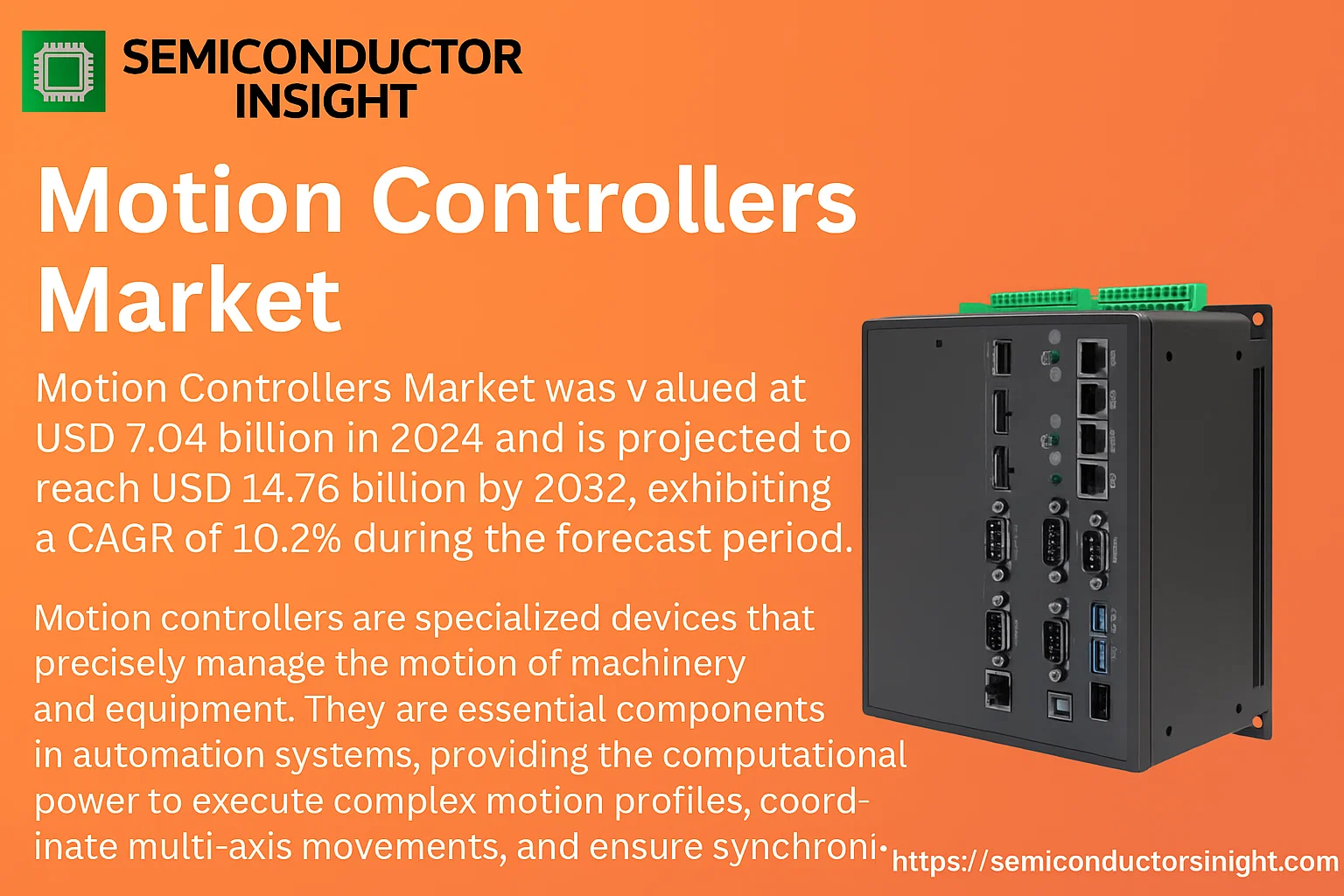
Global Motion Controllers Market was valued at USD 7.04 billion in 2024 and is projected to reach USD 14.76 billion by 2032, exhibiting a CAGR of 10.2% during the forecast period.
Motion controllers are specialized devices that precisely manage the motion of machinery and equipment. They are essential components in automation systems, providing the computational power to execute complex motion profiles, coordinate multi-axis movements, and ensure synchronization. Their applications span across industrial automation, robotics, CNC machinery, and various precision-required sectors.
The robust growth is primarily driven by the increasing adoption of automation across manufacturing, logistics, and healthcare sectors. The demand for high precision, high-speed manufacturing, and the rise of Industry 4.0 initiatives are accelerating the adoption of advanced motion control solutions. Furthermore, the integration of IoT and AI for predictive maintenance and optimization is creating new growth avenues. While the market faces challenges related to the high initial investment for small and medium enterprises and the complexity of integrating with legacy systems, the overall trajectory remains strongly positive due to the ongoing global industrial automation trend.
MARKET DRIVERS
Rising Automation in Industrial Manufacturing
The global push for enhanced productivity and efficiency in manufacturing is a primary driver for the motion controllers market. Industries are increasingly adopting automation to achieve higher precision, repeatability, and throughput in processes such as assembly, packaging, and material handling. The demand for motion controllers is further amplified by the need to reduce operational costs and human error, with the industrial automation sector witnessing a compound annual growth rate of over 8%.
Expansion of Robotics and CNC Machinery
The proliferation of industrial robots and Computer Numerical Control (CNC) machinery across various sectors, including automotive, electronics, and aerospace, significantly fuels market growth. Motion controllers are integral to these systems, providing the precise control required for complex tasks. The industrial robotics market is projected to exceed $75 billion by 2028, creating substantial demand for advanced motion control solutions.
➤ The integration of Industrial Internet of Things (IIoT) and Industry 4.0 principles is transforming motion control systems into intelligent, connected nodes within smart factories.
Furthermore, the miniaturization of electronic components and the development of multi-axis controllers are enabling more compact and powerful systems, catering to the needs of high-tech manufacturing applications.
MARKET CHALLENGES
High Initial Investment and Integration Complexity
The adoption of advanced motion control systems requires significant capital investment for hardware, software, and system integration. Small and medium-sized enterprises (SMEs) often find the upfront costs prohibitive. Additionally, integrating new motion controllers with legacy machinery and existing automation infrastructure can be technically challenging and time-consuming, requiring specialized expertise.
Other Challenges
Rapid Technological Obsolescence
The fast pace of technological innovation in electronics and software means that motion controllers can become outdated quickly. Companies face the challenge of continuous investment in upgrades to stay competitive, which can strain budgets and resources.
Cybersecurity Vulnerabilities
As motion controllers become more connected through IIoT, they are increasingly exposed to cybersecurity threats. Protecting these critical industrial control systems from cyber-attacks requires robust security measures, adding another layer of complexity and cost.
MARKET RESTRAINTS
Economic Volatility and Supply Chain Disruptions
Global economic fluctuations can lead to reduced capital expenditure in manufacturing sectors, directly impacting the demand for new motion control systems. The market is also sensitive to disruptions in the supply chain for critical components like semiconductors, which have faced significant shortages, causing production delays and increased costs for controller manufacturers.
Lack of Standardization
The absence of universal communication protocols and interoperability standards across different manufacturers’ equipment can hinder seamless integration. This lack of standardization often forces end-users to rely on proprietary solutions, limiting flexibility and potentially increasing long-term costs.
MARKET OPPORTUNITIES
Growth in Emerging Economies
Rapid industrialization in emerging economies across Asia-Pacific, Latin America, and Eastern Europe presents significant growth opportunities. Governments in these regions are investing heavily in manufacturing infrastructure, driving the adoption of automation technologies. The motion controllers market in Asia-Pacific is expected to grow at a CAGR of over 9% in the coming years.
Advancements in Motion Control Software
The development of sophisticated software for motion control, including AI and machine learning algorithms, opens new avenues for predictive maintenance, optimization, and energy efficiency. Software-defined motion control allows for greater flexibility and customization, meeting the demands of complex and dynamic industrial applications.
Expansion into New Application Areas
Beyond traditional manufacturing, motion controllers are finding new applications in medical devices, renewable energy systems (like solar panel positioning), and collaborative robotics (cobots). These emerging segments offer substantial potential for market expansion and diversification.
Motion Controllers Market Trends
Robust Market Growth Driven by Industrial Automation
The global motion controllers market is experiencing significant expansion, with a valuation of $7044 million in 2024 and a projected growth to $14760 million by 2032, representing a compound annual growth rate of 10.2%. This accelerated growth is fundamentally driven by the increasing demand for automation across a diverse range of industries. Motion controllers are specialized devices designed to manage motion, offering commands and input/output tailored to industrial needs. Their integration, often within PC-based systems, provides sophisticated graphical user interfaces that simplify complex operations such as tuning and commutation sensing, which are critical for high-performance applications.
Other Trends
Diversification Across Application Sectors
The application landscape for motion controllers is exceptionally broad, underpinning the market’s resilience. Key sectors such as machine tools, packaging, and the automobile industry are major consumers, requiring precise positioning and synchronization. The 3C (computer, communication, and consumer electronics) and semiconductor sectors represent high-growth segments due to the extreme precision required in manufacturing processes. Furthermore, emerging applications in logistics, photovoltaic (solar) panel production, and lithium battery manufacturing are creating new revenue streams, diversifying the market’s dependency on traditional industrial segments.
Regional Market Dynamics and Competitive Landscape
The Asia-Pacific region leads the global market in terms of consumption and production, fueled by manufacturing hubs in China, Japan, and South Korea. North America and Europe remain significant markets, characterized by advanced manufacturing and a strong focus on technological innovation. The competitive environment is intense, with key players including Siemens, Yaskawa, Mitsubishi Electric, ABB, and Schneider Electric dominating a significant share. These companies compete on technological advancement, reliability, and the ability to provide integrated automation solutions. The market is also seeing a steady influx of specialized players focusing on niche applications, contributing to a dynamic and evolving competitive field.
COMPETITIVE LANDSCAPE
Key Industry Players
A Highly Consolidated Market Dominated by Global Automation Giants
The global motion controllers market is characterized by a high degree of consolidation, with the top five companies accounting for a significant revenue share. Market leadership is firmly held by established global automation and industrial conglomerates such as Siemens AG, Yaskawa Electric Corporation, and Mitsubishi Electric Corporation. These players leverage their extensive product portfolios, strong global distribution networks, and deep integration capabilities across factory automation solutions to maintain a competitive edge. Their dominance is further solidified by continuous investment in research and development, focusing on advancements like integrated safety functions, IoT connectivity, and support for advanced industrial communication protocols, which are critical for modern smart factories and Industry 4.0 applications.
Beyond the dominant leaders, the market includes a robust ecosystem of significant niche players that cater to specialized application requirements. Companies like Kollmorgen (a Regal Rexnord company), Physik Instrumente (PI), and Aerotech Inc. are renowned for their high-precision motion controllers used in demanding sectors such as semiconductor manufacturing, medical devices, and aerospace. Additionally, regional players, particularly from Asia-Pacific, such as Delta Electronics, Shenzhen Inovance Technology, and Estun Automation, are gaining substantial market traction by offering cost-effective and increasingly sophisticated solutions, intensifying competition especially in the mid-range product segments across various industrial applications.
List of Key Motion Controllers Companies Profiled
- Siemens AG
- Yaskawa Electric Corporation
- Mitsubishi Electric Corporation
- Omron Corporation
- ABB Ltd.
- Shenzhen Inovance Technology Co., Ltd.
- LS Electric Co., Ltd.
- Emerson Electric Co.
- Schneider Electric SE
- Robert Bosch GmbH
- Delta Electronics, Inc.
- Parker Hannifin Corporation
- Kollmorgen (Regal Rexnord Corporation)
- Physik Instrumente (PI) GmbH & Co. KG
- Advanced Micro Controls Inc. (AMCI)
Segment Analysis:
| Segment Category | Sub-Segments | Key Insights |
| By Type |
|
PLC-based motion controllers are witnessing a dominant position, particularly within established industrial manufacturing environments due to their ruggedness and seamless integration with existing Programmable Logic Controller (PLC) ecosystems. Their reliability for high-speed sequential control tasks in harsh conditions makes them a preferred choice. Conversely, PC-based controllers are gaining significant traction for applications demanding complex algorithms, advanced graphical user interfaces, and high computational power, especially in robotics and precision automation systems. |
| By Application |
|
3C, Electronics and Semiconductor application is regarded as a leading and highly dynamic segment, driven by the insatiable demand for miniaturization and ultra-high precision in the manufacturing of consumer electronics, communication devices, and sensitive semiconductor components. Motion controllers are indispensable for operating robotic arms, precise placement systems, and wafer handling equipment in cleanroom environments. Meanwhile, the Packaging industry demonstrates robust demand for motion controllers to achieve high-speed, efficient, and synchronized operations on filling, labeling, and palletizing lines, highlighting the critical role of automation in modern logistics and supply chains. |
| By End User |
|
Discrete Manufacturing end users, encompassing industries like automotive, electronics, and machinery, constitute the largest consumer base for motion controllers. The relentless pursuit of production efficiency, quality control, and assembly line automation within these sectors fuels continuous innovation and adoption. The Research & Development segment, while smaller in volume, is crucial as it serves as the testing ground for next-generation motion control technologies, pushing the boundaries of precision and speed for future industrial applications. |
| By Technology |
|
Digital / Networked technology is unequivocally the leading segment, aligning with the industry-wide transition towards Industry 4.0 and smart factories. These controllers offer superior capabilities for remote monitoring, data analytics, and seamless integration within broader Industrial Internet of Things (IIoT) architectures, enabling predictive maintenance and optimized performance. The shift towards digital systems is fundamental for achieving the interconnected and data-driven automation environments that define modern manufacturing, overshadowing traditional analog solutions. |
| By Performance Level |
|
Mid-Range performance level controllers currently represent the most actively demanded segment, striking an optimal balance between advanced functionality, reliability, and cost-effectiveness for a vast array of industrial applications. They cater to the broad needs of general automation without the premium cost associated with ultra-high-performance models. However, the High-Performance segment is experiencing accelerated growth, driven by specialized requirements in semiconductor fabrication, aerospace, and advanced robotics where nanometric precision and extreme speed are non-negotiable. |
Regional Analysis: Motion Controllers Market
The relentless drive for factory automation across Asia-Pacific, especially in China’s “Made in China 2025” initiative, fuels demand for high-performance motion controllers in robotics, CNC machinery, and automated assembly lines, emphasizing precision and integration with IoT platforms.
As the global epicenter for smartphone, tablet, and wearable device production, the region requires sophisticated motion controllers for precise component placement, testing, and packaging, creating a vast, high-volume market for compact and efficient motion solutions.
The significant investment in new semiconductor fabs and packaging plants across South Korea, Taiwan, and China necessitates ultra-precise motion control for lithography, wafer handling, and inspection systems, demanding controllers with nanometer-level accuracy.
National policies promoting advanced manufacturing and local innovation, coupled with strong technical universities and research institutes, foster a fertile environment for developing next-generation motion control technologies tailored to regional industry needs.
North America
North America, particularly the United States, represents a mature yet highly sophisticated market for motion controllers, characterized by a strong emphasis on cutting-edge technology and high-value applications. The region’s robust aerospace and defense sectors demand extremely reliable and precise motion control systems for applications ranging from flight simulators to satellite positioning mechanisms. There is also significant adoption in the medical device industry for surgical robots and diagnostic equipment, where accuracy is paramount. The market is driven by a need for integration with advanced software and data analytics, pushing demand for smart controllers that offer predictive maintenance and real-time performance monitoring. The presence of major technology firms and a culture of innovation ensures North America remains a key region for high-end, specialized motion controller solutions.
Europe
Europe maintains a strong position in the motion controllers market, supported by its world-leading automotive manufacturing industry and a strong focus on industrial robotics, particularly in Germany, Italy, and France. The region’s stringent regulations regarding energy efficiency and safety drive the adoption of advanced motion control systems that optimize performance while reducing power consumption. There is growing demand in niche sectors such as renewable energy, where motion controllers are critical for solar tracking systems and wind turbine blade pitch control. The European market is also characterized by a high degree of collaboration between automotive OEMs, robotics integrators, and controller manufacturers, fostering the development of customized, application-specific solutions that meet rigorous quality standards.
South America
The motion controllers market in South America is emerging, with growth primarily concentrated in the industrial and agricultural sectors of Brazil and Argentina. The region’s mining industry utilizes motion control systems for heavy machinery and conveyor systems, focusing on robustness and reliability in harsh environments. In agriculture, there is increasing adoption of automation for harvesting and processing equipment. While the market is smaller compared to other regions, it presents opportunities driven by gradual industrial modernization and infrastructure development projects. The adoption rate is influenced by economic fluctuations, but a steady push towards improving manufacturing efficiency is expected to create a steady demand for basic to mid-range motion controller solutions.
Middle East & Africa
The Middle East & Africa region shows niche but growing potential for motion controllers, primarily linked to infrastructure development and the oil & gas industry. In the Gulf Cooperation Council (GCC) countries, motion controllers are used in automated building management systems, airport baggage handling, and entertainment setups. The oil & gas sector employs these systems for pipeline control and valve actuation. In Africa, growth is slower but present in sectors like packaging and food processing as industries begin to modernize. The market is characterized by a demand for durable controllers capable of withstanding extreme climatic conditions, with potential for growth as industrialization efforts gradually increase across the continent.
Report Scope
This market research report provides a comprehensive analysis of the Motion Controllers Market , covering the forecast period 2025–2032. It offers detailed insights into market dynamics, technological advancements, competitive landscape, and key trends shaping the industry.
Key focus areas of the report include:
- Market Overview: The report begins with an overview outlining its current market scenario, key growth indicators, and industry transformation drivers. It discusses macroeconomic factors, demand–supply balance, regulatory landscape, and the strategic role of semiconductors in powering advancements across industries such as automotive, telecommunications, consumer electronics, and industrial automation.
- Market Size & Forecast: Historical data and future projections for revenue, unit shipments, and market value across major regions and segments.
- Segmentation Analysis: Detailed breakdown by product type, technology, application, and end-user industry to identify high-growth segments and investment opportunities.
- Regional Insights: Insights into market performance across North America, Europe, Asia-Pacific, Latin America, and the Middle East & Africa, including country-level analysis where relevant.
- Competitive Landscape: Profiles of leading market participants, including their product offerings, R&D focus, manufacturing capacity, pricing strategies, and recent developments such as mergers, acquisitions, and partnerships.
- Technology Trends & Innovation: Assessment of emerging technologies, integration of AI/IoT, semiconductor design trends, fabrication techniques, and evolving industry standards.
- Market Drivers & Restraints: Evaluation of factors driving market growth along with challenges, supply chain constraints, regulatory issues, and market-entry barriers.
- Stakeholder Insights: Insights for component suppliers, OEMs, system integrators, investors, and policymakers regarding the evolving ecosystem and strategic opportunities.
Primary and secondary research methods are employed, including interviews with industry experts, data from verified sources, and real-time market intelligence to ensure the accuracy and reliability of the insights presented.
FREQUENTLY ASKED QUESTIONS:
What is the current market size of Motion Controllers Market?
-> Motion Controllers Market was valued at USD 7.04 billion in 2024 and is projected to reach USD 14.76 billion by 2032, exhibiting a CAGR of 10.2% during the forecast period.
Which key companies operate in Motion Controllers Market?
-> Key players include Siemens, Yaskawa, Mitsubishi Electric, Omron, ABB, and Schneider Electric, among others.
What are the key growth drivers?
-> Key growth drivers include the growing need for automation across industries such as manufacturing, robotics, healthcare, and aerospace, which drives demand for high precision motion controllers.
Which region dominates the market?
-> Asia is a key region, with significant market presence in countries like China, Japan, and South Korea.
What are the emerging trends?
-> Emerging trends include the integration of advanced features for ease of tuning, graphical user interfaces, and enhanced commutation sensing.

Get Sample Report PDF for Exclusive Insights
Report Sample Includes
- Table of Contents
- List of Tables & Figures
- Charts, Research Methodology, and more...
 Download Sample Report PDF