
MicroLED vs OLED for Holographic Display Market Which Technology Leads in 2026
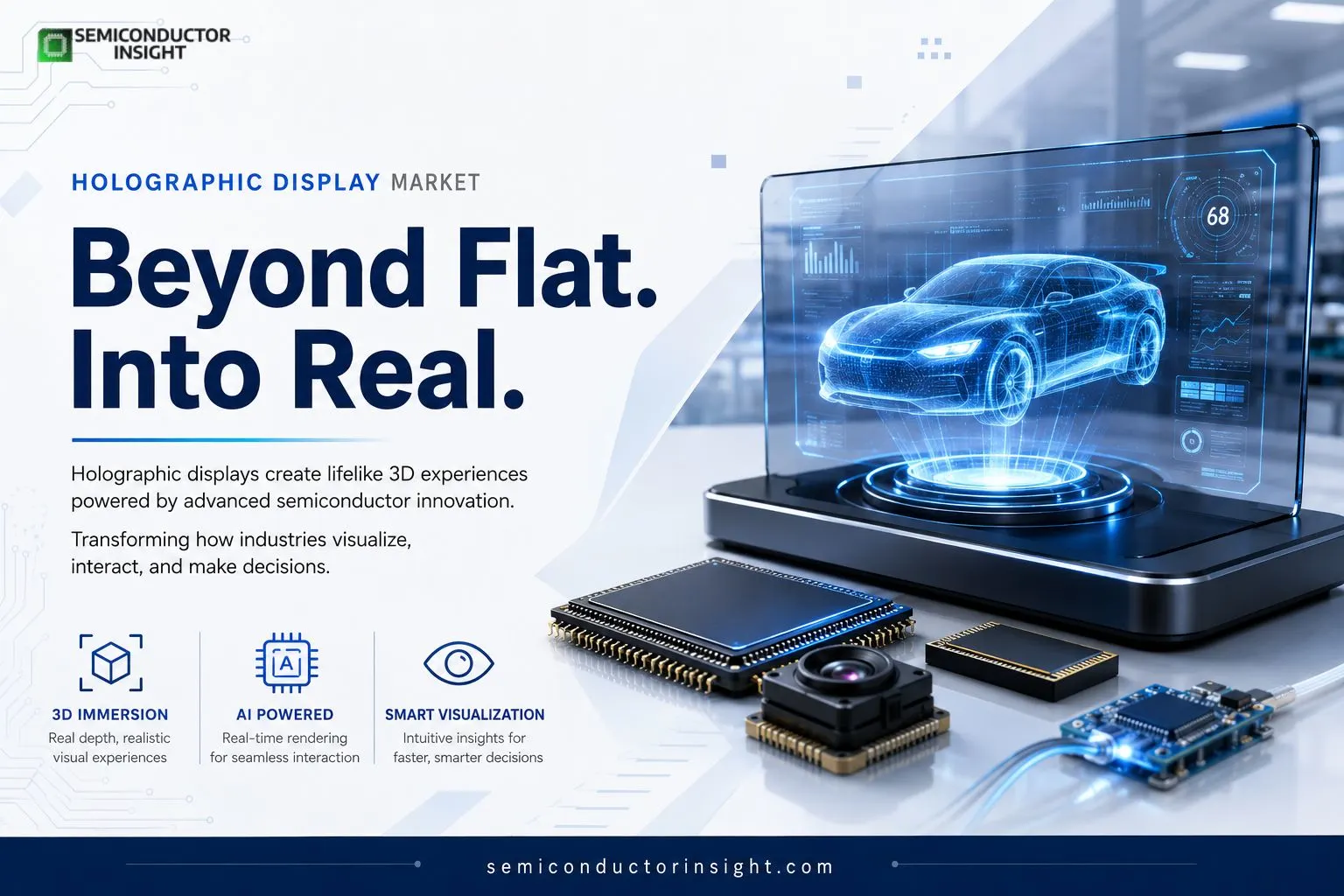
For decades, digital displays have remained confined to flat screens. That limitation is rapidly disappearing as holographic display technologies move from research laboratories into hospitals, automotive dashboards, industrial control rooms, defense systems, and immersive consumer electronics. Holographic systems, in contrast to traditional displays, recreate light waves to produce lifelike three-dimensional images that viewers may see without the need for special glasses.
The semiconductor industry is enabling this transition by delivering increasingly powerful processors, image sensors, optical engines, photonic integrated circuits, and AI accelerators capable of processing enormous volumes of visual information in real time. As industries pursue more intuitive human-machine interaction, holographic displays are becoming an important part of next-generation visualization.
The Semiconductor Foundation behind Every Hologram
- Every holographic display depends on a combination of advanced semiconductor technologies rather than optics alone.
- High-speed GPUs generate millions of image calculations each second, while CMOS image sensors capture environmental data for dynamic rendering.
- Silicon photonics improves optical signal transmission with reduced energy consumption, and specialized AI chips optimize image reconstruction almost instantly.
- The increasing adoption of chiplet architectures and advanced packaging has further improved computing density for holographic rendering engines.
- These developments allow manufacturers to reduce system size while increasing image quality and refresh rates, making commercial deployment increasingly practical.
Where Global Investments Are Creating Real Commercial Demand
Governments and technology companies are investing heavily in immersive technologies as part of broader semiconductor and digital infrastructure strategies.
According to the Semiconductor Industry Association, global semiconductor sales reached approximately USD 627.6 billion during 2024, representing one of the strongest years for the industry. Meanwhile, the global semiconductor ecosystem continues expanding through investments in AI accelerators, advanced memory, silicon photonics, and display processing technologies.
The European Union continues funding photonics research through Horizon Europe initiatives, while the United States has accelerated domestic semiconductor manufacturing through the CHIPS and Science Act. Japan and South Korea are also supporting advanced display manufacturing with substantial investments in next-generation fabrication facilities.
These initiatives collectively strengthen the manufacturing ecosystem required for sophisticated holographic display hardware.
For a more thorough report, please contact us using our most recent report: https://semiconductorinsight.com/report/holographic-display-market-2/
Industries Turning Holograms into Everyday Business Tools
Healthcare is rapidly integrating holographic visualization for surgical planning, anatomy education, and medical imaging. Surgeons can now visualize organs in three dimensions before complex procedures, improving spatial understanding beyond conventional CT or MRI images.
Automotive manufacturers are introducing holographic head-up displays capable of projecting navigation, hazard alerts, and driving information directly into the driver’s field of view. Companies including BMW, Hyundai Mobis, and Continental continue demonstrating increasingly advanced holographic cockpit concepts at international technology exhibitions.
Industrial manufacturing is another emerging application where engineers interact with digital twins through holographic interfaces for equipment maintenance and factory planning.
Defense organizations are exploring holographic visualization for battlefield mapping, command centers, and pilot training simulations.
AI and Spatial Computing Are Expanding the Opportunity
- Artificial intelligence has transformed holographic rendering from static visualization into adaptive interaction.
- Modern AI processors continuously analyze gestures, eye movement, voice commands, and surrounding environments to modify holographic content dynamically. Instead of displaying fixed images, intelligent holographic systems respond naturally to user behavior.
- This evolution closely aligns with the growing spatial computing ecosystem, where digital information blends seamlessly with physical environments. AI also reduces computational workload through predictive rendering, allowing smoother visualization while lowering power consumption.
- As AI inference hardware becomes more efficient, holographic devices are expected to become lighter, faster, and more affordable.
Performance Indicators Driving Market Confidence
Recent technological progress illustrates how rapidly supporting infrastructure is evolving.
The global installed base of industrial robots surpassed 4.28 million operational units according to the International Federation of Robotics, increasing demand for advanced visualization tools in manufacturing environments.
The consumer electronics industry shipped approximately 1.24 billion smartphones worldwide during 2024, according to IDC, demonstrating the enormous installed ecosystem capable of supporting future holographic content generation and connectivity.
The semiconductor industry is simultaneously advancing toward 2-nanometer manufacturing, enabling higher transistor density and lower power consumption for graphics-intensive applications required by holographic systems.
Together, these developments provide the computational backbone necessary for widespread holographic adoption.
Companies Redefining Visual Experiences
- Technology leaders are no longer treating holography as experimental.
- Microsoft continues expanding mixed reality capabilities for enterprise visualization. Sony has introduced spatial content creation displays targeting professional designers.
- Looking Glass Factory develops standalone holographic displays requiring no wearable devices, while Leia Inc. advances light-field display technology for consumer electronics.
- Semiconductor manufacturers including NVIDIA, AMD, Intel, Qualcomm, Samsung Electronics, and TSMC continue introducing processors optimized for AI graphics, high-bandwidth memory, and real-time rendering, all of which directly support holographic visualization workloads.
- Their combined innovation is reducing latency while increasing image realism across commercial applications.
Why This Technology Matters Beyond Entertainment?
The greatest impact of holographic displays extends far beyond gaming or immersive media.
Digital healthcare can become more accurate, industrial maintenance more efficient, engineering collaboration more intuitive, and education significantly more interactive. Instead of interpreting complex information on flat monitors, professionals can engage directly with realistic three-dimensional visual data.
As semiconductor fabrication, AI acceleration, silicon photonics, and optical computing continue advancing together, holographic displays are steadily transitioning from specialized demonstrations into practical business solutions. The convergence of these technologies positions Holographic Display Market as one of the most transformative segments within the global semiconductor ecosystem.

Comments (0)