
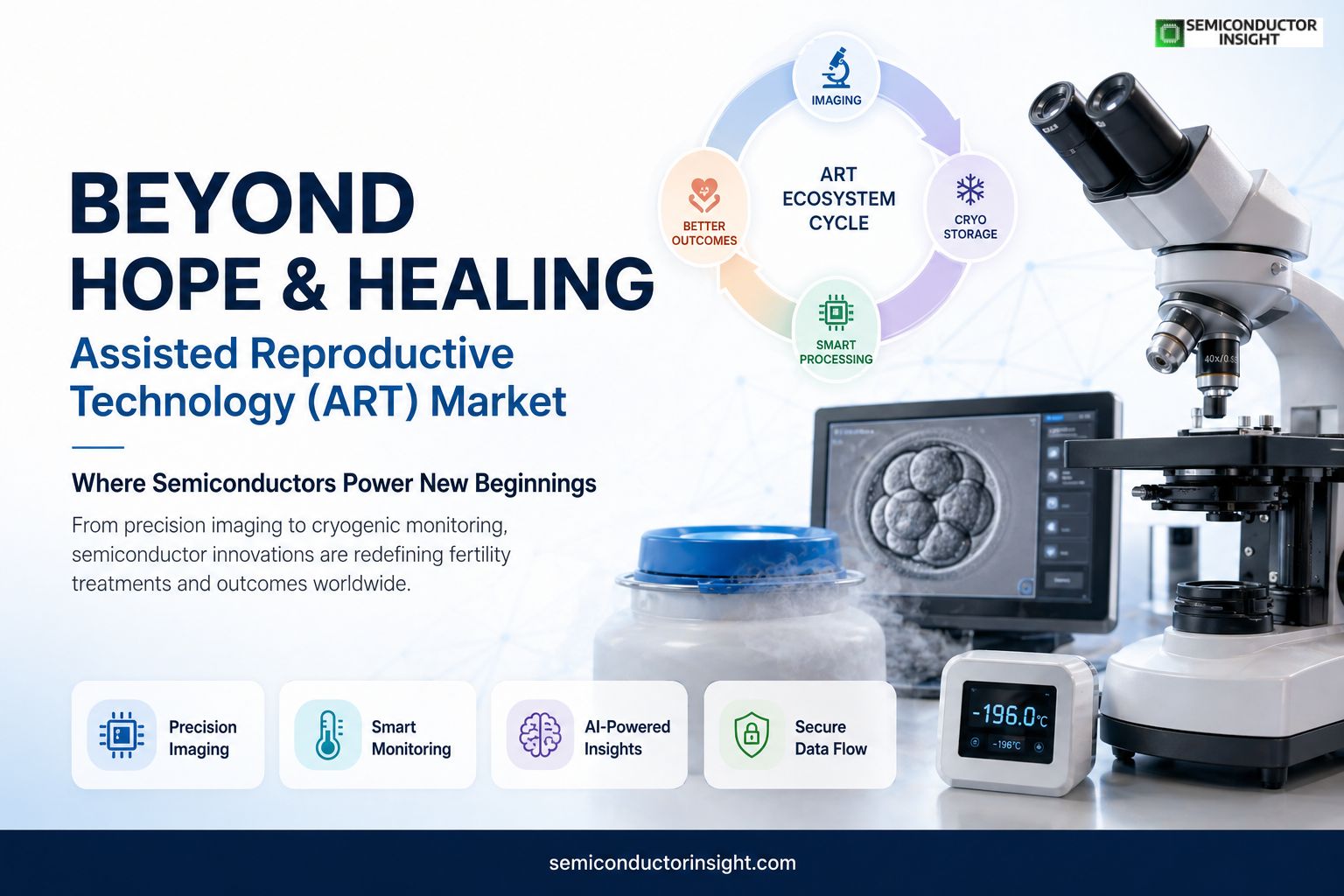
Microelectronics Meets Medicine in Assisted Reproductive Technology Market
Assisted reproductive technology (ART) market is no longer confined to fertility clinics and medical protocols it has quietly become a high-precision technology ecosystem where semiconductors play a foundational role.
From imaging systems to cryopreservation monitoring, semiconductor-enabled devices are redefining how fertility treatments are delivered globally.
- According to data from national health registries and medical associations, more than 2.5 million IVF rounds are done around the world every year, resulting in more than 500,000 new-borns.
- Japan alone does more than 450,000 IVF cycles every year, and Europe is responsible for about 40% of all ART treatments.
- These numbers mean that there is a growing need for embedded systems, sensors, and imaging chips that make sure everything is accurate at every level of reproduction.
Precision at the Cellular Level Where Chips Meet Embryology
ART procedures rely heavily on microscopic precision. Semiconductor-based imaging sensors especially CMOS image sensors are embedded in advanced microscopes used for embryo selection. These systems capture high-resolution images at sub-micron levels, enabling embryologists to assess cell division patterns in real time.
Time-lapse imaging incubators, now widely used in clinics, generate thousands of embryo images per cycle, requiring robust processing units and memory chips. A single IVF lab may handle terabytes of imaging data annually, pushing demand for efficient data handling hardware. This is where semiconductor advancements in low-power processors and high-density memory become critical.
Additionally, microfluidic chips often called lab-on-chip devices are being used for sperm sorting and embryo culture. These chips manipulate fluids at the microliter scale, reducing manual intervention and improving success rates.
Get the freshest updates and analysis from the related report: https://semiconductorinsight.com/report/global-medical-equipment-batteries-market/
Cryogenic Intelligence and Sensor-Driven Storage
Cryopreservation is a cornerstone of ART, with millions of embryos and gametes stored globally. Semiconductor-based temperature sensors and control units ensure storage conditions remain stable at -196°C in liquid nitrogen tanks.
A modern fertility clinic may store tens of thousands of samples, each requiring continuous monitoring. IoT-enabled semiconductor sensors now provide:
- Real-time temperature tracking with accuracy within ±0.1°C
- Automated alert systems to prevent storage failures
- Cloud-based data logging for regulatory compliance
In 2024, reports from healthcare infrastructure studies indicated that over 70% of advanced fertility clinics have adopted smart monitoring systems, highlighting the growing integration of semiconductor technologies.
AI Acceleration and Edge Computing in Fertility Labs
Artificial intelligence is rapidly transforming embryo selection, and semiconductors are at the heart of this shift. AI models trained on millions of embryo images require specialized chips such as GPUs and AI accelerators.
Edge computing is becoming particularly relevant. Instead of sending sensitive patient data to centralized servers, clinics are deploying on-site semiconductor-powered systems to process data locally. This reduces latency and enhances data privacy critical in healthcare environments.
For example, AI-assisted embryo grading systems can now analyze over 100 morphological parameters in seconds, compared to manual evaluations that take significantly longer and may vary between specialists.
Supply Chain Convergence between Healthcare and Electronics
ART market’s dependence on semiconductor components has created a unique overlap between healthcare and electronics supply chains. Equipment such as ultrasound machines, incubators, and laser systems for assisted hatching all rely on semiconductor components.
Recent global chip shortages highlighted this interdependence. In previous years i.e. 2022-2023, delays in semiconductor supply impacted the production of medical devices, including fertility equipment, extending delivery timelines by 3 to 6 months in some regions.
This has pushed manufacturers to rethink sourcing strategies, with increased localization of chip production and partnerships between medical device companies and semiconductor firms.
Emerging Use Cases Expanding the Market Scope
The ART ecosystem is expanding beyond traditional IVF procedures, opening new avenues for semiconductor integration:
- Wearable fertility trackers using biosensors to monitor hormone levels
- Portable ultrasound devices powered by compact semiconductor chips
- Blockchain-integrated systems for secure patient data management
In India, for instance, the number of ART clinics has crossed 1,500 centers, with urban hubs like Pune, Mumbai, and Delhi leading adoption. This expansion is driving demand for cost-effective semiconductor solutions tailored to mid-scale clinics.
Smart Care Designed for Real Family Journeys
Despite its technological complexity, ART remains deeply human. The role of semiconductors is not just about efficiency it’s about enabling better outcomes for families. Improved imaging leads to higher success rates, smarter storage prevents loss, and AI-driven insights reduce emotional and financial strain on patients.
Semiconductor technology will only become more integrated into the market for assisted reproductive technologies as it develops. Once a specialised area of medicine, it is today a hub for data science, electronics, and human care, subtly influencing the worldwide future of reproduction.

Comments (0)