Key Statistics
Key Takeaways
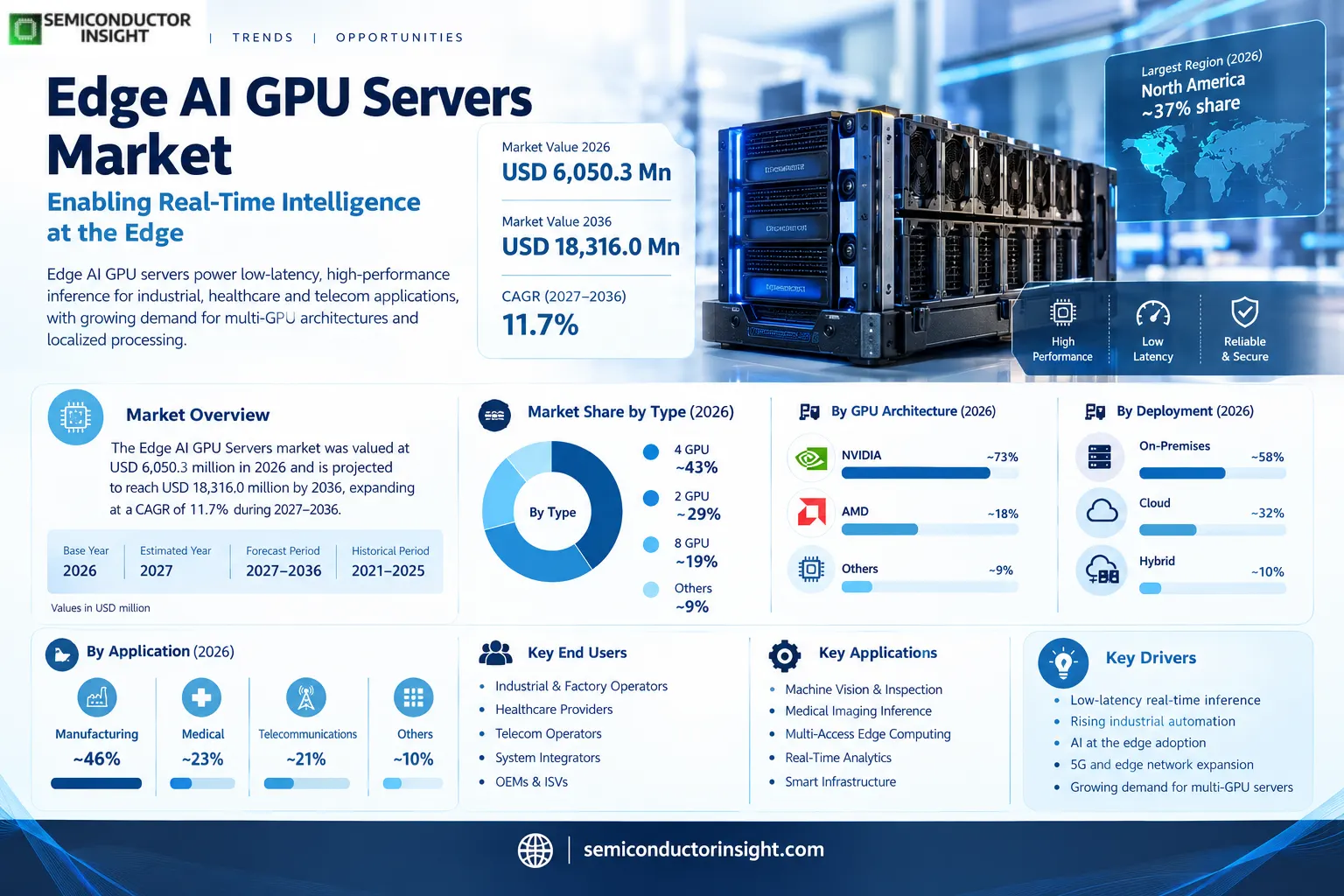
- Market value: The edge ai gpu servers market stands at USD 6,050.3 million in 2026 and is projected to reach USD 18,316.0 million by 2036 at a CAGR of 11.7% during 2027–2036. The buying environment is shaped by factory machine vision, hospital imaging inference and telecom multi-access edge computing and the need to reconcile performance with availability, qualification and ownership costs.
- 4 GPU: leads the type classification with an estimated ~43% of 2026 revenue; GPU utilization, inference latency, thermal budget, redundant storage, remote management and supported operating temperatures define why this offering reaches the largest customer base, while differently configured products compete on cost, deployment restrictions and future upgrade paths.
- Manufacturing: accounts for an estimated ~46% of 2026 revenue, reflecting factory machine vision, hospital imaging inference and telecom multi-access edge computing; purchasing tends to follow equipment approval, system design and long-term service arrangements instead of isolated chip or hardware demonstrations.
- North America: holds an estimated ~37% of global market revenue in 2026. The regional growth pattern is uneven: Asia-Pacific has an estimated ~13.4% annual growth outlook, and access to product qualification routes differs by geography.
- Key constraint: Electric-power ceilings, service maintenance, gpu supply and incompatible deployment software limit conversion of planned technology spend into deliveries. Customers purchasing multi-GPU edge inference servers need supplier evidence that parts remain supported, compatible and serviceable over extended deployments, particularly when a product becomes part of critical infrastructure.
Edge AI GPU Servers Market Overview
Edge ai gpu servers market was valued at USD 6,050.3 million in 2026 and is projected to reach USD 18,316.0 million by 2036, expanding at a CAGR of 11.7% during 2027–2036. North America represented the largest regional revenue share in 2026, estimated at ~37%, reflecting its central role in the supply or procurement of multi-GPU edge inference servers.
Edge AI GPU Servers depends on the design and deployment of short-depth rack or industrial enclosure platforms holding two to eight discrete graphics accelerators with localized storage and network links. For edge ai gpu servers, customers evaluate GPU utilization, inference latency, thermal budget, redundant storage, remote management and supported operating temperatures before adopting a design in production.
Edge AI GPU Servers revenue boundary depends on the sale of multi-GPU edge inference servers rather than all equipment or cloud services that incorporate them. For edge ai gpu servers revenue boundary, customers evaluate sales eligibility, product configuration and exclusion of adjacent system revenue for Edge AI GPU Servers before adopting a design in production.
Technology architecture depends on short-depth rack or industrial enclosure platforms holding two to eight discrete graphics accelerators with localized storage and network links; inputs include GPU modules, host CPUs, high-bandwidth memory, NICs, power supplies, thermal systems and ruggedized enclosures. For technology architecture, customers evaluate GPU utilization, inference latency, thermal budget, redundant storage, remote management and supported operating temperatures before adopting a design in production.
Edge AI GPU Servers end-customer demand depends on factory machine vision, hospital imaging inference and telecom multi-access edge computing. For edge ai gpu servers end-customer demand, customers evaluate long-term availability and qualified performance from suppliers of multi-GPU edge inference servers before adopting a design in production. Exposure to deployment timing and the availability of compatible infrastructure in edge ai gpu servers end-customer demand can affect unit cost, availability and technical qualification.
Current industry transition depends on rapid deployment of real-time vision workloads that cannot tolerate persistent cloud round trips. For current industry transition, customers evaluate cost per deployed workload and the maturity of accompanying software and supply contracts for Edge AI GPU Servers before adopting a design in production. Exposure to electric-power ceilings, service maintenance, GPU supply and incompatible deployment software in current industry transition can affect unit cost, availability and technical qualification.
Segment Analysis: By Type
Type segmentation depends on 4 published type categories: 2 GPU, 4 GPU, 8 GPU, Others; 4 GPU leads at an estimated ~43%. For type segmentation, customers evaluate GPU utilization, inference latency, thermal budget, redundant storage, remote management and supported operating temperatures before adopting a design in production. Exposure to electric-power ceilings, service maintenance, GPU supply and incompatible deployment software in type segmentation can affect unit cost, availability and technical qualification.
| Type | Function | Market position |
|---|---|---|
| 2 GPU | 2 GPU type depends on its use within short-depth rack or industrial enclosure platforms holding two to eight discrete graphics accelerators with localized storage and network links for factory machine vision, hospital imaging inference and telecom multi-access edge computing. For 2 gpu type, customers evaluate operating limits, interoperability and technical qualification specific to 2 GPU in Edge AI GPU Servers before adopting a design in production. | 2 GPU commercial position depends on an estimated ~29% of 2026 category revenue and ~10.1% annual growth to 2036. For 2 gpu commercial position, customers evaluate commercial selection of 2 GPU on GPU utilization, inference latency, thermal budget, redundant storage, remote management and supported operating temperatures before adopting a design in production. |
| 4 GPU | 4 GPU type depends on its use within short-depth rack or industrial enclosure platforms holding two to eight discrete graphics accelerators with localized storage and network links for factory machine vision, hospital imaging inference and telecom multi-access edge computing. For 4 gpu type, customers evaluate operating limits, interoperability and technical qualification specific to 4 GPU in Edge AI GPU Servers before adopting a design in production. | 4 GPU commercial position depends on an estimated ~43% of 2026 category revenue and ~12.0% annual growth to 2036. For 4 gpu commercial position, customers evaluate commercial selection of 4 GPU on GPU utilization, inference latency, thermal budget, redundant storage, remote management and supported operating temperatures before adopting a design in production. |
| 8 GPU | 8 GPU type depends on its use within short-depth rack or industrial enclosure platforms holding two to eight discrete graphics accelerators with localized storage and network links for factory machine vision, hospital imaging inference and telecom multi-access edge computing. For 8 gpu type, customers evaluate operating limits, interoperability and technical qualification specific to 8 GPU in Edge AI GPU Servers before adopting a design in production. | 8 GPU commercial position depends on an estimated ~19% of 2026 category revenue and ~14.6% annual growth to 2036. For 8 gpu commercial position, customers evaluate commercial selection of 8 GPU on GPU utilization, inference latency, thermal budget, redundant storage, remote management and supported operating temperatures before adopting a design in production. |
| Others | Others type depends on its use within short-depth rack or industrial enclosure platforms holding two to eight discrete graphics accelerators with localized storage and network links for factory machine vision, hospital imaging inference and telecom multi-access edge computing. For others type, customers evaluate operating limits, interoperability and technical qualification specific to Others in Edge AI GPU Servers before adopting a design in production. | Others commercial position depends on an estimated ~9% of 2026 category revenue and ~8.4% annual growth to 2036. For others commercial position, customers evaluate commercial selection of Others on GPU utilization, inference latency, thermal budget, redundant storage, remote management and supported operating temperatures before adopting a design in production. Exposure to electric-power ceilings, service maintenance, GPU supply and incompatible deployment software in others commercial position can affect unit cost, availability and technical qualification. |
Secondary segmentation: additional product dimensions
Secondary market segmentation depends on the commercial market also separates By GPU Architecture into NVIDIA, AMD, Others; By Deployment into On-Premises, Cloud, Hybrid. For secondary market segmentation, customers evaluate GPU utilization, inference latency, thermal budget, redundant storage, remote management and supported operating temperatures before adopting a design in production. Exposure to electric-power ceilings, service maintenance, GPU supply and incompatible deployment software in secondary market segmentation can affect unit cost, availability and technical qualification.
| Axis | Members | Commercial role |
|---|---|---|
| By GPU Architecture | NVIDIA, AMD, Others | By GPU Architecture depends on the gpu architecture classes distinguish NVIDIA, AMD, Others, with NVIDIA accounting for an estimated ~73% of base-year revenue. For by gpu architecture, customers evaluate GPU utilization, inference latency, thermal budget, redundant storage, remote management and supported operating temperatures before adopting a design in production. Exposure to electric-power ceilings, service maintenance, GPU supply and incompatible deployment software in by gpu architecture can affect unit cost, availability and technical qualification. |
| By Deployment | On-Premises, Cloud, Hybrid | By Deployment depends on the deployment classes distinguish On-Premises, Cloud, Hybrid, with On-Premises accounting for an estimated ~58% of base-year revenue. For by deployment, customers evaluate GPU utilization, inference latency, thermal budget, redundant storage, remote management and supported operating temperatures before adopting a design in production. Exposure to electric-power ceilings, service maintenance, GPU supply and incompatible deployment software in by deployment can affect unit cost, availability and technical qualification. |
Segment Analysis: By Application
Application segmentation depends on Manufacturing is the leading end use at an estimated ~46% of 2026 revenue among 4 application classes. For application segmentation, customers evaluate factory machine vision, hospital imaging inference and telecom multi-access edge computing before adopting a design in production. Exposure to electric-power ceilings, service maintenance, GPU supply and incompatible deployment software in application segmentation can affect unit cost, availability and technical qualification.
| Application | Demand characteristics |
|---|---|
| Manufacturing | Manufacturing application depends on an estimated ~46% of 2026 application revenue and a modeled ~12.5% CAGR, with demand from factory machine vision, hospital imaging inference and telecom multi-access edge computing. For manufacturing application, customers evaluate integration testing, operational reliability and buying cycles for Manufacturing uses of multi-GPU edge inference servers before adopting a design in production. |
| Medical | Medical application depends on an estimated ~23% of 2026 application revenue and a modeled ~11.2% CAGR, with demand from factory machine vision, hospital imaging inference and telecom multi-access edge computing. For medical application, customers evaluate integration testing, operational reliability and buying cycles for Medical uses of multi-GPU edge inference servers before adopting a design in production. |
| Telecommunications | Telecommunications application depends on an estimated ~21% of 2026 application revenue and a modeled ~12.1% CAGR, with demand from factory machine vision, hospital imaging inference and telecom multi-access edge computing. For telecommunications application, customers evaluate integration testing, operational reliability and buying cycles for Telecommunications uses of multi-GPU edge inference servers before adopting a design in production. |
| Others | Others application depends on an estimated ~10% of 2026 application revenue and a modeled ~7.7% CAGR, with demand from factory machine vision, hospital imaging inference and telecom multi-access edge computing. For others application, customers evaluate integration testing, operational reliability and buying cycles for Others uses of multi-GPU edge inference servers before adopting a design in production. |
Application purchasing channels depends on most deployments depend on the larger system integrator which qualifies multi-GPU edge inference servers within an end product. For application purchasing channels, customers evaluate GPU utilization, inference latency, thermal budget, redundant storage, remote management and supported operating temperatures before adopting a design in production. Exposure to electric-power ceilings, service maintenance, GPU supply and incompatible deployment software in application purchasing channels can affect unit cost, availability and technical qualification.
Regional Analysis
Global regional markets depends on North America leads with ~37% estimated share, followed by Asia-Pacific (~28%) and Europe (~24%), while Asia-Pacific has ~13.4% annual growth. For global regional markets, customers evaluate GPU utilization, inference latency, thermal budget, redundant storage, remote management and supported operating temperatures before adopting a design in production.
How do regional requirements differ for multi-GPU edge inference servers?
Regional differences depends on five market geographies have different roles in factory machine vision, hospital imaging inference and telecom multi-access edge computing, with qualification and manufacturing centers separated across borders. For regional differences, customers evaluate GPU utilization, inference latency, thermal budget, redundant storage, remote management and supported operating temperatures before adopting a design in production.
| Region | Position | Growth outlook | Demand profile | What decides supplier selection |
|---|---|---|---|---|
| North America | Largest (~37%) | ~11.2% CAGR | North America demand profile depends on US industrial integrators and research labs specify rugged GPU inference systems for production systems while Canada and Mexico contribute service and manufacturing activity. For north america demand profile, customers evaluate GPU utilization, inference latency, thermal budget, redundant storage, remote management and supported operating temperatures before adopting a design in production. | North America vendor access depends on US industrial integrators and research labs specify rugged GPU inference systems for production systems while Canada and Mexico contribute service and manufacturing activity. For north america vendor access, customers evaluate GPU utilization, inference latency, thermal budget, redundant storage, remote management and supported operating temperatures before adopting a design in production. |
| Europe | Rank 3 (~24%) | ~10.6% CAGR | Europe demand profile depends on German machine building, French instrumentation and British engineering require carefully qualified rugged GPU inference systems and long vendor support. For europe demand profile, customers evaluate GPU utilization, inference latency, thermal budget, redundant storage, remote management and supported operating temperatures before adopting a design in production. | Europe vendor access depends on German machine building, French instrumentation and British engineering require carefully qualified rugged GPU inference systems and long vendor support. For europe vendor access, customers evaluate GPU utilization, inference latency, thermal budget, redundant storage, remote management and supported operating temperatures before adopting a design in production. |
| Asia-Pacific | Rank 2 (~28%) | ~13.4% CAGR | Asia-Pacific demand profile depends on Taiwan, China, Japan, South Korea and India combine electronic-system manufacturing with growing domestic demand for rugged GPU inference systems. For asia-pacific demand profile, customers evaluate GPU utilization, inference latency, thermal budget, redundant storage, remote management and supported operating temperatures before adopting a design in production. | Asia-Pacific vendor access depends on Taiwan, China, Japan, South Korea and India combine electronic-system manufacturing with growing domestic demand for rugged GPU inference systems. For asia-pacific vendor access, customers evaluate GPU utilization, inference latency, thermal budget, redundant storage, remote management and supported operating temperatures before adopting a design in production. |
| South America | Rank 4 (~6%) | ~9.6% CAGR | South America demand profile depends on Brazilian industrial customers and Chilean infrastructure operators purchase imported rugged GPU inference systems through regional engineering distributors. For south america demand profile, customers evaluate GPU utilization, inference latency, thermal budget, redundant storage, remote management and supported operating temperatures before adopting a design in production. | South America vendor access depends on Brazilian industrial customers and Chilean infrastructure operators purchase imported rugged GPU inference systems through regional engineering distributors. For south america vendor access, customers evaluate GPU utilization, inference latency, thermal budget, redundant storage, remote management and supported operating temperatures before adopting a design in production. |
| Middle East & Africa | Rank 5 (~5%) | ~11.9% CAGR | Middle East & Africa demand profile depends on Gulf national infrastructure projects and South African industrial applications demand rugged GPU inference systems supported through integrator and distributor networks. For middle east & africa demand profile, customers evaluate GPU utilization, inference latency, thermal budget, redundant storage, remote management and supported operating temperatures before adopting a design in production. | Middle East & Africa vendor access depends on Gulf national infrastructure projects and South African industrial applications demand rugged GPU inference systems supported through integrator and distributor networks. For middle east & africa vendor access, customers evaluate GPU utilization, inference latency, thermal budget, redundant storage, remote management and supported operating temperatures before adopting a design in production. |
Competitive Landscape
Competition and supplier positioning depends on Dell Technologies; Hewlett Packard Enterprise; Supermicro; Lenovo participate in the supply chain for multi-GPU edge inference servers. For competition and supplier positioning, customers evaluate GPU utilization, inference latency, thermal budget, redundant storage, remote management and supported operating temperatures before adopting a design in production.
Principal direct suppliers depends on qualified commercial offerings from Dell Technologies; Hewlett Packard Enterprise; Supermicro; Lenovo. For principal direct suppliers, customers evaluate GPU utilization, inference latency, thermal budget, redundant storage, remote management and supported operating temperatures before adopting a design in production. Exposure to electric-power ceilings, service maintenance, GPU supply and incompatible deployment software in principal direct suppliers can affect unit cost, availability and technical qualification.
Specialist supplier channel depends on ASUS; GIGABYTE; ADLINK Technology; Advantech; MiTAC Computing Technology participate in the wider competitive environment. For specialist supplier channel, customers evaluate traceable product capabilities and fulfilment of Edge AI GPU Servers specifications before adopting a design in production. Exposure to electric-power ceilings, service maintenance, GPU supply and incompatible deployment software in specialist supplier channel can affect unit cost, availability and technical qualification.
Edge AI GPU Servers integration ecosystem depends on NVIDIA and AMD supply GPUs, while software developers do not sell complete server chassis can influence integration while not automatically counting toward the same revenue boundary. For edge ai gpu servers integration ecosystem, customers evaluate GPU utilization, inference latency, thermal budget, redundant storage, remote management and supported operating temperatures before adopting a design in production.
Procurement competition depends on rapid deployment of real-time vision workloads that cannot tolerate persistent cloud round trips affects both established and challenger suppliers. For procurement competition, customers evaluate secure lead time and technical support in the Edge AI GPU Servers supply chain before adopting a design in production. Exposure to electric-power ceilings, service maintenance, GPU supply and incompatible deployment software in procurement competition can affect unit cost, availability and technical qualification.
Tier structure
| Tier | Companies | Basis of competition |
|---|---|---|
| Tier 1 | Dell Technologies; Hewlett Packard Enterprise; Supermicro; Lenovo | Tier-one competition depends on complete supplier offerings for factory machine vision, hospital imaging inference and telecom multi-access edge computing. For tier-one competition, customers evaluate GPU utilization, inference latency, thermal budget, redundant storage, remote management and supported operating temperatures before adopting a design in production. Exposure to electric-power ceilings, service maintenance, GPU supply and incompatible deployment software in tier-one competition can affect unit cost, availability and technical qualification. |
| Tier 2 | ASUS; GIGABYTE; ADLINK Technology; Advantech; MiTAC Computing Technology | Tier-two competition depends on focus on selected applications and specific integration pathways for multi-GPU edge inference servers. For tier-two competition, customers evaluate GPU utilization, inference latency, thermal budget, redundant storage, remote management and supported operating temperatures before adopting a design in production. Exposure to electric-power ceilings, service maintenance, GPU supply and incompatible deployment software in tier-two competition can affect unit cost, availability and technical qualification. |
| Tier 3 | NVIDIA and AMD supply GPUs, while software developers do not sell complete server chassis | Edge AI GPU Servers ecosystem support depends on component technology or downstream integration that shapes short-depth rack or industrial enclosure platforms holding two to eight discrete graphics accelerators with localized storage and network links. For edge ai gpu servers ecosystem support, customers evaluate GPU utilization, inference latency, thermal budget, redundant storage, remote management and supported operating temperatures before adopting a design in production. |
Key companies profiled
- Dell Technologies
- Hewlett Packard Enterprise
- Supermicro
- ASUS
- GIGABYTE
- Lenovo
- ADLINK Technology
- Advantech
- Hypertec Group
- MiTAC Computing Technology
- xFusion Digital Technologies
Production Capacity Analysis
Production and capacity depends on server motherboard and chassis integration in Taiwan, China, North America and partner facilities. For production and capacity, customers evaluate GPU utilization, inference latency, thermal budget, redundant storage, remote management and supported operating temperatures before adopting a design in production. Exposure to electric-power ceilings, service maintenance, GPU supply and incompatible deployment software in production and capacity can affect unit cost, availability and technical qualification.
Production concentration depends on server motherboard and chassis integration in Taiwan, China, North America and partner facilities; output requires GPU modules, host CPUs, high-bandwidth memory, NICs, power supplies, thermal systems and ruggedized enclosures. For production concentration, customers evaluate GPU utilization, inference latency, thermal budget, redundant storage, remote management and supported operating temperatures before adopting a design in production.
Cross-border sourcing depends on subsystem integration for short-depth rack or industrial enclosure platforms holding two to eight discrete graphics accelerators with localized storage and network links frequently spans foundries, board makers, and qualified manufacturers. For cross-border sourcing, customers evaluate configuration control and qualified alternatives for Edge AI GPU Servers before adopting a design in production.
Upstream bottlenecks depends on GPU modules, host CPUs, high-bandwidth memory, NICs, power supplies, thermal systems and ruggedized enclosures can become constrained when accelerator or embedded-system demand accelerates. For upstream bottlenecks, customers evaluate GPU utilization, inference latency, thermal budget, redundant storage, remote management and supported operating temperatures before adopting a design in production.
Market Dynamics
Market drivers, restraints and opportunities depends on rapid deployment of real-time vision workloads that cannot tolerate persistent cloud round trips; the market must still manage electric-power ceilings, service maintenance, GPU supply and incompatible deployment software. For market drivers, restraints and opportunities, customers evaluate GPU utilization, inference latency, thermal budget, redundant storage, remote management and supported operating temperatures before adopting a design in production.
MARKET DRIVERS
Drivers Impact Analysis*
| Driver | (~) % impact on CAGR forecast | Geographic relevance | Impact timeline |
|---|---|---|---|
| AI workload localization | +1.5% | North America and Asia-Pacific | 2026–2029 |
| Product performance upgrades | +1.1% | Global AI and compute centers | 2027–2032 |
| Industrial deployment scale | +0.8% | Europe and Asia-Pacific | 2026–2034 |
| Integration ecosystem investment | +0.7% | Cross-region system deployment | 2028–2036 |
| Channel expansion | +0.4% | Regional industrial customers | 2026–2036 |
AI workload localization
AI workload localization depends on rapid deployment of real-time vision workloads that cannot tolerate persistent cloud round trips, raising the need for multi-GPU edge inference servers. For ai workload localization, customers evaluate GPU utilization, inference latency, thermal budget, redundant storage, remote management and supported operating temperatures before adopting a design in production.
Product performance upgrades
Product performance upgrades depends on rapid deployment of real-time vision workloads that cannot tolerate persistent cloud round trips, raising the need for multi-GPU edge inference servers. For product performance upgrades, customers evaluate GPU utilization, inference latency, thermal budget, redundant storage, remote management and supported operating temperatures before adopting a design in production.
Industrial deployment scale
Industrial deployment scale depends on rapid deployment of real-time vision workloads that cannot tolerate persistent cloud round trips, raising the need for multi-GPU edge inference servers. For industrial deployment scale, customers evaluate GPU utilization, inference latency, thermal budget, redundant storage, remote management and supported operating temperatures before adopting a design in production.
Integration ecosystem investment
Integration ecosystem investment depends on rapid deployment of real-time vision workloads that cannot tolerate persistent cloud round trips, raising the need for multi-GPU edge inference servers. For integration ecosystem investment, customers evaluate GPU utilization, inference latency, thermal budget, redundant storage, remote management and supported operating temperatures before adopting a design in production.
MARKET RESTRAINTS
Restraints Impact Analysis*
| Restraint | (~) % impact on CAGR forecast | Geographic relevance | Impact timeline |
|---|---|---|---|
| Integration qualification costs | −0.9% | All regions | 2026–2030 |
| Power and thermal envelope | −0.8% | Asia-Pacific | 2027–2034 |
| Supply and software fragmentation | −0.6% | Industrial projects | 2026–2036 |
| Long-lifecycle replacement risk | −0.5% | Global procurement | 2028–2036 |
Integration qualification costs
Integration qualification costs depends on electric-power ceilings, service maintenance, GPU supply and incompatible deployment software change the level of attainable installation and supply. For integration qualification costs, customers evaluate GPU utilization, inference latency, thermal budget, redundant storage, remote management and supported operating temperatures before adopting a design in production. Exposure to electric-power ceilings, service maintenance, GPU supply and incompatible deployment software in integration qualification costs can affect unit cost, availability and technical qualification.
Power and thermal envelope
Power and thermal envelope depends on electric-power ceilings, service maintenance, GPU supply and incompatible deployment software change the level of attainable installation and supply. For power and thermal envelope, customers evaluate GPU utilization, inference latency, thermal budget, redundant storage, remote management and supported operating temperatures before adopting a design in production.
Supply and software fragmentation
Supply and software fragmentation depends on electric-power ceilings, service maintenance, GPU supply and incompatible deployment software change the level of attainable installation and supply. For supply and software fragmentation, customers evaluate GPU utilization, inference latency, thermal budget, redundant storage, remote management and supported operating temperatures before adopting a design in production.
Long-lifecycle replacement risk
Long-lifecycle replacement risk depends on electric-power ceilings, service maintenance, GPU supply and incompatible deployment software change the level of attainable installation and supply. For long-lifecycle replacement risk, customers evaluate GPU utilization, inference latency, thermal budget, redundant storage, remote management and supported operating temperatures before adopting a design in production. Exposure to electric-power ceilings, service maintenance, GPU supply and incompatible deployment software in long-lifecycle replacement risk can affect unit cost, availability and technical qualification.
MARKET OPPORTUNITIES
System design wins in underserved verticals
System design wins in underserved verticals depends on customer priorities around factory machine vision, hospital imaging inference and telecom multi-access edge computing shift toward new configurations of short-depth rack or industrial enclosure platforms holding two to eight discrete graphics accelerators with localized storage and network links. For system design wins in underserved verticals, customers evaluate GPU utilization, inference latency, thermal budget, redundant storage, remote management and supported operating temperatures before adopting a design in production.
Infrastructure retrofits and upgrades
Infrastructure retrofits and upgrades depends on customer priorities around factory machine vision, hospital imaging inference and telecom multi-access edge computing shift toward new configurations of short-depth rack or industrial enclosure platforms holding two to eight discrete graphics accelerators with localized storage and network links. For infrastructure retrofits and upgrades, customers evaluate GPU utilization, inference latency, thermal budget, redundant storage, remote management and supported operating temperatures before adopting a design in production.
Local processing in privacy-sensitive sites
Local processing in privacy-sensitive sites depends on customer priorities around factory machine vision, hospital imaging inference and telecom multi-access edge computing shift toward new configurations of short-depth rack or industrial enclosure platforms holding two to eight discrete graphics accelerators with localized storage and network links. For local processing in privacy-sensitive sites, customers evaluate GPU utilization, inference latency, thermal budget, redundant storage, remote management and supported operating temperatures before adopting a design in production.
Supplier partnerships for qualified new products
Supplier partnerships for qualified new products depends on customer priorities around factory machine vision, hospital imaging inference and telecom multi-access edge computing shift toward new configurations of short-depth rack or industrial enclosure platforms holding two to eight discrete graphics accelerators with localized storage and network links. For supplier partnerships for qualified new products, customers evaluate GPU utilization, inference latency, thermal budget, redundant storage, remote management and supported operating temperatures before adopting a design in production.
Supply Chain Analysis
Supply chain structure depends on GPU modules, host CPUs, high-bandwidth memory, NICs, power supplies, thermal systems and ruggedized enclosures enter a chain of server motherboard and chassis integration in Taiwan, China, North America and partner facilities. For supply chain structure, customers evaluate GPU utilization, inference latency, thermal budget, redundant storage, remote management and supported operating temperatures before adopting a design in production.
Upstream inputs. Upstream inputs depends on GPU modules, host CPUs, high-bandwidth memory, NICs, power supplies, thermal systems and ruggedized enclosures serve a defined position in the supply of multi-GPU edge inference servers. For upstream inputs, customers evaluate GPU utilization, inference latency, thermal budget, redundant storage, remote management and supported operating temperatures before adopting a design in production.
Fabrication and assembly. Fabrication and assembly depends on server motherboard and chassis integration in Taiwan, China, North America and partner facilities serve a defined position in the supply of multi-GPU edge inference servers. For fabrication and assembly, customers evaluate GPU utilization, inference latency, thermal budget, redundant storage, remote management and supported operating temperatures before adopting a design in production.
System integration. System integration depends on short-depth rack or industrial enclosure platforms holding two to eight discrete graphics accelerators with localized storage and network links serve a defined position in the supply of multi-GPU edge inference servers. For system integration, customers evaluate GPU utilization, inference latency, thermal budget, redundant storage, remote management and supported operating temperatures before adopting a design in production.
Deployment channel. Deployment channel depends on factory machine vision, hospital imaging inference and telecom multi-access edge computing serve a defined position in the supply of multi-GPU edge inference servers. For deployment channel, customers evaluate GPU utilization, inference latency, thermal budget, redundant storage, remote management and supported operating temperatures before adopting a design in production.
Recent Developments
- 2026-08-25 Published
Lenovo Press 2026-08-25 development depends on the thinkedge se455 v3 and se455i engineering guide announcement; The technical guide describes a short-depth 2U edge server, supported GPUs and environmental limits.. For lenovo press 2026-08-25 development, customers evaluate qualified procurement and integration of multi-GPU edge inference servers before adopting a design in production. Source - 2026-08-20 Announced
Qualcomm 2026-08-20 development depends on the embedded industrial ai software and hardware announcement; A competing low-power edge compute architecture changes GPU server system sizing.. For qualcomm 2026-08-20 development, customers evaluate qualified procurement and integration of multi-GPU edge inference servers before adopting a design in production. Exposure to electric-power ceilings, service maintenance, GPU supply and incompatible deployment software in qualcomm 2026-08-20 development can affect unit cost, availability and technical qualification. Source - 2026-07-23 Published
AMD 2026-07-23 development depends on the 2026 ai and embedded platform releases announcement; AMD broadened embedded edge and accelerated server offerings.. For amd 2026-07-23 development, customers evaluate qualified procurement and integration of multi-GPU edge inference servers before adopting a design in production. Exposure to electric-power ceilings, service maintenance, GPU supply and incompatible deployment software in amd 2026-07-23 development can affect unit cost, availability and technical qualification. Source - 2026-04-21 Announced
OnLogic 2026-04-21 development depends on the siemens industrial edge partnership announcement; Industrial system providers work with automation ecosystems for deployments.. For onlogic 2026-04-21 development, customers evaluate qualified procurement and integration of multi-GPU edge inference servers before adopting a design in production. Exposure to electric-power ceilings, service maintenance, GPU supply and incompatible deployment software in onlogic 2026-04-21 development can affect unit cost, availability and technical qualification. Source - 2026-03-17 Published
ADLINK 2026-03-17 development depends on the thor industrial edge systems announcement; Industrialized Thor systems extend GPU computing into robotics environments.. For adlink 2026-03-17 development, customers evaluate qualified procurement and integration of multi-GPU edge inference servers before adopting a design in production. Exposure to electric-power ceilings, service maintenance, GPU supply and incompatible deployment software in adlink 2026-03-17 development can affect unit cost, availability and technical qualification. Source - 2026-03-05 Announced
ADLINK 2026-03-05 development depends on the industrial ai platforms at embedded world announcement; ADLINK documented modular edge AI platforms for industrial deployments.. For adlink 2026-03-05 development, customers evaluate qualified procurement and integration of multi-GPU edge inference servers before adopting a design in production. Exposure to electric-power ceilings, service maintenance, GPU supply and incompatible deployment software in adlink 2026-03-05 development can affect unit cost, availability and technical qualification. Source - 2026-02-25 Published
Dell Technologies 2026-02-25 development depends on the xr9700 outdoor edge ai server introduction announcement; Dell introduced an outdoor liquid-cooled server for constrained network-edge deployments.. For dell technologies 2026-02-25 development, customers evaluate qualified procurement and integration of multi-GPU edge inference servers before adopting a design in production. Exposure to electric-power ceilings, service maintenance, GPU supply and incompatible deployment software in dell technologies 2026-02-25 development can affect unit cost, availability and technical qualification. Source - 2026-02-03 Announced
ADLINK 2026-02-03 development depends on the industrial xeon workstation and edge server update announcement; Industrial server configurations address machine vision and robotic perception.. For adlink 2026-02-03 development, customers evaluate qualified procurement and integration of multi-GPU edge inference servers before adopting a design in production. Exposure to electric-power ceilings, service maintenance, GPU supply and incompatible deployment software in adlink 2026-02-03 development can affect unit cost, availability and technical qualification. Source
REPORT SCOPE & SEGMENTATION
| Attribute | Details |
|---|---|
| Report Title | Edge AI GPU Servers Market |
| Study Period | 2021–2036 |
| Historical Period | 2021–2025 |
| Base Year | 2026 |
| Estimated Year | 2027 |
| Forecast Period | 2027–2036 |
| Base Year Market Size | USD 6,050.3 million |
| Estimated Market Size | USD 6,759.0 million |
| Forecast Market Size | USD 18,316.0 million |
| CAGR (2027–2036) | 11.7% |
| Market Revenue Unit | USD million |
| Market Boundary | Commercial revenues attributable to multi-GPU edge inference servers; downstream service revenue and unrelated systems are excluded. |
| By Type | 2 GPU · 4 GPU · 8 GPU · Others |
| By Application | Manufacturing · Medical · Telecommunications · Others |
| By GPU Architecture | NVIDIA · AMD · Others |
| By Deployment | On-Premises · Cloud · Hybrid |
| By Region | Global geographic analysis across five regions, with base-year revenue shares shown as estimates. North AmericaUnited States · Canada · Mexico EuropeGermany · France · United Kingdom · Netherlands Asia-PacificChina · Japan · South Korea · India South AmericaBrazil · Argentina · Chile Middle East & AfricaSaudi Arabia · United Arab Emirates · South Africa · Egypt |
| Key Companies Profiled | Dell Technologies · Hewlett Packard Enterprise · Supermicro · ASUS · GIGABYTE · Lenovo · ADLINK Technology · Advantech · Hypertec Group · MiTAC Computing Technology · xFusion Digital Technologies |
| Customization Scope | Country-level procurement patterns, GPU utilization, inference latency, thermal budget, redundant storage, remote management and supported operating temperatures, equipment qualification, capacity assumptions and buyer-specific industry segmentation. |
Frequently Asked Questions
What is the edge ai gpu servers market size and forecast?
The global edge ai gpu servers market was valued at USD 6,050.3 million in 2026 and is projected to reach USD 18,316.0 million in 2036, expanding at a CAGR of 11.7% over 2027–2036. Forecast demand depends on rapid deployment of real-time vision workloads that cannot tolerate persistent cloud round trips. For forecast demand, customers evaluate GPU utilization, inference latency, thermal budget, redundant storage, remote management and supported operating temperatures before adopting a design in production. Exposure to electric-power ceilings, service maintenance, GPU supply and incompatible deployment software in forecast demand can affect unit cost, availability and technical qualification.
Which product type leads the edge ai gpu servers market?
4 GPU leadership depends on an estimated ~43% of 2026 revenues and continuing demand from factory machine vision, hospital imaging inference and telecom multi-access edge computing. For 4 gpu leadership, customers evaluate GPU utilization, inference latency, thermal budget, redundant storage, remote management and supported operating temperatures before adopting a design in production.
What is the leading edge ai gpu servers application?
Manufacturing demand depends on an estimated ~46% of 2026 application revenues. For manufacturing demand, customers evaluate GPU utilization, inference latency, thermal budget, redundant storage, remote management and supported operating temperatures before adopting a design in production. Exposure to electric-power ceilings, service maintenance, GPU supply and incompatible deployment software in manufacturing demand can affect unit cost, availability and technical qualification.
Which region has the largest edge ai gpu servers market?
Regional market leader depends on North America represented an estimated ~37% in 2026 and US industrial integrators and research labs specify rugged GPU inference systems for production systems while Canada and Mexico contribute service and manufacturing activity. For regional market leader, customers evaluate GPU utilization, inference latency, thermal budget, redundant storage, remote management and supported operating temperatures before adopting a design in production.
Which region is expanding fastest for edge ai gpu servers?
Fastest regional growth depends on Asia-Pacific has modeled annual expansion near ~13.4% and Taiwan, China, Japan, South Korea and India combine electronic-system manufacturing with growing domestic demand for rugged GPU inference systems. For fastest regional growth, customers evaluate GPU utilization, inference latency, thermal budget, redundant storage, remote management and supported operating temperatures before adopting a design in production.
What determines product selection in edge ai gpu servers?
Selection requirements depends on GPU utilization, inference latency, thermal budget, redundant storage, remote management and supported operating temperatures are decisive when implementing short-depth rack or industrial enclosure platforms holding two to eight discrete graphics accelerators with localized storage and network links. For selection requirements, customers evaluate GPU utilization, inference latency, thermal budget, redundant storage, remote management and supported operating temperatures before adopting a design in production.
Which firms participate in the edge ai gpu servers market?
Supplier structure depends on Dell Technologies; Hewlett Packard Enterprise; Supermicro; Lenovo represent a major part of the commercial supply environment. For supplier structure, customers evaluate GPU utilization, inference latency, thermal budget, redundant storage, remote management and supported operating temperatures before adopting a design in production. Exposure to electric-power ceilings, service maintenance, GPU supply and incompatible deployment software in supplier structure can affect unit cost, availability and technical qualification.
What are the key constraints on edge ai gpu servers growth?
Principal restraints depends on electric-power ceilings, service maintenance, GPU supply and incompatible deployment software add cost and schedule uncertainty. For principal restraints, customers evaluate GPU utilization, inference latency, thermal budget, redundant storage, remote management and supported operating temperatures before adopting a design in production. Exposure to electric-power ceilings, service maintenance, GPU supply and incompatible deployment software in principal restraints can affect unit cost, availability and technical qualification.
How do manufacturing and supply affect edge ai gpu servers?
Manufacturing availability depends on server motherboard and chassis integration in Taiwan, China, North America and partner facilities and the sourcing of GPU modules, host CPUs, high-bandwidth memory, NICs, power supplies, thermal systems and ruggedized enclosures. For manufacturing availability, customers evaluate GPU utilization, inference latency, thermal budget, redundant storage, remote management and supported operating temperatures before adopting a design in production.
What does the edge ai gpu servers study cover?
The study spans 2021–2036 and examines the revenue of configured edge AI GPU servers, with 2026 as the base year and 2027–2036 as the forecast period. Product categories distinguish two-, four- and eight-GPU systems and other configurations, while applications cover manufacturing, medical, telecommunications and other industries. Five regions are evaluated through supplier qualification, site-power constraints, lifecycle maintenance and installation economics. The boundary excludes unrelated cloud subscriptions and separate component sales outside qualified complete server systems.
Research Sources & Evidence Base

Get Sample Report PDF for Exclusive Insights
Report Sample Includes
- Table of Contents
- List of Tables & Figures
- Charts, Research Methodology, and more...
 Download Sample Report PDF