Market Insights
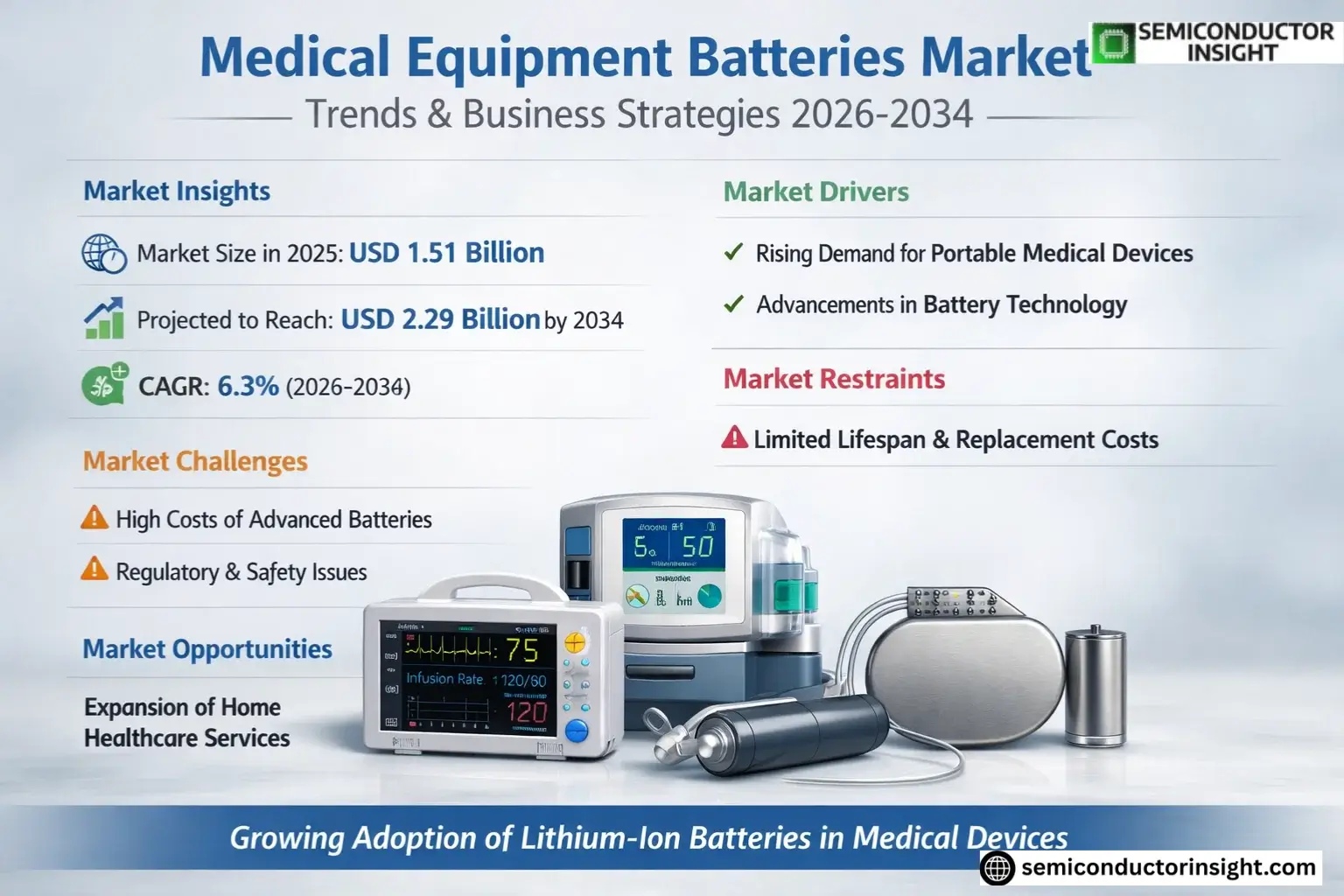
Global Medical Equipment Batteries Market size was valued at USD 1.51 billion in 2025. The market is projected to grow from USD 1.61 billion in 2026 to USD 2.29 billion by 2034, exhibiting a CAGR of 6.3% during the forecast period.
Medical equipment batteries are specialized power sources designed to provide reliable and consistent energy for a wide range of medical devices, including implantable and non-implantable applications. These batteries ensure uninterrupted operation of critical healthcare equipment such as pacemakers, infusion pumps, portable monitors, and surgical tools.
The market growth is driven by increasing demand for portable medical devices, advancements in battery technology, and rising healthcare expenditure globally. Lithium-ion batteries dominate the segment due to their high energy density and longer lifespan. Key players like Panasonic, EnerSys, and Murata Manufacturing are investing in R&D to enhance battery performance and safety standards for medical applications.
MARKET DRIVERS
Growing Demand for Portable Medical Devices
Medical Equipment Batteries Market is experiencing significant growth due to the increasing adoption of portable medical devices. Hospitals and clinics are shifting toward compact, battery-powered equipment such as infusion pumps, patient monitors, and portable ventilators to enhance mobility and patient care efficiency. Global portable medical device market is projected to grow at a CAGR of 8.2% over the next five years, directly influencing demand for high-performance batteries.
Advancements in Battery Technology
Technological innovations in lithium-ion and solid-state batteries are enhancing the reliability and lifespan of medical equipment batteries. Improved energy density and faster charging capabilities are critical for emergency medical applications where downtime is unacceptable. Medical device manufacturers are increasingly partnering with battery suppliers to develop custom solutions for specialized equipment.
Government regulations promoting the use of rechargeable and sustainable power solutions in healthcare settings are further propelling market expansion.
MARKET CHALLENGES
High Costs of Advanced Battery Technologies
The development and implementation of high-capacity, medical-grade batteries require specialized materials and rigorous testing, increasing overall production costs. Many healthcare providers, particularly in developing regions, face budget constraints when upgrading to modern battery-powered equipment.
Other Challenges
Regulatory Compliance and Safety Standards
Medical Equipment Batteries must comply with stringent FDA and ISO certifications, which prolongs development cycles and increases costs. Battery failures in critical care devices can have life-threatening consequences, necessitating extensive quality control measures.
MARKET RESTRAINTS
Limited Lifespan and Replacement Costs
Despite technological improvements, medical batteries degrade over time and require frequent replacement, adding to operational expenses for healthcare facilities. The average lifespan of lithium-ion batteries in medical devices ranges between 2-5 years depending on usage intensity, creating recurring procurement challenges.
MARKET OPPORTUNITIES
Expansion of Home Healthcare Services
The rapid growth of home-based medical care presents lucrative opportunities for the Medical Equipment Batteries Market. Chronic disease management devices like portable oxygen concentrators and wearable glucose monitors require dependable, long-lasting power solutions, driving demand for advanced battery systems.
Medical Equipment Batteries Market Trends
Growing Adoption of Lithium-Ion Technology in Medical Devices
Medical Equipment Batteries Market is witnessing significant growth in lithium-ion battery adoption across portable and implantable medical devices. Manufacturers are prioritizing higher energy density, longer lifespan, and enhanced safety features that lithium batteries provide. This aligns with increasing demand for compact, lightweight medical equipment with extended operational time between charges.
Other Trends
Expansion of Rechargeable Battery Solutions
Medical device manufacturers are transitioning from single-use to rechargeable battery systems to reduce operational costs and environmental impact. Advanced battery management systems now ensure reliable performance over hundreds of charge cycles while maintaining strict safety standards required for medical applications.
Stringent Safety and Regulatory Compliance
Medical Equipment Batteries Market faces increasing regulatory scrutiny, particularly for implantable devices. Battery manufacturers are investing in certified production facilities and extensive testing protocols to meet FDA, CE, and other global medical device standards. This includes enhanced protection against leakage, overheating, and short-circuit risks.
Advancements in Wireless Charging Integration
Emerging technologies in wireless power transfer are being incorporated into medical battery systems, particularly for portable diagnostic equipment. This reduces wear on physical connectors and enables more robust, sealed device designs while maintaining the high reliability demands of medical applications.
Regional Market Dynamics
North America and Europe maintain strong positions in the Medical Equipment Batteries Market due to established medical device industries and strict quality requirements. However, Asia-Pacific is emerging as a high-growth region, supported by expanding local manufacturing capabilities and increasing healthcare infrastructure investments.
COMPETITIVE LANDSCAPE
Key Industry Players
Lithium Battery Specialists Dominate Medical Power Solutions Market
Panasonic and EnerSys currently lead the Medical Equipment Batteries Market through advanced lithium-ion battery technologies, collectively holding significant revenue share. The industry structure remains moderately consolidated with the top five manufacturers controlling substantial market presence across North America and Europe. These leaders focus on R&D investments for batteries used in critical applications like implantable devices, where reliability and longevity are paramount.
Niche specialists like EaglePicher Technologies and Ultralife Corporation have carved strong positions in military-medical hybrid applications. Asia-Pacific demonstrates rapid growth with regional players such as Murata Manufacturing and Guangzhou Battsys expanding production capacities to meet rising demand from portable medical device manufacturers.
List of Key Medical Equipment Batteries Companies Profiled
- Panasonic Corporation
- EnerSys
- Maxell Holdings
- Murata Manufacturing
- Toshiba Corporation
- Varta AG
- EaglePicher Technologies
- Ultralife Corporation
- Saft Groupe S.A.
- Renata SA
- Videndum PLC
- Camelion Battery
- Duracell Inc.
- Guangzhou Battsys Co., Ltd
- Tadiran Batteries GmbH
Segment Analysis:
| Segment Category | Sub-Segments | Key Insights |
| By Type |
|
Lithium Batteries dominate due to their superior energy density and longer lifespan.
|
| By Application |
|
Non-Implantable Medical Devices show strongest demand due to broader device applications.
|
| By End User |
|
Hospitals remain the primary consumption point for medical batteries.
|
| By Safety Certification |
|
UL Certified batteries are most preferred in medical applications.
|
| By Battery Rechargeability |
|
Rechargeable Systems are gaining significant traction in modern medical setups.
|
Regional Analysis: Global Medical Equipment Batteries Market
North America
North American innovators are pioneering smart battery systems with IoT connectivity for real-time performance monitoring in medical equipment. These advanced power solutions incorporate predictive maintenance features, reducing downtime for critical healthcare devices. The region leads in developing batteries with adaptive charging algorithms that extend operational life while maintaining safety standards.
Strict certification requirements for medical equipment batteries create high barriers to entry but ensure superior product quality. The FDA’s evolving guidelines on battery safety and electromagnetic compatibility drive continuous innovation cycles. Medical device manufacturers must comply with rigorous testing protocols for thermal stability and leakage prevention.
Established manufacturing hubs in Michigan and Texas support localized production of specialized medical batteries. The region maintains strategic raw material partnerships for lithium and cobalt sourcing. Recent supply chain optimizations focus on reducing dependency on overseas components while maintaining cost competitiveness.
Growing demand for portable dialysis machines and wearable drug delivery systems creates new opportunities. Battery-powered surgical tools and robotic-assisted devices are gaining traction in ambulatory care centers. The rise of telemedicine is driving innovation in long-lasting power solutions for remote monitoring equipment.
Europe
Europe maintains strong growth in the Medical Equipment Batteries Market through harmonized regulatory frameworks and emphasis on sustainable power solutions. The region sees increasing adoption of rechargeable lithium polymer batteries in diagnostic imaging equipment and patient monitoring systems. German and French manufacturers lead in developing eco-friendly battery chemistries with reduced heavy metal content. The EU Medical Device Regulation accelerates standardization of power systems across member states, benefiting interoperable device ecosystems. Growth is particularly strong in Nordic countries, where mobile healthcare solutions rely on reliable cold-weather battery performance.
Asia-Pacific
The Asia-Pacific Medical Equipment Batteries Market experiences rapid expansion due to healthcare infrastructure modernization. China, Japan, and South Korea drive innovation in miniaturized power solutions for portable diagnostic devices. Local manufacturers focus on cost-optimized battery systems while meeting increasing safety requirements. India’s growing medical tourism sector boosts demand for reliable power in surgical equipment. Regional advantages include access to raw materials and government support for domestic battery production, though technology gaps persist in advanced battery management systems.
South America
South America shows steady adoption of medical equipment batteries, particularly in Brazil and Argentina. The region benefits from increasing investments in primary healthcare centers requiring portable diagnostic devices. Challenges include price sensitivity and variable regulatory enforcement across countries. Local manufacturers emphasize rugged battery designs suitable for tropical climates and intermittent power infrastructure. Growth opportunities exist in remote monitoring applications and vaccine cold chain logistics solutions.
Middle East & Africa
The Middle East & Africa Medical Equipment Batteries Market grows through hospital expansions and medical device imports. Gulf countries prioritize high-performance battery solutions for advanced diagnostic equipment in private hospitals. African markets see increasing demand for durable power systems in mobile clinics and vaccination programs. Localized challenges include high-temperature operation requirements and need for extended maintenance cycles. The region shows potential for solar-charged battery hybrids in off-grid healthcare applications.
Report Scope
This market research report provides a comprehensive analysis of the Medical Equipment Batteries Market, covering the forecast period 2025–2034. It offers detailed insights into market dynamics, technological advancements, competitive landscape, and key trends shaping the industry.
Key focus areas of the report include:
- Market Overview: The report begins with an overview outlining its current market scenario, key growth indicators, and industry transformation drivers. It discusses macroeconomic factors, demand–supply balance, regulatory landscape, and the strategic role of medical batteries in powering critical devices across industries such as healthcare, emergency medical services, and homecare equipment.
- Market Size & Forecast: Historical data and future projections for revenue, unit shipments, and market value across major regions and segments.
- Segmentation Analysis: Detailed breakdown by product type, technology, application, and end-user industry to identify high-growth segments and investment opportunities.
- Regional Insights: Insights into market performance across North America, Europe, Asia-Pacific, Latin America, and the Middle East & Africa, including country-level analysis where relevant.
- Competitive Landscape: Profiles of leading market participants, including their product offerings, R&D focus, manufacturing capacity, pricing strategies, and recent developments such as mergers, acquisitions, and partnerships.
- Technology Trends & Innovation: Assessment of emerging battery technologies, energy density improvements, safety features, and evolving industry standards.
- Market Drivers & Restraints: Evaluation of factors driving market growth along with challenges, supply chain constraints, regulatory issues, and market-entry barriers.
- Stakeholder Insights: Insights for component suppliers, OEMs, healthcare providers, investors, and policymakers regarding the evolving ecosystem and strategic opportunities.
Primary and secondary research methods are employed, including interviews with industry experts, data from verified sources, and real-time market intelligence to ensure the accuracy and reliability of the insights presented.
FREQUENTLY ASKED QUESTIONS:
What is the current market size of Medical Equipment Batteries Market?
-> Medical Equipment Batteries Market size was valued at USD 1.51 billion in 2025. The market is projected to grow from USD 1.61 billion in 2026 to USD 2.29 billion by 2034, exhibiting a CAGR of 6.3% during the forecast period.
Which key companies operate in Medical Equipment Batteries Market?
-> Key players include Panasonic, Maxell, EnerSys, Energizer, Arotech, Murata Manufacturing, Toshiba, Varta, Camelion Battery, Duracell, among others. In 2025, the global top five players held approximately % market share in terms of revenue.
What are the key growth drivers?
-> Key growth drivers include increasing adoption of portable medical devices, aging population, technological advancements in battery technology, and rising healthcare expenditure.
What is the market segmentation by battery type?
-> Market segments include Lithium Batteries, Alkaline Batteries, Zinc Air Batteries, and Others. Lithium Batteries segment is projected to reach USD million by 2034 with % CAGR.
Which regions show strongest growth potential?
-> Asia-Pacific shows significant growth potential, with China expected to reach USD million market size. North America remains a dominant market with U.S. estimated at USD million in 2025.

Get Sample Report PDF for Exclusive Insights
Report Sample Includes
- Table of Contents
- List of Tables & Figures
- Charts, Research Methodology, and more...
 Download Sample Report PDF