

Medical Device PCB Market Trends: Flexible Circuits, Biocompatibility Standards, and the Wearable Health Revolution
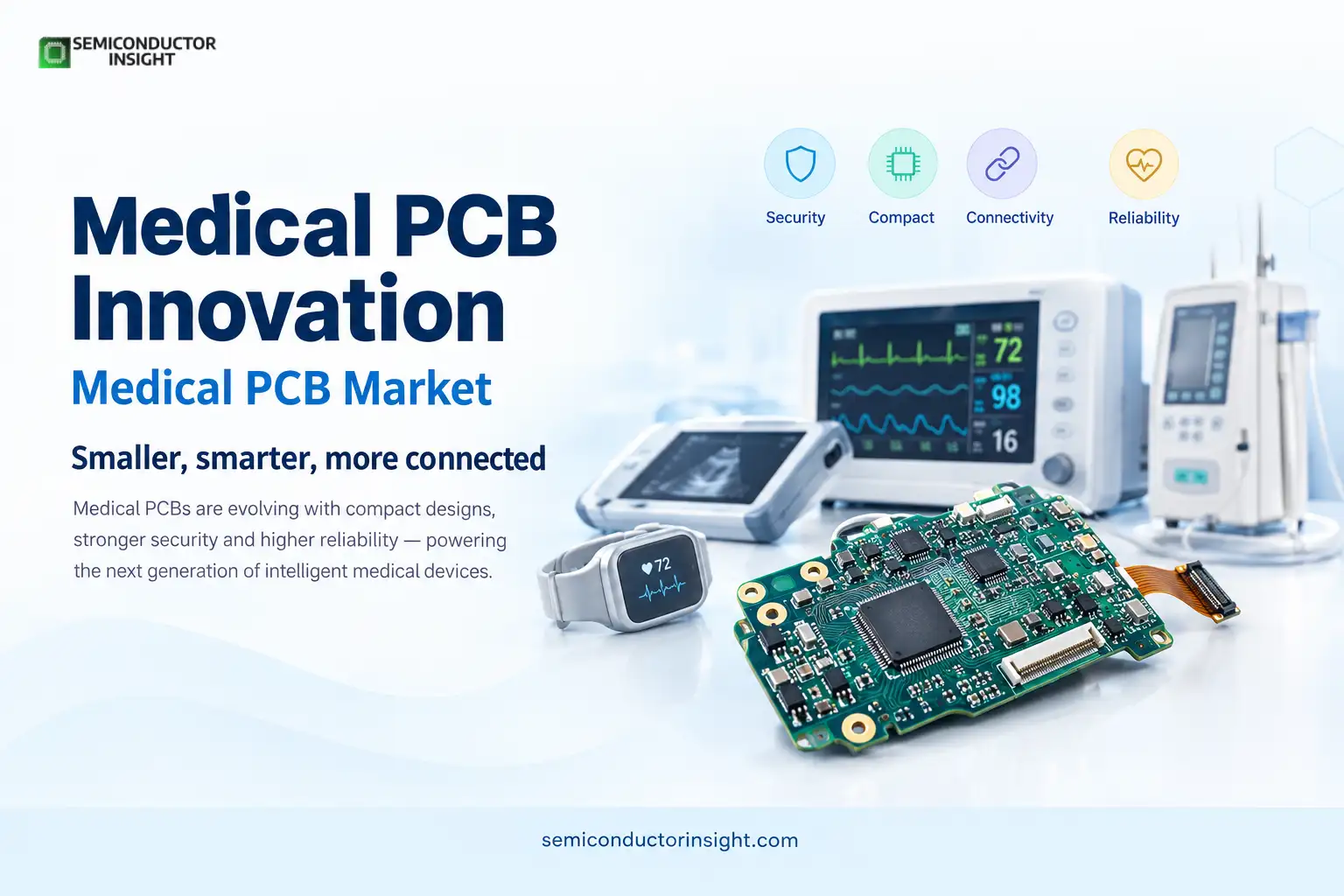
A medical PCB is no longer simply the board connecting components inside a piece of equipment. It increasingly carries the power management, sensing, communication, processing and control functions that allow medical devices to become smaller, connected and more intelligent. From patient monitors and infusion pumps to ultrasound equipment, wearable sensors and implantable systems, printed circuit boards are moving closer to the center of medical-device architecture.
- In 2026, that transition is being reinforced by two developments happening simultaneously: increasingly compact electronics and stronger expectations around device cybersecurity and lifecycle reliability.
The Board Is Becoming Part of the Medical System
Medical electronics cover a remarkably broad range of hardware. Diagnostic imaging equipment may require complex multilayer boards capable of handling high-speed signals, while wearable and implantable products can demand extremely compact rigid-flex or flexible circuitry.
IPC specifically recognizes medical electronics as a distinct application area. Its medical PCB requirements address both conventional medical equipment and miniature, high-density boards used in devices that may be implanted inside the human body. (IPC)
This creates several different PCB design environments rather than one uniform medical-board category.
Where Complexity Is Concentrating
- The strongest electronics development is appearing where physical size, data processing and patient interaction converge.
- Wearable monitoring systems are pushing flexible circuits closer to the body. Portable diagnostic equipment requires compact power and signal architectures.
- Imaging systems demand controlled impedance and high-speed interconnects. Implantable devices place exceptional emphasis on size, reliability and biocompatibility.
- The result is a gradual movement from conventional board layouts toward HDI, rigid-flex, embedded components and increasingly specialized material stacks.
A Medical PCB Now Has a Digital Security Role
Connectivity is changing the engineering equation. A modern medical device may communicate with a hospital network, another medical device, a clinician’s workstation or a cloud-based platform.
- The FDA’s February 2026 cybersecurity guidance specifically addresses cybersecurity-related device design, labeling and information recommended in premarket submissions. The agency notes that connected medical devices can create cybersecurity vulnerabilities that may affect device safety and effectiveness. (FDA)
For PCB designers, this means electrical architecture increasingly has to coexist with secure processors, communication interfaces, memory, and authentication hardware and power-management circuitry.
The Numbers behind the Miniaturization Story
- Medical PCB development is increasingly measurable through physical and manufacturing parameters rather than only finished-device specifications.
- IPC’s rigid-board specification covers constructions ranging from single- and double-sided boards to multilayer boards containing buried vias, blind vias and microvias.
- Its latest IPC-6012F revision also expanded attention to microvia reliability, copper wrap plating, cavities, hole registration and internal plated layers.
- At the component level, these technologies allow designers to pack substantially more electrical functionality into a constrained area while maintaining controlled electrical and mechanical performance.
The Flexible Board Is Finding More Medical Applications
Rigid PCBs remain fundamental to hospital equipment, but flexible and rigid-flexible circuits are particularly suited to products that must bend, conform to anatomy or fit inside compact housings.
This is relevant to wearable ECG systems, continuous monitoring equipment, portable sensors and certain implantable architectures. Instead of treating the PCB as a flat rectangular component, engineers can integrate circuitry around mechanical structures and moving or curved surfaces.
The design flow increasingly resembles:
Sensor layer
↓
Flexible interconnect
↓
Signal conditioning
↓
Processing and memory
↓
Wireless communication
↓
Power management
↓
Clinical or patient-facing output
That architecture is helping electronics move from equipment cabinets toward the patient.
You Can Freely Surf Our Latest Updated Report Here: https://semiconductorinsight.com/report/medical-device-pcb-market/
Reliability Is Moving Into the Layout Process
Medical electronics cannot be evaluated only after assembly. Board architecture itself affects reliability through thermal paths, dielectric spacing, via construction, solder joints, contamination control and electrical isolation.
IPC-6012F explicitly addresses reliability considerations involving complex microvia structures, dielectric spacing, solderability and internal plated layers. The standard also supports medical-specific addenda within the IPC framework.
For medical-device manufacturers, this makes PCB fabrication parameters part of product-development decisions rather than merely supplier specifications.
Current Device Activity Shows Why PCB Architecture Matters
- The FDA’s medical-device safety database illustrates the breadth of electronics-intensive equipment currently operating in healthcare.
- Its September 2026 early-alert listings included issues involving a ventilator and a heart-pump controller, while 2026 recalls have included infusion pumps and imaging-related systems.
- These events should not be interpreted as evidence about PCB failure specifically. They do, however, demonstrate the variety of electronically controlled medical systems in which hardware, firmware, sensors, power systems and communications must operate together reliably.
AI and Digital Health Are Adding More Electronics Layers
Medical-device development is also being influenced by AI-enabled software and digital-health functionality. FDA’s current digital-health guidance portfolio includes final guidance on clinical decision-support software issued in January 2026 and guidance covering AI-enabled device software functions.
As algorithms move closer to the device, PCB architecture can increasingly need higher-performance processors, additional memory, faster interfaces and dedicated security components. This is particularly relevant to portable imaging, physiological monitoring and connected diagnostic systems.
What Makes Medical PCBs Different?
The defining characteristic of the market is not simply that the PCB is used inside healthcare equipment. It is the combination of electronics density, reliability expectations, traceability and application-specific qualification.
A consumer board may prioritize cost and rapid product cycles. A medical board can require a much stronger emphasis on documented processes, controlled materials, inspection, verification and lifecycle support.
That difference is encouraging PCB manufacturers and medical OEMs to treat board design as an integral element of device engineering.
The Next Design Frontier Is Smaller Electronics with More Responsibility
- Medical Device PCB Market is moving toward a model in which the board carries more functionality while occupying less physical space. HDI structures, rigid-flex architectures, embedded components, high-speed interfaces, secure processing and advanced thermal management are converging inside increasingly compact medical products.
The most important shift is therefore not simply more PCBs entering healthcare. It is the transformation of the PCB into a highly engineered subsystem responsible for sensing, computing, connectivity, power and reliability. As medical devices become more connected and software-defined, the physical electronics underneath them are becoming equally important to the overall architecture.

Comments (0)