Semiconductor Thermal Management Materials Market Insights
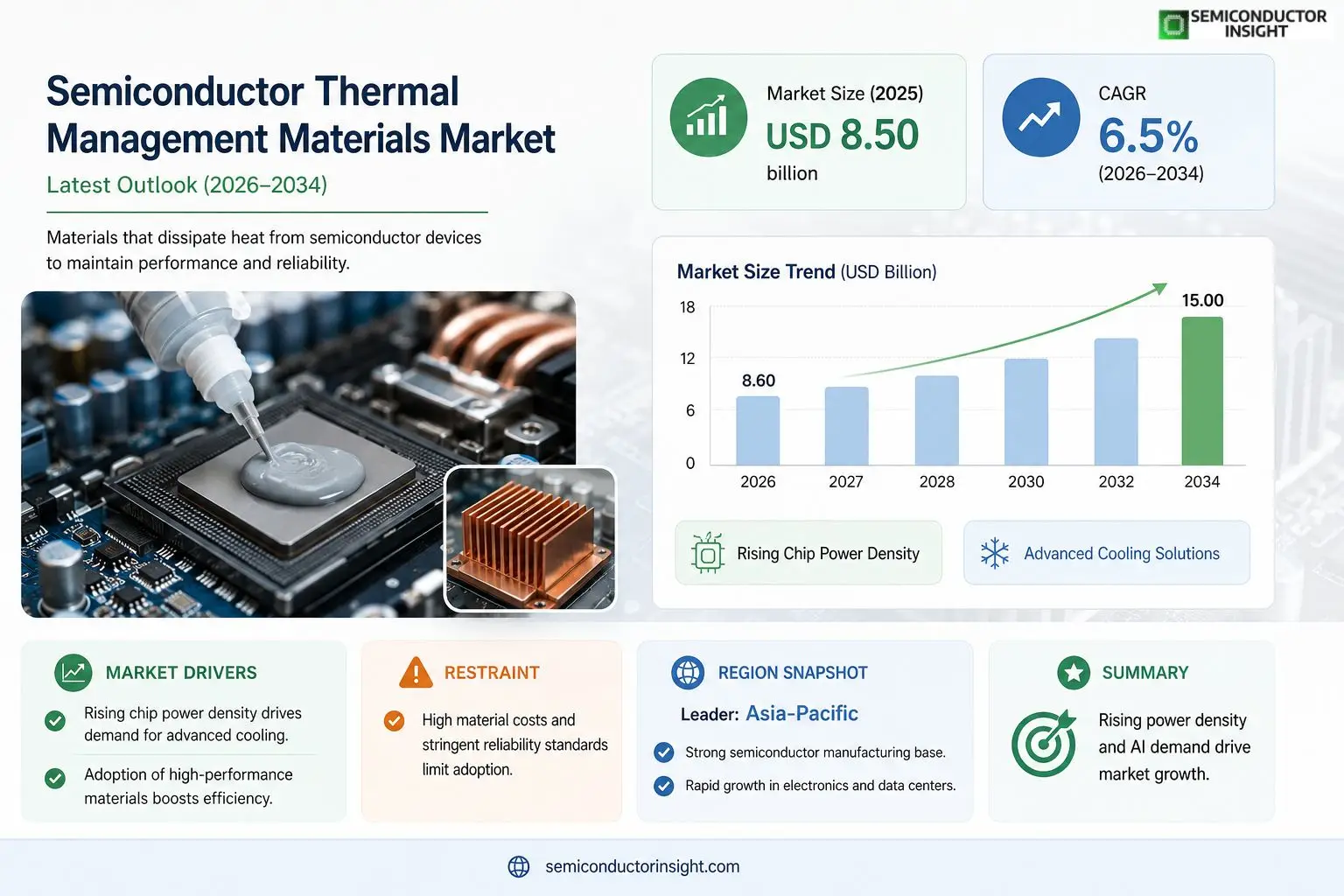
Global Semiconductor Thermal Management Materials market size was valued at USD 8.50 billion in 2025. The market is projected to grow from USD 8.60 billion in 2026 to USD 15.00 billion by 2034, exhibiting a CAGR of 6.5% during the forecast period.
Semiconductor thermal management materials encompass a range of engineered compoundssuch as thermal interface materials (TIMs), phase‑change materials, heat spreaders and heat sinksdesigned to dissipate heat generated by high‑performance chips and maintain optimal operating temperatures.Effective thermal management is critical for reliability and efficiency across consumer electronics, automotive power modules, and data‑center servers.The market is accelerating because chip power density continues to rise and emerging applications like AI accelerators and electric‑vehicle power electronics demand superior cooling solutions.Furthermore, expanding data‑center capacity and stricter energy‑efficiency regulations drive adoption of advanced TIMs.However, high material costs and stringent reliability standards pose challenges.Key players such as Dow Inc., Henkel AG & Co., Laird Performance Materials and Fujipoly are investing heavily in R&D and strategic partnerships to capture growth.
MARKET DRIVERS
Rising Power Density in Advanced Semiconductors
Semiconductor Thermal Management Materials Market is being propelled by a steady increase in power density across next‑generation chips. As transistor sizes shrink while performance targets rise, efficient heat dissipation becomes critical to maintain reliability and prevent thermal throttling. Manufacturers are therefore investing heavily in high‑thermal‑conductivity solutions such as copper‑based TIMs and ceramic‑filled composites.
Adoption of High‑Performance Materials
Materials like synthetic diamond, graphene, and phase‑change polymers are gaining traction because they offer thermal conductivities well above traditional epoxy‑based compounds. Companies that can scale these technologies are seeing a competitive edge, especially in power electronics and high‑frequency RF modules.
➤ “Thermal design is now a primary gating factor for launch cycles in AI accelerators.” – Industry Analyst
Overall, the convergence of higher integration densities and the availability of novel conductive materials is creating a robust demand pipeline for Semiconductor Thermal Management Materials Market, driving revenue growth across all device categories.
MARKET CHALLENGES
Manufacturing Complexity and Cost Constraints
Although high‑performance materials deliver superior heat removal, their processing often requires specialized equipment and stringent quality controls. This elevates production costs and limits the price‑sensitivity of end‑users, particularly in consumer‑grade electronics where margin pressure remains high.
Other Challenges
Supply Chain Volatility
Global shortages of key raw materials such as high‑purity silicon carbide and specialty polymers have introduced lead‑time uncertainties. Companies that lack diversified sourcing strategies may experience delayed product launches or increased inventory holding costs.
MARKET RESTRAINTS
Stringent Environmental Regulations
Regulatory frameworks in major markets are tightening limits on hazardous substances used in thermal interface materials. Compliance with RoHS and REACH adds testing overhead and can restrict the adoption of certain high‑performance fillers that contain heavy metals.Furthermore, disposal and recycling requirements for composite materials are becoming more demanding, compelling manufacturers to redesign formulations to meet circular‑economy standards, which can slow product rollout cycles.
MARKET OPPORTUNITIES
Emerging Applications in 5G and AI Edge Devices
The rollout of 5G infrastructure and the proliferation of AI‑enabled edge devices create new thermal challenges. Small form‑factor modules that operate at high frequencies generate localized hot spots, opening a niche for ultra‑thin, high‑conductivity thermal pads and gap fillers.In parallel, sustainability pressures are encouraging the development of bio‑based or recyclable thermal management solutions. Companies that can combine high thermal performance with environmental credentials are positioned to capture early‑stage market share in these fast‑growing segments.Semiconductor Thermal Management Materials Market Trends
Rising Power Density Drives Innovation
The continuous increase in semiconductor power density is reshaping cooling strategies across multiple sectors. High‑performance AI accelerators, electric‑vehicle power modules, and next‑generation data‑center servers generate more heat per unit area, creating urgent demand for materials that can efficiently transfer thermal energy away from die‑level hotspots. Engineers are turning to engineered thermal interface materials, phase‑change compounds, and advanced heat spreaders to meet tighter thermal budgets while preserving device reliability. Simultaneously, stricter energy‑efficiency regulations compel manufacturers to adopt low‑resistance solutions that reduce overall power consumption. This convergence of performance pressure and regulatory focus accelerates the adoption of sophisticated thermal management solutions throughout the ecosystem.
Other Trends
Cost and Reliability Pressures
While performance gains are evident, material cost remains a critical barrier for large‑scale deployment. High‑purity polymers and nanocomposite fillers command premium prices, limiting adoption in cost‑sensitive applications such as consumer electronics. In parallel, reliability standards are tightening, with manufacturers requiring extensive lifecycle testing to certify that thermal materials can withstand thermal cycling and mechanical stress without degradation. These dual pressures force suppliers to balance innovative formulations with manufacturability and long‑term stability, prompting incremental improvements in material processing and supply‑chain efficiencies.
Strategic R&D and Partnerships
Major industry players are intensifying research and development investments to stay ahead of emerging cooling requirements. Companies such as Dow Inc., Henkel AG & Co., Laird Performance Materials, and Fujipoly are expanding collaborative programs with semiconductor manufacturers and automotive OEMs, aiming to co‑develop next‑generation thermal solutions tailored to specific device architectures. These partnerships often focus on integrating nanostructured fillers, optimizing thermal conductivity pathways, and enhancing material compatibility with advanced packaging technologies. The strategic emphasis on joint innovation not only shortens time‑to‑market for new thermal management products but also creates a competitive moat that aligns with the evolving demands of high‑power semiconductor applications.
COMPETITIVE LANDSCAPEKey Industry Players
Semiconductor Thermal Management Materials Market – Competitive Landscape Overview
The semiconductor thermal management arena is anchored by a handful of globally integrated chemical and materials groups. Dow Inc., Henkel AG & Co. KGaA, Laird Performance Materials, and Fujipoly Ltd. together control a substantial share of the high‑performance thermal interface materials (TIMs) and phase‑change solutions market. Their scale enables deep R&D investment, advanced polymer chemistries, and strategic collaborations with chip manufacturers to co‑develop customized cooling stacks. Market structure reflects a tiered hierarchy: tier‑one firms deliver broad portfolio coverage and large‑volume contracts for data‑center servers and automotive power modules, while a growing cohort of niche specialists supplies application‑specific products for AI accelerators and electric‑vehicle power electronics. The rapid rise in chip power density and tighter energy‑efficiency mandates are driving these leaders to pursue next‑generation nanocomposite TIMs and high‑conductivity polymer blends, reinforcing their competitive advantage.Beyond the tier‑one cohort, a diverse set of specialized players enriches the competitive landscape. 3M Company, Parker Hannifin Corporation, and Aavid Thermalloy (nVent Aavid) focus on engineered metal‑based heat spreaders and lightweight TIM formulations for aerospace and consumer electronics. LORD Corporation, now part of TE Connectivity, leverages its adhesive expertise to tailor low‑profile TIMs for compact devices. Panasonic Corporation and Taiyo Yuden Co., Ltd. contribute advanced ceramic‑filled compounds targeting automotive power modules. European chemist Wacker Chemie AG and Japanese specialist Shinkawa Inc. supply high‑purity silicone and silicone‑gel solutions for harsh‑environment applications. These niche firms, while smaller in revenue, differentiate through rapid product cycles, deep application engineering, and strategic partnerships that address emerging cooling challenges in AI chips and high‑voltage EV converters.
List of Key Semiconductor Thermal Management Materials Companies Profiled
- Dow Inc.
- Henkel AG & Co. KGaA
- Laird Performance Materials
- Fujipoly Ltd.
- 3M Company
- Parker Hannifin Corporation
- Aavid Thermalloy (nVent Aavid)
- LORD Corporation
- Panasonic Corporation
- Taiyo Yuden Co., Ltd.
- Wacker Chemie AG
- Shinkawa Inc.
Segment Analysis:
| Segment Category | Sub-Segments | Key Insights |
| By Type |
|
Thermal Interface Materials dominate the market because they provide the most reliable microscopic contact between chips and heat sinks. • Their formulation enables low thermal resistance while maintaining electrical insulation. • Continuous R&D is expanding filler technologies for higher conductivity without compromising mechanical compliance. |
| By Application |
|
Data‑Center Servers emerge as the leading application due to relentless demand for higher compute density. • Advanced TIMs enable sustained performance under continuous high‑load conditions. • Energy‑efficiency regulations drive the adoption of low‑resistance materials that reduce overall power consumption of server farms. |
| By End User |
|
OEMs lead the end‑user landscape because they integrate thermal solutions at the design stage, ensuring optimal reliability. • Their close collaboration with material suppliers accelerates the introduction of next‑generation TIM formulations. • OEMs prioritize solutions that combine high thermal conductivity with manufacturability and cost‑effectiveness. |
| By Material Technology |
|
Nanocomposite TIMs are gaining prominence because they blend polymer matrices with high‑conductivity nanoparticles, delivering superior heat flux. • This technology addresses the challenge of rising chip power densities while preserving flexibility. • Industry players are focusing on scalable synthesis methods to maintain consistency across large production volumes. |
| By Market Driver |
|
Increasing Chip Power Density drives relentless innovation in thermal management. • As devices become more compact, efficient heat removal becomes a critical design constraint. • Companies are investing in material science breakthroughs that enable thinner, higher‑performance cooling solutions across diverse form factors. |
Regional Analysis: North America
North America
The United States dominates the North American market for Semiconductor Thermal Management Materials, driven by its extensive semiconductor manufacturing base and significant R&D investments. Stringent quality standards and a focus on advanced technologies further contribute to the market’s growth.
Canada exhibits steady growth in Semiconductor Thermal Management Materials Market, supported by a growing electronics industry and increasing investments in semiconductor research and development.
Mexico is emerging as a key player in the North American Semiconductor Thermal Management Materials market, benefiting from its proximity to the US and growing semiconductor manufacturing capabilities.
South America represents a smaller but growing market for Semiconductor Thermal Management Materials, fueled by increasing adoption of electronics and a burgeoning semiconductor industry in certain countries.
Europe
The European market for Semiconductor Thermal Management Materials is characterized by a strong emphasis on energy efficiency and sustainable technologies. The region boasts a well-established semiconductor industry, particularly in countries like Germany, France, and the Netherlands. Stringent environmental regulations and increasing demand for high-performance computing are driving innovation in thermal management solutions.
Asia-Pacific
Asia-Pacific is the largest and fastest-growing market for Semiconductor Thermal Management Materials, driven by the rapid expansion of the electronics industry in countries like China, Japan, South Korea, and Taiwan. The region’s dominance in semiconductor manufacturing and consumer electronics production fuels significant demand for advanced thermal solutions.
Middle East & Africa
The Middle East & Africa market for Semiconductor Thermal Management Materials is relatively nascent but showing promising growth, driven by increasing investments in infrastructure development and the expansion of the electronics sector.
Report Scope
This market research report provides a comprehensive analysis of the Semiconductor Thermal Management Materials Market , covering the forecast period 2026–2034. It offers detailed insights into market dynamics, technological advancements, competitive landscape, and key trends shaping the industry.
Key focus areas of the report include:
- Market Overview: The report begins with an overview outlining its current market scenario, key growth indicators, and industry transformation drivers. It discusses macroeconomic factors, demand–supply balance, regulatory landscape, and the strategic role of semiconductors in powering advancements across industries such as automotive, telecommunications, consumer electronics, and industrial automation.
- Market Size & Forecast: Historical data and future projections for revenue, unit shipments, and market value across major regions and segments.
- Segmentation Analysis: Detailed breakdown by product type, technology, application, and end-user industry to identify high-growth segments and investment opportunities.
- Regional Insights: Insights into market performance across North America, Europe, Asia-Pacific, Latin America, and the Middle East & Africa, including country-level analysis where relevant.
- Competitive Landscape: Profiles of leading market participants, including their product offerings, R&D focus, manufacturing capacity, pricing strategies, and recent developments such as mergers, acquisitions, and partnerships.
- Technology Trends & Innovation: Assessment of emerging technologies, integration of AI/IoT, semiconductor design trends, fabrication techniques, and evolving industry standards.
- Market Drivers & Restraints: Evaluation of factors driving market growth along with challenges, supply chain constraints, regulatory issues, and market-entry barriers.
- Stakeholder Insights: Insights for component suppliers, OEMs, system integrators, investors, and policymakers regarding the evolving ecosystem and strategic opportunities.
Primary and secondary research methods are employed, including interviews with industry experts, data from verified sources, and real-time market intelligence to ensure the accuracy and reliability of the insights presented.
FREQUENTLY ASKED QUESTIONS:
What is the current market size of Semiconductor Thermal Management Materials Market?
-> Semiconductor Thermal Management Materials Market was valued at USD 8.50 billion in 2025 and is expected to reach USD 15.00 billion by 2034.
Which key companies operate in Semiconductor Thermal Management Materials Market?
-> Key players include Dow Inc., Henkel AG & Co., Laird Performance Materials and Fujipoly, among others.
What are the key growth drivers?
-> Key growth drivers include rising chip power density, adoption of AI accelerators, electric‑vehicle power electronics, expanding data‑center capacity and stricter energy‑efficiency regulations.
Which region dominates the market?
-> The reference does not specify a single dominant region.
What are the emerging trends?
-> Emerging trends include advanced thermal interface materials for AI and EV applications, and heightened focus on energy‑efficiency driven TIM innovations.
Get Sample Report PDF for Exclusive Insights
Report Sample Includes
- Table of Contents
- List of Tables & Figures
- Charts, Research Methodology, and more...
 Download Sample Report PDF