

Manufacturer Certified vs. Independent Refurbishment in refurbished market Which Model Builds Greater Consumer Trust
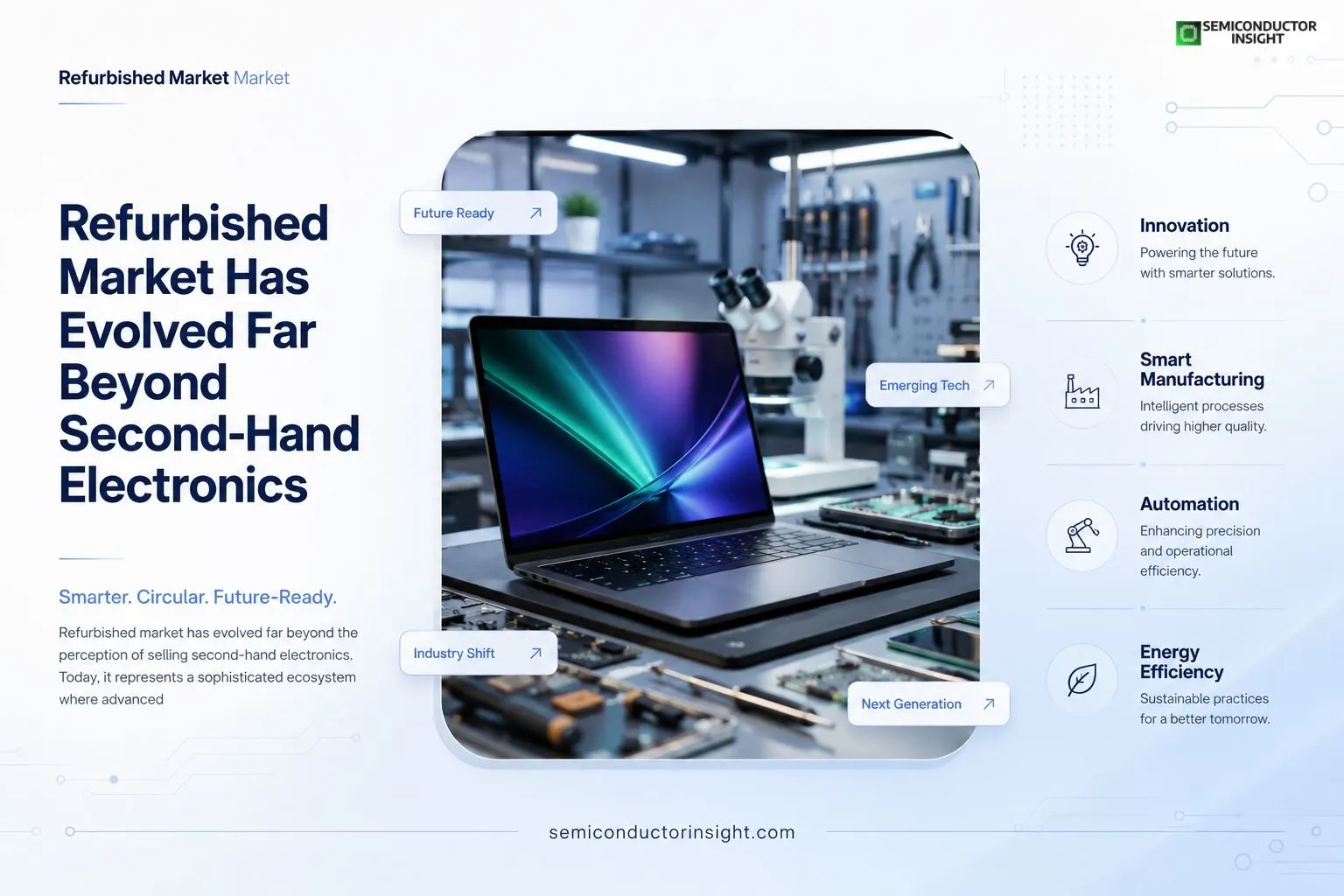
Refurbished market has evolved far beyond the perception of selling second-hand electronics. Today, it represents a sophisticated ecosystem where advanced semiconductor-based products including smartphones, laptops, servers, networking equipment, storage systems, and industrial electronics are restored, tested, certified, and returned to productive use. As chip manufacturing becomes increasingly resource-intensive and sustainability gains strategic importance, refurbishment has become an integral part of extending semiconductor lifecycles while reducing electronic waste.
Only roughly 22.3% of the 62 million metric tonnes of electronic garbage produced worldwide in 2022 were officially collected and recycled, according to the United Nations Global E-waste Monitor 2024.
Instead of being recycled right away, millions of devices that still have fully functional processors, memory chips, sensors, and power management components can be salvaged through refurbishment. This change lowers the need for newly produced components while maintaining integrated semiconductor value.
Semiconductor Value Does Not End After the First Owner
- Semiconductor devices, in contrast to many consumer goods, frequently continue to function for years after the initial ownership cycle.
- Enterprise servers, premium smartphones, industrial controllers, medical electronics, and networking equipment are increasingly designed with durable processors and memory architectures that remain technologically relevant even after replacement by original users.
- Instead of dismantling these systems immediately for material recovery, certified refurbishment facilities perform extensive diagnostics, firmware validation, component replacement where necessary, thermal testing, storage verification, battery replacement, and quality assurance before devices re-enter commercial use.
- This approach extracts significantly greater economic and environmental value from existing semiconductor hardware.
Certified Restoration Is Becoming an Engineering Discipline
Modern refurbishment resembles precision manufacturing more than traditional repair. Facilities now employ automated testing stations capable of evaluating processors, graphics chips, SSD performance, wireless modules, thermal behavior, display quality, battery health, and power delivery systems within minutes.
Artificial intelligence is increasingly supporting diagnostic workflows by identifying hardware anomalies before technicians perform physical inspections. Predictive analytics can detect declining storage performance, abnormal thermal signatures, or motherboard instability, improving refurbishment accuracy while reducing unnecessary component replacement.
These technological improvements have elevated refurbishment into a highly standardized engineering process trusted by enterprises, educational institutions, and government organizations.
Sustainability Metrics Are Becoming Procurement Metrics
- Environmental reporting requirements are encouraging organizations to evaluate electronics procurement through lifecycle emissions rather than purchase price alone.
- According to the United Nations Institute for Training and Research (UNITAR), electronic waste generation continues to rise faster than documented recycling capacity, emphasizing the importance of extending product life before recycling becomes necessary.
- Manufacturing a single modern laptop or smartphone requires complex semiconductor fabrication involving ultrapure water, specialty gases, rare metals, and energy-intensive cleanroom operations.
- By extending product use through refurbishment, organizations effectively preserve much of this embedded manufacturing investment while reducing additional resource consumption.
- Many multinational companies now include refurbished IT equipment within sustainability procurement policies, particularly for employee computing, educational deployments, and temporary infrastructure projects.
Enterprise Computing Is Expanding the Opportunity
Refurbished market is no longer centered exclusively on consumer electronics. Cloud migration, hybrid workplaces, and rapid infrastructure refresh cycles have created significant supplies of enterprise-grade hardware entering certified refurbishment channels.
Servers equipped with high-core-count processors, enterprise SSDs, networking switches, graphics workstations, and storage arrays frequently remain operational long after organizations upgrade to newer platforms. Instead of becoming waste, these systems support small businesses, research laboratories, educational institutions, healthcare providers, and nonprofit organizations seeking reliable computing at lower acquisition costs.
Recent refurbishment programs introduced by global technology vendors in 2025 and 2026 further demonstrate how manufacturers increasingly view certified restoration as part of long-term product lifecycle management rather than merely aftermarket support.
Refurbished Market Outlook Signals a Broader Circular Electronics Economy
- Current industry momentum suggests that refurbishment will continue expanding alongside Right to Repair legislation, digital product passports, and circular manufacturing initiatives being introduced across multiple economies.
- Advances in modular hardware design, standardized component replacement, AI-assisted diagnostics, and remote device health monitoring are expected to improve refurbishment efficiency while extending semiconductor utilization across additional ownership cycles.
- Rather than replacing new semiconductor production, refurbishment complements it by maximizing the productive lifespan of existing chips before material recycling becomes necessary.
- This layered approach supports more efficient resource utilization while helping governments and industries address the growing challenge of electronic waste.
Want to learn more about the report? Check out our latest updated version for free: https://semiconductorinsight.com/report/refurbished-pc-market/
The Next Competitive Advantage Lies in Lifecycle Intelligence
Refurbished market is increasingly becoming a data-driven industry where device history, component traceability, firmware integrity, repair documentation, and performance analytics determine long-term product value. Semiconductor manufacturers, OEMs, enterprise IT providers, and certified refurbishment specialists are collaborating to build transparent lifecycle ecosystems that improve reliability, customer confidence, and environmental performance simultaneously.
As sustainability objectives become inseparable from technology strategies, refurbishment is emerging not simply as a secondary market but as an essential extension of the global semiconductor value chain.

Comments (0)