
Integrated RF IC vs. Discrete RF Components Market 2026: Industry Transformation Analysis
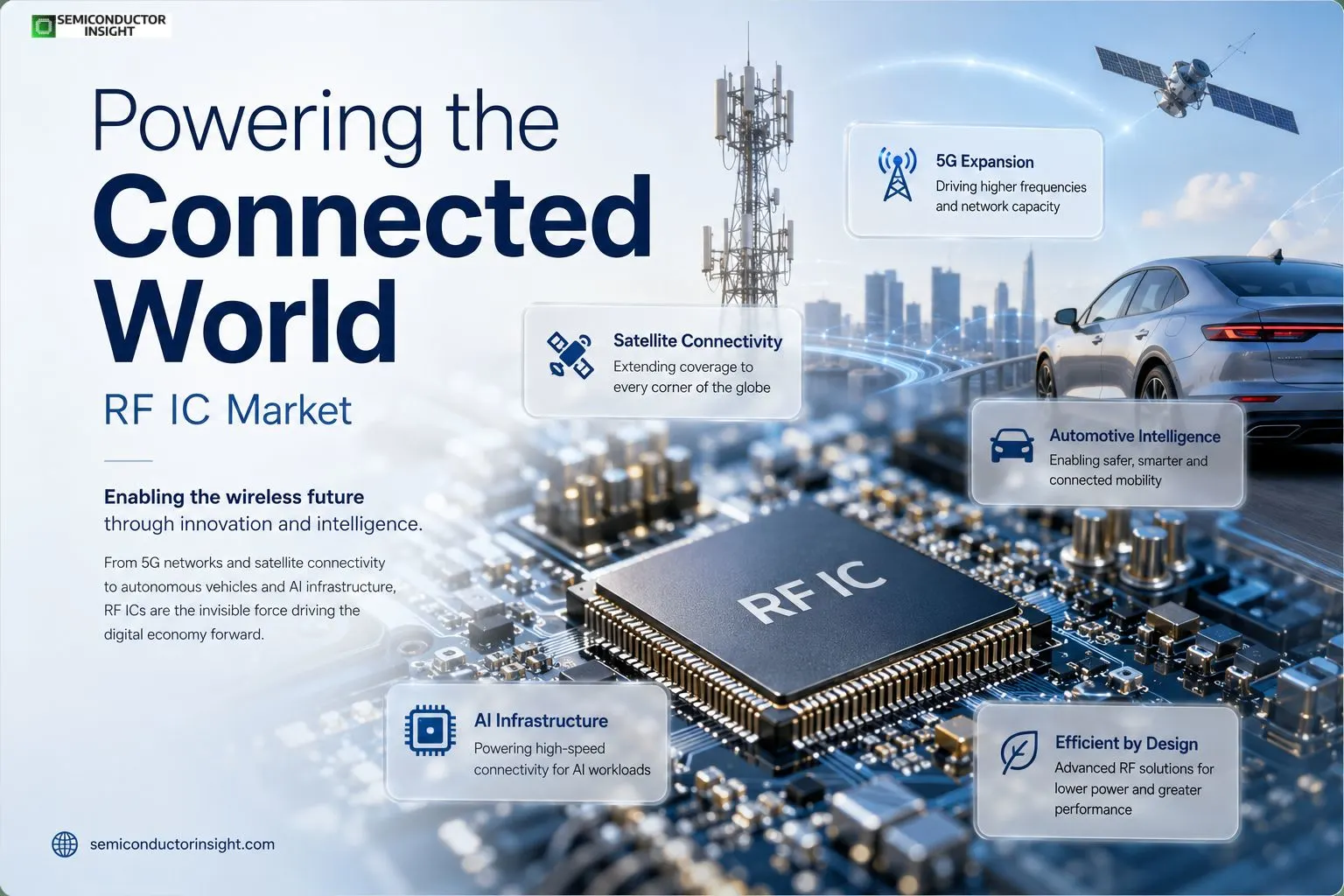
The modern digital economy depends on invisible technologies that move data instantly between devices, networks, vehicles, and industrial systems. At the centre of this transformation is the Radio Frequency Integrated Circuit (RF IC), a semiconductor component responsible for transmitting, receiving, filtering, and amplifying wireless signals.
As demand for uninterrupted connectivity accelerates, RF ICs have become one of the most strategically important segments of the semiconductor ecosystem.
The Wireless Backbone behind Everyday Technology
- Every smartphone call, video stream, GPS navigation request, and wireless payment relies on RF ICs. These chips convert digital information into radio signals and ensure reliable communication across various frequency bands.
- The growing complexity of modern devices is increasing RF content per product. A premium smartphone today supports multiple cellular bands, Wi-Fi, Bluetooth, Near Field Communication, and satellite connectivity, all requiring sophisticated RF architectures.
- According to industry data from the GSM ecosystem, more than 5.8 billion people worldwide use mobile services, creating an enormous installed base that depends on advanced RF semiconductor technologies.
Why 5G Networks Are Redefining RF Design?
The rollout of 5G has significantly altered RF IC requirements. Unlike previous generations, 5G networks operate across a broader range of frequencies and require higher levels of signal efficiency.
The GSMA estimates that global 5G connections are expected to exceed 2 billion by 2025 and continue expanding rapidly through the decade. This growth is creating demand for RF power amplifiers, low-noise amplifiers, antenna tuners, filters, and transceivers capable of handling complex signal environments.
Network operators are also deploying massive MIMO infrastructure containing dozens of antennas within a single base station. Such systems require highly optimized RF components to maintain performance while reducing power consumption.
Satellites Enter the Mainstream Connectivity Story
One of the most notable developments in wireless communication is the integration of satellite connectivity into consumer devices.
Recent smartphone launches now support emergency satellite messaging, while low Earth orbit satellite constellations continue expanding global coverage. Organizations such as SpaceX and other satellite operators are deploying thousands of satellites to improve connectivity in remote locations.
This shift creates new opportunities for RF IC manufacturers because satellite communications require specialized frequency handling, signal amplification, and high reliability under demanding operating conditions.
Automotive Electronics Become a New Growth Arena
- Vehicles are rapidly evolving into connected computing platforms. Modern automobiles increasingly rely on wireless technologies for navigation, telematics, vehicle diagnostics, keyless entry, infotainment, and vehicle-to-everything communication.
- Industry estimates indicate that a typical premium vehicle may contain hundreds of semiconductor devices, with RF chips supporting numerous connectivity functions. As autonomous driving research advances, reliable wireless communication will become even more critical for safety and data exchange.
- Automotive-grade RF ICs must withstand extreme temperatures, vibration, and long operational lifecycles, creating opportunities for innovation beyond traditional consumer electronics applications.
Explore the full report details in our recently refreshed edition anytime: https://semiconductorinsight.com/report/rf-ic-market/
AI Data Centres Are Creating Unexpected RF Demand
Artificial intelligence infrastructure is influencing RF semiconductor development in ways that extend beyond wireless devices.
Large-scale AI data centres increasingly depend on high-speed networking technologies, advanced optical interconnects, and wireless monitoring systems. Semiconductor companies are developing RF solutions that support faster data transmission, network synchronization, and edge computing deployments.
The convergence of AI and communications infrastructure is encouraging chipmakers to design highly integrated platforms capable of managing both computation and connectivity requirements.
Advanced Packaging Changes the RF Performance Equation
As wireless systems become more compact, semiconductor manufacturers are turning to advanced packaging technologies.
System-in-package architectures allow multiple RF functions to be integrated into smaller footprints while improving signal integrity. Materials such as gallium arsenide, silicon germanium, and RF silicon-on-insulator technologies are gaining attention for their ability to enhance efficiency at higher frequencies.
These innovations are helping device manufacturers balance performance, battery life, thermal management, and form factor constraints simultaneously.
The Shift toward an Always Connected World
- The future of connectivity extends far beyond smartphones.
- Smart factories, wearable electronics, connected healthcare equipment, industrial sensors, drones, and intelligent transportation systems all rely on dependable radio communication.
- Industry organizations estimate that tens of billions of connected IoT devices could be operating globally within the coming years.
- Each new endpoint increases demand for compact, energy-efficient RF solutions capable of maintaining secure and reliable communication.
As wireless technologies continue expanding across consumer, industrial, automotive, aerospace, and infrastructure applications, RF ICs are becoming essential building blocks of the digital economy. Their role is no longer limited to enabling communication. They are now fundamental components shaping how information moves across the connected world.

Comments (0)